To the CTOs, Product Heads, and Founders defining the B2B SaaS Product Development roadmap: the ground beneath your SEO strategy has shifted. Your most informed, high-intent buyers are no longer navigating a list of 10 blue links on a Search Engine Results Page (SERP). They are asking a conversational AI-like Google Gemini, Microsoft Copilot, or ChatGPT-a highly specific question about a problem they need to solve.
The AI responds with a synthesised answer, citing a few authoritative sources. If your B2B SaaS product isn’t one of those cited sources, you are invisible to the most valuable segment of the market. This paradigm shift demands a new discipline: Generative Engine Optimisation (GEO), and its mandate extends deep into your product’s UI/UX Design & Engineering.
The New Funnel: Why LLMs are the First Point of Contact
The New B2B Funnel – When LLMs Choose Your Product Before Users Do
Your first impression now happens inside a generative model.
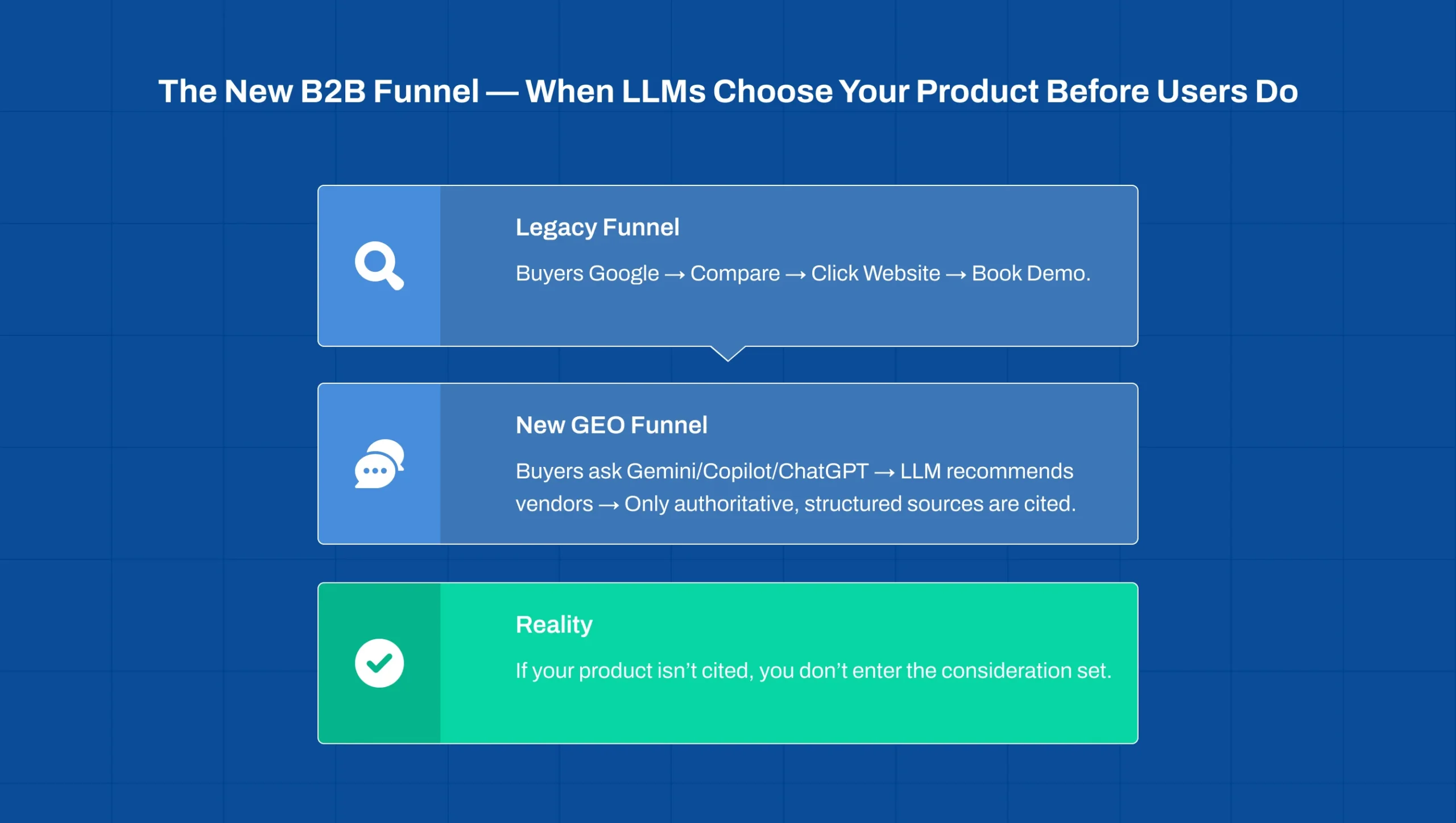
B2B buyers operate on long, complex, non-linear journeys. They ask things like, “What’s the best tool to automate compliance checks for GDPR in the US, and which platforms integrate with Salesforce?” The Large Language Model (LLM) is now the first layer of the marketing funnel, acting as an AI research assistant that pre-vets vendors.
If your product’s feature set and value proposition cannot be easily and reliably parsed, summarised, and quoted by the LLM, you have already lost the lead.
What Exactly is Generative Engine Optimisation (GEO)?
Generative Engine Optimisation (GEO) is the strategic process of preparing and structuring digital content and technical architecture so it is easily understood, trusted, and cited by Large Language Models (LLMs) and Generative AI platforms. Unlike traditional SEO (which targets rankings), GEO targets citation and inclusion in the AI-generated answer snippet. The core focus shifts from keyword density to topical authority and data clarity.
The GEO Mandate for SaaS: From Website to Product UX
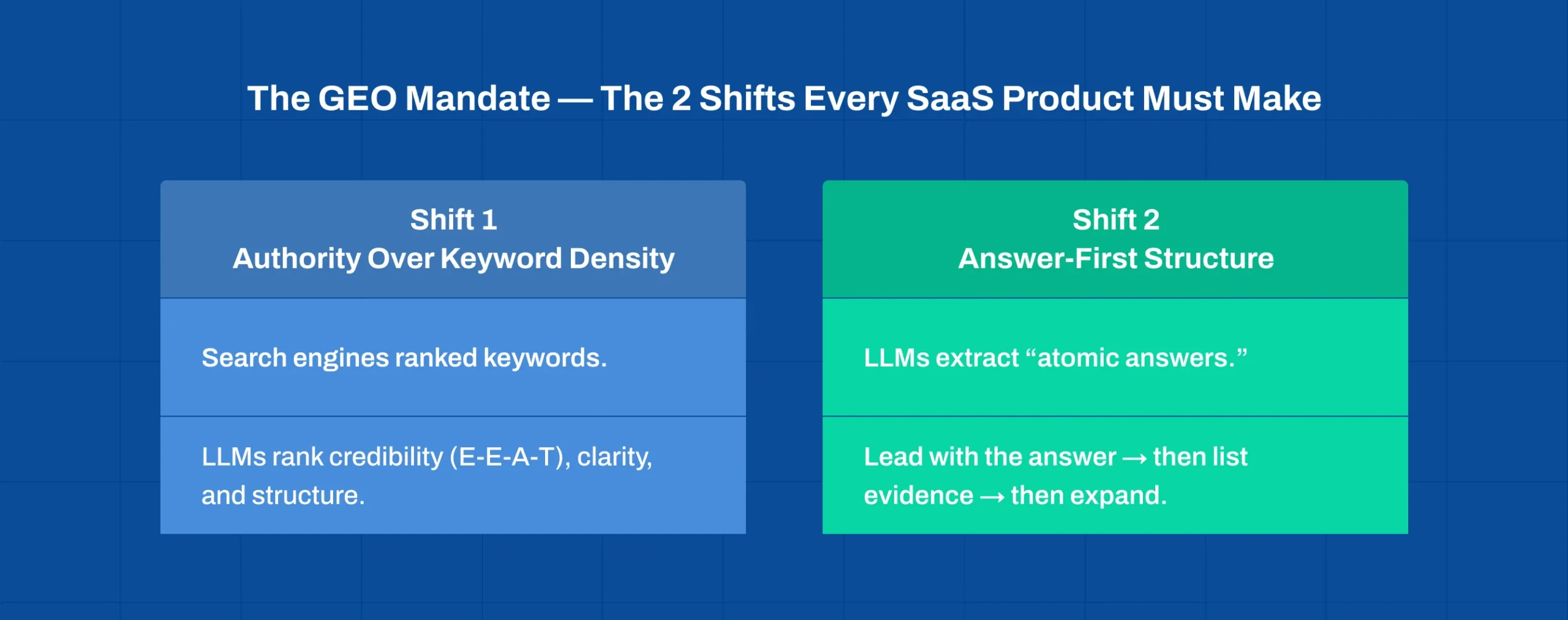
The GEO Mandate – 2 Shifts Every SaaS Must Make Authority first. Answers first.
For B2B SaaS, GEO isn’t just a marketing task; it’s a product strategy mandate. The AI is now crawling and synthesizing information not only from your blog but also from your help docs, feature pages, and public API documentation.
Shift 1: Authority Over Keyword Density
AI systems prioritise Experience, Expertise, Authoritativeness, and Trustworthiness (E-E-A-T). A lengthy blog post stuffed with a target keyword will be ignored if it lacks credibility signals.
Shift 2: Answer-First Content Structure
LLMs are designed to extract concise, factual answers. They favour content that is modular and easily quotable. This means structuring every piece of content-from a landing page to an in-app help article-to lead with a clear, declarative answer, immediately followed by the evidence (stats, citations).
5 Steps to Future-Proof Your B2B SaaS Product UX
5 Steps to Future-Proof Your SaaS Product with GEO
Visibility = Clarity + Structure + Credibility.
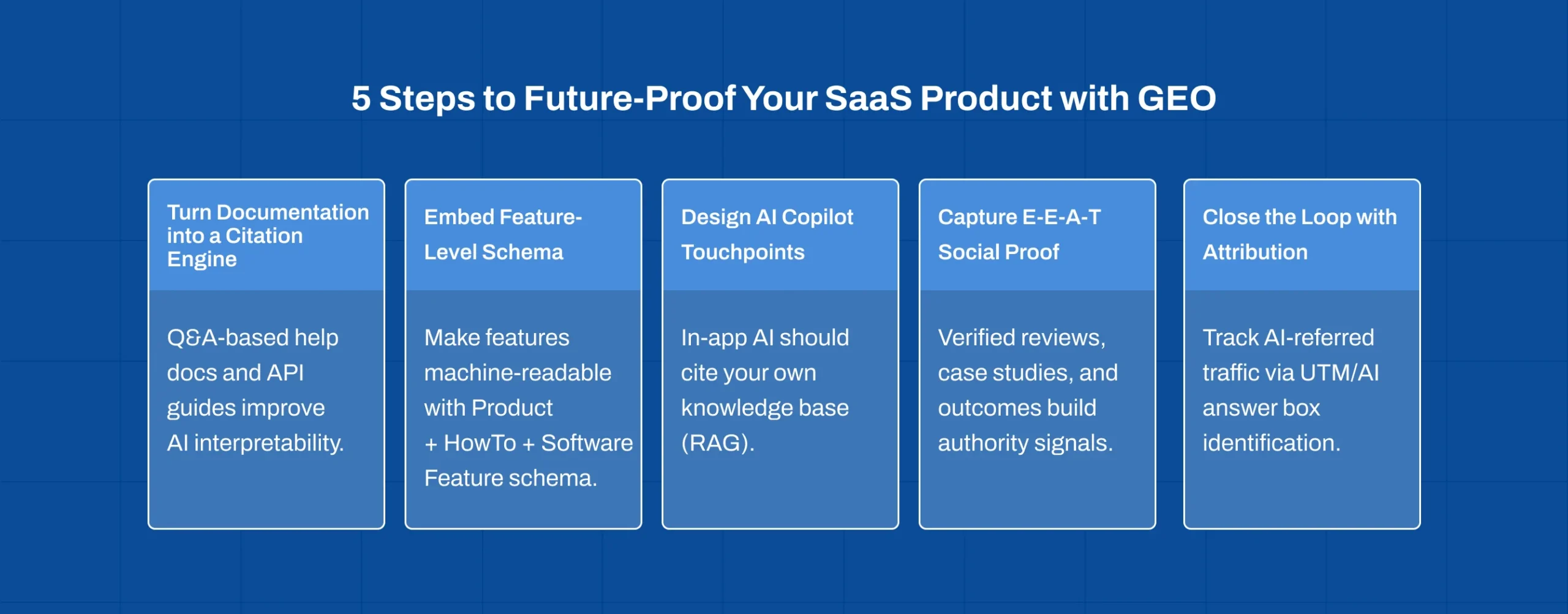
To ensure your SaaS Product becomes an AI-cited source of truth, implement these five GEO-driven shifts:
1. Transform Product Documentation into a Citation Engine
Your technical documentation is an LLM’s ideal training data. Treat it as your most critical SEO asset.
- Action: Rewrite all help centre articles and API docs using clear Question & Answer formats. Each article should start with an H1 that is a common user question (e.g., “How do I integrate our CRM with your reporting tool?”). Use clear H2/H3 subheadings as step-by-step instructions.
- Result: This structure aligns perfectly with how LLMs synthesize step-by-step instructions and technical definitions, increasing your likelihood of a direct citation.
2. Embed Schema and Structured Data at the Feature Level
Schema markup makes your technical details machine-readable, improving the AI’s understanding of your product’s capabilities.
- Action: Apply Schema Markup for Product, FAQPage, and HowTo to relevant feature pages. Crucially, use the software feature schema to clearly define what your tool does and the audience it serves.
- Result: When a buyer asks, “What B2B marketing automation platforms offer an in-app AI writing assistant?” the schema tells the LLM exactly what features you possess and allows it to match the buyer’s intent with unprecedented accuracy.
3. Design Conversational Touchpoints (The “AI Copilot” UX)
Conversational UX – The AI Copilot Architecture
When your product can answer before the user searches.
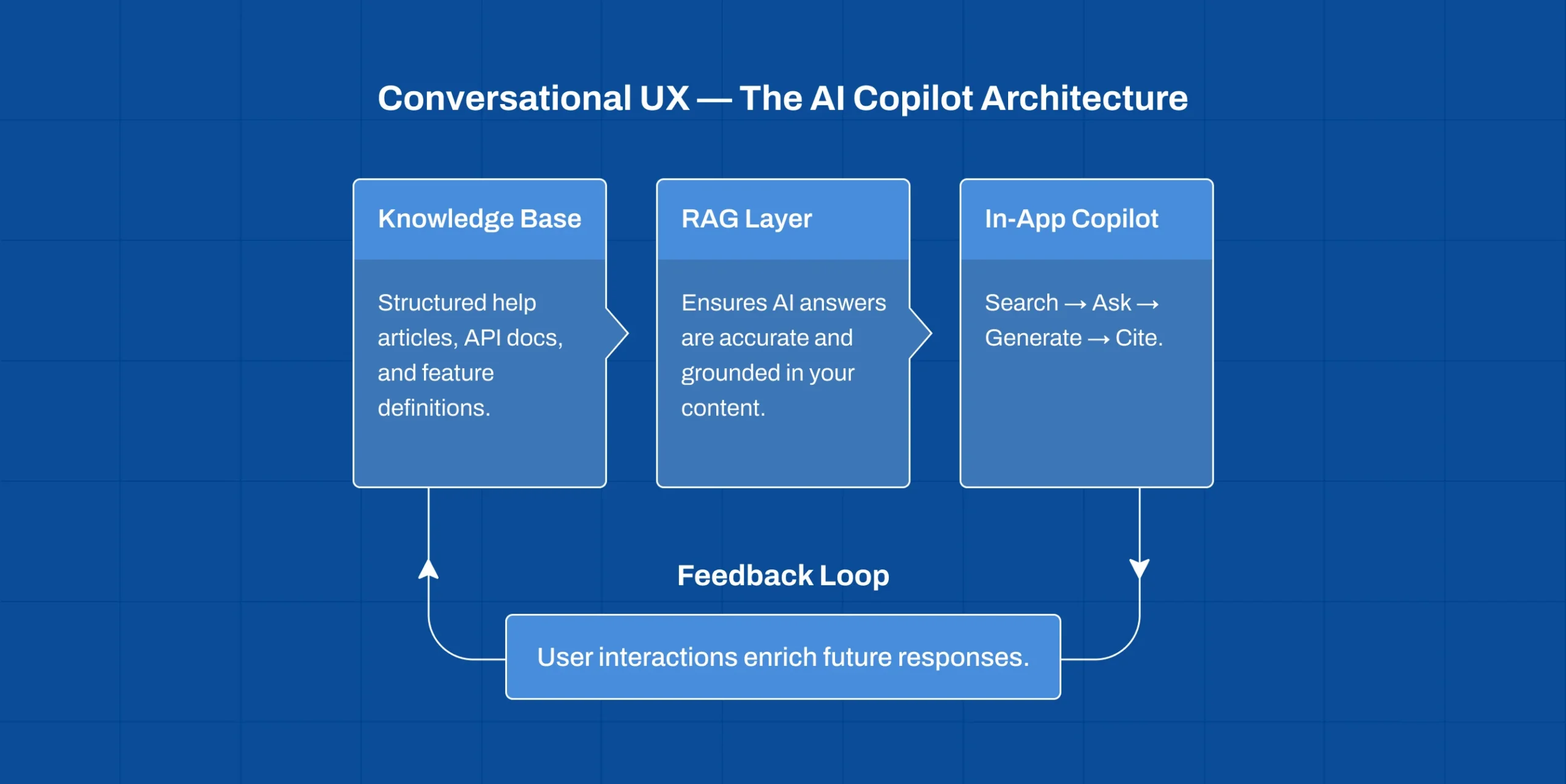
The AI assistant in your product is where GEO meets UI/UX Design. A good UX ensures the in-app AI provides answers consistent with the AI answers a user sees before they signed up.
- Action: Ensure your in-app AI Copilot (if you have one) uses your official, GEO-optimised knowledge base for Retrieval-Augmented Generation (RAG). Design the input and output to be clear, iterative, and capable of citing its internal sources.
- Result: This creates a seamless, high-trust experience where the user immediately finds value, reinforcing the authority the external LLM established.
4. Capture E-E-A-T Signals Through In-App Social Proof
LLMs value content that is validated by real users. User-Generated Content (UGC) is the new high-trust signal.
- Action: Strategically encourage and structure user testimonials and case studies. On your website, publish customer stories and clearly tag them with the industry (Retail & eCommerce, FinTech) and measurable outcome (e.g., “20% reduction in churn”).
- Result: When an LLM summarizes product categories, it often pulls from platforms like G2 or Capterra. Ensuring your product has recent, verified reviews directly contributes to your external authority and trust score.
5. Close the Loop: Instrumenting AI-Influenced Pipeline
The GEO Measurement Loop – Tracking AI-Influenced Revenue
You can’t scale what you can’t measure.
- AI-Generated Citation
- Traffic from AI Overviews / Copilot Links
- Session Tracking & Behavioural Data
- Conversion Events (Demo / Signup / PQL)
- Closed-Won Attribution
If you can’t measure it, it doesn’t exist. For the CTO, GEO must demonstrate pipeline influence.
- Action: Use specific UTM parameters or referral tracking for traffic originating from AI-generated answer boxes (e.g., Google’s AI Overviews, Perplexity citations). Track these sessions through to demo requests and closed-won revenue.
- Result: This provides measurable evidence of GEO’s contribution to high-intent lead generation, justifying further investment in your AI & Machine Learning and Digital Marketing strategies.
Conclusion: Winning the Zero-Click B2B Buyer
The Generative Engine Optimisation mandate requires B2B SaaS companies to shift their focus from pleasing traditional algorithms to providing clear, authoritative, and structured answers that an LLM can instantly recognise, trust, and cite.
By integrating GEO principles into your content, your technical architecture, and your UI/UX Design, you ensure your product not only addresses the highly complex needs of the B2B buyer but also meets them at their first moment of inquiry-whether that happens in a traditional browser or in a conversational AI interface. This is how you future-proof your visibility and win the zero-click buyer.