The Design System at Scale Problem: Bottom Line
- A design system at scale rarely fails because of the components. It fails because of the operating model around the components.
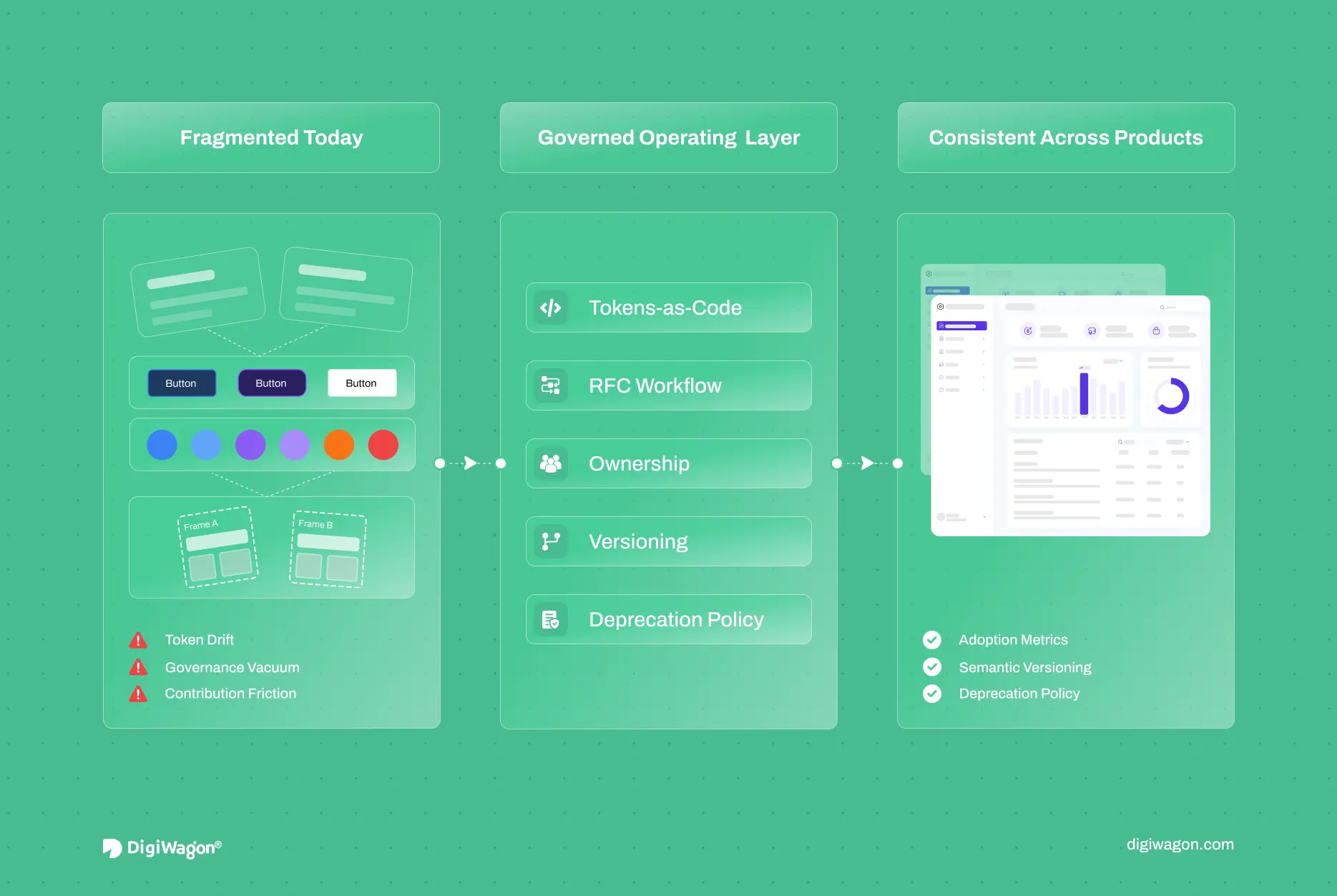
- Token drift, governance vacuum, and contribution friction are the three failure modes that account for almost every design system at scale breakdown.
- Adoption is the only honest metric of design system at scale health. Component count and Storybook coverage are vanity numbers.
- Fixing a broken design system at scale means fixing the team structure first, then the tokens, then the components.
What Is an Enterprise Design System at Scale?
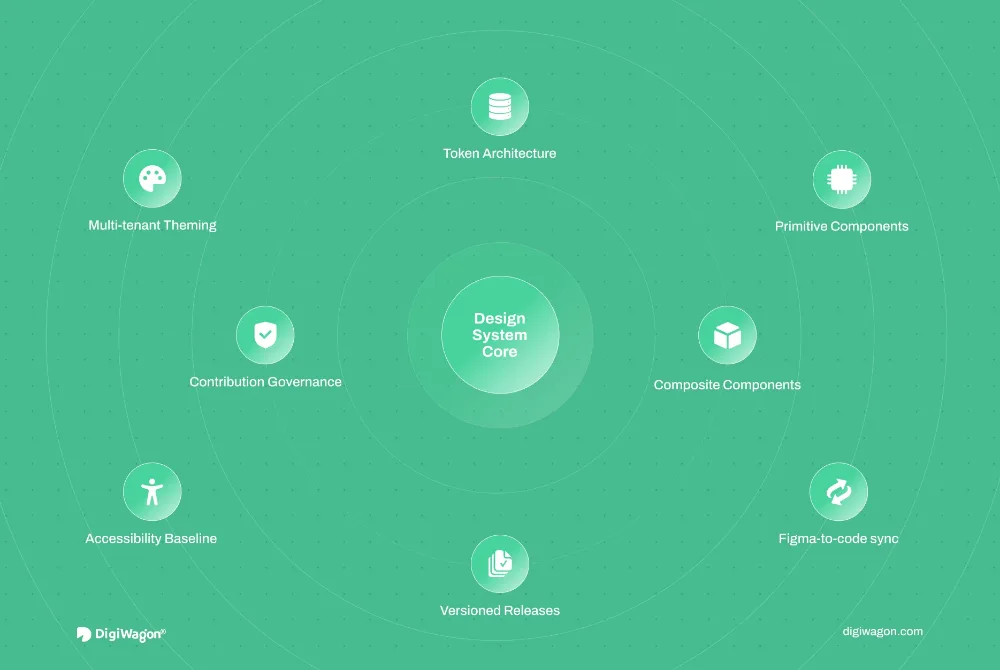
An enterprise design system at scale is a layered architecture of tokens, primitives, and contract-versioned components that lets every product team ship without forking the source library. The hard part is not the component catalog – it is the token contract, the deprecation schedule, and the governance model that decides who can extend what. Done right, a design system holds across five or six surfaces from a single source of truth.
Why Most Enterprise Design Systems at Scale Are Bleeding Velocity
Most enterprise teams in 2026 already have a design system. The question is no longer whether to build one. It is why the design system at scale already in place is leaking velocity instead of compounding it.
The Sparkbox Design Systems Survey has found, year after year, that fewer than half of teams running a design system measure its adoption inside their organisation. Without that signal, a design system at scale can publish components for months while product teams quietly fork them, ship one-off variants, and lose the consistency the system was meant to enforce.
In Europe, the cost of design system at scale drift compounds faster than in many other regions because enterprise products often serve multiple regulatory regimes simultaneously (EU, UK, GCC, plus localised banking and insurance rules). A design system at scale that breaks down means each regulatory variant gets built from scratch, with the consistency burden falling on individual designers and engineers rather than the system. Drift becomes a delivery risk, not just a brand risk.
The Three Failure Modes of a Design System at Scale
After auditing dozens of enterprise systems across FinTech and SaaS, the same three failure modes show up almost every time. The components are not the problem. The operating model around the design system at scale is.
Failure Mode 1: Token Drift in a Design System at Scale
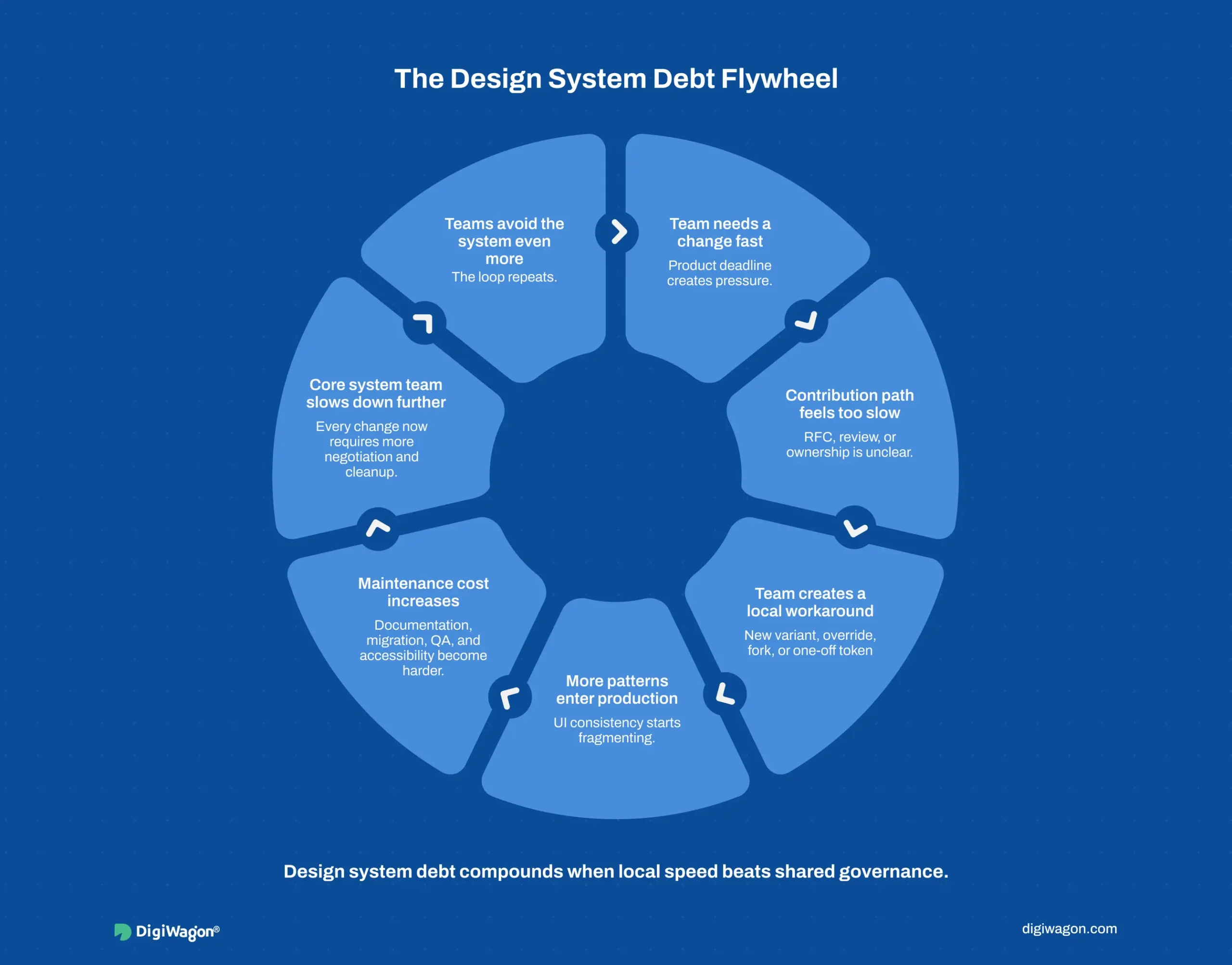
Token drift is what happens when the design source of truth (usually a Figma library) and the engineering source of truth (the codebase) stop agreeing on what a “primary button” actually is. Designers update the colour token in Figma. Engineers ship a release without picking up the change. Product teams override the token locally because their feature shipped on a deadline. Two months later, you have three shades of “primary blue” in production.
Token drift inside a design system at scale is rarely caused by laziness. It is caused by the absence of a single, machine-readable source of truth that both Figma and the codebase pull from automatically.
Failure Mode 2: Governance Vacuum in a Design System at Scale
Governance vacuum is the state where everyone uses the design system, but no one owns it. Contributions are accepted casually, deprecated patterns linger for quarters, and breaking changes go out without a migration path. Product teams stop trusting the system because they cannot predict when the rug will move.
Nielsen Norman Group’s design system maturity research describes this stage well. A design system at scale without explicit ownership and a published contribution policy degrades to a shared graveyard of well-intentioned components.
Failure Mode 3: Contribution Friction in a Design System at Scale
Contribution friction is the operational tax product teams pay to use the system. If proposing a new component takes three weeks, two reviews, and an architecture meeting, teams will stop proposing components and just build their own. The design system at scale slowly becomes a hostile bureaucracy that designers route around.
The fix is not less governance. It is governance that distinguishes between high-stakes changes (tokens, accessibility patterns, primary navigation) and low-stakes changes (a new icon variant, a layout helper).
| Dimension | UI Kit | Design System | Design System at Scale |
|---|---|---|---|
| Source of truth | Figma file | Figma + codebase, manually synced | Tokens-as-code, single source, automated sync |
| Ownership | Whoever created it | A designer or two, part-time | Dedicated team or rotating federated maintainers |
| Versioning | Untracked | Tagged releases | Semantic versioning with deprecation windows |
| Contribution model | Ad hoc | Pull requests, no policy | Published RFC and review process |
| Adoption tracking | None | Anecdotal | Instrumented, reported quarterly |
| Failure mode | Goes stale | Token drift | Governance vacuum if neglected |
What Does “At Scale” Actually Mean for a Design System?
“At scale” is not a number of components. It is a number of consumers and a level of consequence.
A design system supporting one product, with one design team and one engineering team, can run on goodwill and weekly Slack threads. The same system supporting four products across three regulatory regimes cannot. The decision points multiply faster than any informal process can absorb.
Brad Frost’s Atomic Design framing remains a useful lens for thinking about a design system at scale. Atoms (tokens, base styles) need to be machine-readable and version-controlled. Molecules and organisms (components, patterns) need ownership and a contribution policy. Templates and pages stay with the product teams.
The transition from “design system” to “design system at scale” usually happens when:
- A second product team starts consuming the system and producing override requests
- A regulatory or accessibility audit requires provable consistency across surfaces
- Two designers ship contradictory versions of the same component in the same quarter
- The “design system maintainer” role stops being one designer’s 15% time and becomes a real seat
If two of these are already true, the system is operating at scale whether you have set it up that way or not.
The Operating Model a Design System at Scale Needs
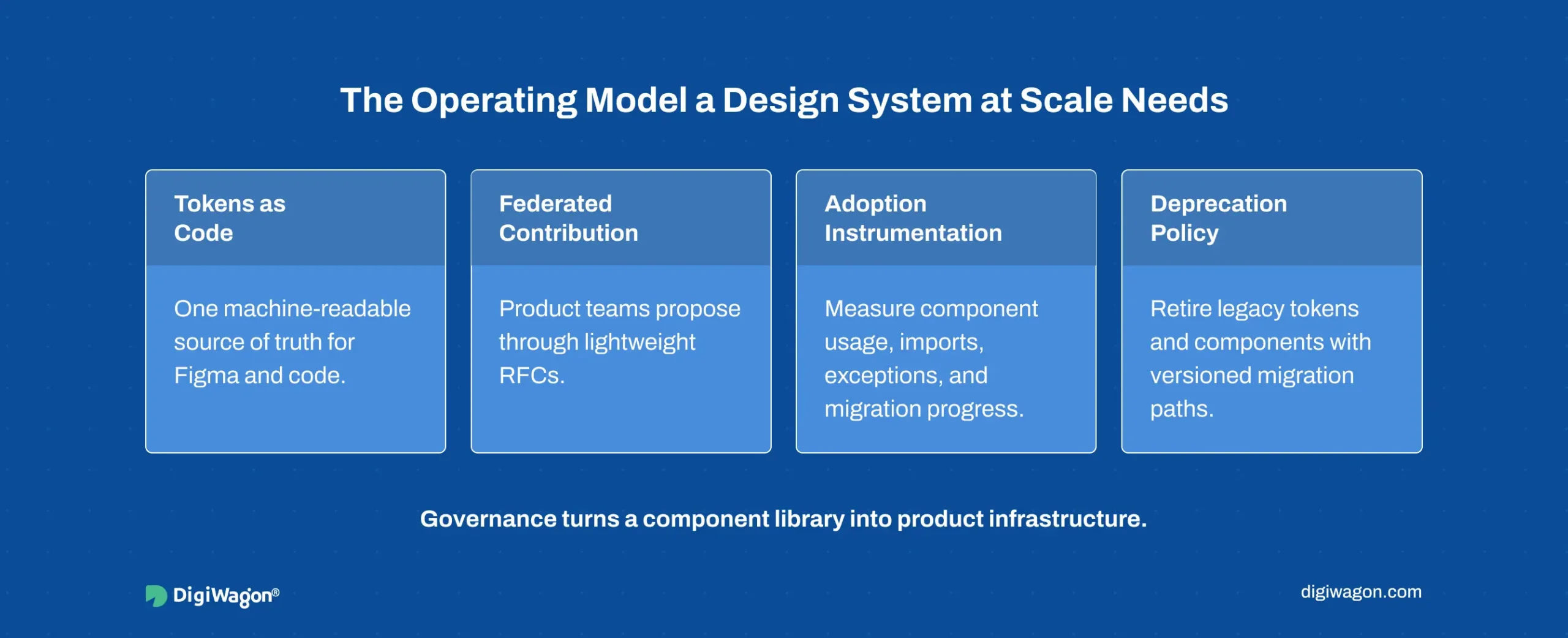
The fix for a broken design system at scale is rarely a redesign. It is an operating model that survives the third, fourth, and fifth product team joining.
Single Source of Truth: Tokens as Code in a Design System at Scale
Tokens (colour, spacing, typography, motion, elevation) live in a single source-of-truth file or repository, in a machine-readable format. Both Figma and the codebase pull from it. Tooling like Style Dictionary, Tokens Studio, or platform-native equivalents removes the manual sync step that causes most token drift in a design system at scale.
Federated Contribution with a Single Owner
A working model has one team that owns the design system at scale, plus a federated contribution model that lets product teams propose components through a lightweight RFC. The owning team reviews, accepts, and publishes. Product teams stop forking because contributing is faster than forking.
Adoption Instrumentation for a Design System at Scale
Adoption is measured, not assumed. The simplest version is a dependency check that runs at build time, reporting which components are imported from the system versus locally implemented. The harder version is interaction-level tracking. Either is better than nothing.
Deprecation Policy in a Design System at Scale
Every component and token has a documented deprecation policy. When something is replaced, the old version is marked deprecated, a migration path is published, and the component is removed in a major version release. This is the boring discipline that separates a design system at scale from a graveyard.
For teams running a design system at scale across multiple products and regulatory regimes, partnering with a team that treats the system as an internal product avoids the rebuild later. DigiWagon’s enterprise design system services sit alongside our broader UI/UX engineering practice for exactly this reason.
How to Fix a Broken Design System at Scale Without Starting Over
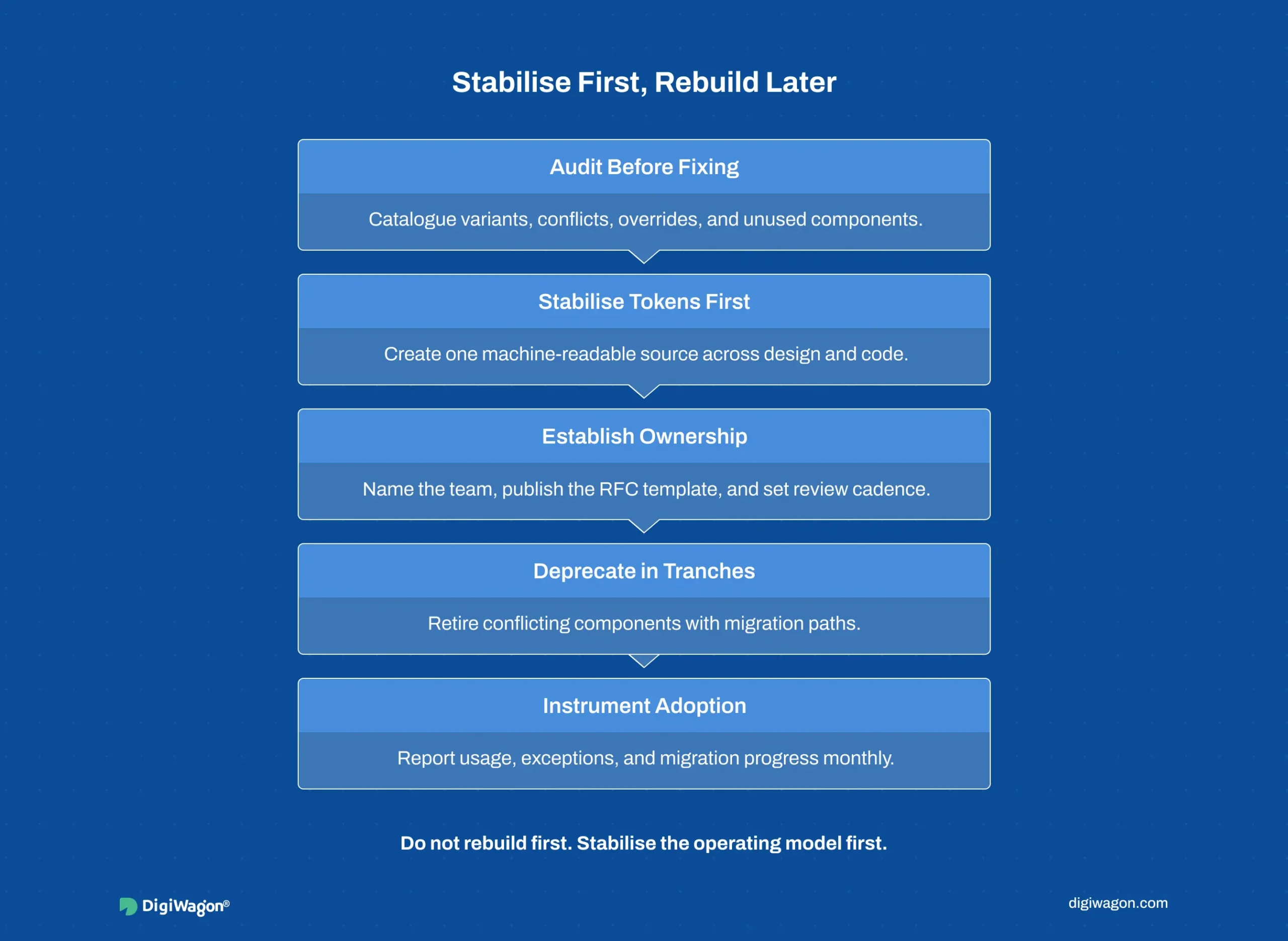
Most teams who recognise the problem assume the answer is a rebuild. It almost never is. Rebuilds carry the same drift back into the new design system at scale within a year because the operating model has not changed.
The proven sequence:
- Audit before fixing. Run a coverage and conflict audit on the design system at scale. Catalogue every variant of every component in production. List the tokens that have drifted. The audit produces the priority list, not your assumptions about what is broken. Many teams pair this with a wider product audit (see our take on design audits in legacy enterprise software).
- Stabilise tokens first. Before touching components, get tokens into a single machine-readable source. Token consistency is the foundation everything else stands on. Without it, fixes to components leak immediately.
- Establish ownership and the contribution model. Name the team. Publish the RFC template. Set the review cadence. Make it real before redesigning anything.
- Deprecate in tranches. Group orphaned and conflicting components into deprecation tranches with published migration paths. Resist the urge to deprecate everything at once.
- Instrument adoption and report it. A monthly adoption report visible to product leadership is the single highest-leverage governance tool. What gets measured gets used.
This sequence (audit, tokens, ownership, deprecation, instrumentation) takes work. It does not take a rebuild.
Why AI Will Stress-Test Your Design System at Scale Next
Even teams with a mature design system at scale are about to face a new pressure. As AI agents and conversational interfaces enter enterprise products, a design system at scale is being asked to express patterns that did not exist three years ago: agent-state surfaces, suggestion overlays, confidence indicators, and zero-interface fallbacks. A token system designed only for buttons and tables will not survive the transition. We covered the implications in detail in The Rise of Invisible UI, but the short version is: tokens for state, motion, and confidence become first-class citizens, not afterthoughts.
Building a Design System at Scale That Holds Up
DigiWagon designs and operates an enterprise design system at scale for FinTech, SaaS, and RegTech products that span multiple geographies and regulatory regimes.
- Tokens-as-code architecture with automated Figma-to-codebase sync
- Federated contribution models with published RFC processes
- Adoption instrumentation and quarterly governance reporting
- Deprecation and migration playbooks for legacy component libraries
Making the Operating Model the Real Deliverable
A design system at scale is not a Figma library and a Storybook URL. It is an operating model: ownership, contribution policy, adoption metrics, and a deprecation discipline that survives leadership turnover. The teams that get this right do not have flashier components. They have a design system at scale that compounds value across every product team that consumes it. The teams that do not, eventually rebuild, then drift again, then rebuild again. The way out of that cycle is not better design. It is treating the design system at scale as a real product, with a real team, doing real product work.