Data Governance Strategy: What Actually Holds Up
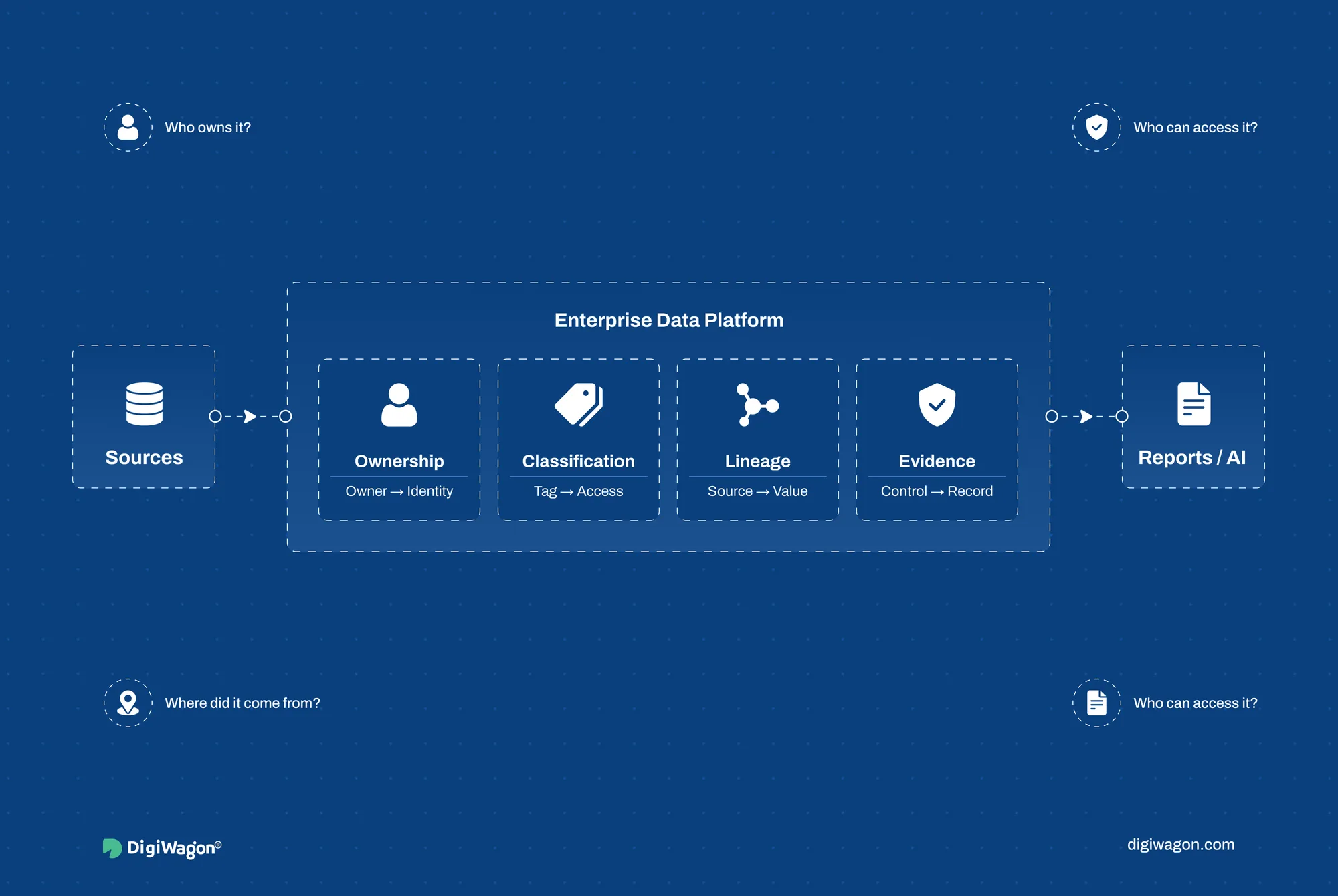
- A data governance strategy is credible only when every policy names the control that enforces it.
- Ownership belongs in the platform as a resolvable property, not in a spreadsheet of steward names.
- Classification means nothing until each class drives an access decision made at query time.
- Lineage exists to answer one question: where did this number come from, and when.
- A control that cannot produce evidence it ran is indistinguishable from a control that never ran.
What Is a Data Governance Strategy?
A data governance strategy is the mapping between the obligations a business carries and the controls its data platform enforces. Each obligation resolves to a named control, and each control to a mechanism in the stack. The deliverable is a platform where any reported number can be reconstructed from source, on demand.
Why Governance Programmes and Data Platforms Drifted Apart
Most governance programmes were written as documents, because a document was what the business asked for. The platform was built by another team on another schedule, and nothing in the document compiled.
That gap used to be survivable. It is getting harder, because more data now arrives with provenance nobody can vouch for. Gartner predicted in January 2026 that by 2028, 50% of organisations will implement a zero-trust posture for data governance, driven by the spread of unverified AI-generated data (Gartner, 2026).
Zero trust is an architectural stance, not a policy one: a dataset is untrusted until the platform can show where it came from, who owns it, and which controls it passed. A platform with an identity layer, a metadata store and a lineage graph can assert that. A document cannot.
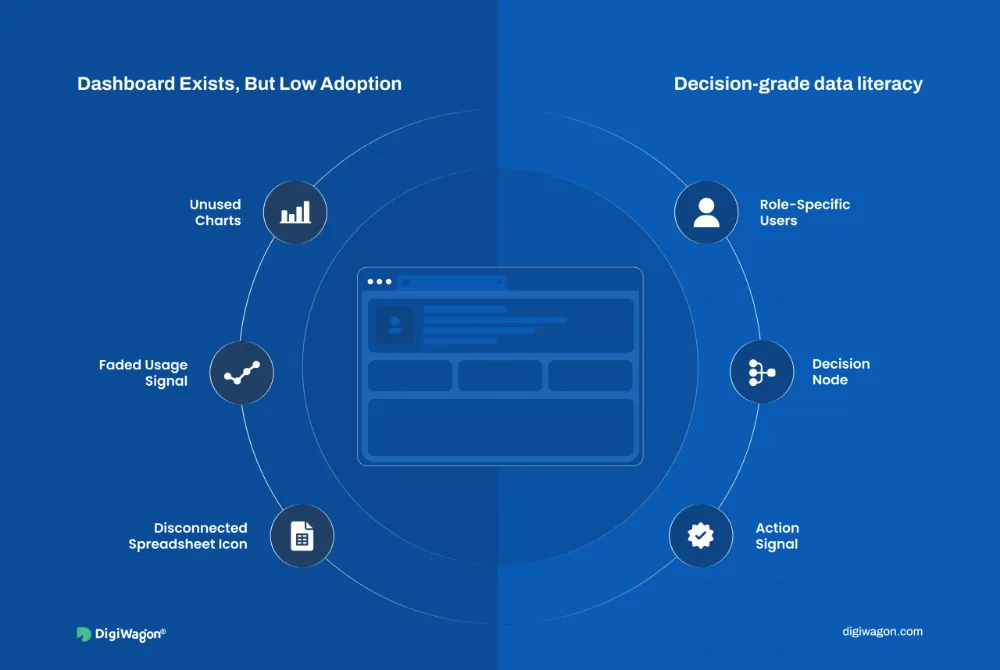
Unenforceable governance surfaces downstream as reports nobody acts on, most of the pattern behind why BI dashboards get abandoned.
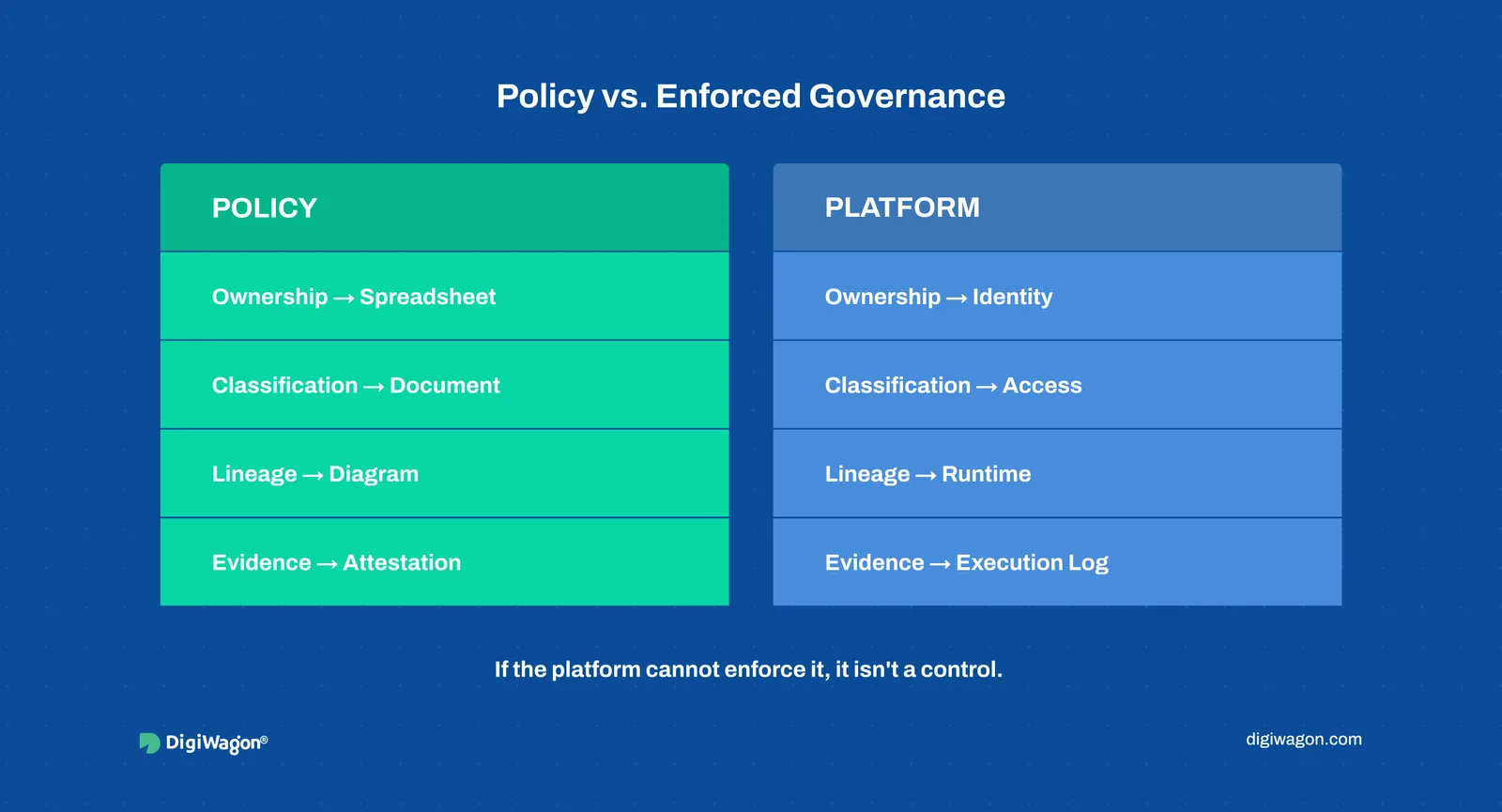
| Control area | Written as policy | Enforced as architecture | What an auditor tests |
|---|---|---|---|
| Ownership | Steward names in a spreadsheet | Owner is a required registration field resolving to an identity group | Datasets with no resolvable owner |
| Classification | A sensitivity scale in a PDF | Column tags driving masking and row filters at query time | A read as an unentitled principal |
| Lineage | A diagram redrawn each review cycle | Column-level lineage emitted per run by the transformation layer | A figure traced to source for a past date |
| Control evidence | A signed quarterly attestation | Per-execution logs carrying run identity, input versions, outcome | A past decision reconstructed from stored inputs |
Where Does Data Ownership Actually Live in a Platform?
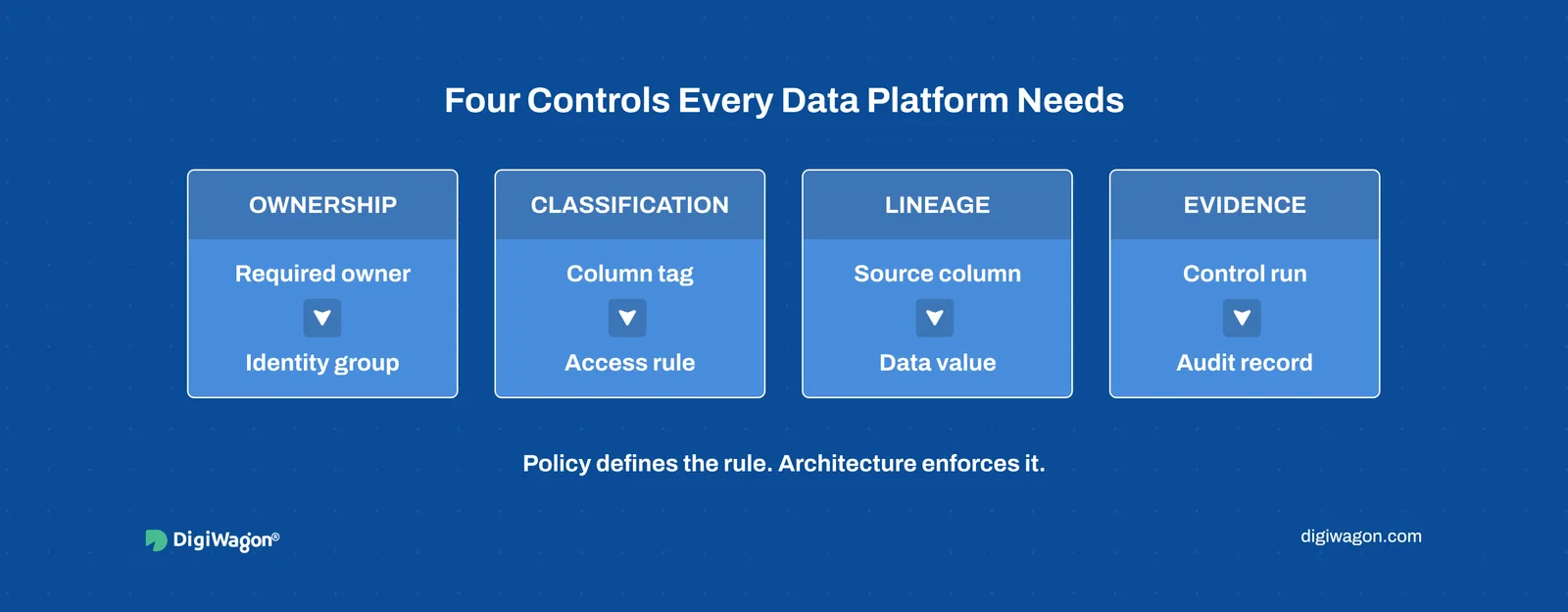
Ownership is the control most often written down and least often enforced. A spreadsheet of steward names is not an ownership model, because nothing in the platform reads it.
ISO/IEC 38505-1:2026 frames governance as an accountability model with defined evaluate, direct and monitor duties rather than a body of documents (ISO/IEC, 2026). The architectural translation is narrow: ownership has to be a property the platform can resolve, not a label a human maintains.
Three mechanisms carry it:
- Owner is a required field on dataset registration, and registration gates publishing.
- The owner value resolves to a group in the identity provider, so ownership survives someone leaving.
- Unowned datasets are queryable as a set, which turns coverage into a metric instead of an assertion.
DAMA-DMBOK2 draws the same line between accountability and execution (DAMA International, 2017). When the business assigns accountability to a named role, the architectural response is to bind that role to an identity group, and make the binding a precondition for the dataset entering the catalogue.
Ask the platform which datasets have no resolvable owner. If answering needs a person to go and look, ownership is not yet a control.
How Do You Enforce Classification at Query Time?
Classification fails when it stops at the tag. A four-tier sensitivity scale becomes a control only when each tier resolves to an access decision the query engine makes on its own.
The NIST Privacy Framework 1.0 pairs data inventory and mapping with the control functions that act on them (NIST, 2020). An access layer needs the same separation: know what the column is, then decide who may read it.
Tag granularity
Table-level classification is easy to apply and close to useless: the sensitive column is usually one of forty. Only column-level tags give a masking policy something to act on.
Policy location
- Native warehouse policies, row-level security and dynamic masking, enforce inside one engine and are the cheapest correct option when there is only one.
- An external policy decision point covers several engines, at the price of an authorisation hop per query and one more component to keep available.
When the obligation is that a class of data is never read in the clear outside a named group, the architectural response is a masking policy attached to the column tag, evaluated per query, with every denial written to a log. That log is the only artefact showing the control was reachable and active.
Teams retrofitting these controls can see how data engineering and platform build work covers ingestion through the metadata layer.
What Must Lineage Capture to Answer an Auditor?
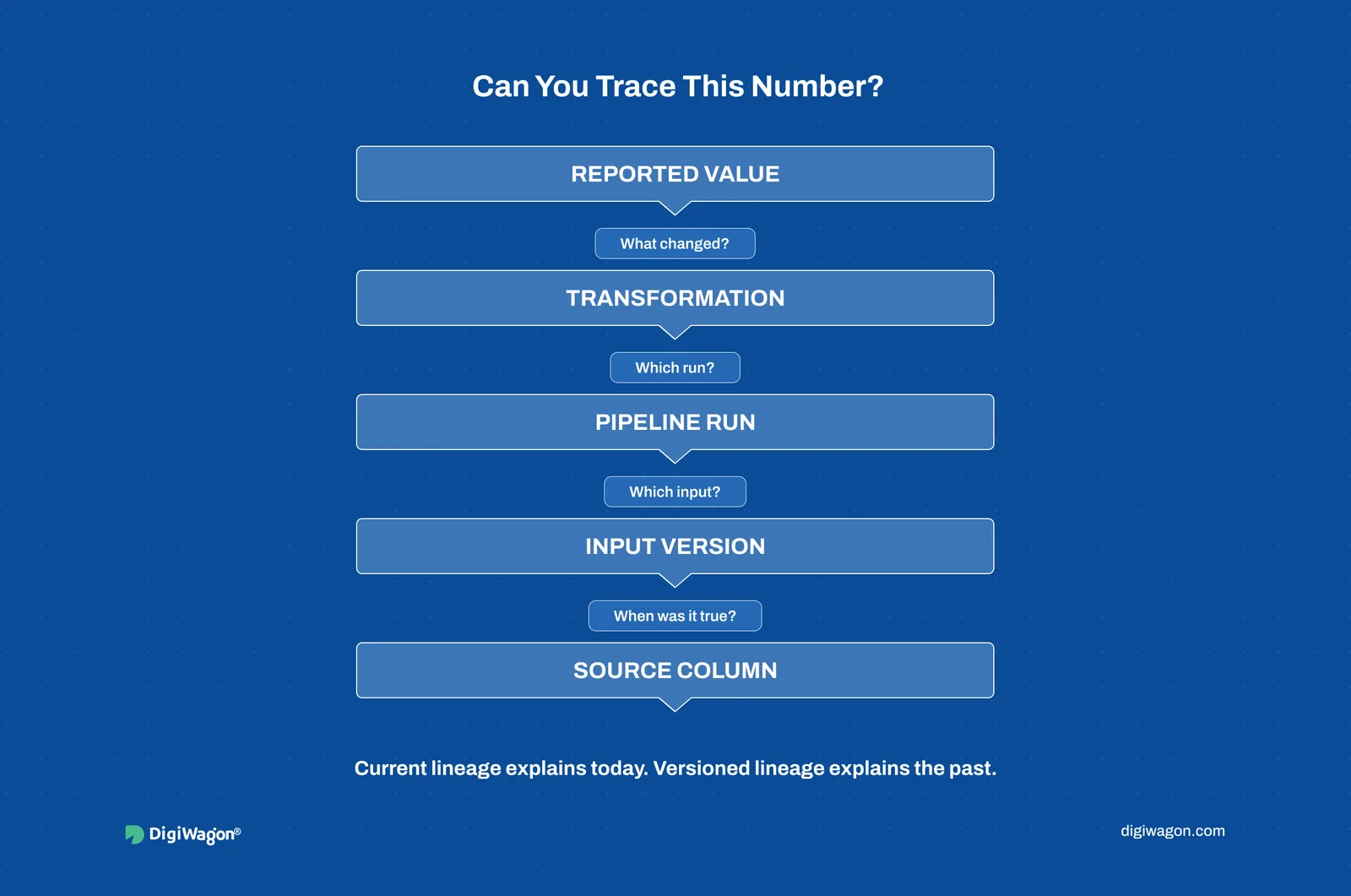
An auditor asks one question in many forms: where did this number come from. Lineage is the control that answers it, and diagram-shaped lineage does not.
GDPR Article 30 requires controllers to maintain records of processing activities, and Article 5(2) places the burden of demonstrating compliance on the controller (EU, 2016). Both are metadata obligations, and neither is discharged by a drawing.
Run-time lineage has to carry four things:
- Column-level derivation. Which source columns produced this column, through which transformation.
- Execution identity. Which pipeline run, under which code version, wrote this row.
- Input versions. Which version of each upstream input the run consumed, not merely which table.
- Time validity. When the value was true, held separately from when the row was written.
Miss the third and fourth and lineage explains today's number while saying nothing about the one reported last March. A current-state graph is not reconstruction.
The mechanism is emission, not inspection: the transformation layer writes lineage as a by-product of running. Emitted lineage is correct by construction. Inferred lineage degrades whenever someone writes SQL the parser cannot follow.
How Does a Data Governance Strategy Prove Its Controls Ran?
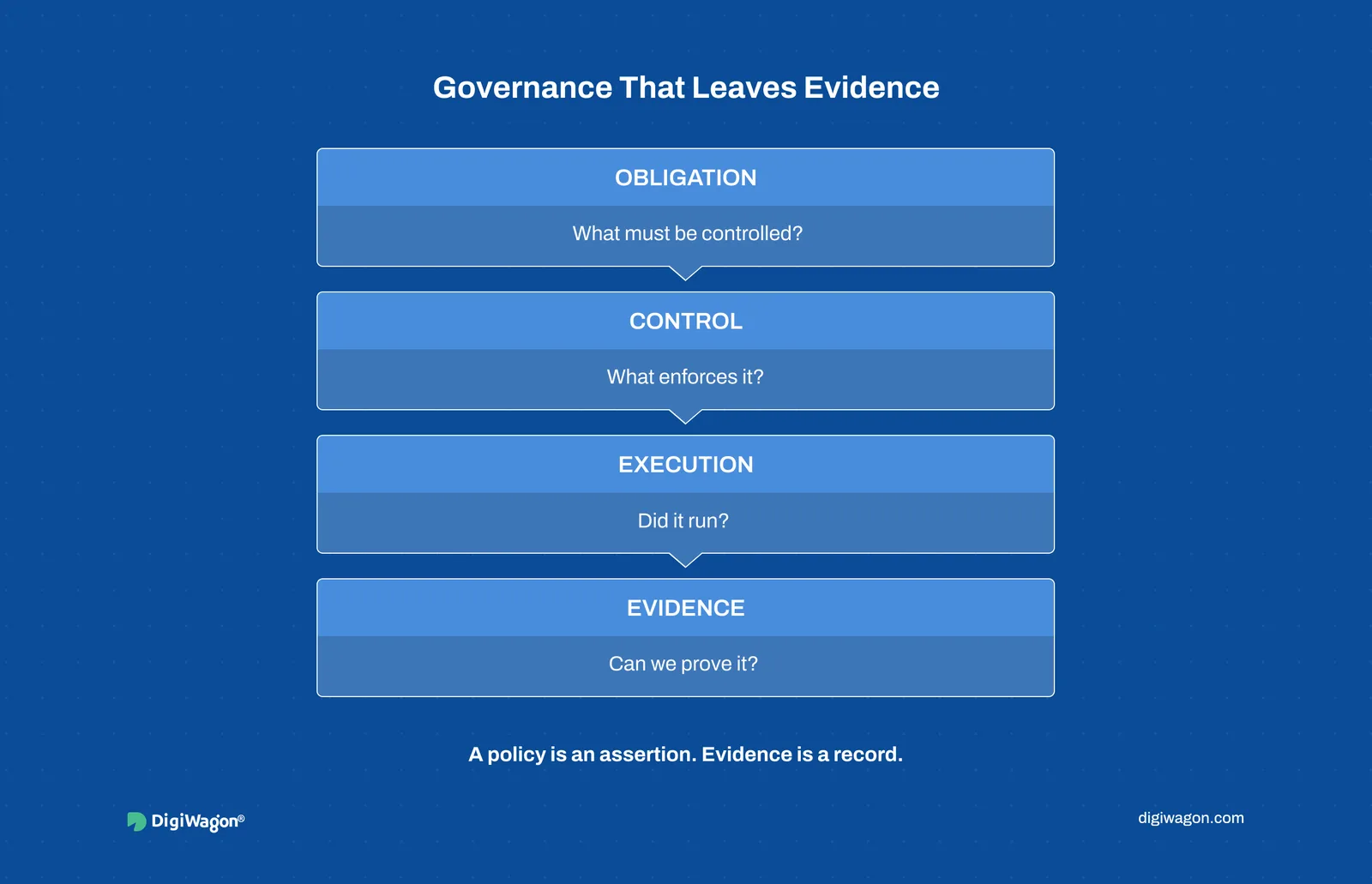
A control that cannot produce evidence it ran is indistinguishable from a control that never ran. That is the gap between design effectiveness and operating effectiveness, and where governance programmes are usually found out.
Existence evidence is a policy document and a screenshot. Operating evidence is a per-execution record: what ran, when, on which inputs, with what outcome, under whose identity. One is an assertion, the other a query.
ISO/IEC 38505-1:2026 splits the governing body's duties into evaluate, direct and monitor, and monitor is the duty that cannot be discharged without per-execution evidence (ISO/IEC, 2026).
When the obligation is to reconstruct a past decision, the architectural response is an append-only execution log joined to versioned inputs, immutable on the write path so no entry can be edited into agreement with a later story. The control log and the lineage store are therefore one design problem, both sitting in the metadata layer covered in how the modern data stack fits together.
Lessons from Governing Reference Data Under Regulatory Obligation
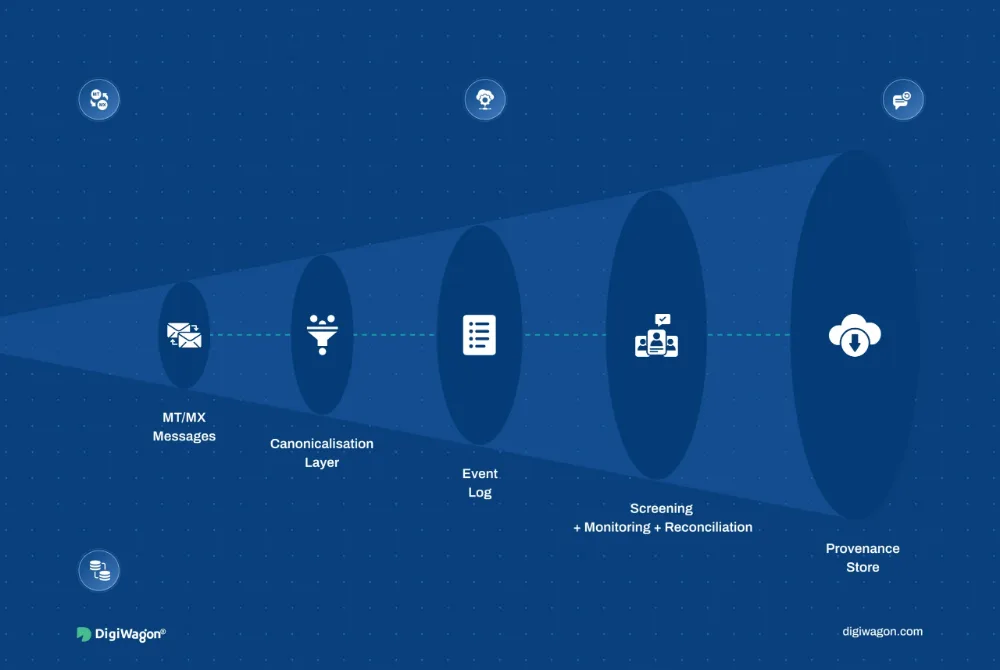
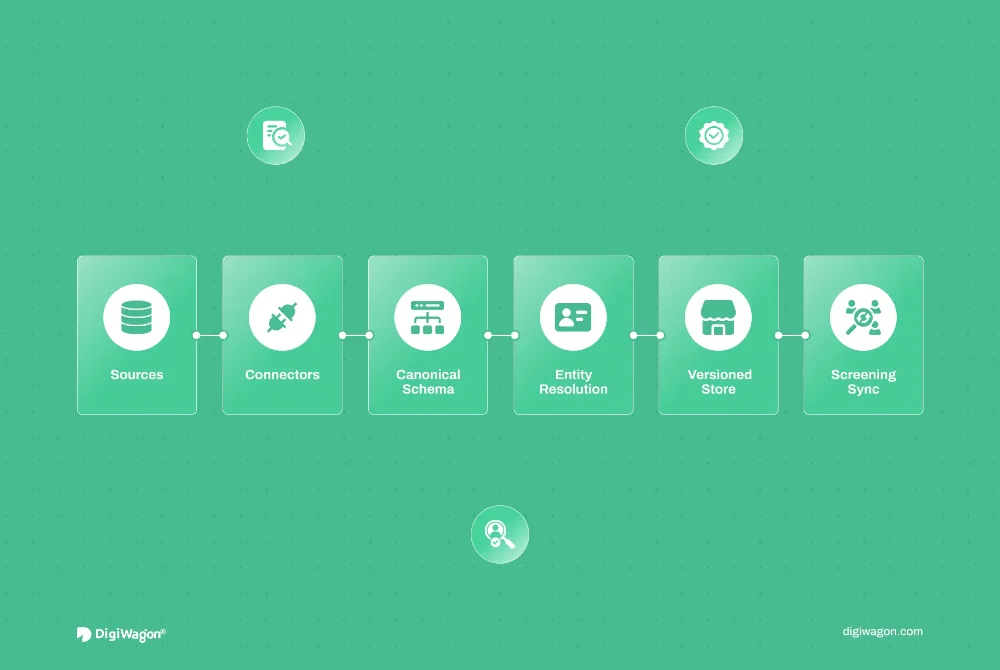
Two of our builds put these controls under regulatory load. The watchlist governance platform unified regulatory, commercial and internal list sources into a single governed store. The SWIFT data orchestration build did the equivalent for records arriving over scattered email and SFTP channels.
Both run on Node.js services over PostgreSQL on AWS, with a React operator console. The consequential call was centralising the governed store rather than federating list management to each consuming system.
Published outcomes: 50% faster watchlist updates and 40% fewer duplicate and inconsistent list records on the watchlist platform, and 40% better data accuracy and audit transparency on the SWIFT build (DigiWagon case studies, 2026).
Building the Control Layer with DigiWagon
DigiWagon builds the enforcement layer a governance strategy needs: catalogue, access policy, lineage capture and control logging, inside the platform your teams already run. The work is scoped inside the broader data and analytics engineering engagement.
- Dataset registration with owner resolution against your identity provider
- Column-level classification wired to query-time masking and row filters
- Lineage emitted by the transformation layer, at column level
- Append-only control logging built for replay against versioned inputs
Where a Governance Blueprint Earns Its Keep
A governance strategy is only as strong as the weakest control it names. Ownership no system can resolve, and classification no query respects, are gaps an auditor finds fast. Start from the obligation, name the control, then the mechanism that enforces it. Platforms built to that chain answer a reconstruction request with a query instead of a fire drill.