Key Takeaways
- Multi-geography AML platforms fail when compliance is treated as a configurable feature instead of a core architecture layer.
- The most important design decisions usually sit in tenant isolation, data residency routing, and jurisdiction-aware rule execution.
- Expanding AML SaaS into a new market should not require rewriting core platform logic every time.
- The right architecture must support both regional compliance boundaries and shared product scalability.
- In multi-jurisdiction AML systems, infrastructure, observability, and auditability are part of the compliance design, not post-launch additions.
What is Multi-Geography SaaS Architecture for AML Compliance?
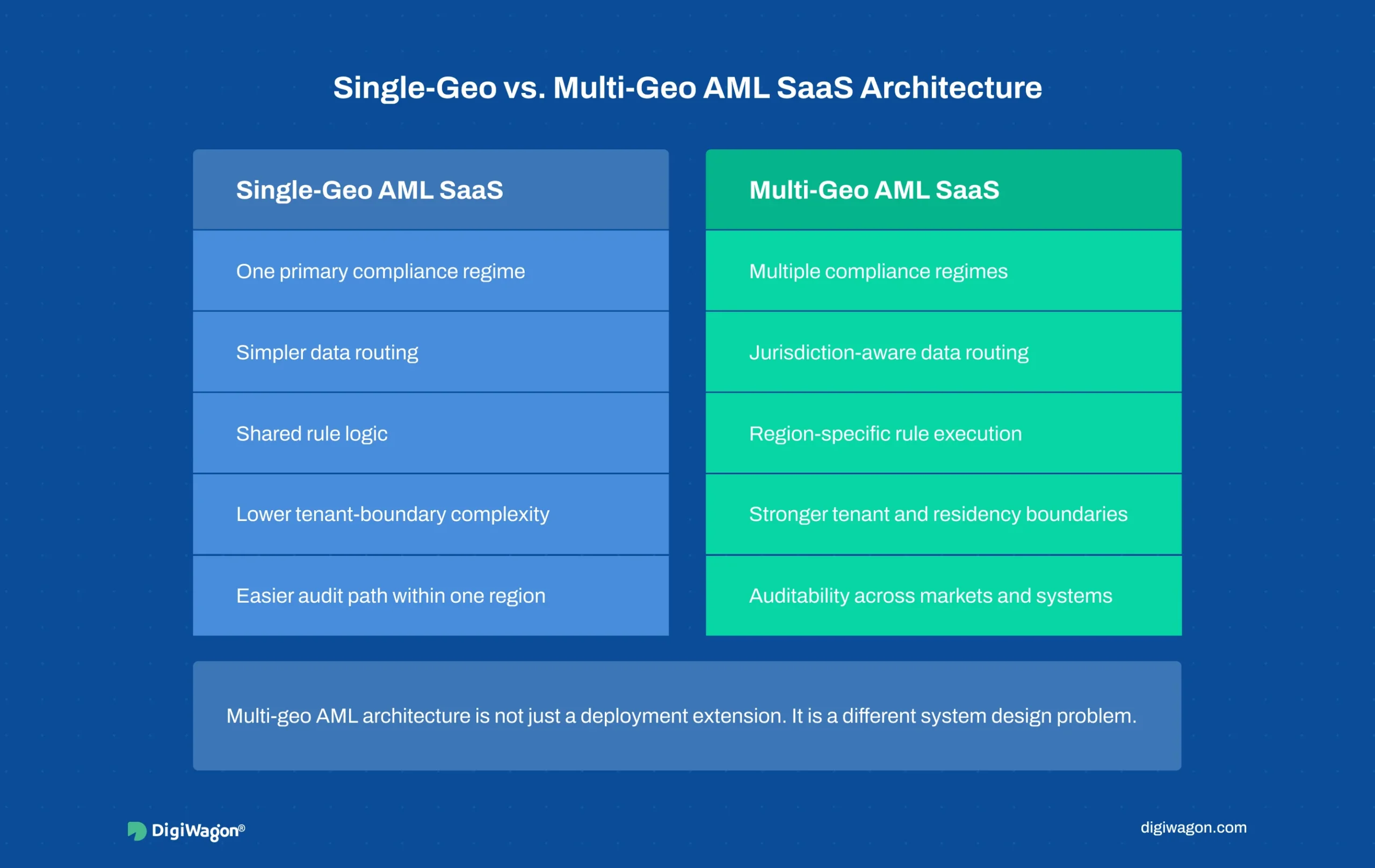
Multi-geography SaaS architecture for AML compliance is the system design approach used to support different regulatory, data-handling, and rule-enforcement requirements across multiple jurisdictions within one platform.
This is not just SaaS deployed in more than one country. In AML systems, regional expansion creates architectural pressure because the platform must handle:
- Different data residency rules
- Different compliance workflows
- Different jurisdiction-specific rule sets
- Different evidence and audit expectations
A normal SaaS platform can often localize through language, content, or workflow variations. AML platforms cannot rely on that alone. They need architectural controls that govern where data lives, how requests are routed, which rules execute, and what traceability is preserved under audit.
The goal is not simply to launch the same product in more markets. It is to design a platform that can expand across jurisdictions without losing compliance integrity or forcing market-specific rewrites each time.
Why This Becomes an Architecture Problem
In many software systems, regional variation can be handled through configuration, feature flags, or process-level changes.
In AML systems, that approach breaks down quickly.
The differences between markets often affect:
- Where data may be stored
- Where it may be processed
- Which screening or risk rules apply
- How decisions must be logged and reconstructed
- Which services can interact across regional boundaries
That means compliance does not sit only in the product layer. It becomes part of the data plane, the control plane, and the architecture that connects them.
This is where many platforms go wrong. Teams treat geography as a deployment issue and compliance as a feature issue. The result is usually:
- Duplicated logic across markets
- Brittle exceptions at the workflow layer
- Market-specific rewrites
- Inconsistent auditability
- Increasing operational risk every time a new region is added
A multi-jurisdiction AML platform needs architectural boundaries from the start. Without them, scale creates fragmentation instead of reuse.
The Architecture Layers That Matter Most
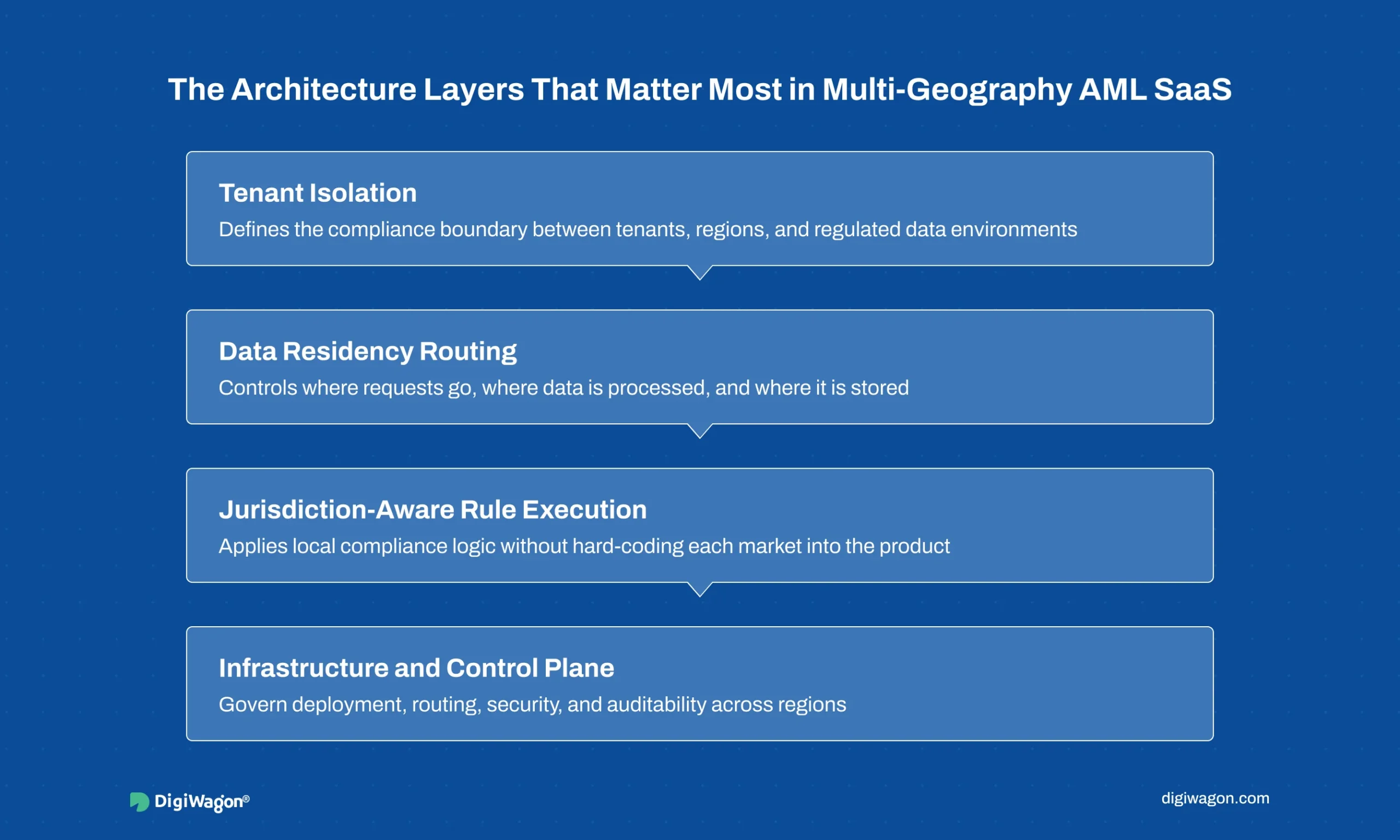
Multi-geography AML compliance becomes an architecture problem when geography changes how data is separated, where it can move, and which compliance logic must execute.
At that point, expansion is no longer just a product rollout question. It becomes a systems design problem involving boundaries, routing, enforcement, and auditability.
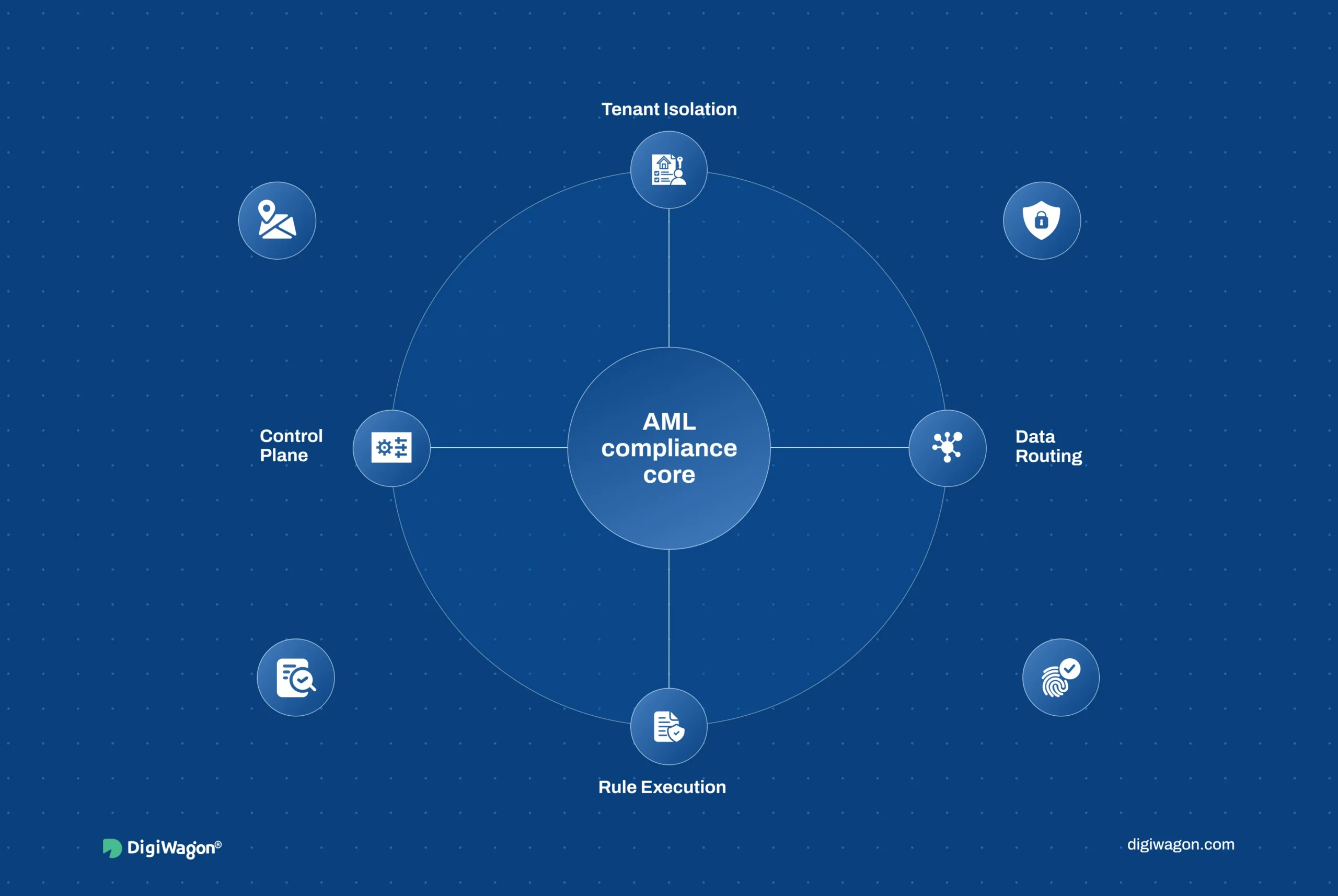
Four layers usually determine whether an AML platform can scale safely across jurisdictions.
Tenant Isolation
Tenant isolation defines the compliance boundary between customers, markets, and regulated data environments. It determines how strongly the system separates data, controls, and operational risk across geographies.
Key considerations include:
- Shared schema when operational simplicity matters most and regional separation requirements are relatively light
- Separate schema when stronger tenant boundaries are needed without full database isolation
- Separate database when residency, auditability, or regional governance needs must be enforced more explicitly
- Backup, restore, retention, and encryption policies that may need to diverge by geography
- The fact that lightweight isolation models often become harder to manage as jurisdiction-specific controls increase over time
The right isolation model should be chosen as a compliance boundary, not just a multi-tenancy convenience.
Data Residency Routing
Residency is not only about where data is stored. It also depends on where requests are routed, where processing occurs, and how jurisdiction constraints are preserved across the full data path.
Key considerations include:
- Region-aware request routing at the API or service entry layer
- Metadata tagging at ingest so records carry jurisdiction context through the platform
- Storage targets aligned to residency requirements by geography
- Policy-based controls for movement, retrieval, and processing across regions
- Failover design that does not silently violate residency rules during recovery or rerouting
A platform can store data in the right region and still break compliance if the routing and processing path is not jurisdiction aware.
Jurisdiction-Aware Rule Execution
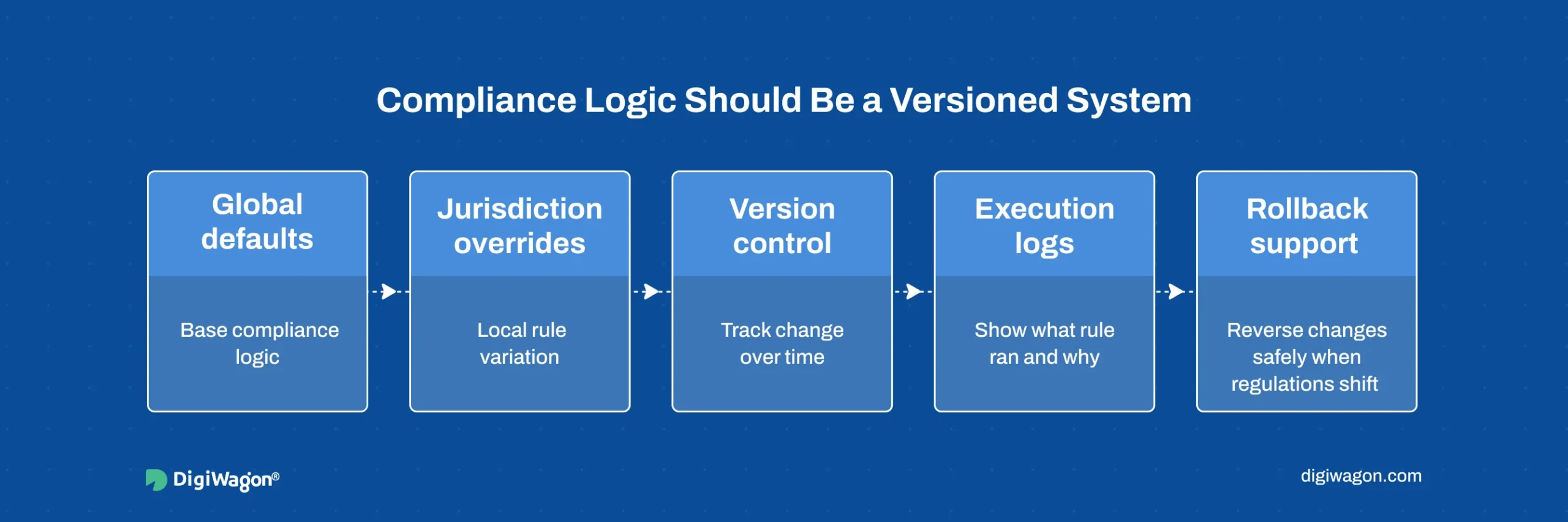
A multi-market AML platform cannot rely on one static global rule set. Compliance logic needs to vary by geography without turning every new jurisdiction into an application rewrite.
Key considerations include:
- Support for jurisdiction-specific rules without hard-coding market logic into core services
- Inheritance and override models where global defaults and local compliance requirements must coexist
- Versioning so rule changes can be tested, deployed, and audited safely
- Rollback mechanisms when regulatory updates need to be reversed without destabilizing the system
- Execution logs that preserve which rule set ran, when it ran, and why it produced a specific outcome
In practice, the rule layer should behave like a governed, versioned system, not a spreadsheet of conditional exceptions.
Infrastructure and Control-Plane Design
Multi-geography AML architecture also depends on the systems that govern deployment, routing, security, and observability across regions. These are not supporting concerns. They are part of the compliance architecture itself.
Key considerations include:
- Multi-region deployment model Teams need to decide whether services run centrally, region-locally, or in a hybrid form depending on which layers handle data, rules, and execution.
- Secrets and key management Encryption and secrets management may need to align with geography, especially where tenant or jurisdiction controls require separate cryptographic boundaries.
- Event and queue boundaries Async workflows can create hidden cross-region risk if queue topology is not designed with jurisdiction constraints in mind.
- Observability and auditability In AML systems, observability is part of the architecture. The platform needs tenant-aware logs, rule execution traces, lineage across data movement, region-aware audit evidence, and the ability to reconstruct how a decision happened under review.
These layers are interdependent. Weakness in one usually creates risk across the rest of the platform.
How DigiWagon Helps
DigiWagon helps teams design AML platforms where geography, compliance, and SaaS scale have to coexist without constant architectural rewrites.
That includes:
- Selecting the right tenant isolation model
- Designing jurisdiction-aware routing and storage boundaries
- Structuring rule engines for multi-market compliance logic
- Planning rollout paths for new geographies
- Aligning platform architecture with long-term audit and operational requirements
The focus is not just on enabling a compliant feature set. It is on designing a system that can support multi-jurisdiction growth without losing control over boundaries, traceability, and maintainability.
Conclusion
Multi-geography AML compliance is not just a deployment problem and not just a workflow problem.
It is a systems architecture problem.
The platforms that scale well across jurisdictions are the ones that treat tenant boundaries, data routing, rule execution, and auditability as first-order design decisions from the start.
The real goal is not only to enter more markets. It is to do so without rebuilding platform integrity every time the compliance model changes.