The Four Decisions: Bottom Line
- Legacy system modernization fails on sequencing and disposition decisions, not on the technology chosen.
- No application moves until the portfolio is described: dependencies, criticality, lifecycle and owner.
- Every application needs one explicit disposition: retire, retain, rehost, relocate, repurchase, replatform or refactor.
- Replace versus refactor is an evidence question answered by measured maintainability, not by team preference.
- Incremental cutover behind a boundary layer beats a cutover date, because behaviour moves in reversible steps.
What Is Legacy System Modernization?
Legacy system modernization is the engineering discipline of replacing or restructuring a running software estate without interrupting the business it serves. It assigns every application a disposition, then moves behaviour incrementally behind a stable interface. The deliverable is a system whose modules can be changed independently and tested in isolation.
Why Legacy Estates Stall Mid-Programme
Most legacy programmes do not fail at the architecture review. They fail well into delivery, when a dependency nobody mapped turns a planned increment into an unplanned integration, and the schedule absorbs it until the budget runs out.
The pattern is measurable. McKinsey found that companies in the bottom twentieth percentile for technical debt severity are 40 percent more likely to have incomplete or cancelled IT modernizations than those in the top twentieth percentile (McKinsey, 2023). The debt does not only make the system harder to change. It makes the programme to change it harder to finish.
What has shifted is the pressure on capacity. Estates are now being asked to absorb AI capability on top of a modernization backlog already competing for the same engineers.
This post covers the decision surface: what you establish before anything moves, how each application gets a disposition, how the replace-or-refactor call is settled with evidence, how the work is sequenced so the business keeps running, and how you know it is finished. The transformation programme roadmap owns the question of whether to run a programme at all; this page owns the legacy-system decisions inside one.
What Do You Actually Have Before You Modernize Anything?
"Modernize the legacy system" is not a decidable instruction. It names an outcome and hides every decision that produces it.
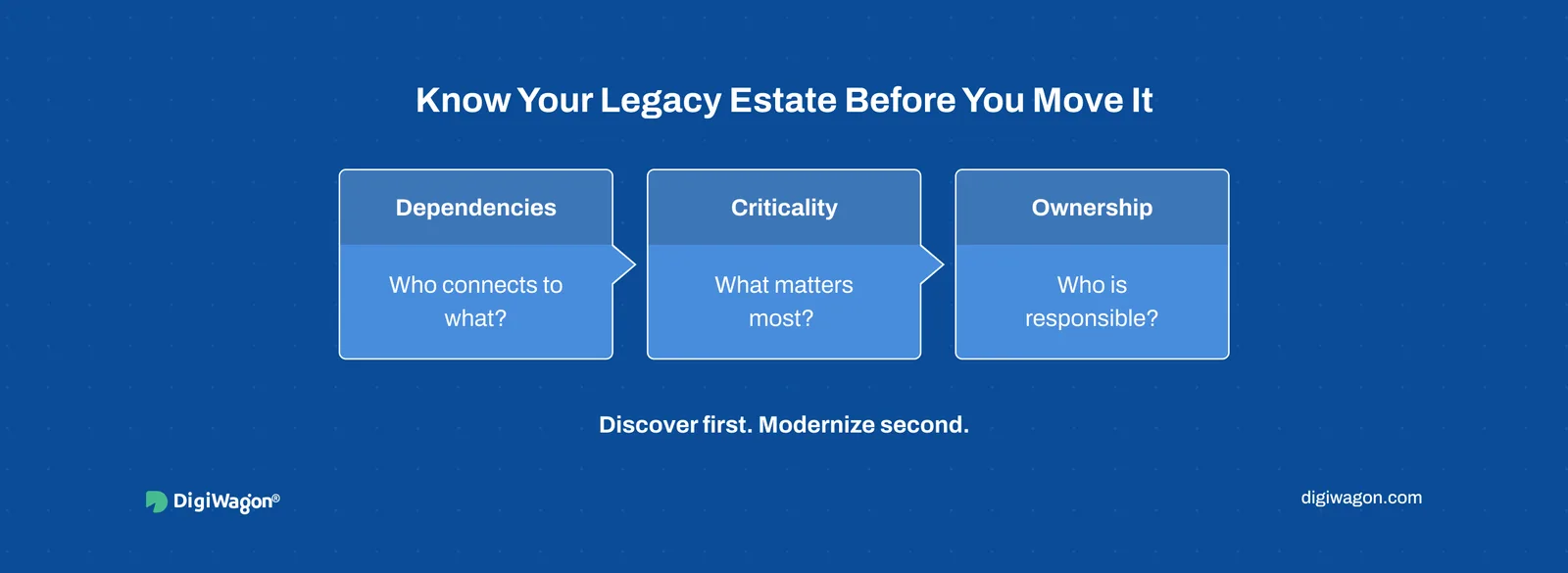
The first decision is descriptive rather than architectural. AWS Prescriptive Guidance is explicit that portfolio discovery precedes strategy selection: discovery has to determine application and infrastructure dependencies and document application criticality, lifecycle and business cycle before anything is rationalised against a migration strategy (AWS Prescriptive Guidance). Skip it and the target architecture gets chosen first, with dependencies discovered during cutover.
The three things discovery has to produce
- A dependency graph at interface level, not server level. Two applications on the same host are not coupled. Two applications sharing a write path are.
- A criticality and lifecycle attribute per application. Disposition depends on both, so a portfolio missing them cannot be dispositioned.
- A named owner per application. An application with no owner cannot be retired, and unowned applications are the most common reason a retire list stalls.
The shape of the graph varies by estate. In manufacturing systems modernization the graph is usually wider than expected, because shop-floor systems accumulate point integrations that no diagram records. In lending and deposit estates it runs deeper instead, because one customer journey crosses core banking, identity verification and payment rails.
How Do You Assign a Disposition to Every Application?
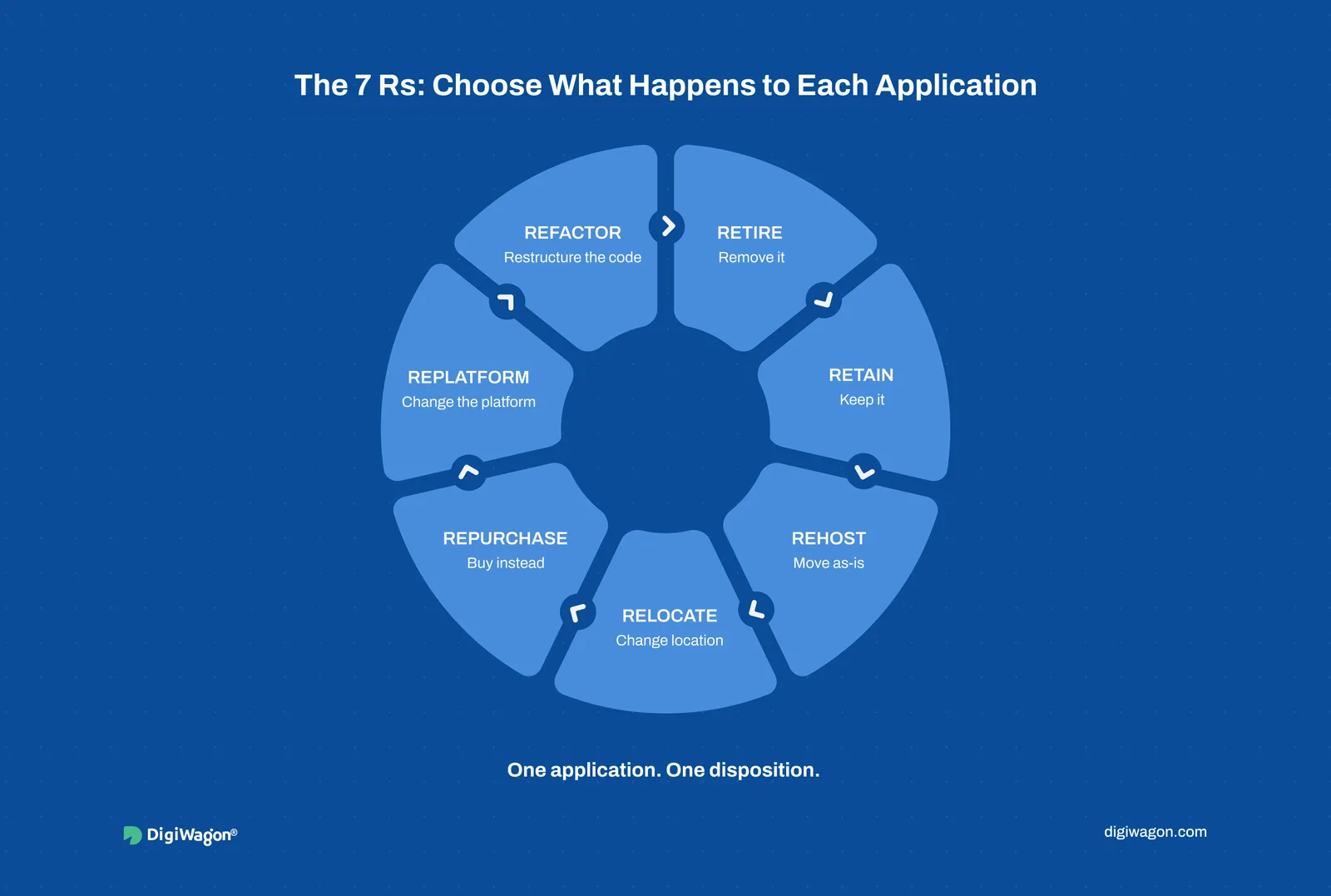
Disposition is the decision that each application gets exactly one answer to the question of what happens to it. AWS Prescriptive Guidance names seven, the 7 Rs: retire, retain, rehost, relocate, repurchase, replatform, and refactor or re-architect (AWS Prescriptive Guidance).
Which taxonomy you adopt matters less than the rule around it. Every application in the estate carries one disposition before any code moves, and the disposition is written down with the evidence behind it.
| Disposition | What changes | Deferred cost | Choose it when |
|---|---|---|---|
| Retire | Application is decommissioned or archived | None, once data retention has a home | Traffic data shows no active consumers |
| Retain | Nothing | Full, pushed to a later programme | Dependencies are unmapped or a vendor contract blocks change |
| Rehost | Runtime location only | Architecture debt travels intact | The constraint is the data centre, not the code |
| Replatform | Runtime plus managed services at the edges | Coupling remains in the core | The application is healthy, the operational burden is not |
| Repurchase | The application becomes a product | Configuration and integration debt replaces code debt | The capability is not differentiating |
| Refactor | Internal structure, behind stable interfaces | Lowest, if the boundaries were chosen well | Maintainability is measurably poor and the capability differentiates |
A disposition list where every application says "refactor" is not a disposition list. It is a rewrite with extra steps. Estates that have never been rationalised almost always contain applications whose only correct disposition is retire, and those are the cheapest wins available to the programme.
Where the disposition comes back as rehost or relocate, the work becomes an infrastructure exercise with a different decision surface, and it belongs to a migration track rather than this one.
What the disposition record has to carry
A disposition that exists only in a slide is not a decision. The record needs four fields per application, and it stays live for the length of the programme.
- The disposition itself, one value, with no compound answers such as "replatform then refactor". A compound answer is two decisions pretending to be one, and the second one never gets funded.
- The evidence behind it, named: traffic data for a retire, a contract clause for a retain, a maintainability reading for a refactor, a product evaluation for a repurchase.
- The owner who signed it off, on the business side for criticality and on the engineering side for structure.
- A review date, because dispositions decay. A retain taken against an unmapped dependency stops being correct the moment that dependency is mapped.
Teams working through a disposition pass can see how application modernization services cover discovery, disposition and incremental cutover as one engagement.
What Makes the Replace or Refactor Call an Evidence Question?
Because "the code is bad" is a preference, and maintainability is a measurement.
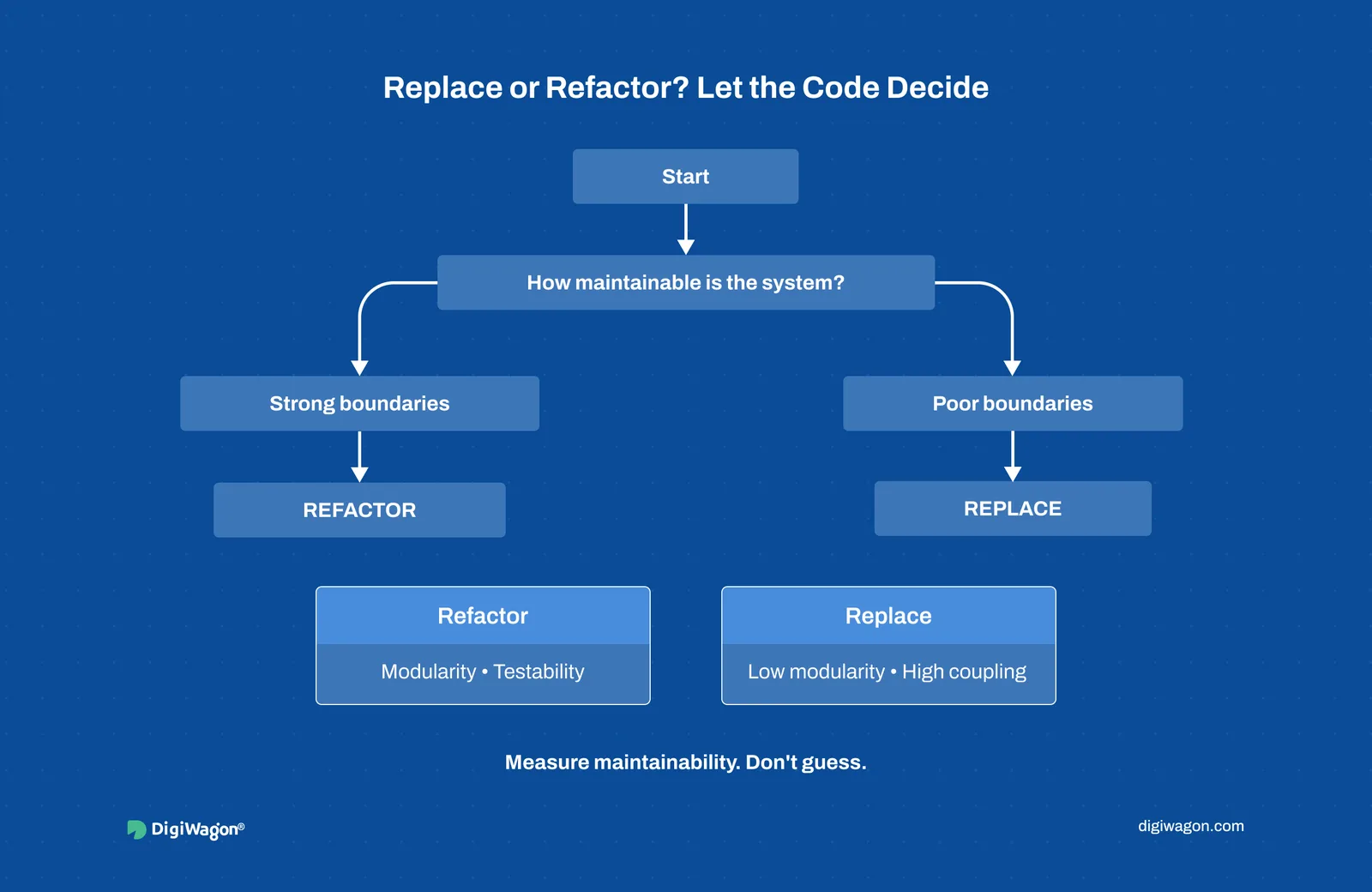
ISO/IEC 25010:2023 defines maintainability as a product quality characteristic with five sub-characteristics: modularity, reusability, analysability, modifiability and testability (ISO/IEC 25010:2023). Each one is assessable against a real codebase, which turns an argument about age into a reading about structure.
When the business requires a capability to keep changing quarterly, the architectural test is modifiability and testability on the module that owns that capability, not the year the codebase was written. When the business needs the capability only to keep working, analysability matters more, because the cost is diagnosis rather than change.
Where the line actually falls
- An application with poor analysability and sound modularity is a refactor candidate. There are boundaries to work behind, and the problem is that nobody can see inside them.
- An application with poor modularity across every module is a replace candidate. There is no boundary to refactor behind, so restructuring becomes a rewrite performed in place, which carries the risk of a replacement without the benefit of one.
Replace resets internal structure and operational model together. It also resets the requirements that were only ever encoded in the old system's behaviour, which is the cost that gets underestimated. Refactor keeps that behaviour as the specification of record. It feels slower and reaches production sooner. The commercial version of this call, framed around ownership rather than structure, sits in the rebuild, refactor or buy playbook.
How Do You Sequence Cutover Without a Cutover Date?
By moving behaviour rather than moving the system.
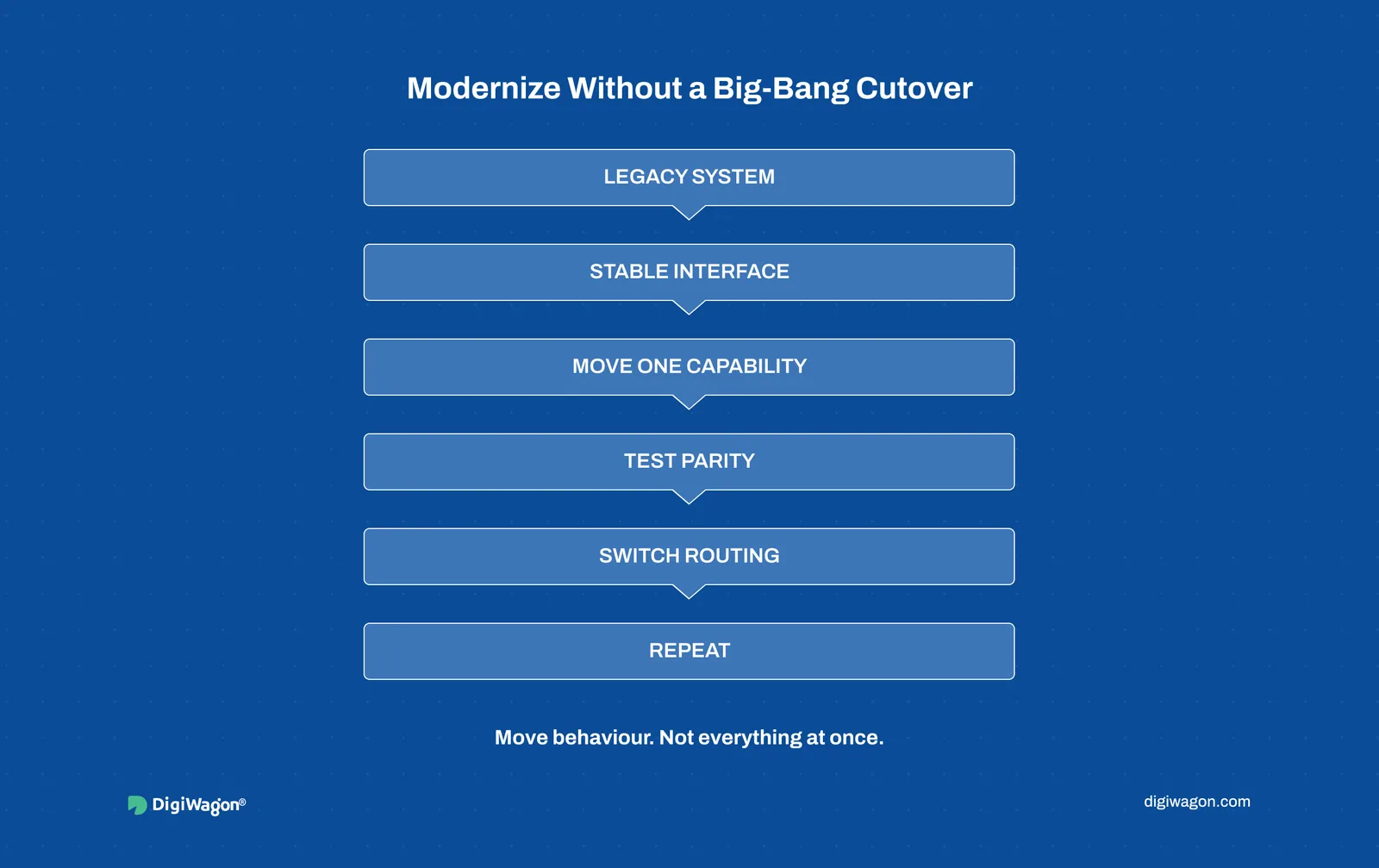
Martin Fowler's strangler fig pattern describes new components built alongside the legacy code base, beginning with small additions, with behaviour transferring progressively (Martin Fowler, 2024). His case for it is a risk case: the reduced risk and earlier value of the gradual approach outweigh the cost of building transitional architecture (Martin Fowler, 2024).
When the new system has to coexist with a legacy schema or an obsolete API, the architectural response is an anti-corruption layer that translates at the boundary, so the legacy data model does not propagate into the new one (Microsoft Azure Architecture Center). Microsoft's guidance also asks the question that keeps the layer honest: decide up front whether it is permanent or scheduled for retirement once all legacy functionality has moved. A boundary layer with no retirement decision becomes the legacy system's second life.
What makes an increment reversible
- A stable interface in front of the behaviour being moved, so consumers do not change when the implementation does.
- A routing decision that can be flipped back. An increment that cannot be reverted is a cutover.
- Parity evidence for the moved behaviour, captured before the old path is switched off.
Parity evidence is the step teams compress under schedule pressure, and it is the one that makes the revert path real. Comparing outputs across the old and new paths on live traffic, before any routing shifts, turns a switchover into a measurement. Where the moved behaviour touches money or identity, that comparison runs across a full business cycle rather than a sample week, because the edge cases live at period close.
Where a journey crosses systems the estate does not own, such as identity verification or payment rails, the increment boundary follows the integration contract rather than the module. That is the point at which FinTech platform engineering and systems integration at the boundary become the same problem.
How Do You Know a Legacy System Modernization Is Done?
Done is a defined state, not a feeling about the architecture diagram.
ISO/IEC/IEEE 14764:2022 places software maintenance inside a defined life cycle process with activities and tasks, and routes retirement through the disposal process defined in ISO/IEC/IEEE 12207:2017 (ISO/IEC/IEEE 14764:2022). Read that way, a programme finishes when the old system has been disposed of, not when the new one goes live.
The economic test is the run-versus-change split. McKinsey's 2026 analysis of enterprise technology budgets found that the organisations it calls deliberate modernizers earmark at least a third of technology spend for change and the rest for run, and hold run-based infrastructure costs at least 20 percent below other organisations (McKinsey, 2026). A modernization that has not moved that ratio has not finished.
Four exit criteria worth writing into the programme
- Every application on the retire list is decommissioned and its data has a retention home.
- No consumer still calls the legacy interface, verified from traffic rather than from a change log.
- Each moved capability deploys independently of the rest of the estate.
- The run-versus-change ratio has moved in the direction the business case claimed.
Lessons from Four Legacy Replacement Programmes
No single programme covers this surface end to end. Four cover it between them: the AI-powered AML screening platform that replaced a compliance workflow which could not scale, the NQBPL Wages Platform that moved production and workforce tracking onto a system of record, and two journeys inside one regulated bank, paperless fixed deposit onboarding and the MSME loan journey.
The composition is the lesson. The screening platform runs React.js, Node.js and PostgreSQL on AWS. The wages platform runs the same React and Node stack on MySQL. The bank's deposit onboarding journey is Java and AngularJS; its MSME lending journey is React, Express.js and MySQL with a React Native field app.
What transferred across all four was the sequencing, not the stack. Each replaced one journey at a time behind a stable interface. The MSME journey moved 60 percent faster through its workflow, and the deposit journey reached 98 percent identity verification accuracy.
Planning a Legacy Replacement with DigiWagon
DigiWagon runs legacy replacement as an enterprise software engineering programme, from the disposition pass through to decommissioning the old system.
- Portfolio discovery and dependency mapping at interface level
- Disposition assignment with recorded evidence per application
- Incremental cutover behind stable interfaces and boundary layers
- Decommissioning, retention and parity verification
Making the Four Decisions Explicit
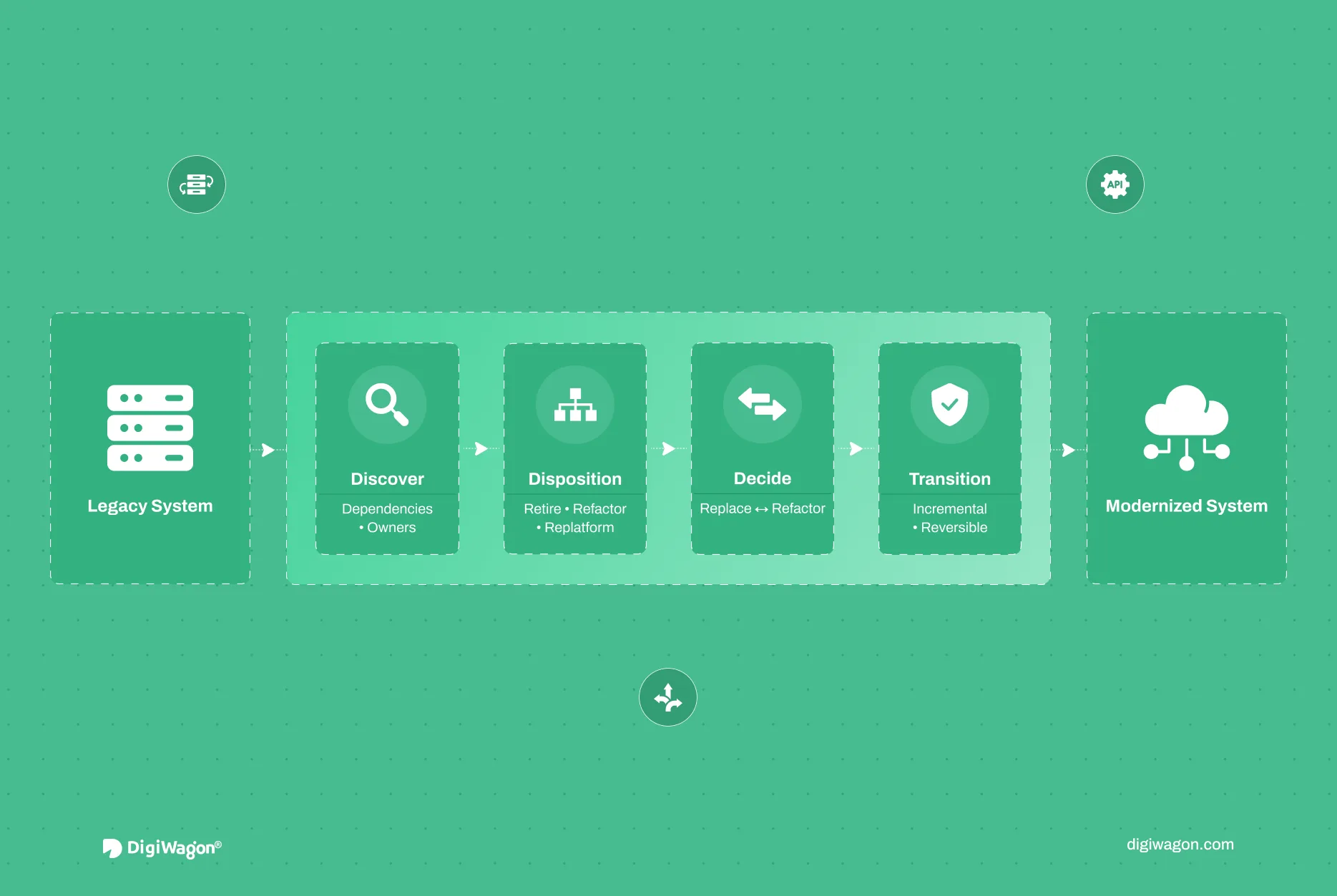
Four decisions carry a legacy modernization: what the portfolio actually contains, what disposition each application gets, whether a differentiating capability is replaced or refactored, and how behaviour moves in reversible increments. Skip the first and dependencies surface during cutover. Skip the second and everything becomes a rewrite. Skip the third and preference stands in for evidence, and skip the fourth and the programme acquires a cutover date it cannot hold. Estates modernized against all four end with the old system decommissioned and every moved capability deployable on its own, which is the engineering deliverable the programme was funded to produce.