Enterprise Mobile Architecture: What Actually Decides It
- Mobile fails at three things the desktop web never had: unreliable network, unmanaged device, unpatchable release.
- The offline and sync boundary is the first decision, because every layer above it inherits the choice.
- Device trust is an architecture problem, not a login screen, on hardware you do not administer.
- Google Play requires Android 16 targeting from 31 August 2026, so release governance is now a dated dependency.
- Observability has to survive a client that is offline, so telemetry buffers on device or it is lost.
What Enterprise Mobile App Development Actually Is
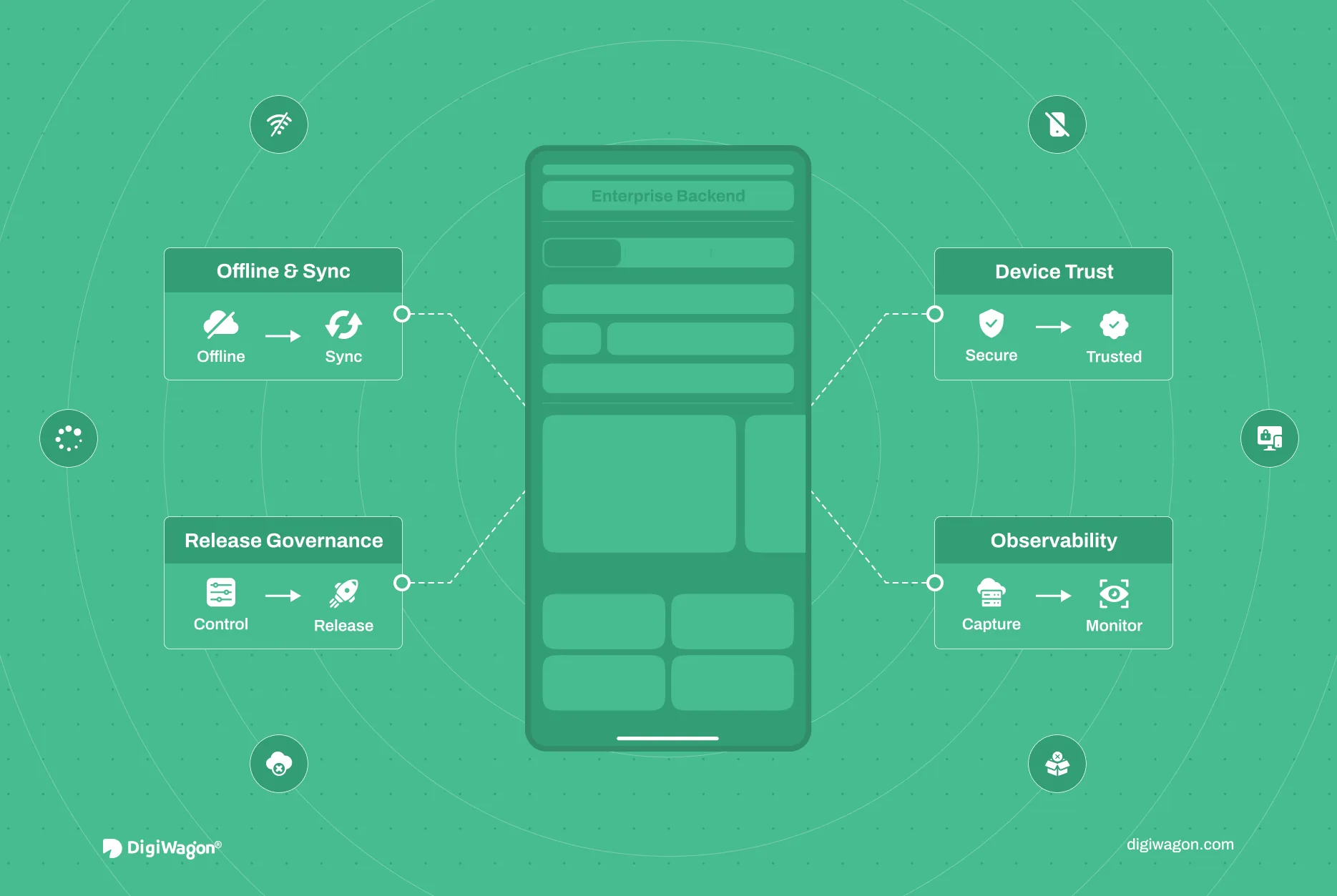
Enterprise mobile app development is the discipline of building applications for networks, devices, and release channels the enterprise does not control. It names four architectural boundaries: offline sync, device trust, store release governance, and on-device observability. Systems that resolve all four survive annual OS churn without a rewrite.
Why the Pressure Is on Right Now
Two dated facts make this a live architecture question rather than a planning-cycle one.
Google Play's target API requirement moves to Android 16, API level 36, on 31 August 2026 for new apps and updates, with existing apps required to target API level 35 or higher to stay available to new users on newer devices (Android Developers, 2026). That is a hard dependency on a calendar date, and it recurs every year.
The second pressure is on the app surface itself. Gartner predicted in January 2025 that mobile app usage will fall 25% by 2027 as AI assistants absorb tasks people currently open apps to do (Gartner, 2025). Read that as a signal about where enterprise mobile value concentrates. The apps that survive are the ones doing work an assistant cannot: operating offline in a warehouse basement, holding a device-bound credential, running against hardware.
Both pressures land on the same place. Not the feature list. The architecture underneath it.
Why Is Enterprise Mobile App Development a Different Discipline from Web?
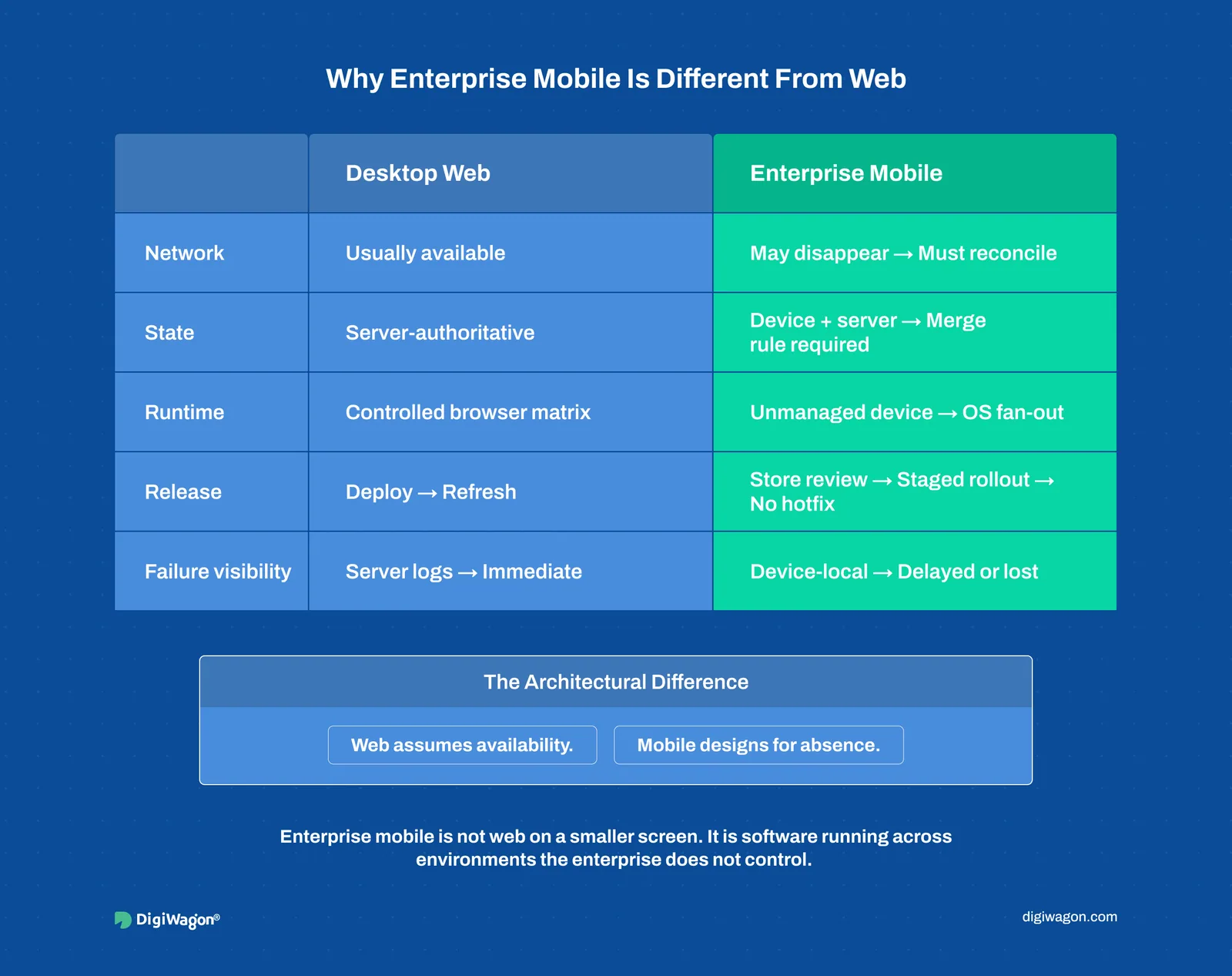
A browser tab runs on a machine with power, a network, and a refresh button. A mobile client has none of those guarantees, and the three gaps are structural rather than incidental.
The network is not a degraded connection, it is an intermittent one. The device is administered by its owner, not by IT. The release is a binary sitting on hardware you cannot reach, gated by a third party's review queue.
| Constraint surface | Desktop web | Enterprise mobile |
|---|---|---|
| Network | Assumed present, degrades gracefully | Assumed absent, must function and reconcile |
| State ownership | Server-authoritative | Split between device and server, needs a merge rule |
| Runtime environment | Controlled browser matrix | Unmanaged device, OS version fan-out |
| Release path | Deploy and refresh | Store review, staged rollout, no hotfix |
| Failure visibility | Server logs, immediate | Device-local, delayed or never delivered |
What are you optimising for?
ISO/IEC 25010:2023 names nine product quality characteristics, and its 2023 revision renamed Portability to Flexibility and Usability to Interaction Capability while adding Safety as a top-level characteristic. Flexibility is the one that matters most here, defined as the degree to which a system adapts to evolving hardware and operational environments.
That reframing is the whole argument. When a platform ships a breaking OS change every twelve months, the quality attribute under pressure is not performance. It is the system's capacity to absorb a change in an environment nobody on your team owns.
Version fan-out is the constraint that makes all of this compound
A web application has one live version. A mobile platform has as many live versions as there are users who have not updated, and that installed base is not something the engineering team controls.
The practical consequence is that every architectural decision below has to hold across a range of client versions simultaneously. A schema change to the local store has to migrate forward from whatever version each device is on. An API change has to serve clients written against contracts you shipped a year ago. A security fix reaches only the users who install it.
This is why the four boundaries are ordered by dependency rather than importance. The sync posture constrains what the local schema can be, which constrains what a forward migration costs, which constrains how aggressively the support floor can move. Decide them in that order or pay to reverse them later.
How Do You Draw the Offline and Sync Boundary?
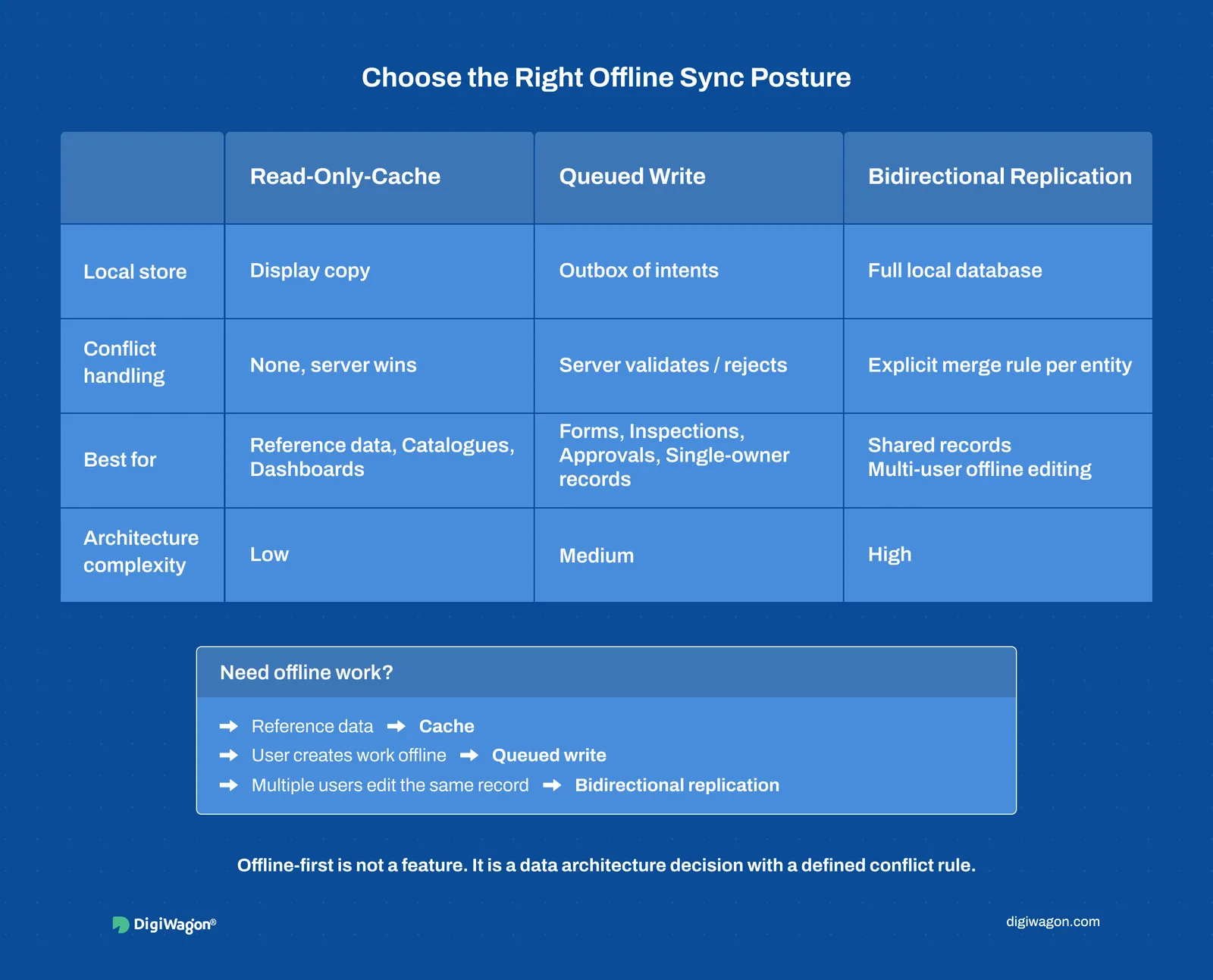
This is the decision that shapes everything above it, and it is routinely made by accident, discovered later as a defect class.
When the business requires a field worker to complete a task without connectivity, the architectural response is a local write path with an explicit reconciliation contract, not a retry wrapper on the network layer. Retry logic assumes the request will eventually succeed. Offline-first assumes the device is the temporary system of record and the server has to be told what happened.
Three sync postures, three different systems
| Posture | Local store role | Conflict handling | Fits when |
|---|---|---|---|
| Read-only cache | Display copy, discarded on refresh | None needed, server always wins | Reference data, catalogues, dashboards |
| Queued write | Outbox of intents, replayed on reconnect | Server validates and can reject | Forms, inspections, approvals, single-owner records |
| Bidirectional replication | Full local database, diverges and merges | Explicit merge rule per entity | Shared records edited by multiple users offline |
The Android architecture guidance treats an offline-first data layer as a repository responsibility with its own reconciliation logic, rather than something the UI layer improvises (Android Developers, 2026). That placement is the point. Sync logic in the view layer becomes untestable within one release.
The merge rule is a product decision, expressed architecturally
Last-write-wins is cheap and silently destroys data. Server-authoritative merge is safe and can reject work a user already believes is saved. Conflict-free replicated data types preserve every edit and cost you schema complexity plus a permanent operational burden.
When the business owner declares that a rejected submission is unacceptable, the architectural response is a queued-write outbox with server validation on ingest and an explicit reconciliation queue surfaced back to the user. The rule belongs in the data layer, versioned per entity, and written down before the first screen is built.
Teams scoping this boundary can see how enterprise mobile app development covers data layer design through store release, and how modern application development handles the server contract on the other side of the sync.
What Does Device Trust Look Like on Hardware You Do Not Administer?
The OWASP Mobile Application Security Verification Standard reached v2.1.0 in January 2025 and organises mobile security into eight control groups: STORAGE, CRYPTO, AUTH, NETWORK, PLATFORM, CODE, RESILIENCE and PRIVACY, with MASVS-PRIVACY added in that release (OWASP, 2025). Two of those eight, RESILIENCE and PLATFORM, have no meaningful desktop web equivalent, which is a useful measure of how much of this surface is genuinely new.
The four decisions inside the trust boundary
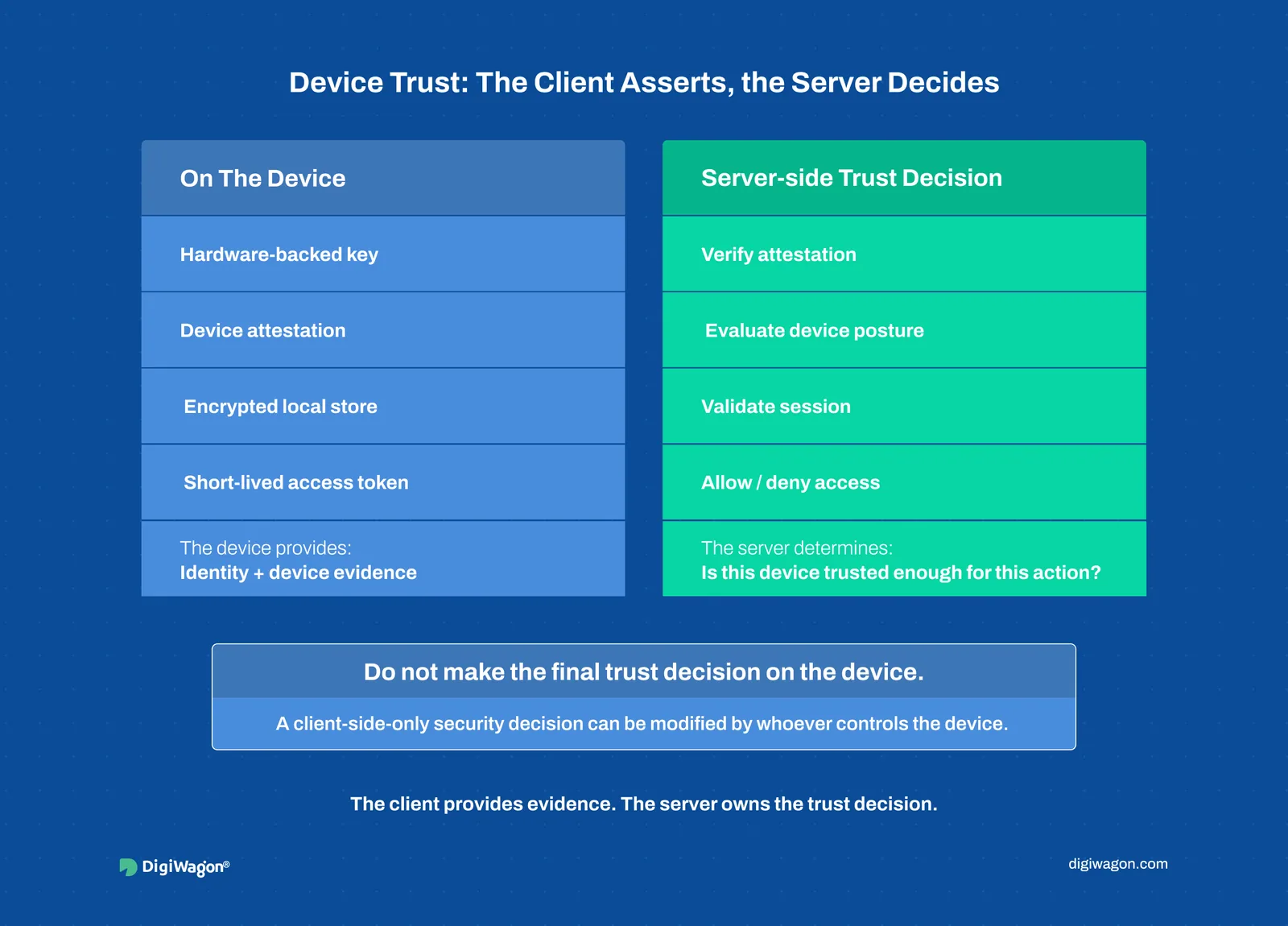
- Credential storage. Hardware-backed keystore or Secure Enclave, never application-managed storage. The key never leaves the secure element.
- Session lifetime. A mobile session that survives weeks is a stolen-device problem. Short-lived access tokens with a refresh token bound to the hardware key.
- Device posture. When the risk policy treats a rooted or jailbroken device as untrusted, the architectural response is an attestation check at session establishment with a server-side decision, not a client-side branch an attacker can patch out.
- Data at rest. Encrypted local store with keys derived from the keystore, plus a defined wipe path on credential revocation.
The pattern across all four: the client asserts, the server decides. Any trust decision made and enforced entirely on the device is a trust decision made by whoever owns the device.
In regulated contexts this boundary carries more weight. FinTech mobile engineering work typically pins the credential to the hardware key and treats the local store as hostile territory, because a lending or payments client holds a bearer credential that is directly monetisable if extracted.
Release Governance When You Cannot Hotfix
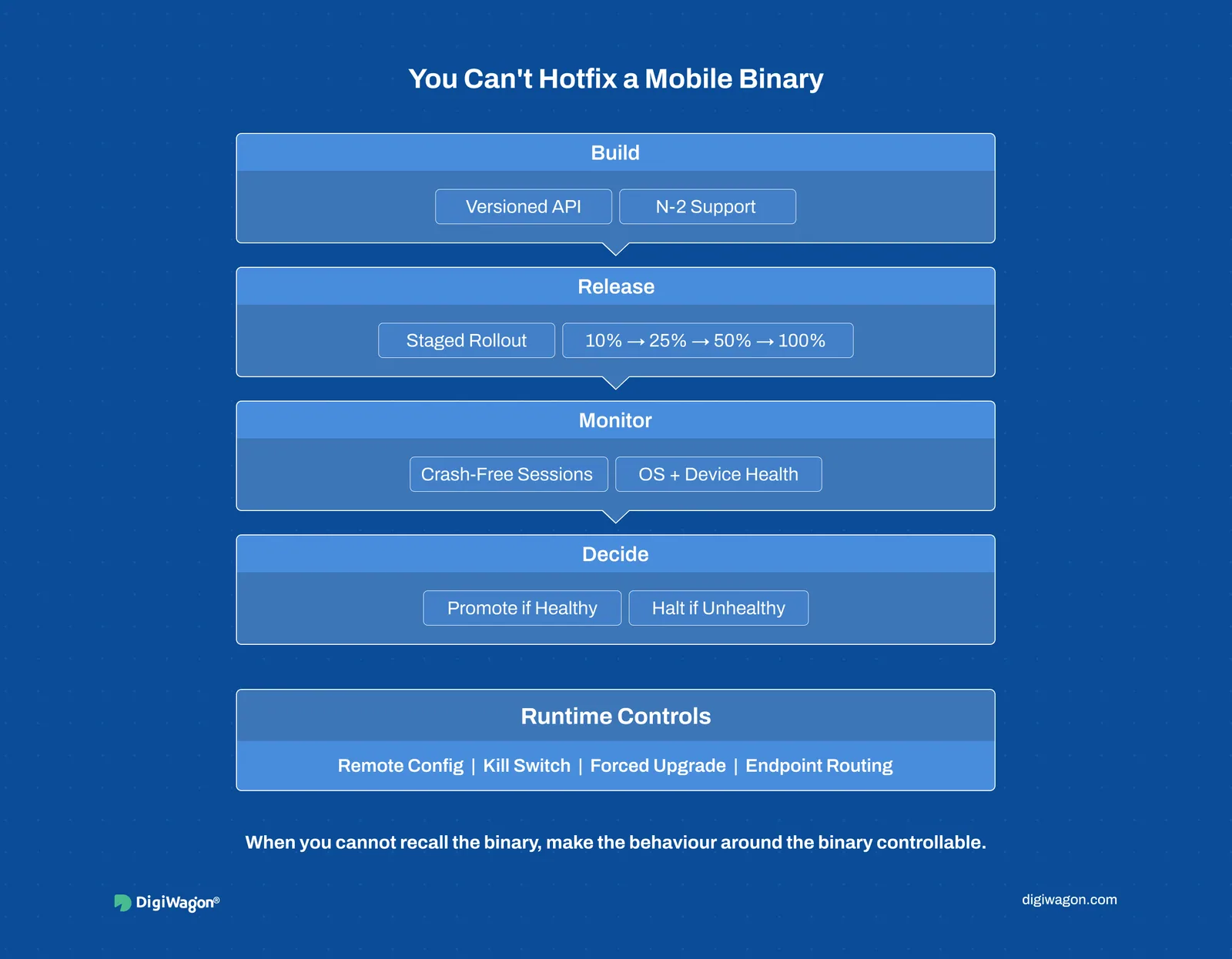
Ship a broken web deploy and you roll back in minutes. Ship a broken binary and you wait for review, then wait for users to update, and some of them never will.
The Google Play requirement above is the recurring version of this problem. Apps targeting API level 34 or lower after 31 August 2026 will only be available on devices running the same or lower OS version, with an extension available to 1 November 2026 (Android Developers, 2026). The platform deprecates on a schedule; your release process either tracks that schedule or accumulates a migration you pay for later.
Four mechanisms that make an unpatchable release survivable
- Server-driven configuration. Anything you might need to change without a release goes in remote config, including feature flags, endpoint routing, and copy.
- A kill switch per feature. Not a global maintenance mode. Per-feature disable, evaluated at runtime.
- A versioned API contract with an N-2 support floor. The server supports the current client and two behind it, and the deprecation window is a written policy rather than an argument during an incident.
- A forced-upgrade gate. A minimum-supported-version check at launch, so a client below the floor cannot reach the API at all.
The staged rollout percentage is the fifth mechanism, and the one most often set and forgotten. A rollout held at a low percentage for a defined bake period, with the crash-free session rate as the promotion gate, converts an unrecallable release into a partially reversible one. Halting a rollout does not fix the users who already have the build, but it caps the population that ever receives it.
Apple's Human Interface Guidelines document platform-specific interaction, navigation, and control conventions that differ from Android's, which means cross-platform parity is a design decision the team makes deliberately, not a build setting a framework provides (Apple, 2026). Where the two platforms diverge on navigation or system integration, the divergence belongs in the design system before it reaches the codebase. That is why mobile design system work sits upstream of the platform build rather than alongside it.
How Do You Get Observability on a Client That Is Offline and Unreachable?
Server observability assumes the emitter can reach the collector. On mobile that assumption is false exactly when you need the data most, because the interesting failures happen where the network is not.
What the telemetry layer has to do
- Buffer locally and forward opportunistically. Events persist to disk and drain on reconnect, with a bounded buffer and a documented drop policy when it fills.
- Report crash-free session rate as the primary health metric. Aggregate crash counts hide a small population failing constantly.
- Symbolicate against archived build artefacts. Unsymbolicated native stack traces are unusable, and the mapping files must be retained per release for as long as that release is supported.
- Slice by OS version and device class, not by app version alone. Version fan-out means the same build behaves differently across the installed base.
- Enforce the PII boundary inside the SDK wrapper. Redaction at the emission point, not at ingest, because anything that leaves the device has already left.
Device-matrix coverage is the other half of this. Emulator suites do not reproduce thermal throttling, background process termination, or vendor OS modifications, which is why physical device-matrix test coverage belongs in the pipeline for the OS version floor the support matrix declares.
Planning an Enterprise Mobile Build with DigiWagon
DigiWagon builds enterprise mobile platforms across Android, iOS, Flutter and React Native, starting from the sync and trust boundaries rather than the screen list.
- Offline-first data layer with an explicit reconciliation contract
- Hardware-backed credential and device attestation architecture
- Release governance: remote config, kill switches, N-2 API support
- On-device telemetry and physical device-matrix coverage
Naming the Boundaries Before They Name Themselves
Every recurring failure in enterprise mobile traces back to one of four boundaries being treated as an edge case: the network that is not there, the device you do not administer, the release you cannot recall, and the client you cannot reach. None of them are solved by framework choice, which is why the platform debate is the wrong first conversation. Name all four in the architecture, write down the merge rule and the support floor, and the annual OS deprecation becomes a scheduled task instead of a migration. Teams that build to this pattern ship a platform that absorbs the next OS release rather than one that has to be rebuilt around it.