Pick the question closest to yours. We’ll show what we would run to answer it and where that sits in the research capabilities below.
Pick the question you need answered
The question
Everyone Is Sure, and They Disagree
Two teams hold confident and opposite views about what users want, the argument is settled by seniority rather than evidence, and the product moves either way.
What we would run
What you could end up with
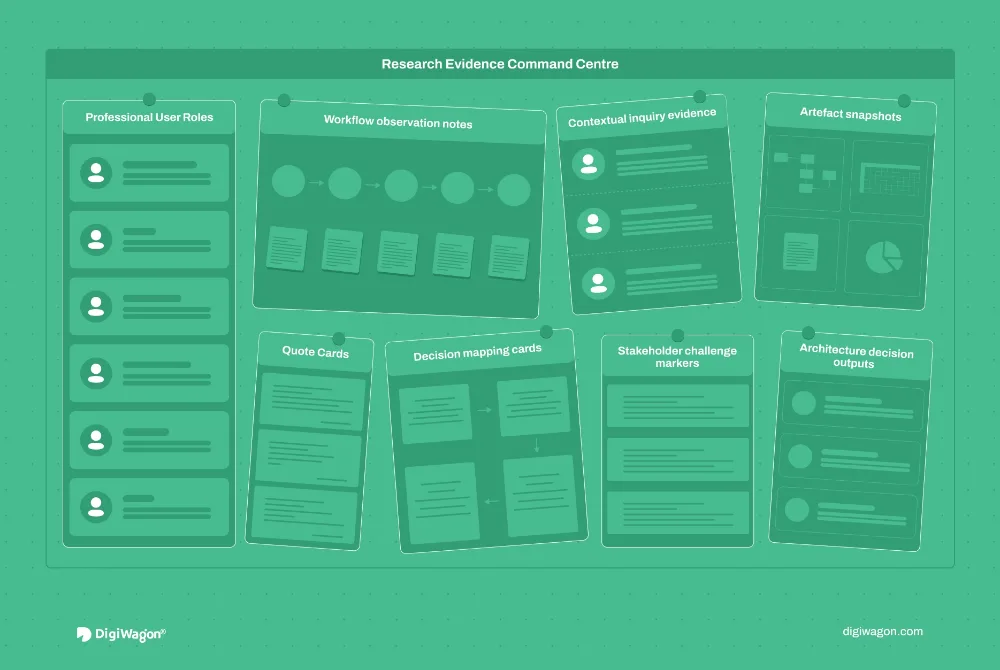
Interviews with the people who use the product and the people who fund it
A stated view of user needs that both sides had a hand in
Personas built from what users said rather than from what the team assumed
What it works with
The assumptions each side is actually arguing from
We combine direct user input, behavioral evidence and expert evaluation to reveal pain points, unmet needs and opportunities that may otherwise be easy to miss.
01
User & Stakeholder Research
Understand user expectations, business priorities, and the context around how the product is used.
User InterviewsStakeholder InterviewsUser Needs IdentificationPersona Development
02
Behavior & Journey Research
Study how people move through the product, where they hesitate, and how the experience connects across different stages.
User Behavior AnalysisCustomer Journey MappingProduct Usage ResearchTask Patterns
03
Usability Testing & Evaluation
Test real journeys and review the interface to identify usability issues, confusing interactions, and accessibility concerns.
Interviews, usability sessions, usage data, and competitor insights can quickly add up. AI helps organize, compare and summarize this information at scale, while researchers determine which signals are meaningful enough to act on.
01
Interview & Feedback Patterns
Analyze interviews and open-ended feedback at scale. AI-supported clustering can group recurring themes, pain points and user language, giving researchers a faster way to spot common concerns.
Interview Themes · Repeated Pain Points · User Language · Sentiment Trends
02
Behavior & Journey Signals
Study drop-offs, task behavior and feature usage. Intelligent analysis can highlight recurring paths, anomalies, and moments that may deserve closer investigation.
Connect findings from different sources through automated summarization and clustering, making it easier to see where signals align, differ, or remain inconclusive.
Assess the frequency, severity and context of findings through AI-supported comparison, then apply researcher judgement to determine which issues deserve attention first.
Issue Severity · User Impact · Opportunity Areas · Priority Decisions
Different sectors raise different questions around users, complexity, risk and task completion. We focus on the interactions that have the greatest impact on usability and confidence.
01 / 09
FinTech
01Onboarding Research
02Lending Journeys
03Payment Usability
04Financial Decision Behavior
05Trust & Confidence
02 / 09
RegTech
01Case Review Behavior
02Compliance Workflows
03Approval Journeys
04Information Density
05Role-Based Research
03 / 09
InsurTech
01Quote Journeys
02Claims Research
03Agent Workflows
04Policy Self-Service
05Form Usability
04 / 09
Healthcare
01Patient Journeys
02Clinical Workflows
03Appointment Research
04Accessibility
05High-Stakes Usability
05 / 09
Manufacturing
01Operator Research
02Shop-Floor Workflows
03Dashboard Usability
04Task Efficiency
05Role-Based Interfaces
06 / 09
Retail & eCommerce
01Product Discovery
02Checkout Behavior
03Purchase Journeys
04Mobile Commerce
05Loyalty Experience
07 / 09
Logistics & Supply Chain
01Shipment Tracking
02Warehouse Workflows
03Driver Research
04Exception Handling
05Operational Usability
08 / 09
SaaS & Technology
01Product Onboarding
02Feature Adoption
03Admin Workflows
04Dashboard Research
05Usage Behavior
09 / 09
Defence
01Mission Workflows
02Operational Interfaces
03Information Load
04Role-Based Access
05Decision-Support Usability
Our work
UX Research in practice.
Engagements where this is what we actually built. 3 of them are written up in full.
We start from the decision that is stuck rather than from a method, choose the smallest study that can settle it, and finish with a prioritized list rather than a report nobody acts on.
01
Frame the Question
Agree what is actually in dispute and what evidence would settle it, so the study is scoped to a decision rather than to a method somebody already had in mind.
Focus
AssumptionsDecisionScopeParticipants
02
Observe the Behavior
Interview the people who use and fund the product, and follow what they do rather than what they report — moderated where depth matters, unmoderated where reach does.
Focus
InterviewsSessionsJourneysAnalytics
03
Evaluate the Interface
Run the tasks that matter against the live product or a prototype, with a heuristic and accessibility review beside them so expert and observed findings check each other.
Focus
TasksHeuristicsAccessibilitySeverity
04
Synthesize and Prioritize
Bring the studies, the behavioral data and the competitor context into one view, then rank findings by severity and impact so the team has an order to work in.
Focus
ThemesGapsImpactPriorities
Frame01 Frame the QuestionObserve02 Observe the BehaviorSynthesize03 Evaluate the InterfacePrioritize04 Synthesize and Prioritize
Insights
Thinking Behind the Evidence.
Field notes on UX research services in practice: method, what usability testing can and cannot settle, and how teams decide which findings are worth acting on.
Experience Design
B2B UX Research: A Field-Tested Methodology
· Pavan Chavda · 9 min read
Experience Design
The Compliance Analyst Workflow Playbook
· Rutvi Kothari · 6 min read
Experience Design
UX Consultant vs. In-House Team: The Decision Framework
Straight answers on what usability testing services cover, moderated versus unmoderated sessions, how many users a study needs, what a UX audit is, and when user research services earn their place in a release.
01What do usability testing services include?
Usability testing services evaluate how real users complete important tasks in a live product or prototype. Sessions may be moderated or unmoderated and can include task scenarios, observation, issue identification and findings synthesis. The outcome is a prioritized view of usability problems, their severity and the areas most worth addressing.
02What is the difference between moderated and unmoderated usability testing?
Moderated testing involves a researcher observing and speaking with participants during the session, making it useful for exploring behavior in depth. Unmoderated testing lets participants complete tasks independently and can reach more users quickly. The right approach depends on the questions being investigated and the stage of the product.
03How many users do you need for usability testing?
There is no single number that works for every study. The right sample depends on the product, user groups, complexity of the journeys, and what the research needs to validate. Smaller focused studies can reveal recurring usability issues, while broader research may require multiple participant groups or testing rounds.
04What is a UX audit?
A UX audit is a structured review of an existing product experience. It can combine heuristic evaluation, journey analysis, accessibility considerations, behavioral evidence, and product context to identify usability issues and experience gaps. Findings are then prioritized so teams can understand what deserves attention rather than receiving a list of disconnected observations.
05When should UX research happen?
UX research can be useful before a new product direction, during design, before a major release or when an existing experience is underperforming. It is particularly valuable when teams have competing assumptions about users, unclear reasons for drop-off or important product decisions that need stronger evidence.
Ready to Validate the Next UX Decision?
Use real user input, usability testing, and behavioral insight to move forward with greater confidence.
One click opens the assistant you already use with a question that points it at this page, so the answer comes from what we publish, not a guess.
The question it opens withRead https://digiwagon.com/ux-research-services and explain how DigiWagon runs a UX Research & Usability Testing Services engagement, what I should expect in the first 90 days, and how to judge whether a partner like this fits a team of our size. Stick to what the page says and mark anything you are not sure about.