To the CTOs, Product Heads, and Founders who build the future:
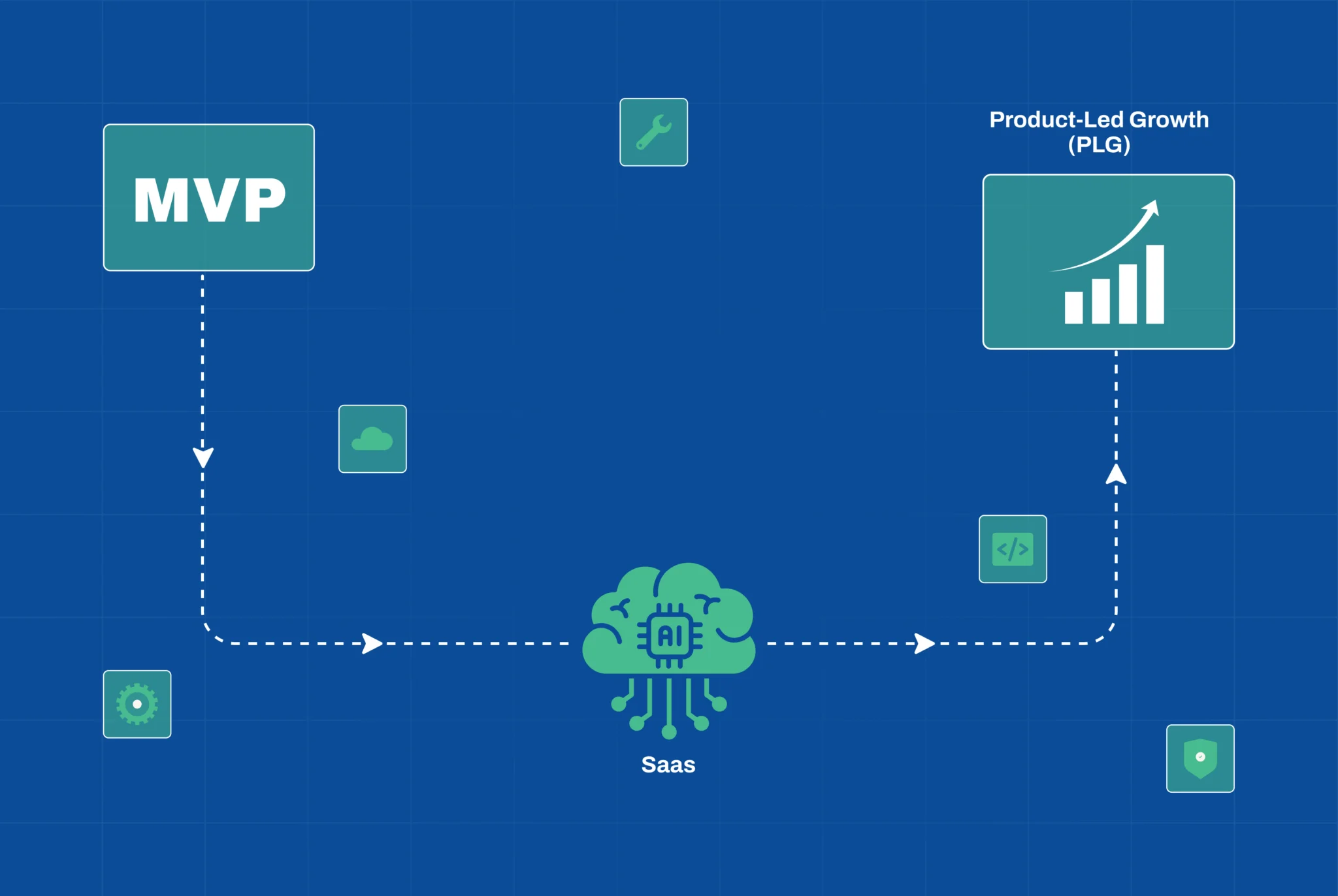
The blueprint for a successful B2B SaaS product has fundamentally changed. Just a few years ago, the path was clear: build a Minimum Viable Product (MVP), prove market fit, and then implement a Product-Led Growth (PLG) model with a simple freemium or free trial.
Today, that path is the baseline, not the differentiator.
In 2025, the competitive edge belongs to the AI-Driven PLG product—a system where Artificial Intelligence isn’t a feature; it’s the operating system that automates the entire customer journey, from initial sign-up to expansion revenue.
If your product strategy still treats AI as a siloed add-on, you’re not just falling behind; you’re building friction into your core growth engine. This is the new architecture you need to adopt to scale efficiently and dominate your vertical.
The New B2B Reality: Why Traditional PLG Isn’t Enough Anymore
The market is saturated. The era of a good product simply selling itself is over. Enterprise leaders in the USA, UK, and Europe are drowning in software choices, and their time is the most valuable commodity.
The Freemium Fatigue and the Crowded Shelf
Users are weary of signing up for “free” tools only to be left to fend for themselves. This is Freemium Fatigue. In a crowded category, users churn not because the product is bad, but because they never reached their first “Aha!” moment. They fail to self-activate. Your PLG motion, therefore, needs to be hyper-intelligent to cut through this noise.
The Critical Metric: Time-to-Value (TTV)
The key to survival in the B2B SaaS world is relentlessly shrinking your Time-to-Value (TTV).
For a new enterprise user, TTV is the time between sign-up and achieving a meaningful, business-critical outcome (e.g., generating their first qualified lead, setting up their first compliant workflow). Traditional, static onboarding takes days. An AI-Driven PLG product aims to reduce this to minutes. This demands an architectural shift that embeds intelligence into the initial user flow.
Phase 1: Building the ‘Intelligent’ MVP (AI as the Core Value)
The old MVP was defined by the minimum feature set. The new one is defined by the minimum AI value proposition.
Start with a Single AI Use Case, Not a Platform
Instead of bolting on a dozen AI features post-launch, start with one high-impact AI capability that delivers your core value proposition.
- Example (FinTech): Your MVP isn’t a full compliance suite, but a tool that uses Generative AI to instantly draft a compliant policy summary based on a user’s uploaded jurisdiction, reducing a 4-hour legal task to 4 seconds.
- Architectural Implication: Your MVP’s core architecture must be optimised for Generative AI & LLM Solutions from day one. This affects your data model, latency, and cost-to-serve.
Data Strategy is the Foundation, Not an Afterthought
AI without data is just expensive logic. Data is the oil for your PLG flywheel. When developing your MVP, focus on three data priorities:
- In-Product Usage Data: Track every click, hover, and drop-off to train the AI on what “success” looks like for your ideal user.
- Vector Databases for LLMs: If you use LLMs, you must implement a Retrieval-Augmented Generation (RAG)architecture to feed the model your proprietary, up-to-date business data (e.g., documentation, customer tickets). This ensures accuracy and dramatically reduces “hallucinations.”
- Data Observability: Deploy systems to monitor not just application health, but model performance (latency, accuracy, drift). Garbage in/out can lead to mass customer churn.
Phase 2: Architecting for PLG Scale with AI (The Technical Shift)
Scaling an AI-first product requires a non-negotiable shift in your technical foundation. Legacy monolithic architectures simply cannot handle the required data throughput or the velocity of model updates.
The Role of Microservices in AI Scalability
To support rapid iteration and the high computational demands of AI, your SaaS Architecture must transition to microservices.
- Isolation: The AI/ML Inference Service (the part of your product that runs the models) should be an independent microservice. This allows you to scale the compute-intensive AI components (e.g., GPU clusters) separately from the rest of your application’s user-facing logic, saving significant costs and ensuring optimal performance.
- Velocity: Your developers can update the core business logic while your Data Science team can fine-tune and deploy a new predictive model, all without impacting the core application uptime-a critical capability for continuous PLG optimisation.
Multi-Tenancy Design in the Age of Custom Models
For B2B enterprises, true scale means supporting multiple tenants securely. The challenge with AI is how to deliver personalisation without violating multi-tenancy principles (i.e., keeping customer data separate).
- Solution: Employ a pooled compute, partitioned data model. Your core product platform and AI infrastructure are shared (pooled compute), but the data used for inference and fine-tuning remains logically and securely separated by a TenantID. This allows you to serve millions of users with one architecture while offering the hyper-relevant experience of a customised solution.
From MVP to AI-Driven PLG – The 2025 SaaS Evolution Blueprint
AI isn’t a feature – it’s your growth engine.
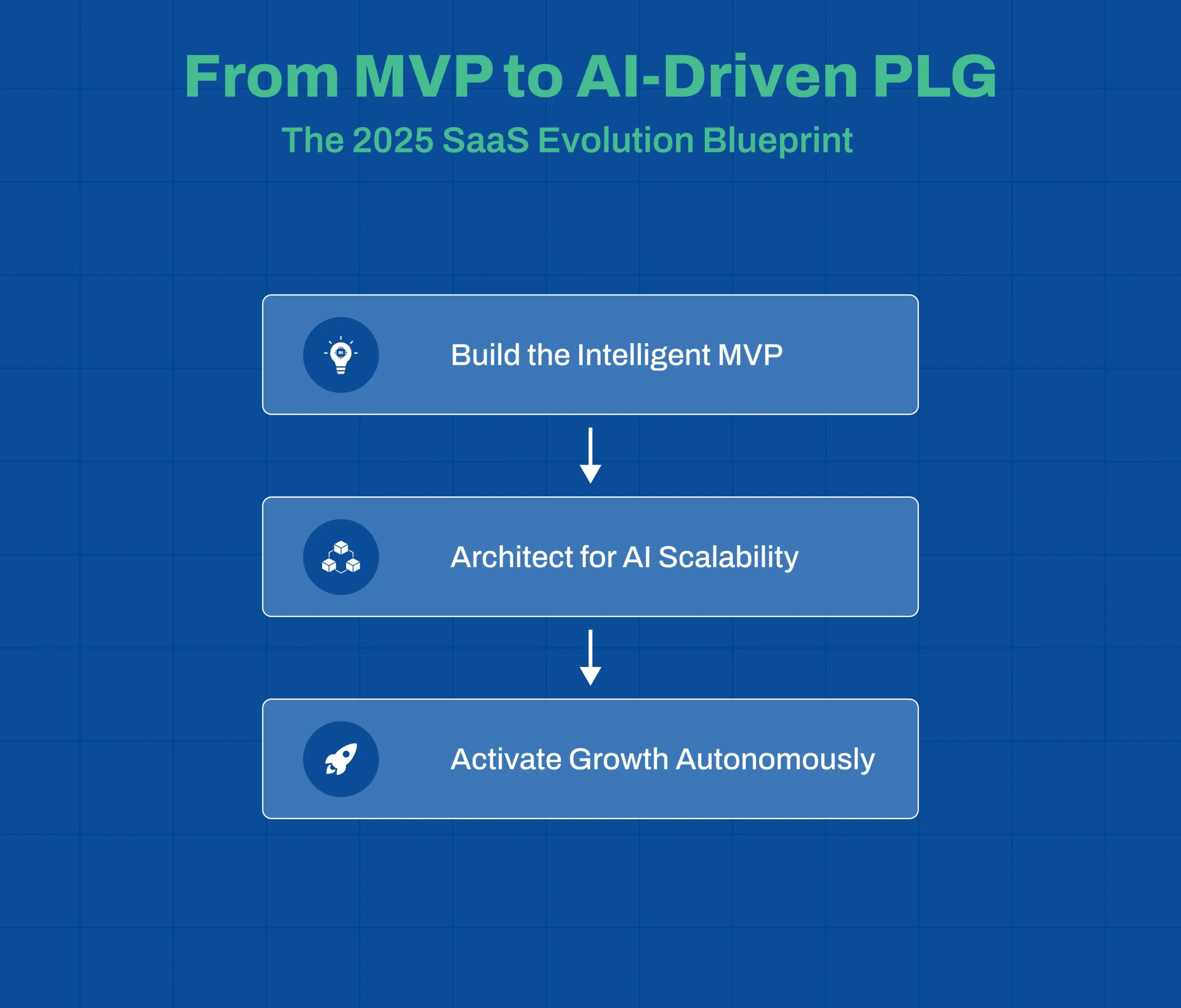
1. Build the Intelligent MVP
The new MVP isn’t defined by minimal features but by maximum intelligence. Start with a single, high-impact AI use case that delivers real business value. Prioritize a strong data foundation-usage analytics, RAG-based vector databases, and data observability-to power learning loops.
2. Architect for AI Scalability
Legacy monoliths can’t keep up with continuous model updates or data flow.
Adopt a microservices-first architecture where AI inference runs independently for scalable cost efficiency.
Design for multi-tenancy with secure data partitioning to deliver personlisation without compromising compliance.
3. Activate Growth Autonomously
Turn your SaaS into a self-activating, retention-driven platform. Integrate Generative AI Co-pilots for hyper-personalised onboarding and predictive analytics to detect churn before it starts. The result: Faster Time-to-Value (TTV), higher retention, and continuous revenue loops.
Phase 3: Activating Users with Embedded Intelligence (The PLG Flywheel)
This is where the rubber meets the road: using AI to automate the acquisition, activation, and retention loops that define Product-Led Growth.
Generative AI Co-pilots for Hyper-Personalised Onboarding
Forget static tooltips and mandatory 10-step tours. The next-generation onboarding flow uses Generative AI to act as a Co-pilot, guiding the user based on their specific, stated goal.
- Scenario: A new user in an InsurTech platform signs up. The Co-pilot asks, “What’s your goal today: Process a claim, or onboard a new client?” Based on the answer, it instantly generates a pre-configured dashboard, imports a relevant template, and offers contextual in-app guidance tailored specifically to that task, dramatically accelerating their Time-to-Value (TTV). This is a game-changer for UI/UX Design & Engineering.
Predictive Analytics to Eliminate Churn Before It Starts
Retention is the heart of B2B SaaS Product growth. The best way to reduce churn is to detect the risk before the user even considers leaving.
- Predictive Churn Models: Implement predictive analytics that score every user in real-time. The model combines dozens of signals: low feature usage, high support ticket volume, recent attempts to export data, or even a decrease in the number of teammates invited.
- Automated Intervention: When an account’s risk score crosses a threshold, the system triggers a proactive, automated intervention: a personalized email from the Customer Success Manager, a targeted in-app offer for a free SaaS Consulting session, or an LLM-generated summary of the product’s recent feature releases they haven’t tried yet.
Conclusion: The Strategic Partner for Your AI-Driven Future
The move from an MVP to a mature, AI-Driven PLG powerhouse is not a feature roadmap; it’s a deep architectural and strategic transformation. It requires simultaneous expertise in multi-tenant architecture, complex AI/ML deployment, and hyper-efficient go-to-market strategy.
The time to build the foundation for 2025 is now. Don’t let your existing architecture become the bottleneck to your growth.
Ready to architect a next-gen SaaS product development roadmap that treats AI as your primary growth engine? Let’s connect and build a strategy that delivers immediate TTV and sustainable enterprise scale.