Regulated FinTech Builds: What Decides the Architecture
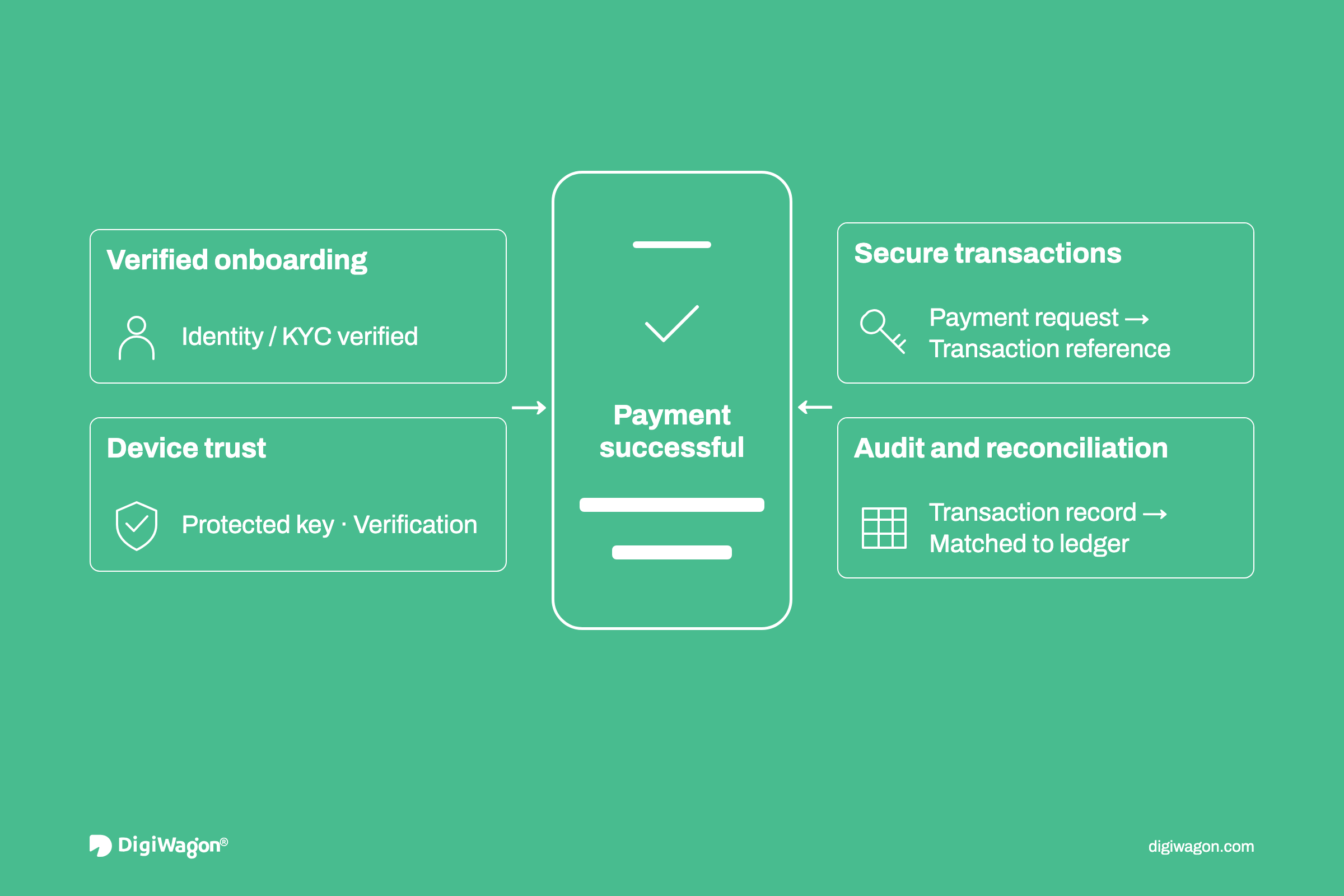
- FinTech app development turns on two problems consumer apps never meet: regulated onboarding and exactly-once money movement.
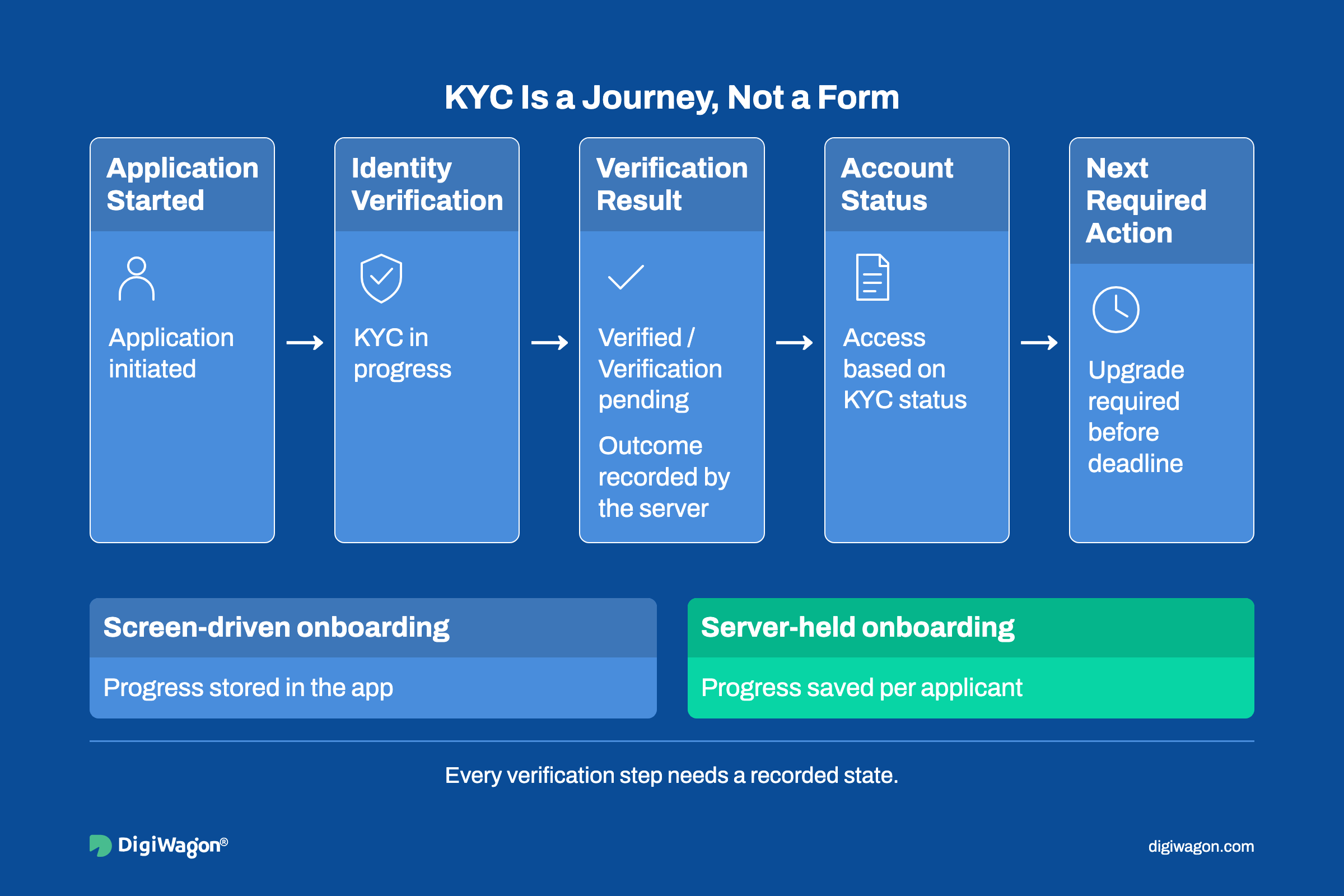
- Onboarding belongs in a server-held state machine, because a KYC outcome carries limits and an upgrade deadline.
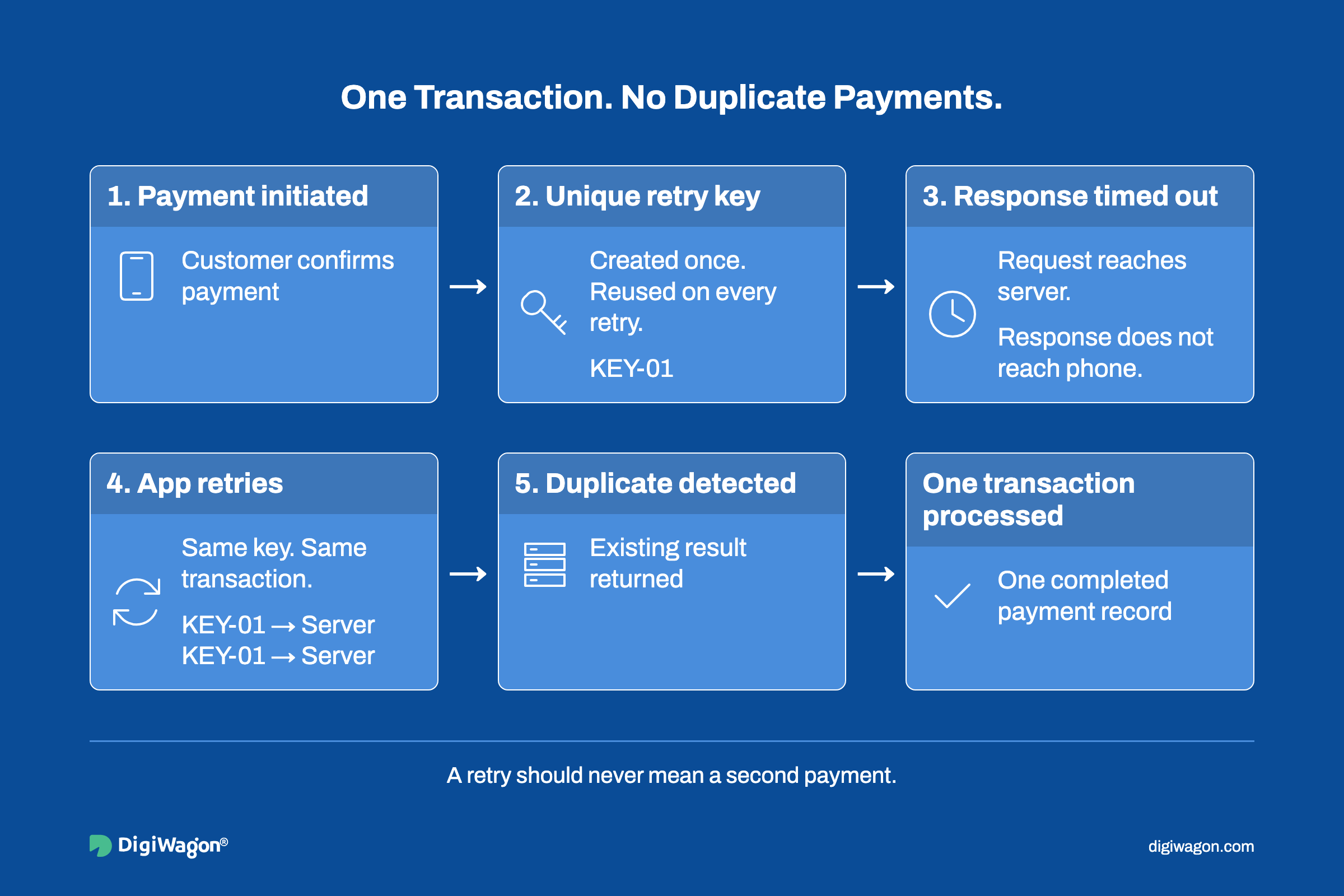
- Each transaction request carries a key the app creates, so a retry cannot move money twice.
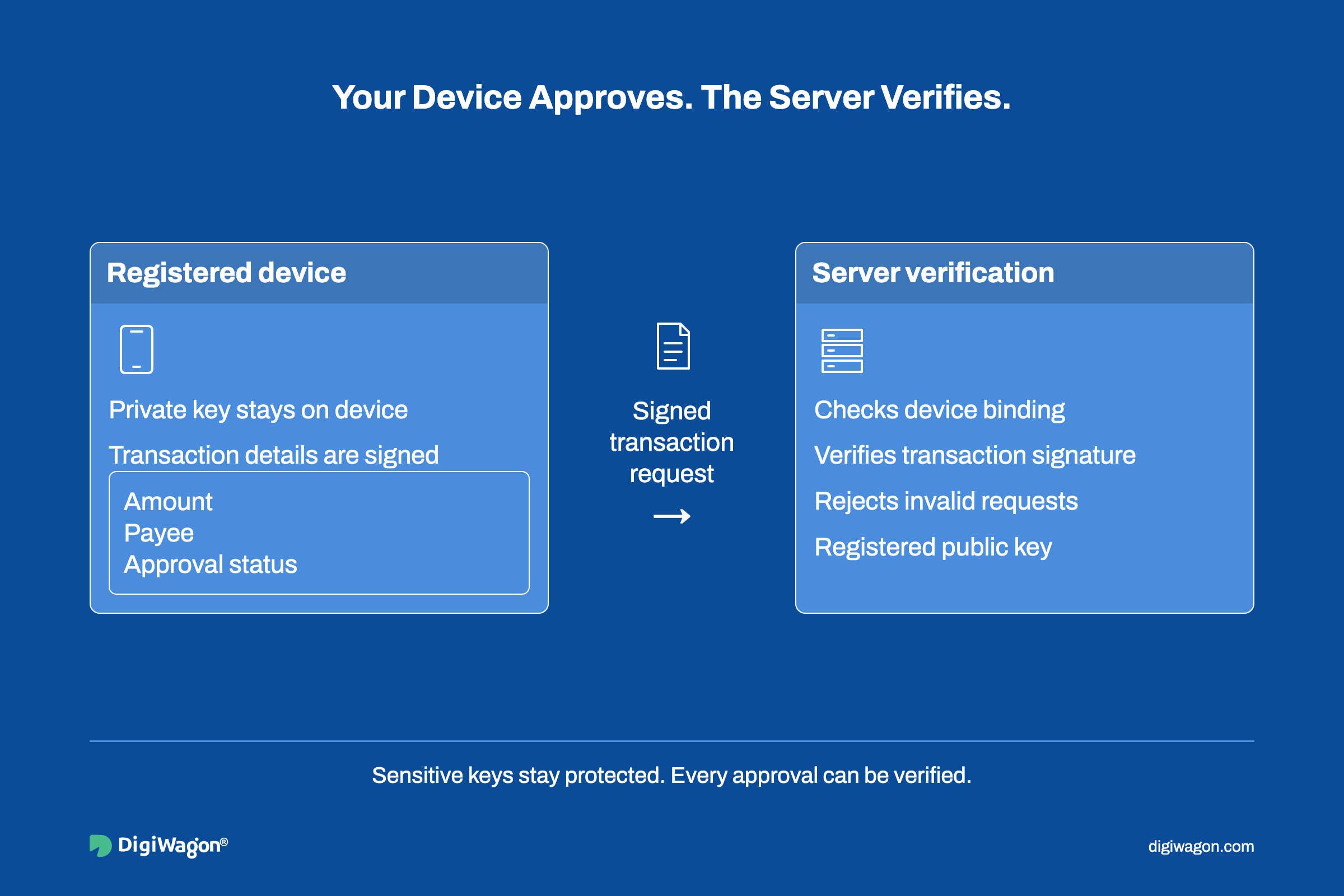
- Signing keys stay in the phone's hardware keystore, and the server checks each signed request against a bound device.
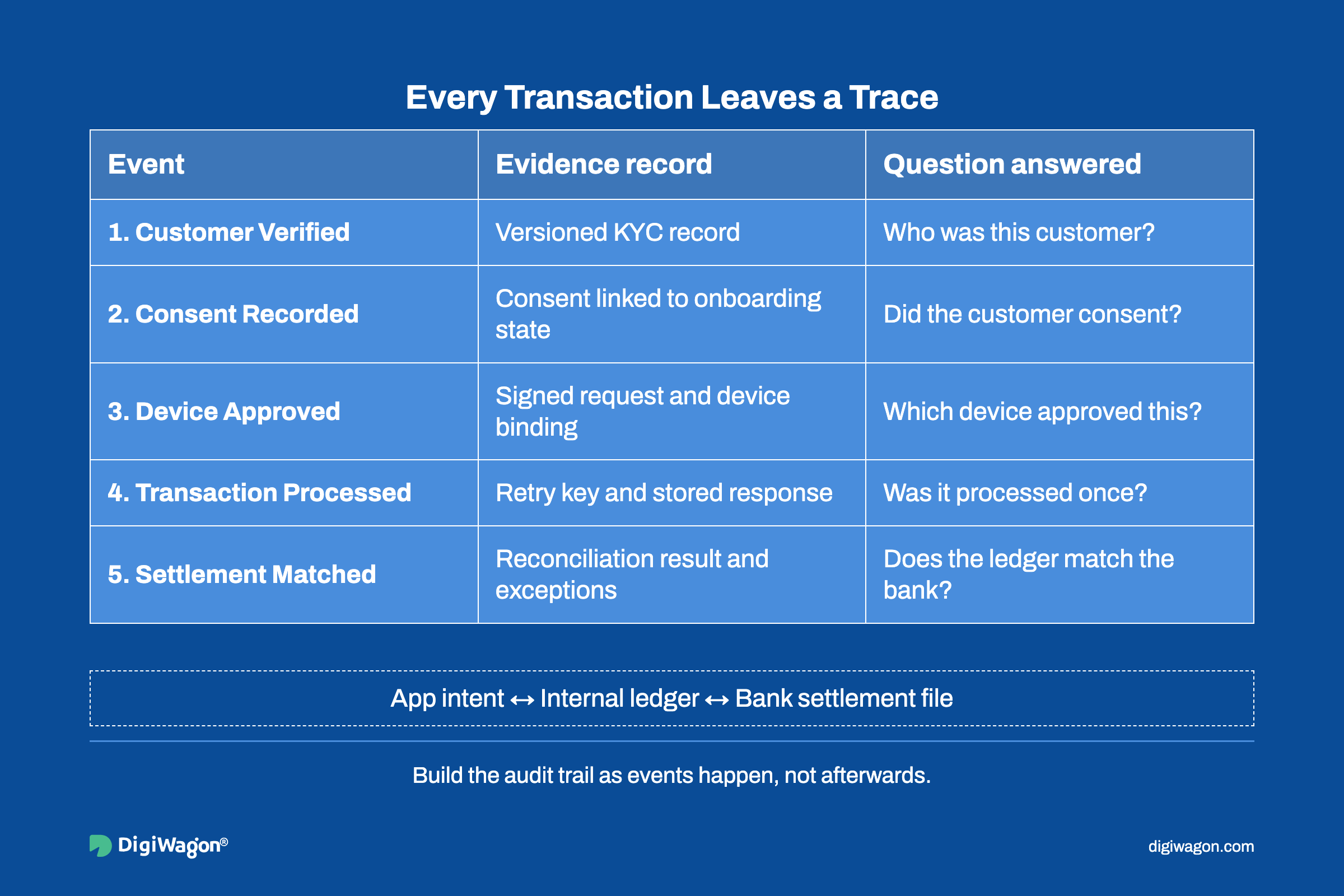
- The system writes audit and settlement-match records from the first release, not after an examiner asks.
What Makes FinTech App Development Its Own Discipline?
FinTech app development is the engineering of mobile clients and their backing services for regulated lending and payments. It departs from consumer app work in two places: onboarding runs as a server-held state machine, and every transaction path is idempotent end to end. The output is a system where each balance traces to exactly one recorded request.
Why the Bar Moved in 2026
The RBI reorganised India's rules for financial apps twice in eight months. On 28 November 2025 it reissued its circulars as directions for each type of lender, and the digital lending app rules moved with them. On 31 July 2026 it did the same for digital payment security controls (RBI, 2025 and 2026).
Both sets reach into the app layer. They govern which phone permissions digital banking and lending apps may request, and how mobile banking apps bind to a device.
Fraud pressure has not eased either. UK Finance's Annual Fraud Report 2026 recorded £1.28 billion stolen through payment fraud in 2025, up 4 per cent (UK Finance, 2026). Each confirmed case becomes a question: what did the app send, and which device approved it?
These rules sit on top of the four boundaries every enterprise mobile build has to draw: offline sync, device trust, release governance and on-device monitoring. The sections below follow one regulated build through them.
Why Is KYC Onboarding a State Machine, Not a Form?
Most teams building a fintech app design onboarding as a run of screens. That is the first architectural mistake, because the screens end up holding state the server never sees.
A KYC outcome is a position, not a pass or fail. Under the RBI's KYC Directions for NBFCs, an account opened through OTP-based e-KYC cannot run beyond one year without full or video-based identification (V-CIP). After that, a loan account accepts no further debits (RBI, 2025, para 25).
That is a state with a deadline, a required transition and a penalty. It belongs in an onboarding service with its own schema.
What Breaks When Onboarding Is Modelled as Screens
- The phone kills the app during an eKYC callback, so the server never records the verified identity.
- A back-button press replays an OTP step and burns a paid provider call.
- A borrower switches phones mid-journey and creates a duplicate applicant.
- A fraud rule cannot block progress, because progress lives in the client.
Permissions Follow States, Not Screens
When the lender is an NBFC, the RBI's Credit Facilities Directions, 2025 apply. The app may then take one-time access to the camera, microphone or location for onboarding or KYC only, with the borrower's explicit consent (RBI, 2025, para 13(1)). The architectural response binds each permission request to a named state and writes the consent record into that transition.
| Concern | Screen-driven onboarding | Server-held state machine |
|---|---|---|
| Where progress lives | App memory and local storage | Onboarding service, saved per applicant |
| Provider timeout | User repeats the whole step | Step retries from the last confirmed state |
| Device switch | Journey restarts | Journey resumes after re-binding |
| Fraud gate | Advisory, client-side | Blocking guard on the transition |
How Do You Make a Mobile Transaction Exactly-Once?
In fintech mobile app development, the retry that causes double disbursals or duplicate money transfers is usually automatic. The HTTP client resends after a timeout, even though the first request reached the server. Only the response was lost.
The Retry That Double-Lends
The fix is an idempotency key: a unique retry key the app creates once per transaction, before the first send. The app stores the key and reuses it on every retry. The server saves it with a fingerprint of the request body and returns the stored response for any duplicate.
The IETF's Idempotency-Key draft (version 08, October 2026, still a work in progress) covers the edge cases, and mobile networks produce both. A retry that arrives while the original is still processing gets HTTP 409. A reused key with a different payload gets HTTP 422 (IETF, 2026).
Exactly-Once Is a Property of Every Leg
- App to API: the retry key plus a request fingerprint.
- API to ledger: the ledger entry and the outbound disbursal message commit in one database transaction, using the transactional outbox pattern.
- Ledger to payment gateways or bank rails: the outbound call carries its own retry reference, because gateways and rails retry too.
- Unknown outcomes: a sweeper job resolves every transaction whose final status never arrived.
The fourth leg has regulatory backing. Under the RBI's digital payment security controls, the bank must resolve or reverse any transaction hit by an interrupted session (RBI, 2026, para 49). A transaction stuck in an unknown state is a design defect, and the system must close it without a human.
Teams scoping a lending or payments app can see how FinTech mobile app engineering covers the build, from onboarding to settlement matching.
Where Do Signing Keys Live on an Unmanaged Phone?
The rule for the device-trust boundary applies with extra force here: the client asserts, the server decides. FinTech adds one more requirement: proof that this device approved this exact transaction.
The RBI's security controls require device binding, built from a mix of hardware, software and service information (RBI, 2026, para 68(6)). At enrolment, the app generates a key pair that cannot leave Android Keystore (StrongBox where supported) or the iOS Secure Enclave. The server stores the public key against the customer and the install.
The app then signs each transaction on the device, and the same pattern covers loan disbursals and digital wallets. This maps onto the EU strong customer authentication standard, which the UK kept in its own version. There, the authentication code must match the amount and payee, and any change to either voids it (Delegated Regulation (EU) 2018/389, Article 5).
Three rules keep data security on the device manageable:
- No secrets in plain storage. OWASP's Mobile Application Security project lists keys stored outside the platform keystore as weakness MASWE-0003, under the MASVS cryptography controls.
- Card numbers go straight to the processor's tokenisation SDK. The API, ledger and logs see only tokens, which narrows cardholder-data scope under PCI DSS v4.0.1 (PCI SSC, 2024).
- A server-side version floor. The backend checks the app version before it enables transactions, and retires older versions within six months of a newer release (RBI, 2026, paras 68(1) and 68(2)).
A healthcare build meets the same hardware with a different payload, so the patterns for clinical data on patient phones differ from these.
What Evidence Must a FinTech App Produce by Design?
Regulators and the financial institutions they supervise rarely ask whether a system was secure. They ask what happened to one transaction for one customer. The system answers from stored records, or it cannot answer at all.
The RBI's controls set the pace. Banks must reconcile digital payment transactions in near-real time, and within 24 hours of the settlement file arriving at the latest (RBI, 2026, para 57).
In practice, that is a three-way match between the app's intent log, the internal ledger and the external settlement file. A scheduled pipeline runs it and routes mismatches to an exceptions queue.
| Question an examiner asks | Record the system already holds | Produced by |
|---|---|---|
| Who was this customer at onboarding? | Versioned KYC transitions with provider responses | Onboarding state machine |
| Did they consent to this data use? | Consent record linked to the transition | Permission-to-state binding |
| Did this device approve this amount? | Signed payload plus bound public key | Transaction signing layer |
| Was the request processed once? | Retry key, fingerprint and stored response | API retry-key store |
| Does the ledger match the bank? | Reconciliation run with its exceptions | Reconciliation pipeline |
The system writes every row at the moment of the event. Nobody can rebuild these records later, because the provider response, app version and device binding from that moment are gone. Screening decisions sit downstream in a separate AML screening engine, outside this build.
Lessons from Shipping Regulated Lending Apps
SmartLend, a white-label personal loan engine we built for a Mumbai FinTech platform, is where we tested most of these patterns. Its tech stack: a Flutter borrower app, a Java and Spring Boot core, and MySQL on AWS EC2.
Four forces shaped the KYC step:
- eKYC and CIBIL calls that time out
- borrowers on weak networks who drop mid-journey
- fraud signals, such as rapid retries and IP mismatches, that must block progress before the bureau pull
- per-brand rules across tenants
Three calls followed:
- Journey state in Spring Boot and MySQL over state held in the app, because provider retries had to resume from the last confirmed step without re-running KYC.
- MySQL over a document store, because audit-trail and approval-stage queries are relational.
- Flutter over React Native for the borrower app, because low-network document upload had to behave the same on low-end Android.
The white-label loan engine case study records loan decision time as "reduced from 20 minutes to under 7 minutes". A separate small finance bank build used React Native for a geo-tagged field-verification app.
Scoping a Regulated Lending or Payments App
DigiWagon's fintech app development services sit inside its software engineering practice. Work starts from the state model and evidence map.
- KYC state machines with provider retry and fraud gates
- Retry-safe transaction APIs with transactional outbox design
- Device binding and hardware-backed transaction signing
- Reconciliation pipelines and audit evidence stores
Provability Ships with Release One
Regulated fintech app development comes down to two decisions consumer apps skip. Onboarding runs as a server-held state machine, and the transaction path stays exactly-once across every leg. Device-bound signing and settlement matching follow from those two, and each one produces evidence at the moment of the event, so none of it can be retrofitted. Apps built on this pattern answer a regulator's reconstruction request with a query rather than a project.