Healthcare Mobile App Compliance: What Holds Up in Review
- Most healthcare mobile builds fail their first review on data classification, not on encryption strength.
- Consent modelled as a versioned record survives a withdrawal request; a boolean flag does not.
- Audit controls are a required specification under the HIPAA Security Rule, and retrofitting one is a rewrite.
- Clinical data on device sits on hardware nobody in the system administers, so the keystore is the boundary.
- One unflagged feature can move an app out of general wellness and into regulated device territory.
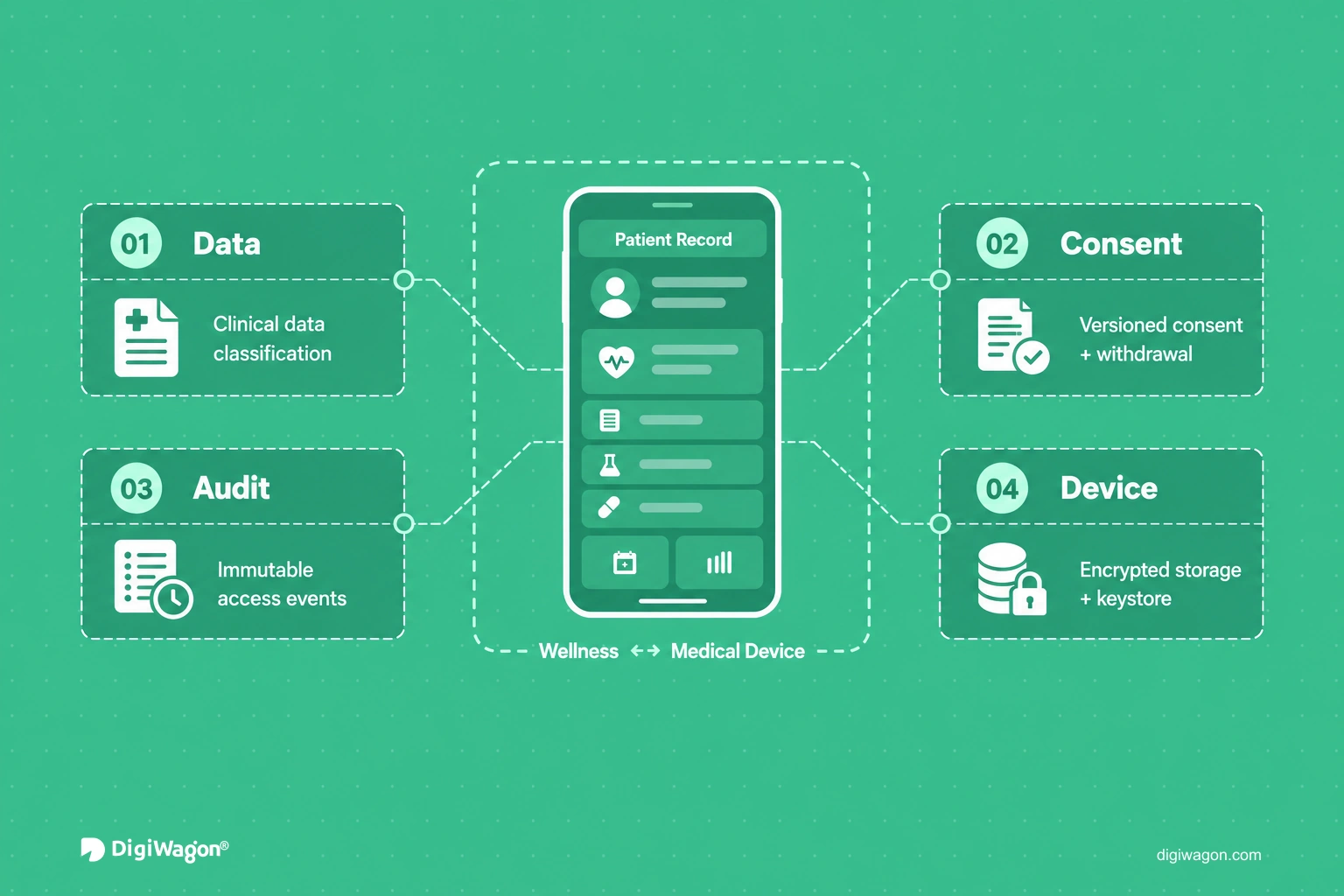
Healthcare mobile app development is the engineering of patient-facing and clinician-facing clients that hold regulated clinical data. It classifies data at the schema level, captures consent as versioned records, and writes immutable access events. The result is a client where every read of a clinical field can be reconstructed from the log months later.
Why the Ground Moved Under Healthcare Mobile Builds
Breach volume is not the interesting part of this problem. Where the data sits when it leaks is. In 2025, 710 breaches of 500 or more records reached the HHS Office for Civil Rights portal, exposing at least 61.5 million individuals (The HIPAA Journal analysis of HHS OCR breach data, February 2026).
Two regulatory surfaces also shifted underneath apps that were already shipping. The FDA reissued its General Wellness guidance as a final document in January 2026, changing what a notification inside a consumer health app may say. India notified the Digital Personal Data Protection Rules in November 2025, with full compliance due 13 May 2027.
A client architected in 2024 against the previous reading of either line can be on the wrong side of it now without a code change. The pillar for this cluster covers the four boundaries of enterprise mobile architecture; healthcare is the constraint set that loads all four at once.
What Counts as Clinical Data in a Healthcare Mobile App?
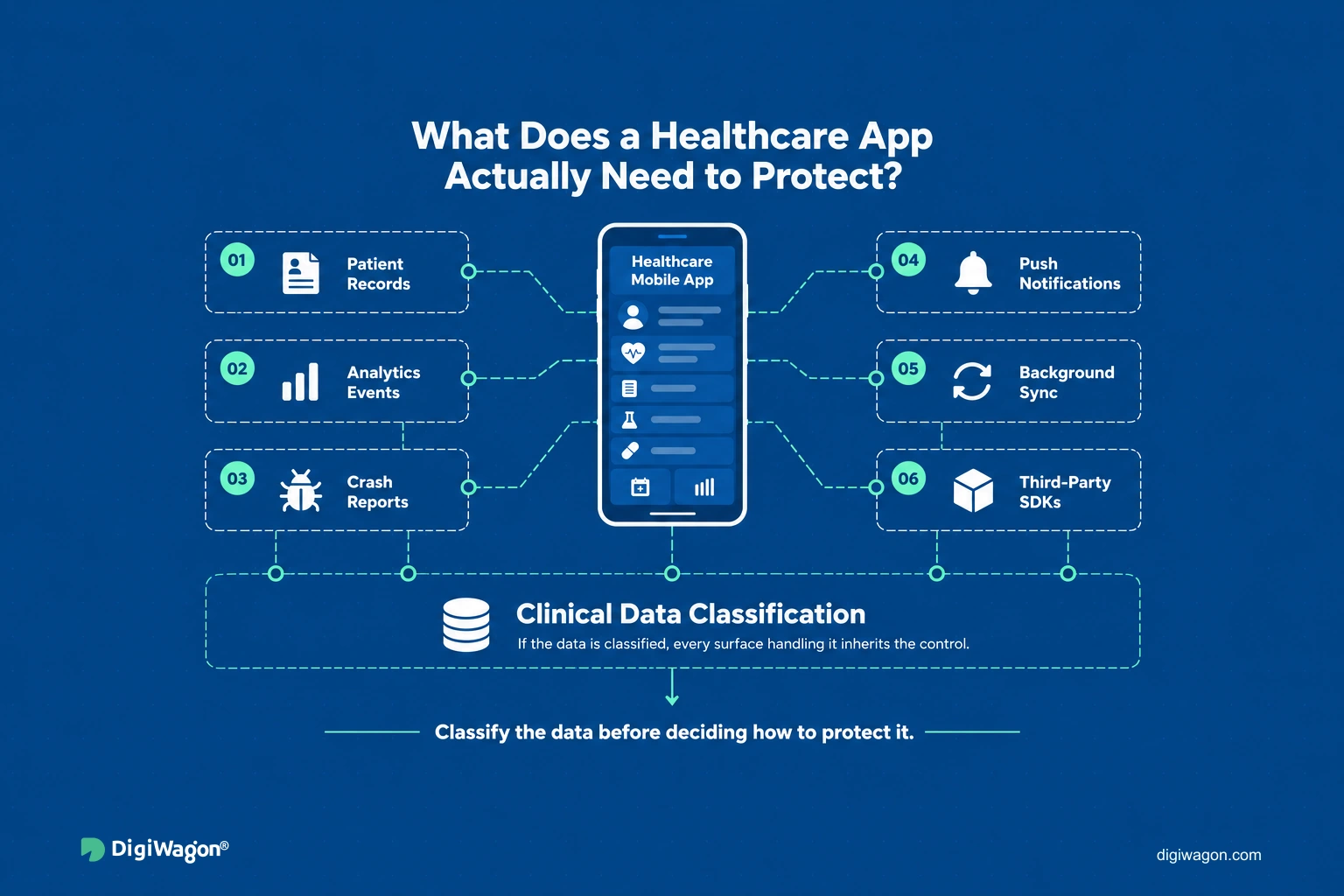
Teams protect the data they noticed. The failure mode is the data the client generates on its own.
The HIPAA Security Rule applies to electronic protected health information wherever it is created, received, maintained or transmitted (HHS, 45 CFR Part 164 Subpart C), which includes surfaces nobody wrote a ticket for:
- Crash reports carrying request payload fragments
- Analytics events keyed to a stable patient identifier
- Screenshots the operating system captures for the task switcher
- Push notification bodies rendered on a locked screen
- Background sync queues holding records after a session ends
- Third-party SDKs with their own network egress
When the clinical team classifies a field as protected, the architectural response is a typed schema boundary that carries the classification with the field rather than a naming convention in a document. Classification that lives in the type system fails the build; classification that lives in a wiki fails the audit.
That boundary is what makes healthcare software engineering portable across client, backend and reporting layer without three teams re-deriving one rule.
How Do You Model Consent as a Data Structure, Not a Checkbox?
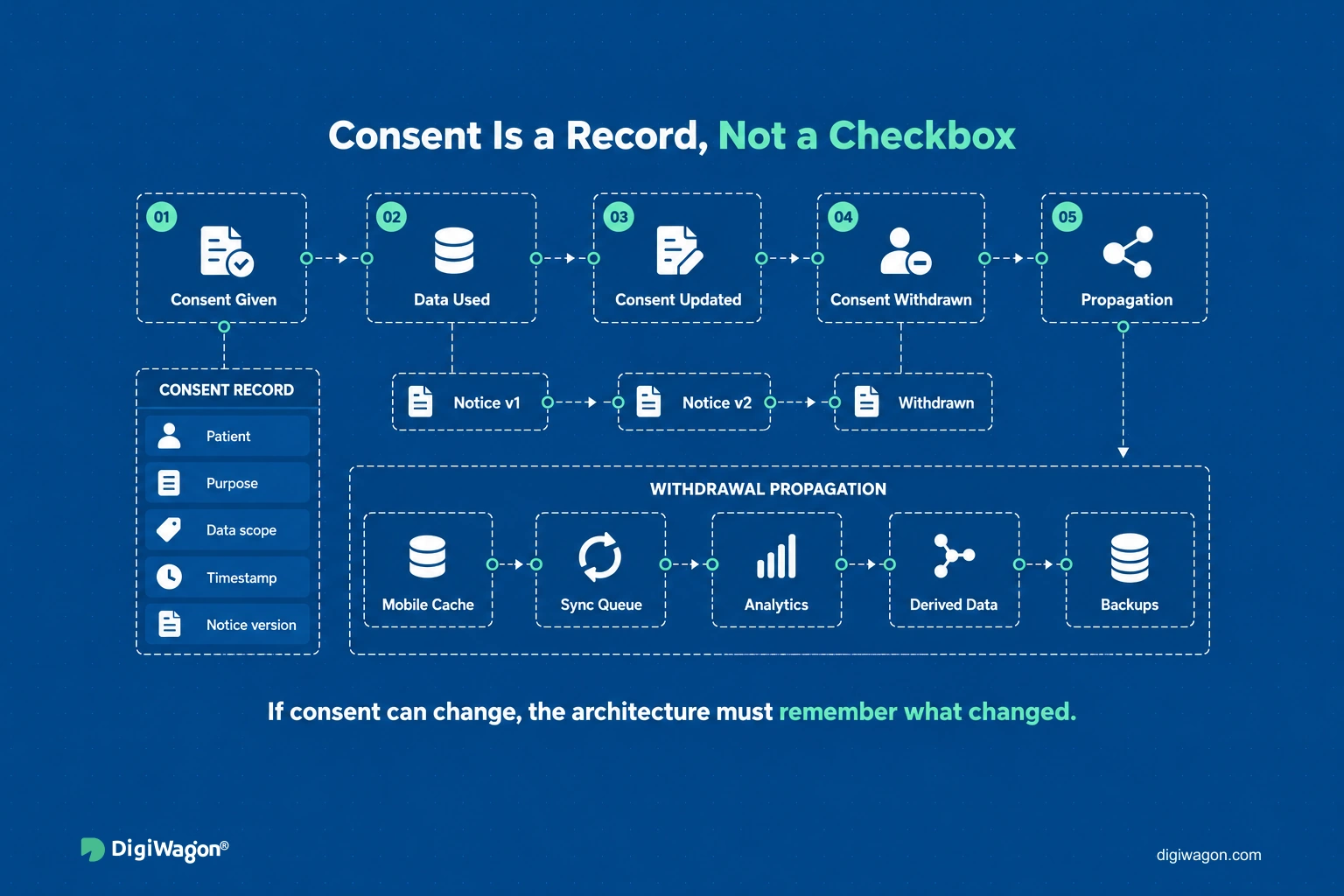
A boolean cannot answer the question a regulator asks, which is what the patient agreed to, when, against which version of the notice, and what happened when they changed their mind.
A consent record that holds up carries subject, purpose, scope of data covered, timestamp, the version identifier of the notice shown, and the withdrawal event if one exists. Purpose-scoped rows, not one row per user.
The India DPDP Rules 2025 require that withdrawal is as easy as giving consent, with an itemised notice kept separate from general terms of service (Ministry of Electronics and Information Technology, 2025). Withdrawal is the harder half of the build, because it is a propagation problem: local cache, sync queue, analytics pipeline, derived features, backups.
When the product requires consent to be revocable, the architectural pattern is a consent version referenced by every downstream write, so revocation becomes a query rather than a manual hunt.
Teams scoping a patient-facing client can see how healthcare mobile app engineering covers consent modelling through store release.
What Does an Inspector Actually Ask the Audit Trail For?
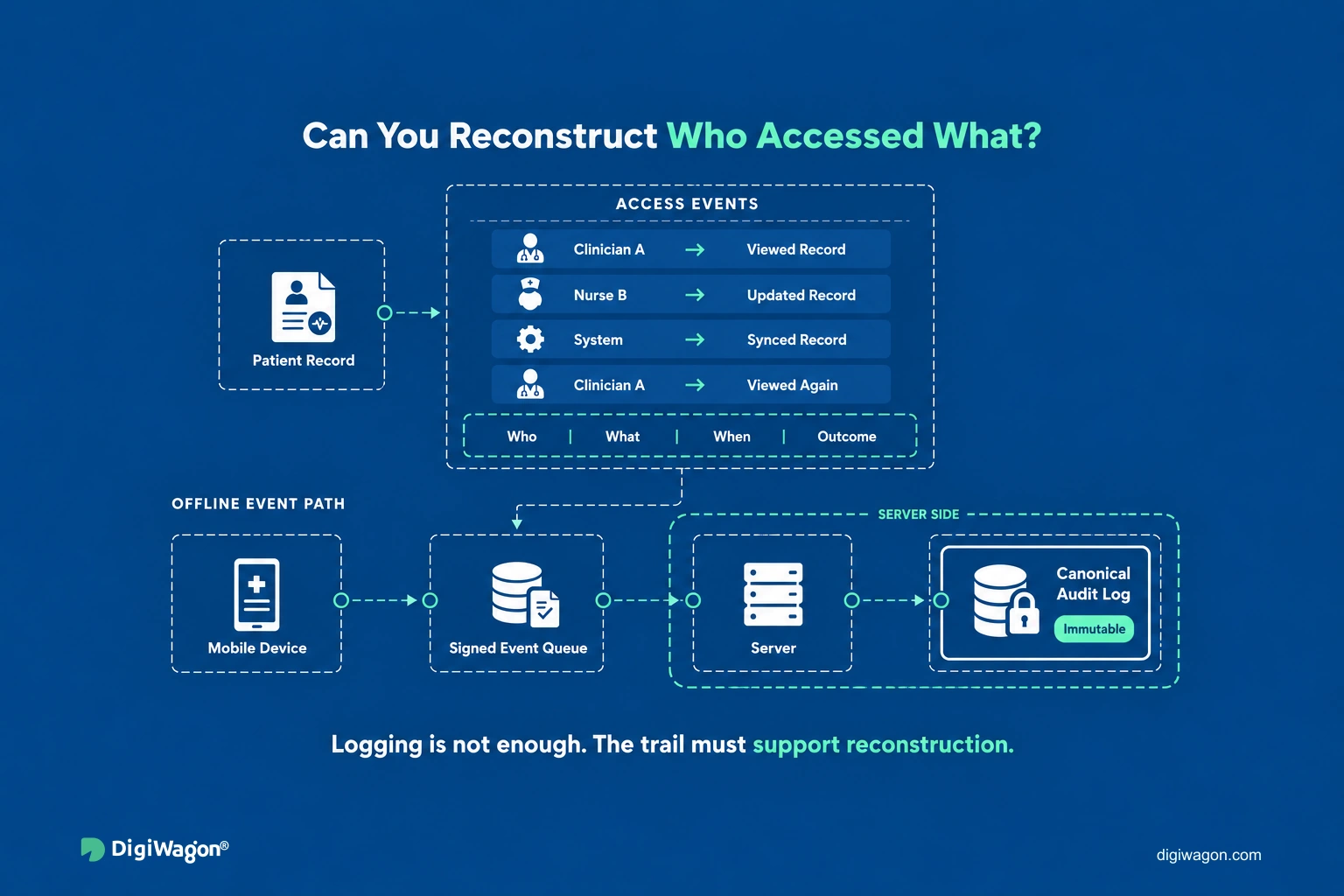
Not whether you log. Whether you can reconstruct who accessed a given record on a given date, and what they saw.
This is the clause engineers most often get backwards. Under the HIPAA Security Rule, audit controls at 45 CFR 164.312(b) are a required implementation specification, while encryption sits as an addressable one (HHS, 2026). Most mobile teams ship strong encryption and a logging story they intend to finish later, which inverts the actual obligation.
The mobile-specific part is offline capture. A client that works without connectivity holds an append-only event queue locally, signed and sequenced, then reconciles it server-side without letting the device clock decide ordering. The canonical log stays on the server; the client is an event source, never the record of truth.
The DPDP Rules 2025 add a retention floor, with logs generally kept for at least a year. The same reconstruction discipline shows up in auditable system design under European compliance rules, where the log schema is fixed before the first feature ships.
Storing Clinical Data on Hardware You Do Not Administer
The device belongs to the patient. It may be rooted, shared, or backed up to a personal cloud account.
OWASP MASVS v2.1.0, released in January 2024, groups these failures under MASVS-STORAGE: unencrypted data in private or external storage, keys held outside the platform keystore, secrets baked into the package, and sensitive values surfacing in logs and backups.
The architectural response set is narrow and well understood:
- Keys in Android Keystore and the iOS Keychain, never in app-managed files
- An encrypted local store holding only what the current session needs
- Backup exclusion set explicitly rather than inherited from platform defaults
- Screenshot and clipboard suppression on clinical screens
- A device-posture check that degrades function instead of failing open
This is the device-trust boundary applied to clinical payloads, and it is the one layer where a platform default is almost always the wrong default.
Where Healthcare Mobile App Development Crosses the Device Line
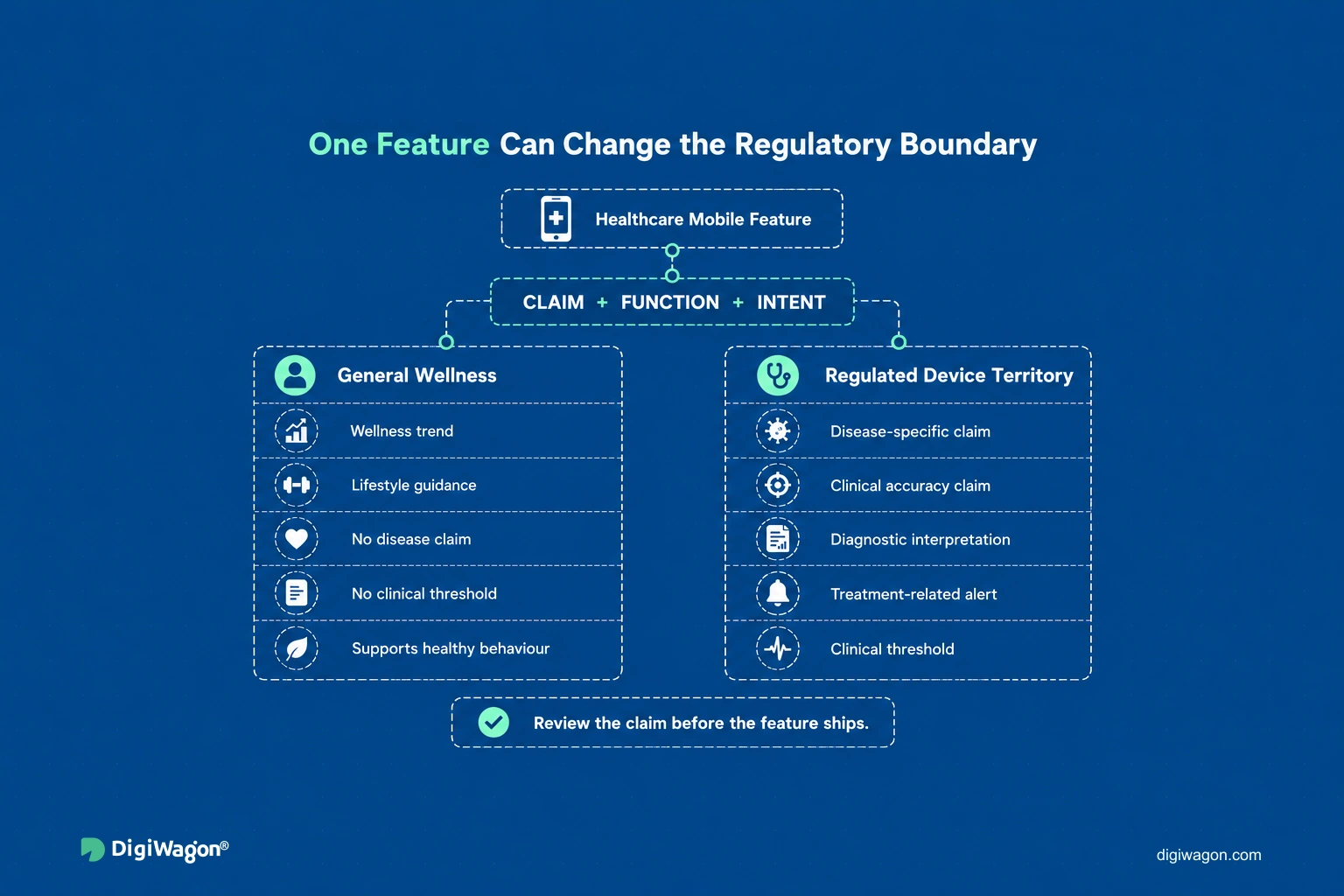
The single decision most teams get wrong is the wellness boundary, because a feature crosses it in copy rather than in code. The FDA's General Wellness guidance, final as of January 2026, holds a product in the general wellness category when it is intended for maintaining a healthy lifestyle and stays unrelated to diagnosing, curing, mitigating, preventing or treating a disease.
| Design decision | Stays general wellness | Crosses into device territory |
|---|---|---|
| Notification copy | Prompts a conversation with a clinician | Calls a reading abnormal |
| Sensor-derived value | Shown as a wellness trend | Presented with a clinical accuracy claim |
| Disease reference | No named condition | Names the condition the app manages |
| Threshold logic | No clinical cut-off in the client | Ships thresholds that drive a clinical alert |
| Positioning | Complements clinician care | Substitutes for an approved product |
Between the two columns sits the FDA's enforcement discretion band for device software functions and mobile medical applications: low-risk functions that help patients self-manage without suggesting treatment.
When the product team wants an alert, the architectural response is a feature flag tied to the claim set, so the boundary is enforced at build time and the copy cannot quietly migrate a release into a regulated class.
Native or Cross-Platform: Where the Compliance Rule Lives
The platform choice in a regulated build is really a question of where each compliance rule is implemented, and how many times.
Two native clients mean two implementations of the classification schema, the consent record and the audit event format. The first is written carefully. The second drifts, usually on an edge case such as a withdrawal arriving while a sync is in flight. A regulator cannot see that drift until it produces different behaviour on one platform.
A single shared model layer, as in Flutter or React Native, lets classification become a compile-time property instead of a code-review convention. The trade-off is that platform security primitives still have to be reached natively, so keystore access, backup exclusion and screenshot suppression need a tested bridge on each OS.
The decision rule is simple. Choose native when the product depends on platform-specific hardware or clinical sensors. Choose a shared codebase when consistent handling of classification, consent and audit events matters more than platform-specific polish. In both cases, the keystore, not the framework, is the trust boundary.
Planning a Patient-Facing Mobile Build
DigiWagon builds mobile clients for regulated healthcare products, from classification design through store review.
- Classification and residency design for clinical fields
- Consent records, withdrawal propagation and audit event schemas
- Encrypted on-device storage and MASVS-aligned hardening
- Wellness versus device boundary review before a feature ships
Before scoping, the HIPAA compliance checklist scores where a product stands on the safeguards these patterns implement.
Getting the Architecture Right Before the First Release
Compliance in a healthcare mobile client is an architecture property, not a review stage. Classification decides what the rest of the system has to protect, consent decides what it has to undo, and the audit trail decides whether either can be proven afterwards. The wellness boundary is the one line a feature crosses without anyone filing a ticket, which is why it belongs in design review. Every pattern here is cheaper before the first release than after it. Clients built this way answer the reconstruction request on the first attempt, because the log was designed to answer it.