Replace or Refactor: What the Decision Turns On
- Legacy system replacement is chosen on frustration more often than evidence, and the cutover exposes the gap.
- Two failure modes dominate: refactoring a system that should have died, and replacing behaviour nobody documented.
- Architecture debt, not code debt, is what a refactor cannot reach (Gartner Peer Community, 2023).
- Choosing replace commits the team to a behaviour-parity problem before a single new line ships.
- Incremental cutover is the only sequencing that keeps the old system available as a live reference.
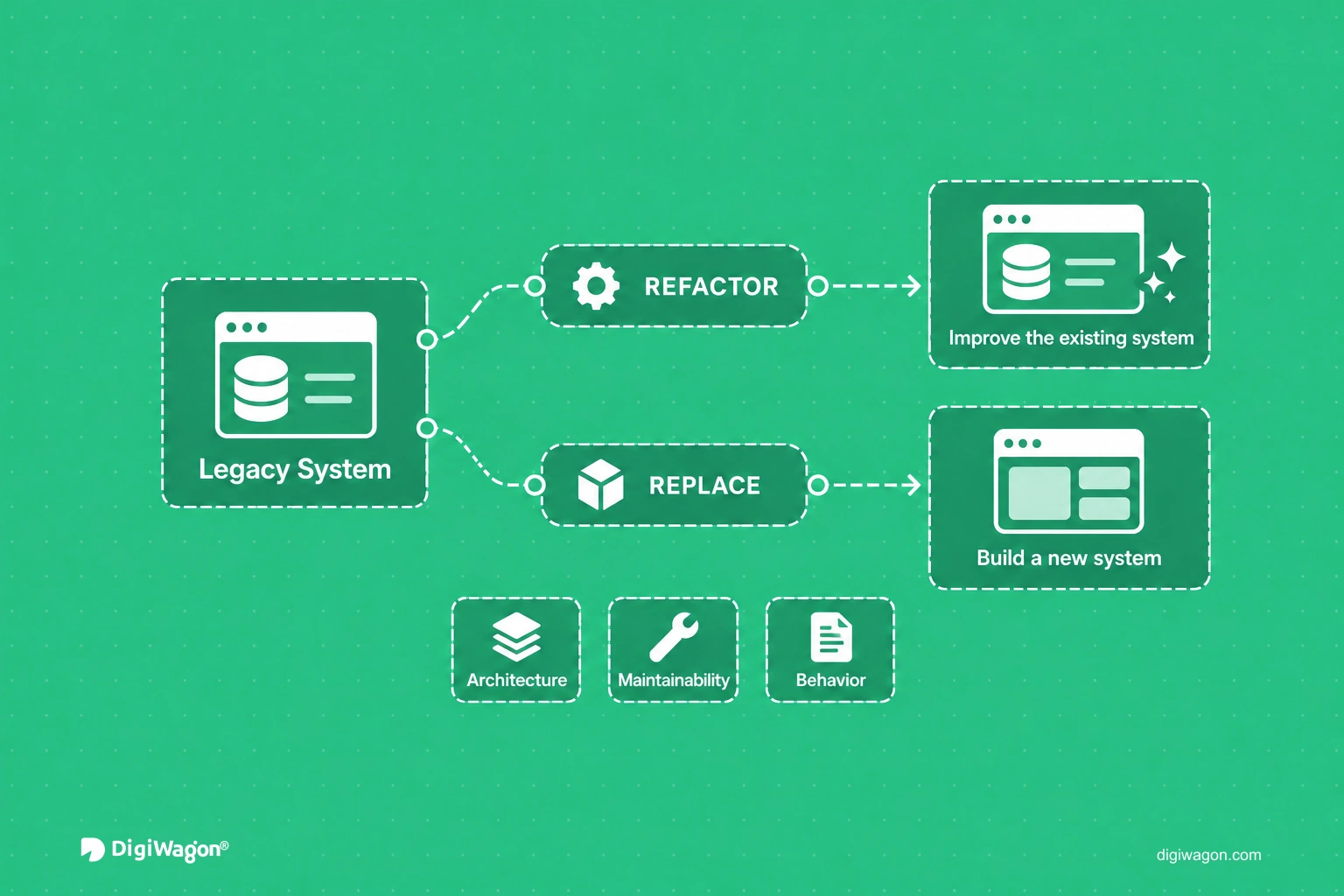
Legacy system replacement is the decision to retire a running system and rebuild its behaviour in new code, rather than repair it in place. The choice commits the team to a behaviour-parity problem: every rule the old system enforced has to be rediscovered, written down, and reimplemented before the old one can be switched off.
Why This Decision Gets Made Badly
The pressure to replace rarely arrives as a technical argument. It arrives as a release that took three weeks for a two-line change, a vendor runtime going end-of-life, or a new hire who cannot get the thing running locally.
Those are real signals. None of them tells you whether the problem is reachable by a refactor.
In a Gartner Peer Community survey of 300 software engineering leaders, architecture debt was the most commonly reported form of technical debt at 67%, ahead of infrastructure debt at 58% and code debt at 53% (Gartner Peer Community, 2023).
That ordering matters. Code debt is what a refactor fixes. Architecture debt is what a refactor cannot reach, because the boundaries are wrong rather than the implementations.
The decision goes badly when the team reads architecture pain and reaches for a code remedy, or reads code pain and reaches for a replacement. Both errors cost the same thing: a year, and a system that still does not do what the old one did. This is the third decision in the modernization decision sequence, after the portfolio call and the target-state call.
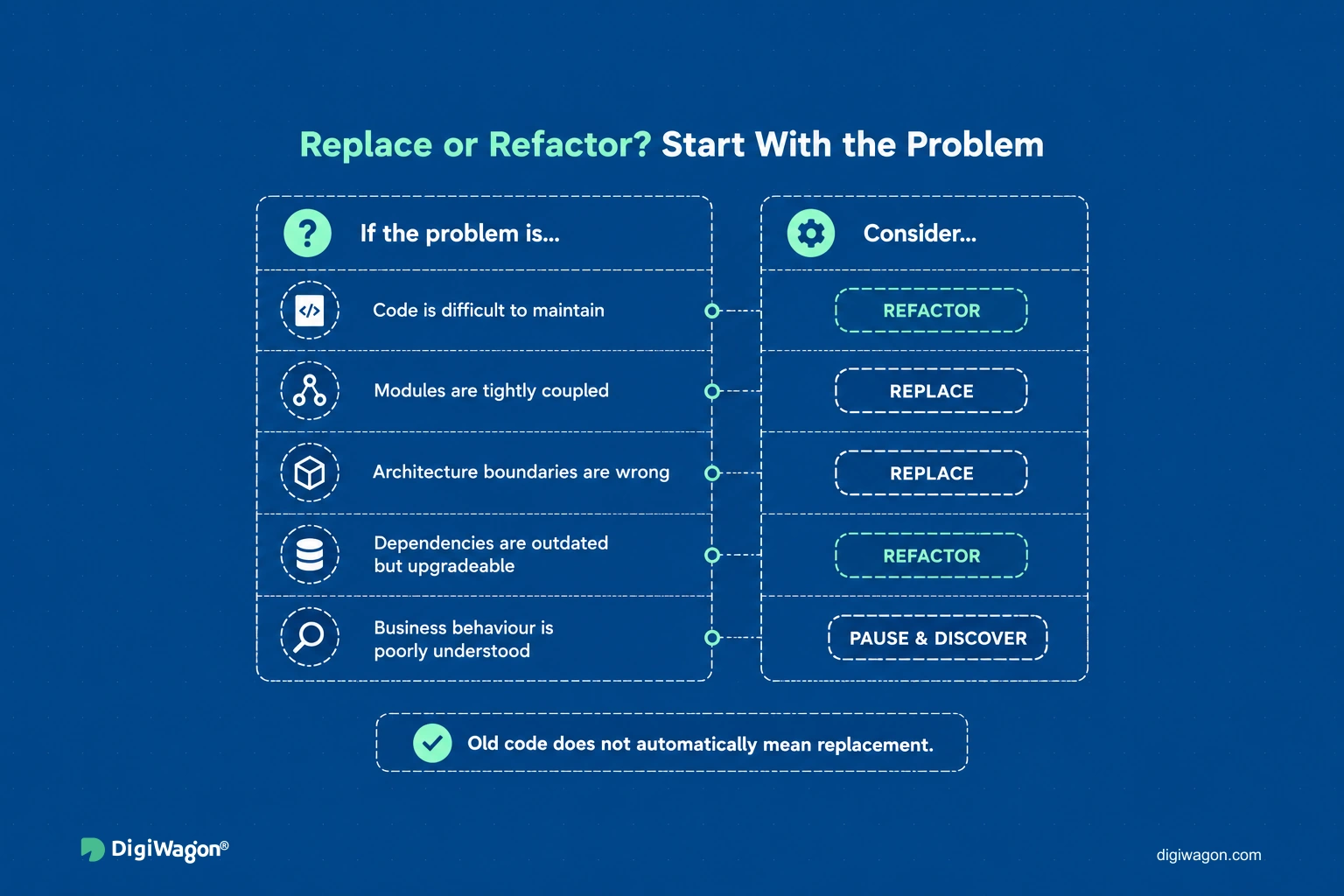
What Are the Two Ways a Legacy System Replacement Decision Goes Wrong?
Refactoring something that should have died
A refactor keeps the system's boundaries and improves what sits inside them. When the boundaries are the defect, the refactor buys a cleaner version of the wrong shape.
The tell is that every feature request crosses three modules that have no business knowing about each other. Extracting a service does not help, because the coupling is in the data model, not the call graph.
ISO/IEC/IEEE 14764:2022 treats maintenance and disposal as distinct lifecycle processes with different entry conditions, not as two intensities of the same activity. Teams that run a replacement as an aggressive maintenance sprint inherit the maintenance process's assumptions, including the assumption that the system keeps running.
Replacing something whose behaviour nobody wrote down
The second failure is more expensive and more common. A system that has been in production for a decade encodes decisions nobody remembers making: a rounding rule, a retry window, an exception for one customer segment that was never a requirement and is now load-bearing.
Replacement does not inherit those. Replacement rediscovers them, usually from the incident channel, three weeks after go-live.
When the business requires that the new system behave as the old one did, the architectural response is a behaviour capture layer built before the replacement starts, not a specification written from the old system's documentation.
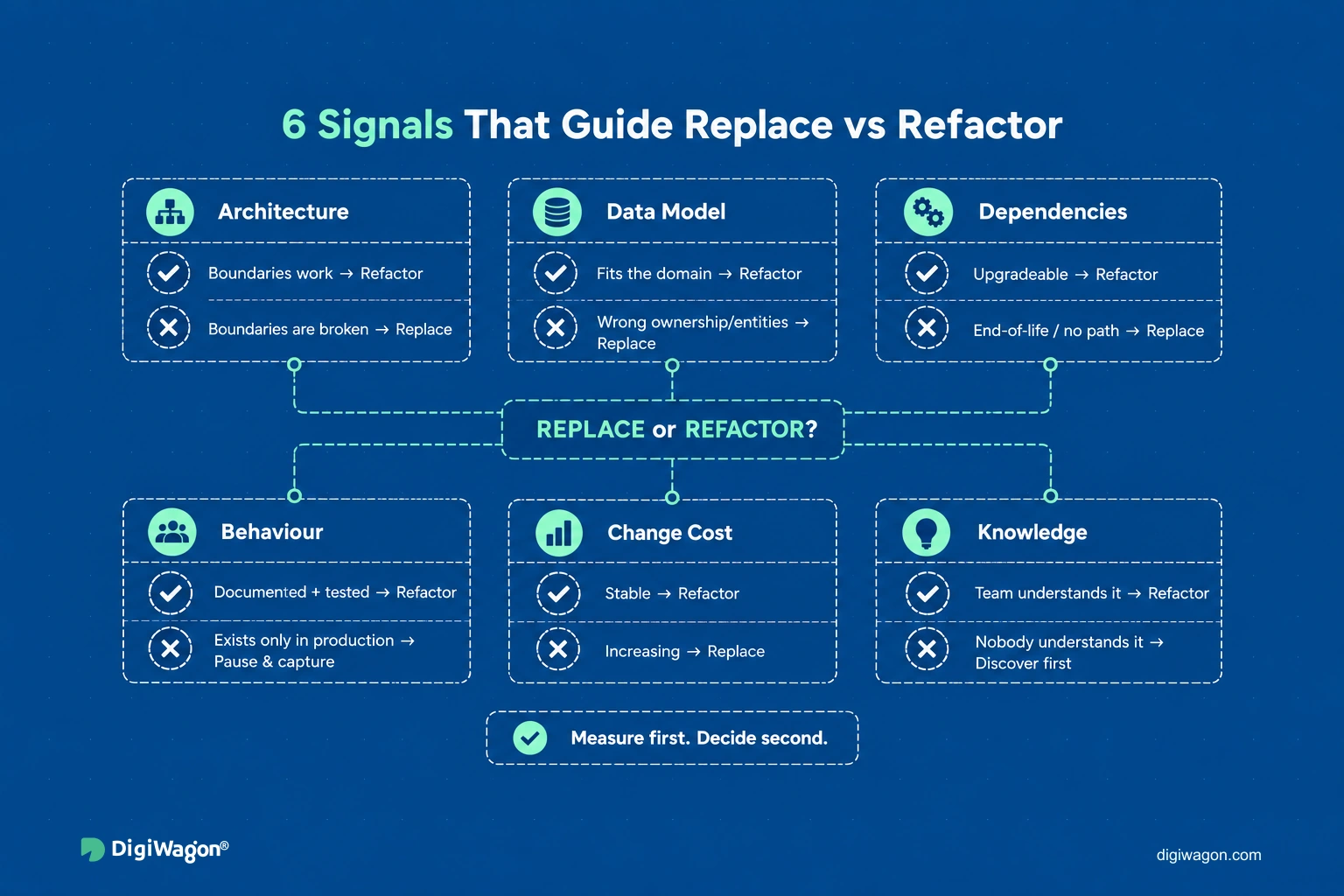
What Evidence Separates Replace From Refactor?
The evidence has to be collected before the preference forms. Once a team has decided it wants to replace, every measurement confirms it.
ISO/IEC 25010:2023 defines nine product quality characteristics, including maintainability, reliability and flexibility. Scoring the running system against named characteristics turns "it's a mess" into a set of numbers that point at a specific remedy.
One signal has hardened. Runtimes that were merely old when that model published are unsupported in 2026, which moves dependency risk from an advisory input to a decisive one.
| Signal | Points to refactor | Points to replace |
|---|---|---|
| Where the pain sits | Inside module boundaries | Across module boundaries |
| Data model | Fits the domain, poorly implemented | Wrong entities, wrong ownership |
| Runtime and dependencies | Supported, upgradable | End-of-life, no upgrade path |
| Behaviour record | Tests and docs exist | Behaviour lives in production only |
| Change cost trend | Flat or improving | Rising with every release |
| Who understands it | Current team | Nobody on staff |
The bottom row decides more replacements than the other five combined, and it is the one that most argues against replacing. A system nobody understands is a system whose behaviour you cannot specify, and replacement is a specification exercise before it is a build exercise.
Teams weighing this call can see how application modernization services cover assessment through cutover.
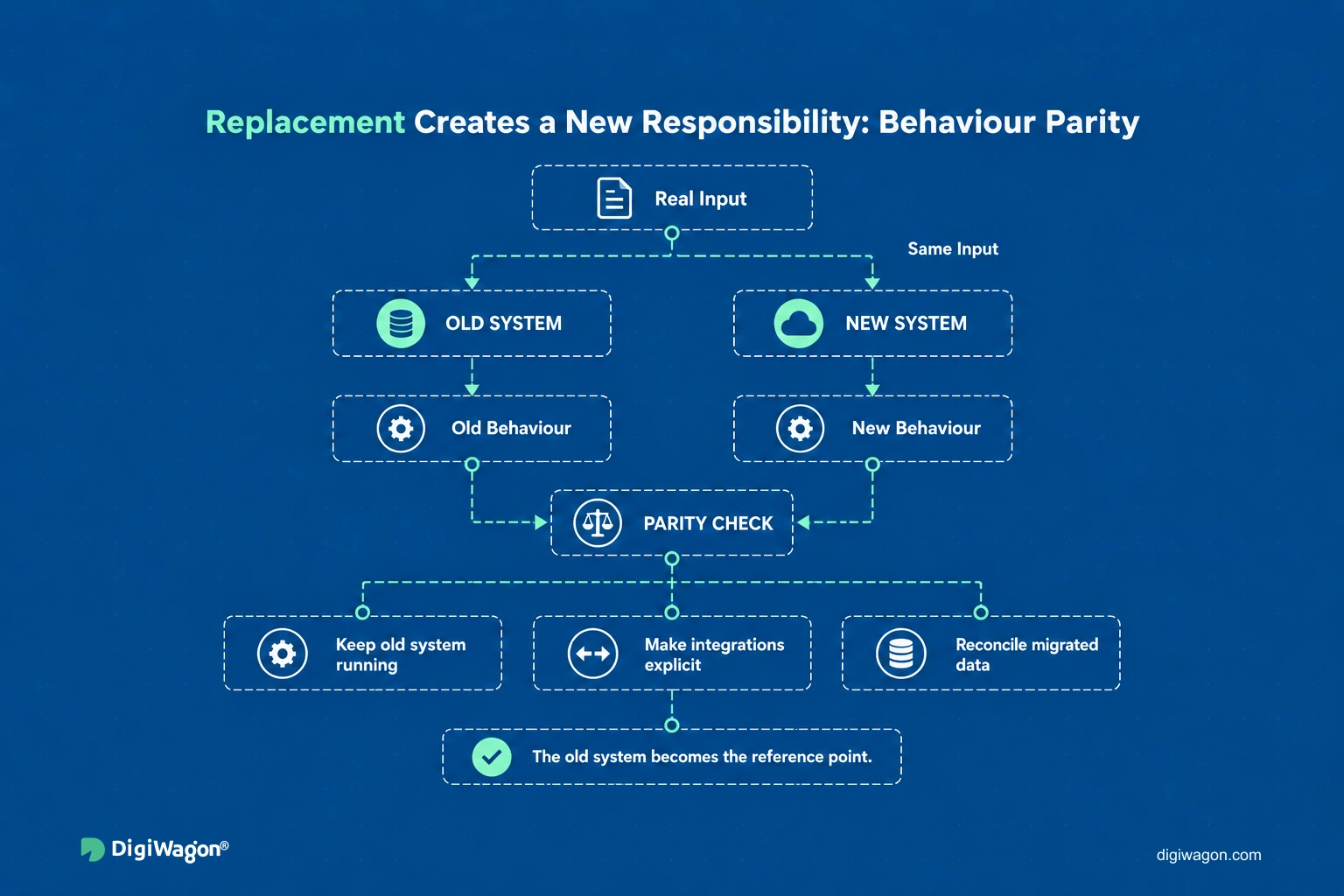
What Changes the Moment Replace Wins
The decision is usually discussed as a technology choice. It is not. The moment replace wins, the team acquires an obligation the refactor path never carried: it now owns a behaviour-parity problem.
Parity is not feature parity. Feature parity is the list of screens. Behaviour parity is the set of outputs the old system produces for a given input, including the outputs that are arguably wrong and that a downstream system has been depending on for years.
Three architectural consequences follow:
- The old system becomes a test oracle. It has to stay running long enough to answer "what would it have done here?"
- Every integration contract becomes explicit. Contracts that were implicit in a shared database now cross a network boundary and need versioning.
- Data migration becomes a reconciliation problem, not a copy. The new schema has to prove it can reproduce the old system's answers, not merely hold its rows.
In manufacturing systems modernization, the parity surface is usually wage and production rules that vary by site. In lending, it is eligibility and verification logic that a regulator can ask about later. Either way, the parity surface is the real scope of the project, and it is discovered rather than estimated.
A wider view of how the sequence treats a replacement programme covers where this obligation lands across several systems. For a single system where the question is whether to build at all, choosing between a product build and a custom build is the prior decision.
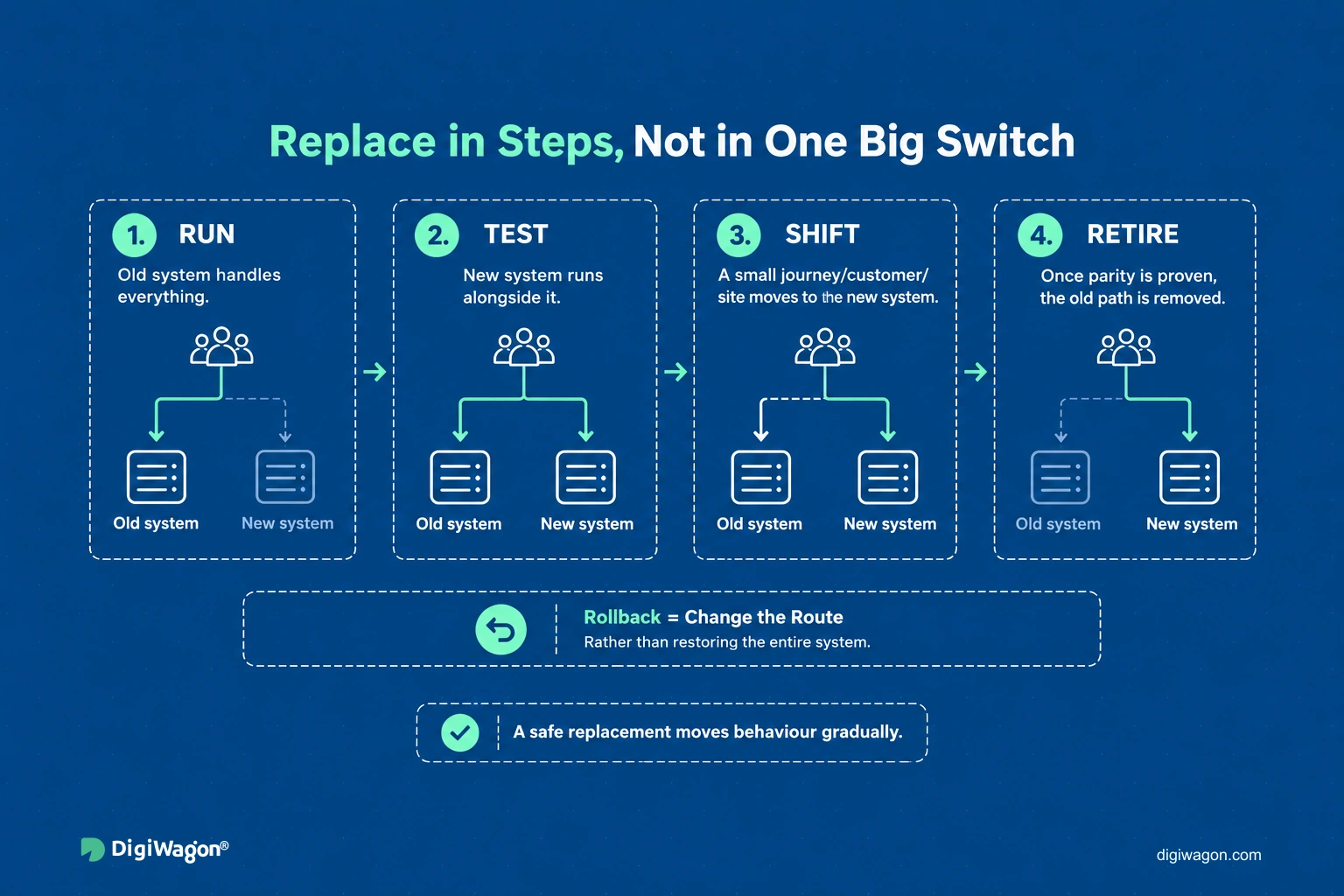
Why Does the Cutover Have to Be Incremental?
Because a replacement with a switch-over date is a rewrite, and rewrites fail on the behaviour nobody wrote down.
Martin Fowler's strangler fig pattern makes the case directly: new functionality is built beside the legacy system and traffic moves across in small increments, because "since these components are small, there isn't so much risk involved when we introduce the new software" (Martin Fowler, StranglerFigApplication, updated 2024).
The architectural requirements that follow are specific:
- A routing layer that can send a single journey, customer segment or site to the new system while everything else stays on the old one.
- A dual-write or shadow-read path so the new system's answers can be compared against the old system's answers under real traffic, before real traffic depends on them.
- A rollback that is a routing change, not a restore.
When the business cannot tolerate a period of running both systems, the honest read is that the replacement is not funded, because the parallel period is where parity is proven. Cutting it is not a schedule saving, it is a decision to discover the parity gaps in production.
Lessons from Replacing Manual Systems in Manufacturing and Lending
NQBPL's manual production and wage tracking was replaced by a unified production-to-payroll platform built on ReactJS, Node.js and MySQL on AWS, delivering 55% faster wage calculation and a 50% reduction in manual payroll and production tracking effort.
The paperless fixed deposit onboarding platform we built for a leading Indian small finance bank is the more instructive one. Its stack runs React and AngularJS on the frontend and Java and Node.js on the backend.
Two frontend frameworks and two backend runtimes on one platform is what an incremental replacement looks like in a stack listing: the new journey shipped beside the retained estate, not instead of it. The bank's constraint was that critical journeys had to be validated before rollout.
Planning a Replacement With DigiWagon
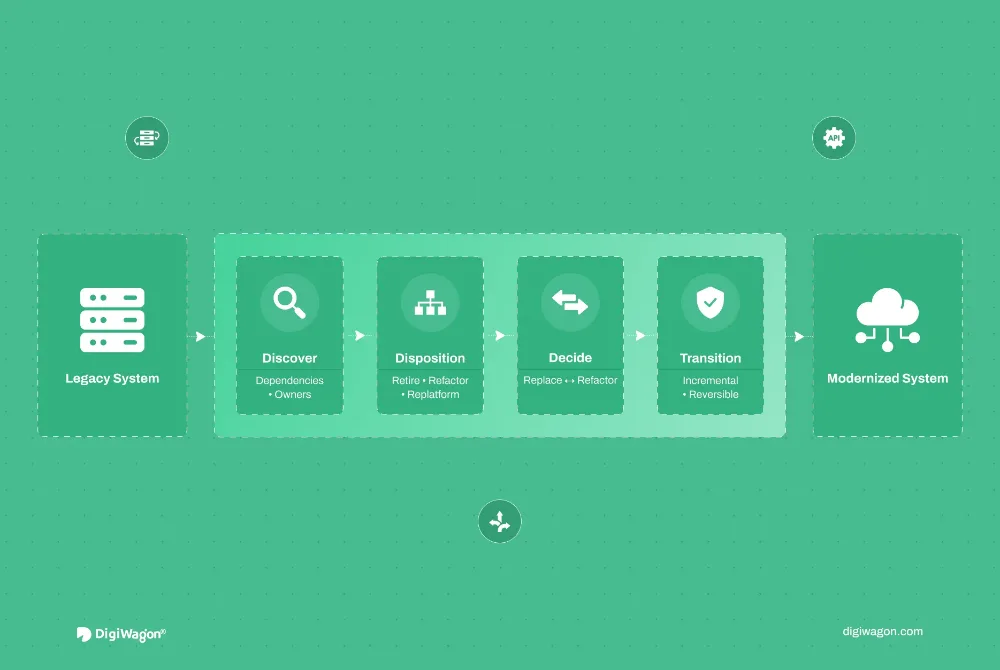
DigiWagon builds the replacement systems this decision commits you to, and the parallel-run architecture that gets there.
- Behaviour capture and parity test suites from the running system
- Strangler-pattern routing, dual-write and shadow-read design
- Enterprise software engineering across Java, Node.js and React estates
- Data migration reconciled against the retained system
Making the Call You Can Defend
The replace-versus-refactor decision is settled by evidence collected before the preference forms: quality characteristics measured against a named model, a written record of what the system actually does, and an honest read on whether the defect is in the architecture or the implementation. Choosing replace does not end the decision, it starts a behaviour-parity problem the team now owns for the life of the project. The cutover is incremental or it is a rewrite. Teams that write down the old system before they switch it off ship replacements that hold their parity tests from the first routed request.