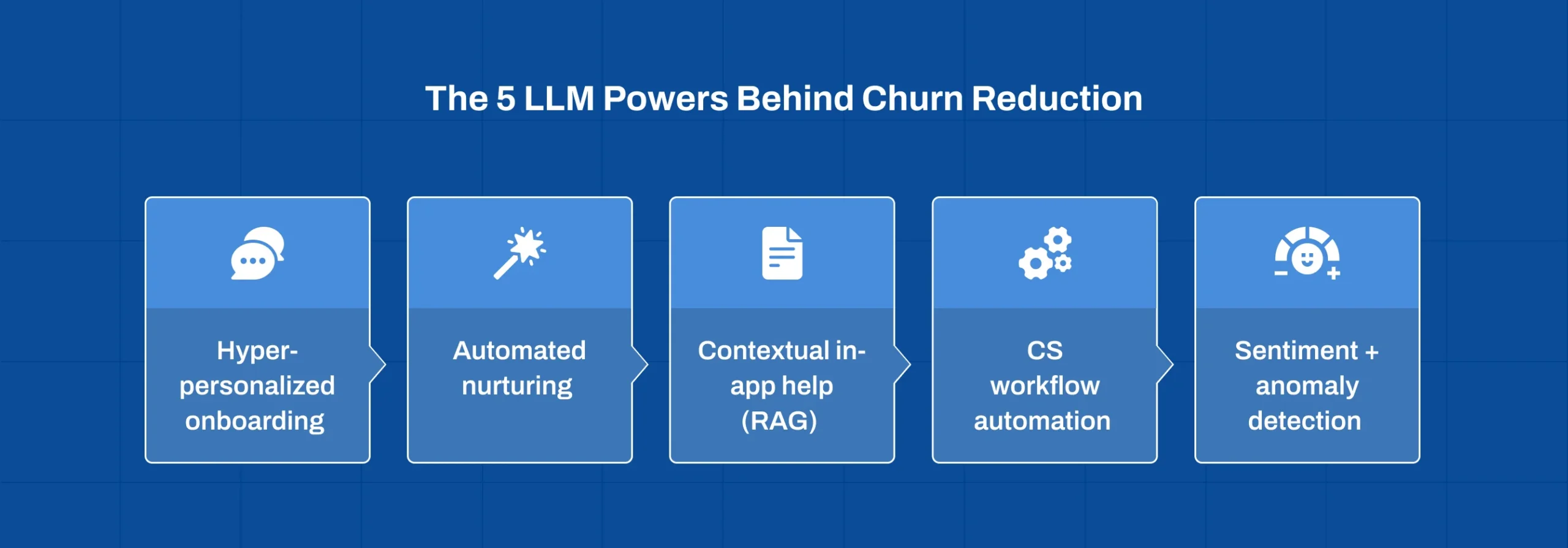
The 5 LLM Powers Behind Churn Reduction
A Co-pilot that works across the entire customer lifecycle.
To the B2B tech leaders, founders, and product visionaries:
If your product is great, but your customers leave, your problem isn’t the feature set—it’s the friction in their journey. In the crowded B2B marketplace, customers churn not because your software lacks functionality, but because it fails to communicate its value quickly, personally, and continuously.
Churn is no longer a human problem; it’s an AI automation opportunity.
The integration of Large Language Models (LLMs) allows you to move beyond reactive support and build a Generative AI Co-pilot into your core product experience. This Co-pilot’s sole mission is to reinforce the customer’s success. Industry data suggests that personalized AI interventions can reduce B2B churn by 10-18%, delivering measurable ROI and fueling Net Revenue Retention (NRR). Here are the 5 must-have LLM use cases you need to architect into your platform now to dominate retention.
The Financial Imperative: Why Churn is the New Enemy of Growth
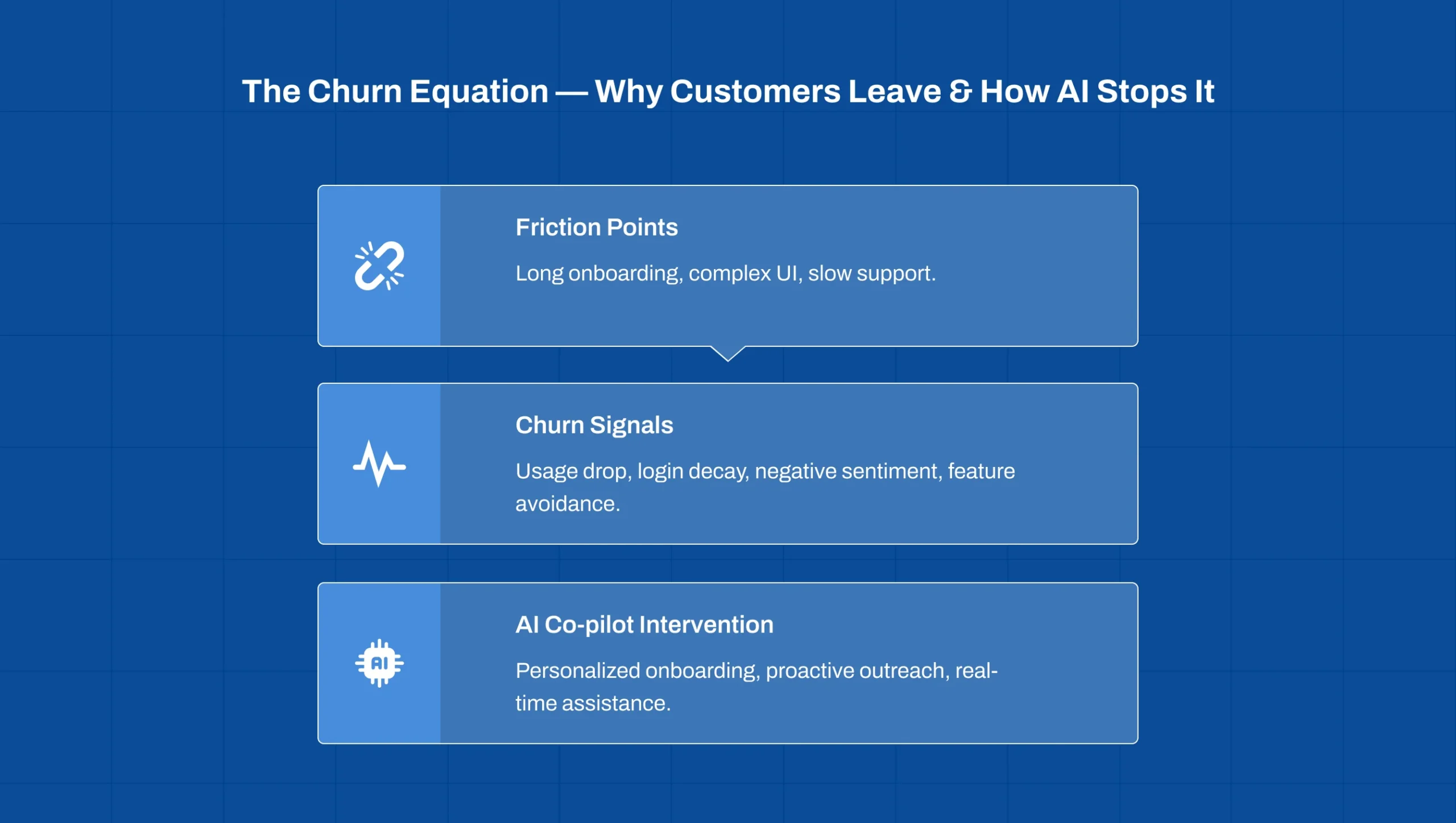
The Churn Equation – Why Customers Leave & How AI Stops It
Fix friction, predict risk, automate intervention.
The ROI of Retention: Churn Reduction by 10-18%
Customer Acquisition Costs (CAC) continue to climb across the US and European markets. This makes customer retention the single most cost-effective path to growth. When an existing customer expands their use of your product, your NRR soars. Generative AI makes this expansion possible by eliminating the two biggest churn drivers: poor onboarding and slow support.
Use Case 1: Hyper-Personalised Onboarding Journeys
The goal of onboarding is to hit the Time-to-Value (TTV) milestone instantly. A generic product tour fails to recognise that a CTO’s needs differ wildly from a Product Manager’s.
Transforming Setup from Static Checklist to Dynamic Dialogue
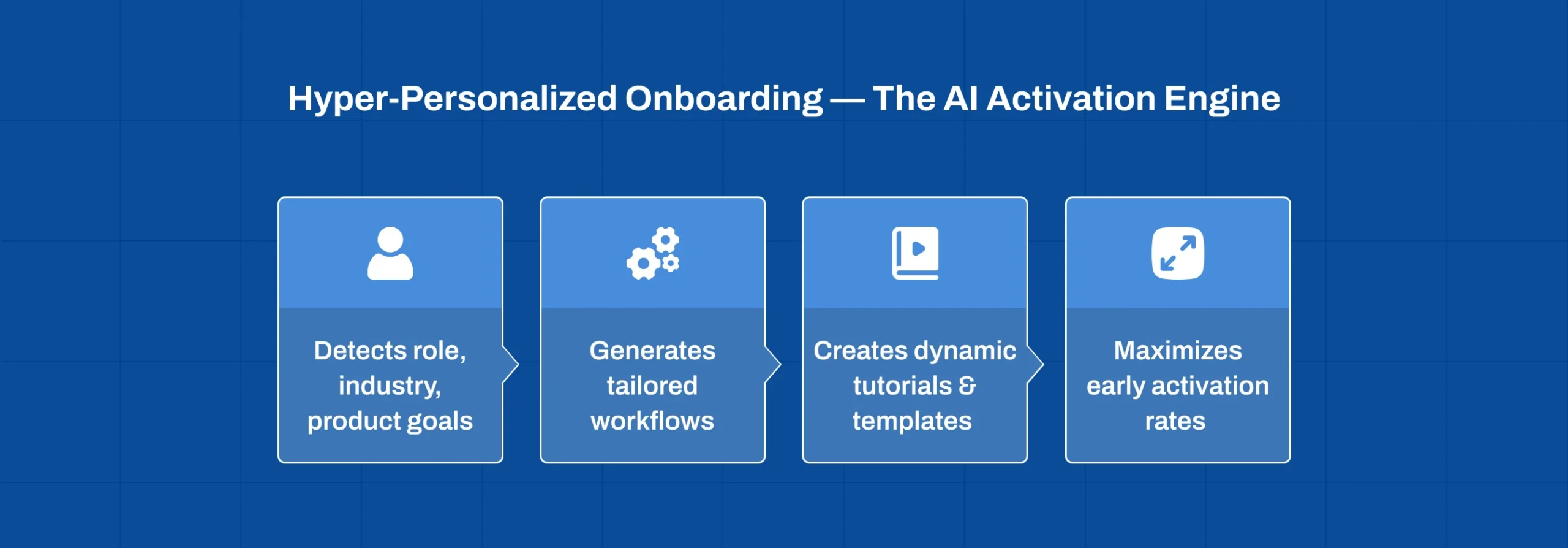
Hyper-Personalised Onboarding – The AI Activation Engine
Cut Time-to-Value from days → minutes.
An LLM-powered Co-pilot makes the onboarding flow conversational:
- The Action: The user signs up and the Co-pilot asks, “Welcome! Based on your job title, I recommend three primary workflows. Which is most important to you today: Compliance Automation or Data Visualisation?”
- The LLM Role: The model uses the user’s input and metadata (company size, industry) to instantly generate a dynamic, role-specific in-app tutorial and pre-populate their dashboard with templates relevant to their stated goal.
- The Retention Impact: TTV is cut from days to minutes, maximising initial user activation.
Use Case 2: Proactive Churn Intervention and Account Nurturing
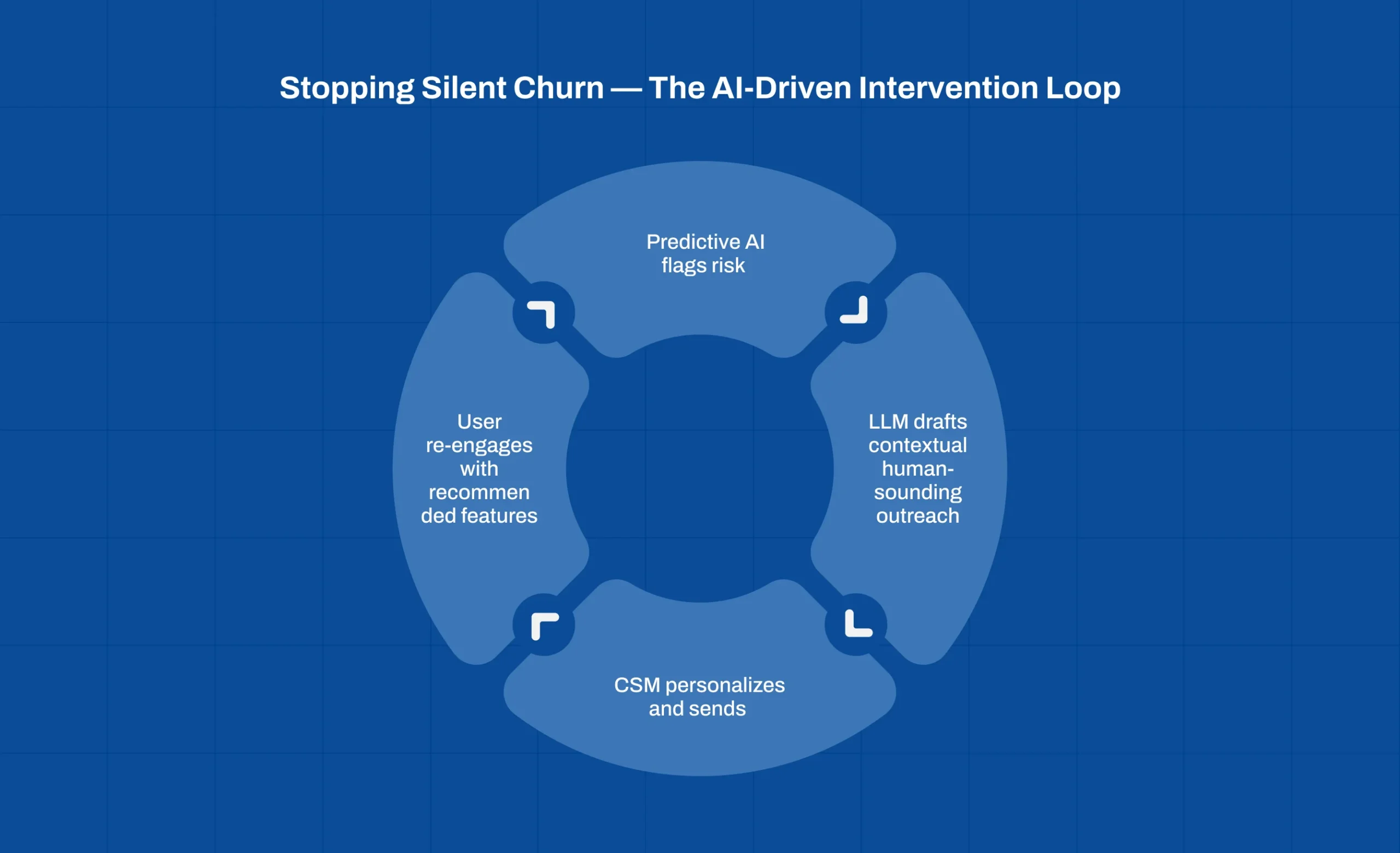
The “silent churner”- the user who stops logging in before contacting support – is an invisible threat. Predictive AI flags the risk;
Generative AI automates the response.
LLMs Automating the Human-Touch Follow-up
Stopping Silent Churn – The AI Intervention Loop
Predict early. Intervene early.
Instead of relying on a human Customer Success Manager (CSM) to manually draft outreach emails, the system automates a highly personalised intervention:
- The Action: A Predictive AI model in the Data & Analytics service flags an account as “High Risk” (e.g., login frequency down 60%, hasn’t used Feature X in 30 days).
- The LLM Role: The LLM generates a personalised email draft for the CSM, summarising the customer’s last successful action and suggesting the next logical feature to try. This makes the outreach feel genuinely human and contextual, not like a generic marketing blast.
- The Retention Impact: LLM Use Cases are used for empathy at scale, ensuring high-value customers receive timely, relevant attention that prevents disengagement from becoming churn.
Use Case 3: Instant, Contextual In-App Guidance (The True Co-pilot)
No user likes leaving the application to search a knowledge base. The modern Co-pilot brings the knowledge base to the user.
RAG Architecture: Grounding the LLM in Your Proprietary Data
RAG Co-pilot Architecture – Contextual Guidance in Real Time
No hallucination. No guesswork. Only verified answers.
- Retrieves correct internal docs
- LLM synthesizes them into instructions
- User gets instant, accurate guidance
- Support tickets drop dramatically
The most powerful Co-pilots use Retrieval-Augmented Generation (RAG) architecture:
- The Action: A user in your Enterprise Software product is stuck on a complex configuration screen and types: “How do I connect my API to the webhook endpoint using OAuth 2.0?”
- The LLM Role: The LLM instantly retrieves the relevant technical documentation (API guides, troubleshooting tickets) from your private, proprietary knowledge base and generates a concise, step-by-step answer in the chat window. It avoids hallucination by grounding its response only in verified internal data.
- The Retention Impact: Functional Testing becomes a real-time, self-serve activity, drastically reducing frustration and support ticket volume.
Use Case 4: Automating Internal Customer Success Workflows
While the Co-pilot helps customers, LLMs also help your team scale human support. This falls under the domain of AI-Powered Automation.
Synthesising Ticket Data to Accelerate Human Agent Response
AI Automation for Customer Success Teams
Let AI handle the grunt work; humans handle relationships.
- Auto-summarises tickets
- Classifies urgency
- Suggests solutions
- Cuts resolution time by up to 50%
The average human support agent spends 40% of their time reading, categorising, and summarising support tickets.
- The Action: A new support ticket arrives with a long email chain, multiple screenshots, and an urgent tone.
- The LLM Role: The LLM instantly analyses the ticket, summarises the core issue, classifies its priority (e.g., P1: Critical bug in Data Export), and automatically suggests the top three solutions/code snippets from past tickets.
- The Retention Impact: Reduces human resolution time by up to 50%, improving response time, which is a key driver of customer satisfaction and retention.
Use Case 5: Real-Time Sentiment and Usage Anomaly Detection
Sometimes, low usage isn’t the only churn signal; frustration is. LLMs are exceptionally good at understanding tone and intent in language.
Catching the ‘Silent Churner’ Before They Quit
The AI Churn Radar – Usage + Sentiment = Accurate Prediction
Detect risk before it becomes revenue loss.
- Tracks usage anomalies
- Reads emotional cues in feedback
- Predicts “silent churners”
- Enables targeted outreach
- The Action: The LLM continuously analyses unstructured text data: in-app chat feedback, support responses, and notes left by sales or customer success teams.
- The LLM Role: It detects real-time anomalies (e.g., a sudden increase in the use of words like “frustrated,” “broken,” or “lagging”) and calculates a Sentiment Score. This is paired with usage data to build a comprehensive churn risk profile.
- The Retention Impact: Allows the CSM to intervene with empathy based on the customer’s emotional state, not just their login frequency, making the intervention more targeted and effective.
Conclusion: Build a Product That Anticipates Needs
The Generative AI Co-pilot is the next evolution in SaaS Product strategy. It transforms your application from a static set of features into a dynamic, proactive partner that guides users, anticipates roadblocks, and automates resolution. Building this requires expertise in integrating AI & Machine Learning with scalable, secure SaaS Product Development and a robust Data Engineering foundation. Don’t simply add an LLM; architect a strategic Co-pilot that reinforces value every day. The ROI is clear: lower churn, higher NRR, and an undeniable competitive advantage.