Smart Predictive Maintenance for Tractors: Bringing AI to the Service Bay
An AI-powered predictive maintenance platform built to forecast tractor health, optimise service schedules, and connect legacy and modern fleets into one intelligent system.
A leading Indian tractor OEM wanted to modernise its nationwide service network across both legacy mechanical tractors and modern ECU-equipped models.
The existing service approach was largely calendar-based, which meant maintenance decisions were not always aligned with real operating conditions, component health, field usage, or early failure signals.
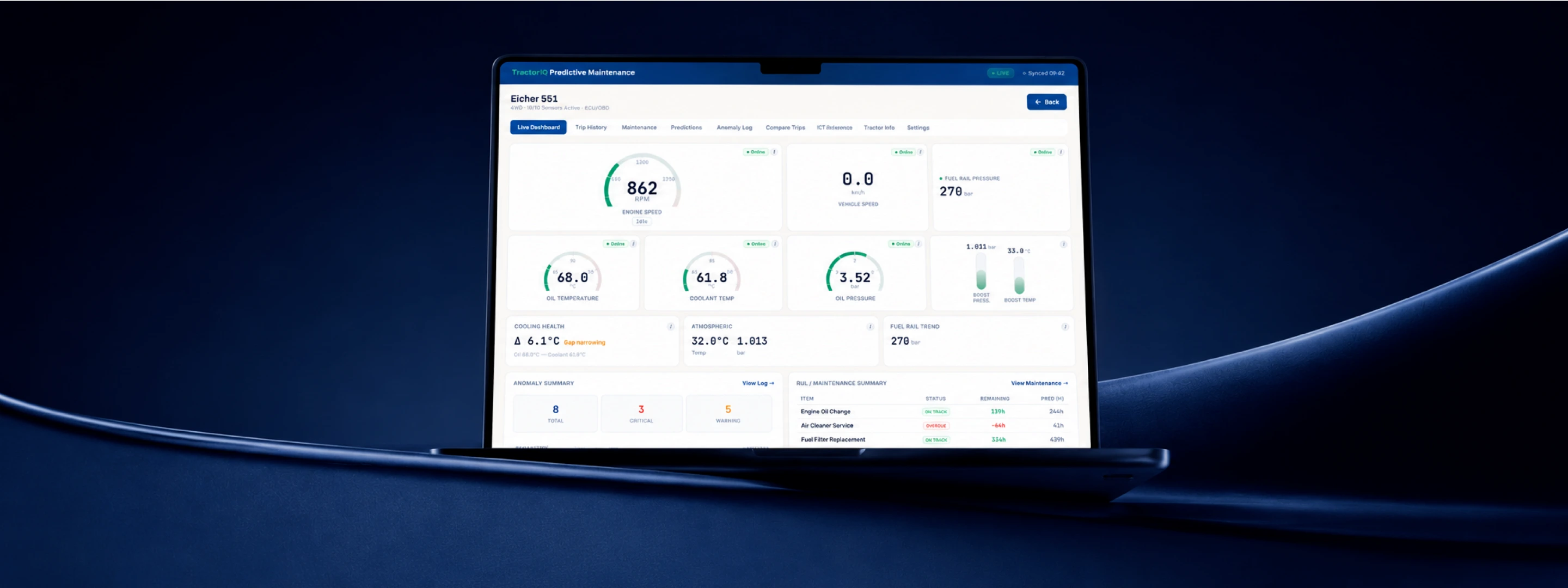
DigiWagon built an AI-powered predictive maintenance platform that captures tractor telemetry during service visits, forecasts component health, predicts Remaining Useful Life, and dynamically recommends maintenance actions.
To extend the intelligence layer across the complete fleet, the solution also included a mechanical-to-digital retrofit kit that brought legacy, ECU-less tractors onto the same monitoring platform as newer connected models.
The OEM’s service network relied on fixed maintenance schedules and reactive diagnosis. This created a gap between how tractors were actually used in the field and how they were serviced at workshops.
Legacy tractors had no onboard electronics, while newer ECU-equipped models generated useful telemetry that was not being fully used after service sessions.
The OEM needed a system that could read operating signals, identify abnormal behaviour, forecast component degradation, and guide service engineers before a failure happened in the field.
Business Challenge
The service network depended on fixed, calendar-based maintenance schedules.
A large portion of the active fleet included legacy tractors with no onboard electronics.
Modern ECU-equipped tractors generated service data that was not being used for long-term intelligence.
Standard service intervals ignored actual operating conditions and component health.
Critical component issues were often detected only after breakdowns occurred.
Service teams had limited visibility into load patterns, regional usage, field conditions, and component-level wear.
Product engineering teams lacked real-world operating data from active tractors.
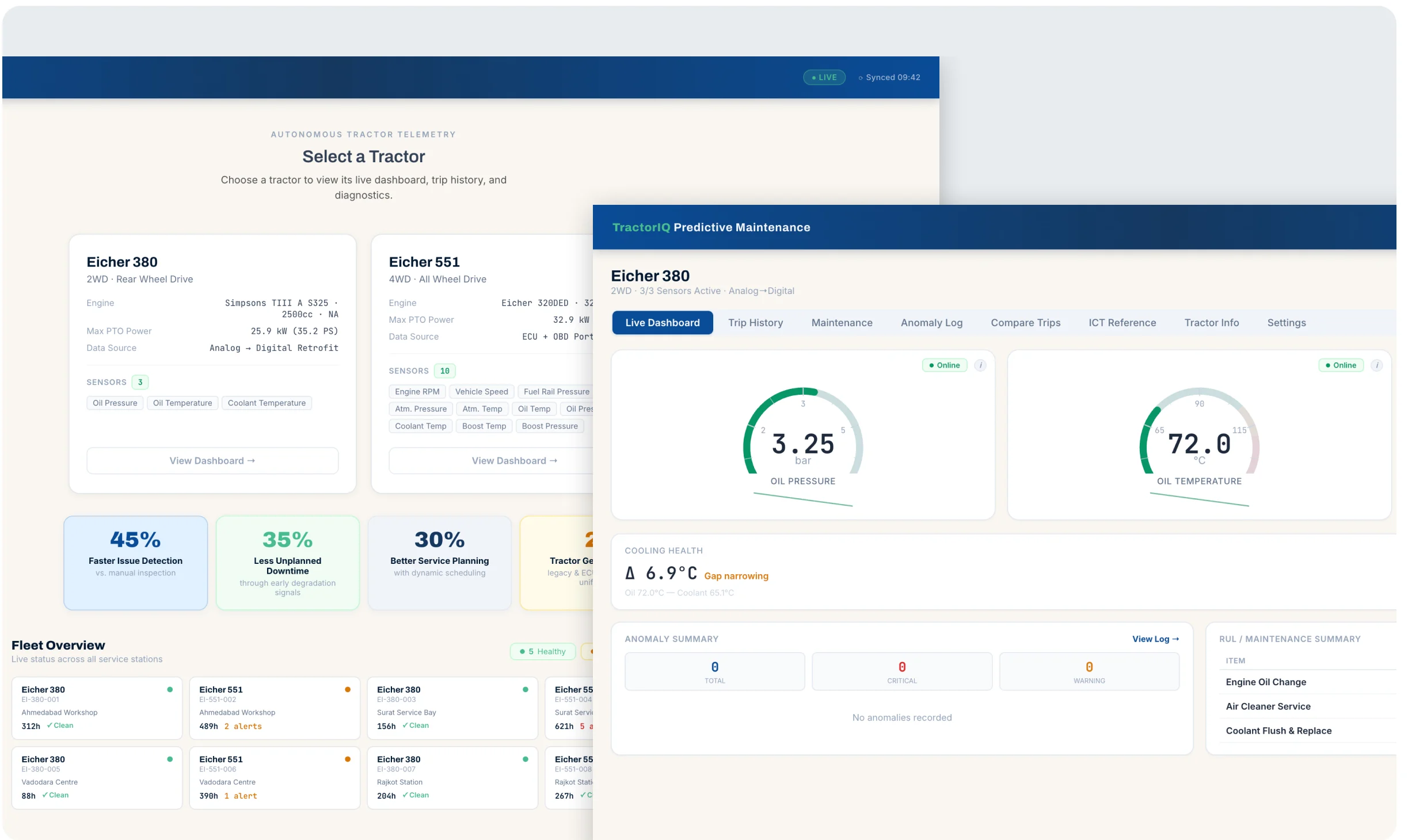
The platform needed to support both 3-sensor legacy tractors and 10-sensor modern tractors.
Manufacturing Context
In agricultural machinery, breakdowns during peak seasons can create high service pressure, customer dissatisfaction, and operational losses.
Predictive maintenance helps OEMs move from routine servicing to condition-based servicing, where every tractor is assessed based on real usage, sensor behaviour, component wear, and service history.
For mixed fleets, the challenge is not only building AI models. It is also creating a common data layer across older mechanical tractors and newer ECU-equipped machines.
User Problem
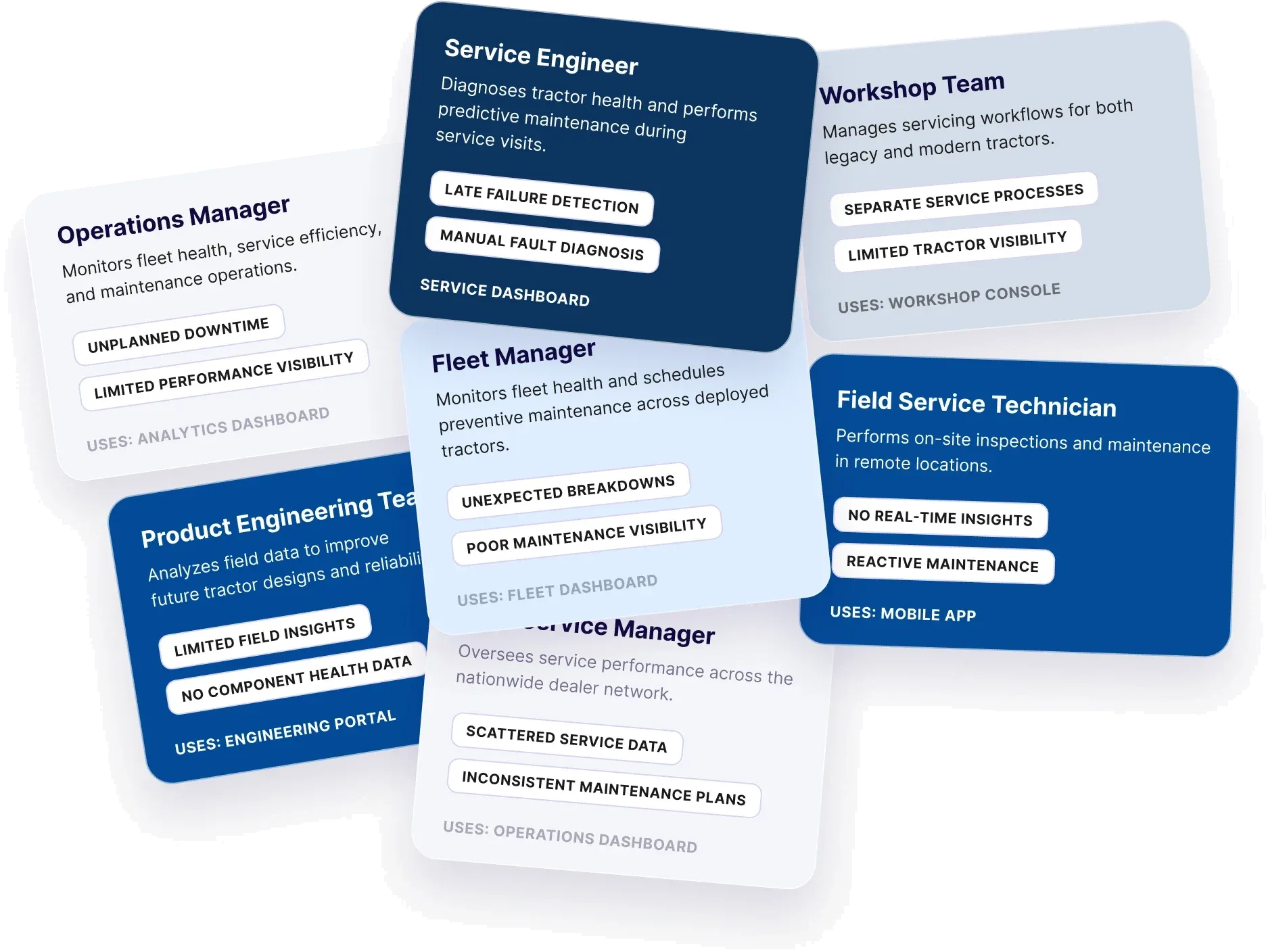
Service engineers needed early warning signals before component failure.
Workshop teams needed a single interface for both legacy and modern tractors.
Field service teams needed data-backed maintenance recommendations.
OEM teams needed visibility into real tractor usage across regions.
Product teams needed operating insights to improve future engineering decisions.
Legacy tractors needed to become digitally readable without replacing the whole machine.
How we delivered
How We Built the Predictive Maintenance Platform
Discover
Mapped failure modes with OEM engineering teams
Component failure patterns
Service history review
Critical subsystem mapping
Senior engineer inputs
Maintenance decision gaps
Capture
Unified telemetry across tractor generations
Native ECU data from modern tractors
Sensor retrofit data from legacy tractors
OBD reader integration
Service-bay telemetry ingestion
Local edge storage
Predict
Built AI models for component health forecasting
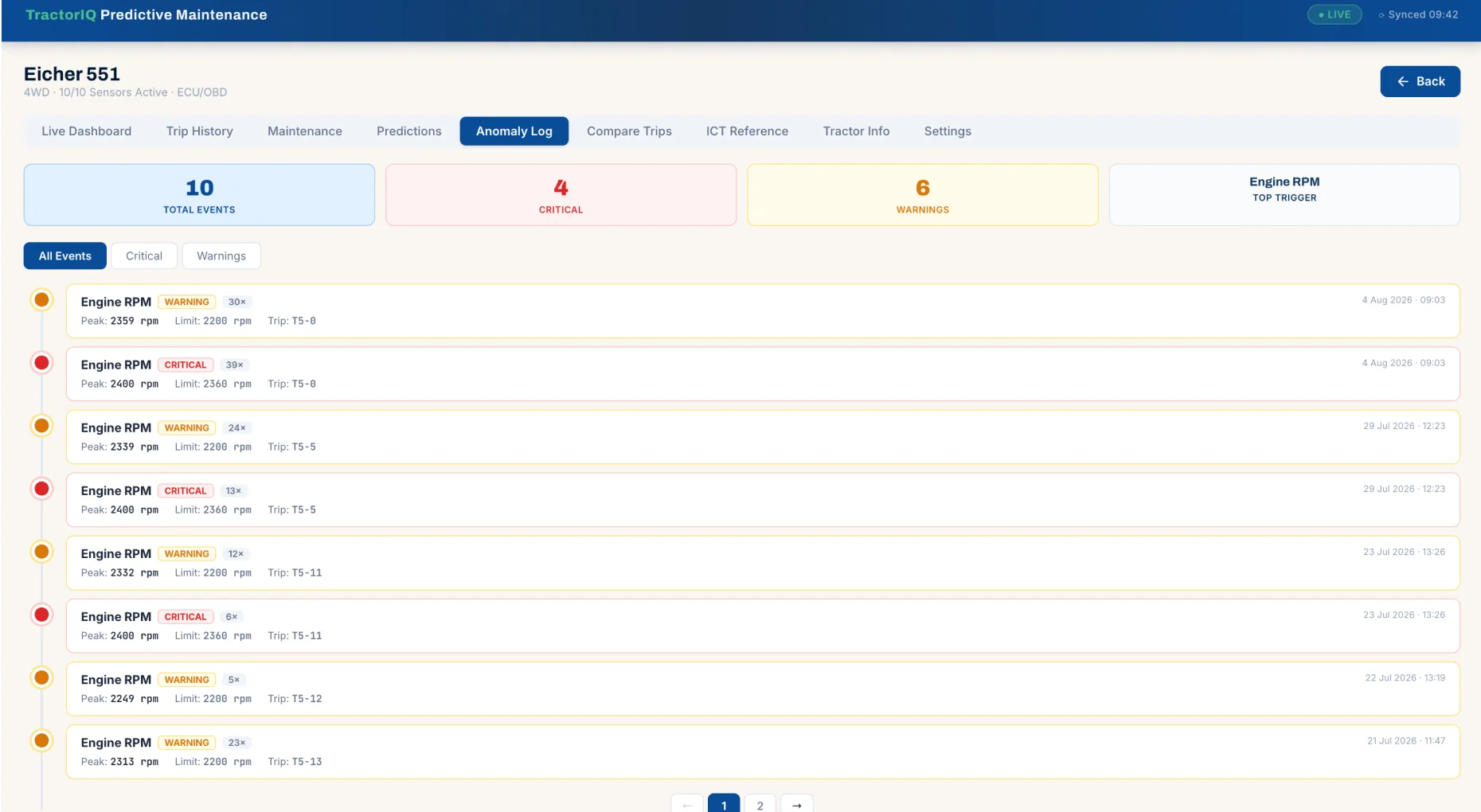
Anomaly detection
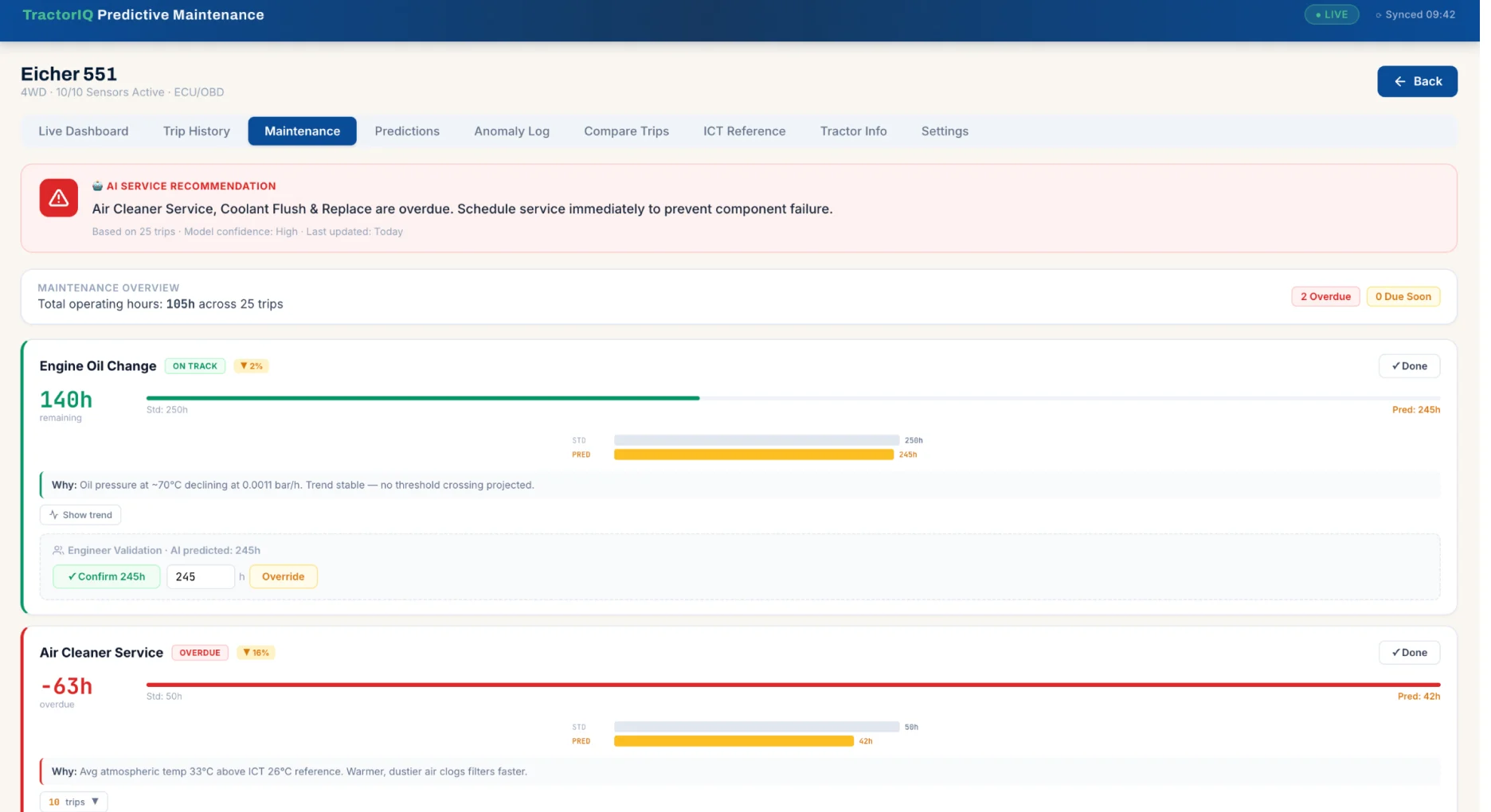
Remaining Useful Life prediction
Degradation modelling
Statistical pattern analysis
Sensor-aware model logic
Deploy
Delivered intelligence directly at the service bay
Edge deployment at service stations
Local AI inference
Service engineer dashboard
AI-backed maintenance recommendations
Periodic central sync
What we built
The platform we shipped.
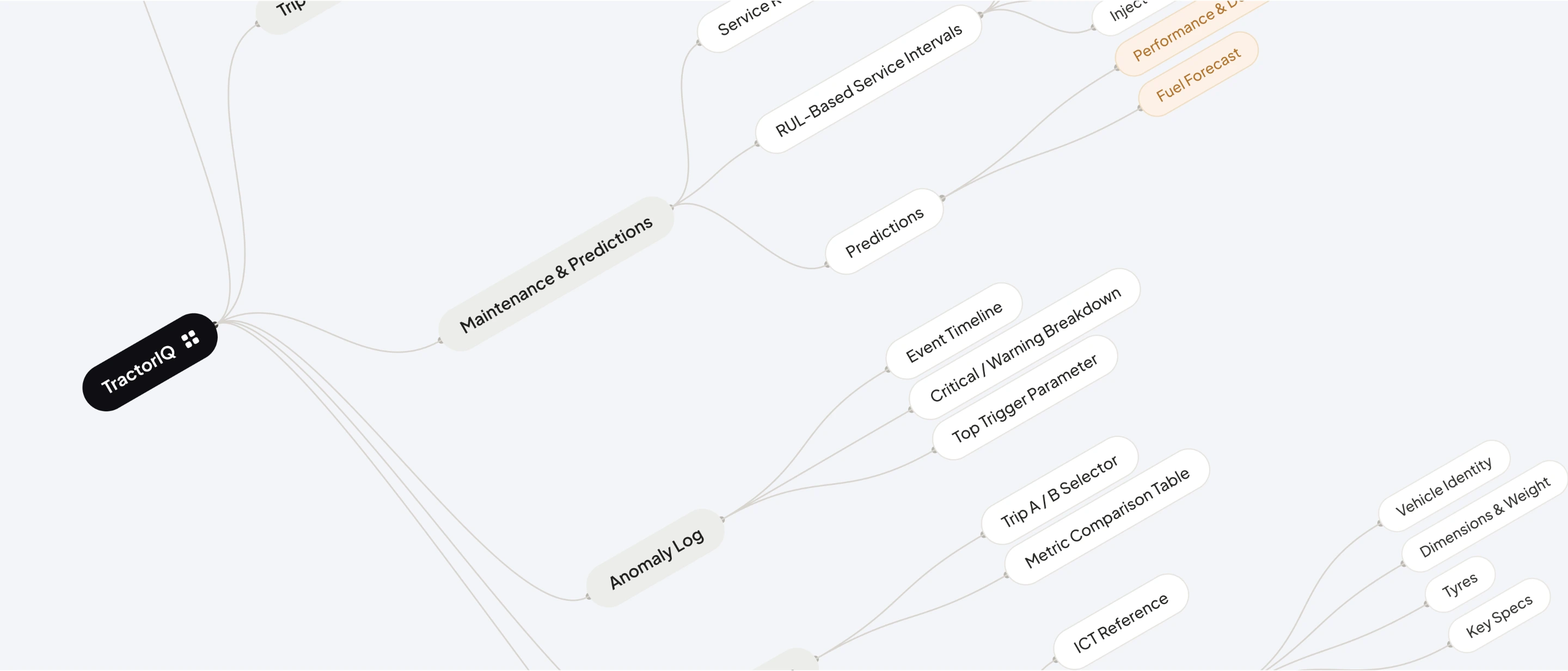
DigiWagon built an AI-powered predictive maintenance ecosystem that connects tractor telemetry, sensor retrofitting, service-station workflows, AI models, edge deployment, and service recommendations into one unified platform.
The system helps service engineers identify issues earlier, forecast component life, adjust service intervals, and support both legacy and modern tractors through a single service-bay interface.
Built an AI-powered predictive maintenance platform for tractor service networks.
Enabled telemetry ingestion at every service visit.
Integrated native ECU data from modern tractor models.
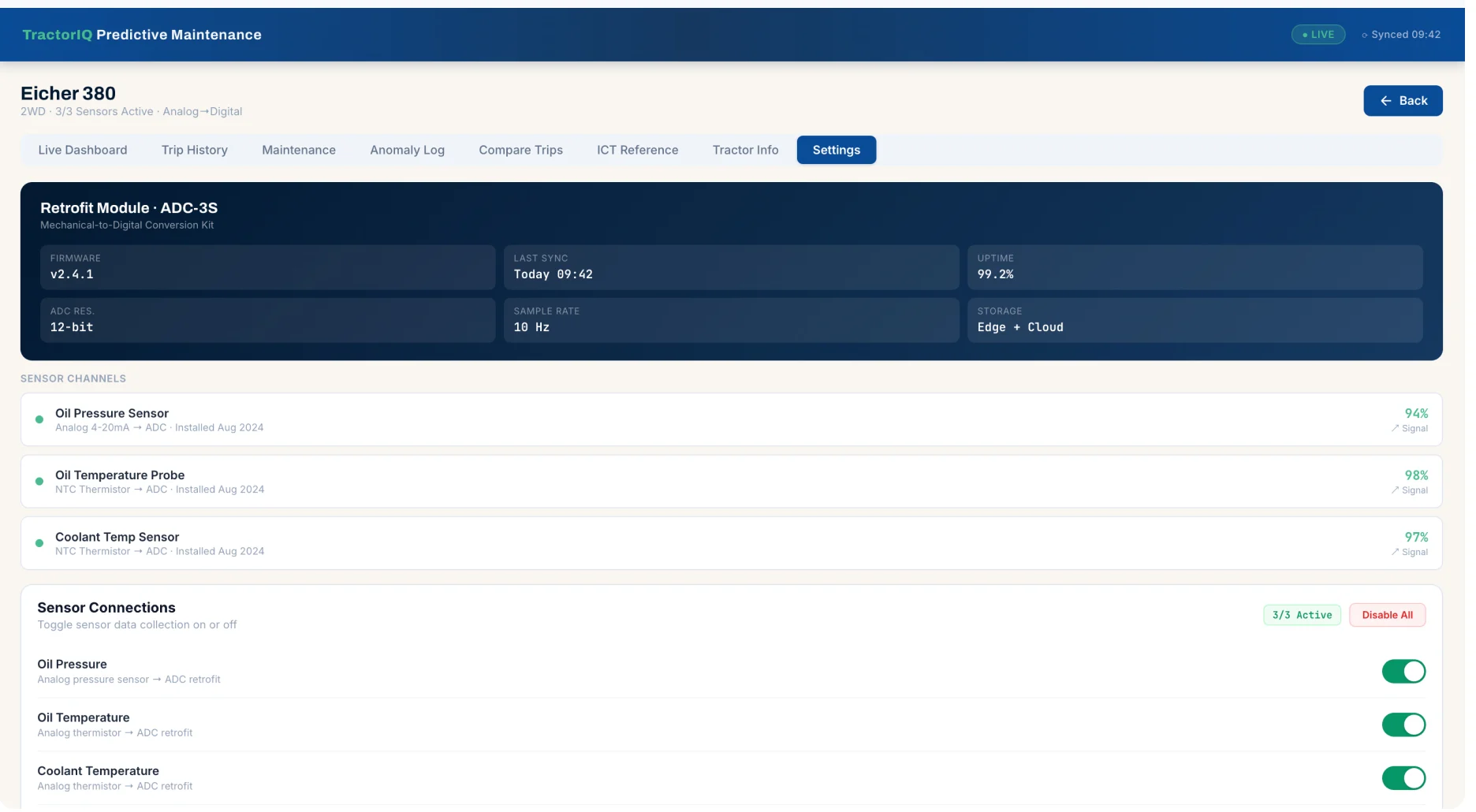
Created a mechanical-to-digital retrofit kit for legacy tractors.
Created maintenance intervals based on actual tractor condition.
Adjusted service plans using operating history and component health.
Reduced unnecessary early servicing.
Helped prevent missed failures caused by fixed schedules.
Human-in-the-Loop Continuous Learning
Enabled service engineers to confirm or correct AI predictions.
Fed validated service feedback back into model training.
Improved prediction quality with every service visit.
Combined AI intelligence with senior engineer judgement.
Cooling Health Intelligence
Built an oil-coolant temperature delta model.
Detected radiator, thermostat, and coolant degradation patterns.
Identified problems that single-sensor checks could miss.
Improved subsystem-level visibility for service engineers.
Trip-Level Operational Analytics
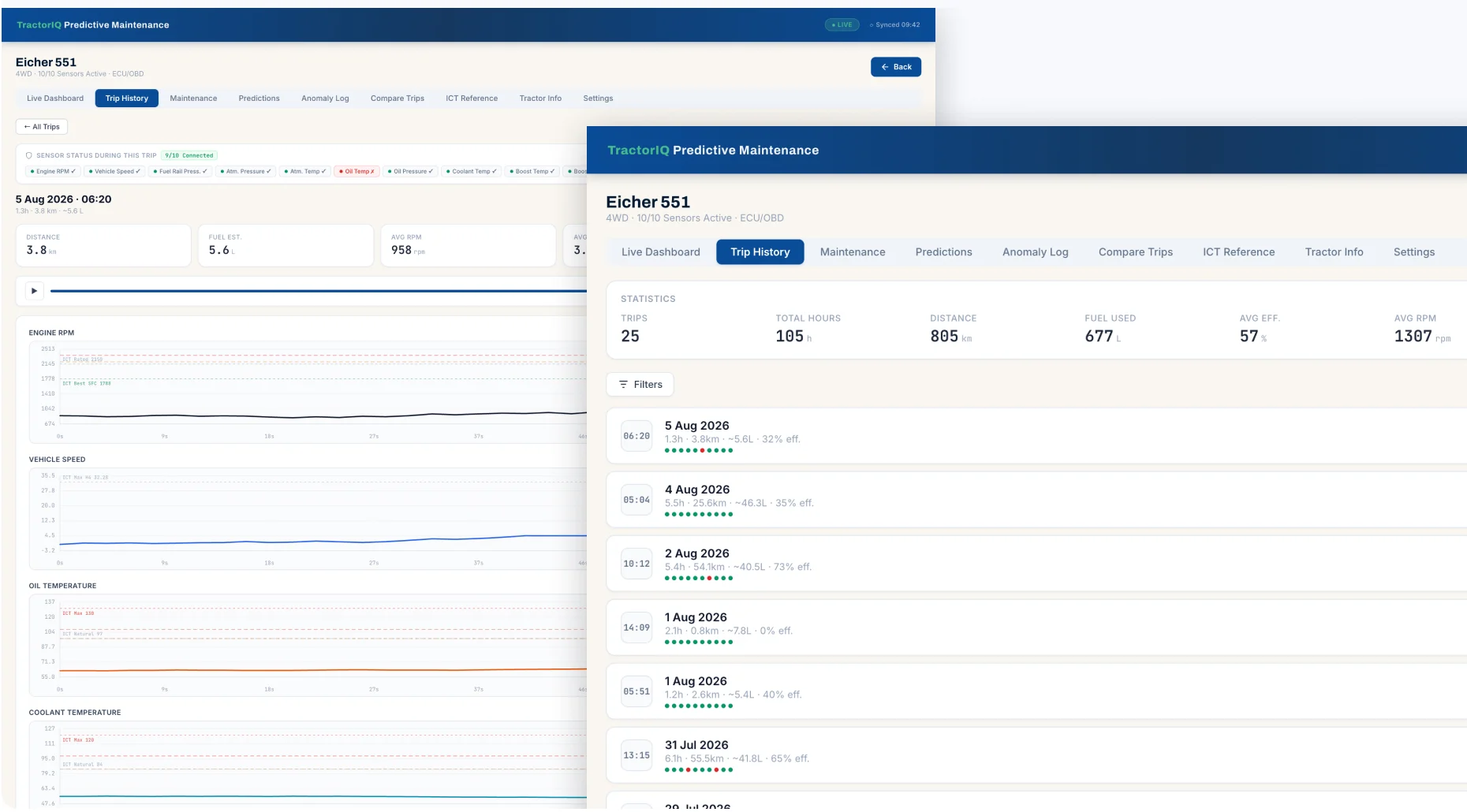
Created per-session scoring across efficiency, RPM band distribution, peak temperatures, and alert events.
Helped teams understand tractor usage behaviour.
Supported service recommendations with session-level context.
Gave OEM teams better insight into real-world field operations.
Mechanical-to-Digital Retrofit Kit
Engineered a field-installable sensor, ECU, and storage harness.
Added digital intelligence to legacy mechanical tractors.
Captured essential operating data without requiring full tractor replacement.
Brought older tractors onto the same AI platform as modern models.
Impact
What changed for the client.
The platform helped the OEM shift from fixed service schedules to AI-backed, condition-based maintenance across its tractor fleet.
1
unified predictive maintenance platform built for legacy and modern tractors.
2
tractor generations supported: mechanical legacy tractors and ECU-equipped modern tractors.
3
sensor retrofit model enabled for legacy tractors.
10
sensor data model supported for modern ECU-equipped tractors.
5+
critical subsystems monitored: engine oil, coolant, fuel filter, air cleaner, and injector health.
45%
faster component issue detection through anomaly alerts and service-bay intelligence.
35%
reduction in unplanned downtime risk through early degradation signals.
30%
improvement in service planning efficiency through dynamic maintenance scheduling.
In closing
Where this leaves the product.
The Smart Predictive Maintenance Platform helped the tractor OEM move from reactive and calendar-based servicing to AI-driven, condition-based maintenance.
By combining sensor retrofitting, ECU integration, edge deployment, anomaly detection, RUL prediction, dynamic scheduling, cooling health intelligence, trip-level analytics, and human-in-the-loop learning, DigiWagon created a unified service intelligence layer for the OEM’s active fleet.
The result is a scalable predictive maintenance ecosystem that improves service accuracy, reduces downtime risk, extends component life, and gives the OEM a deeper view of how tractors perform in real field conditions.
DigiWagon helps industrial teams connect sensor data, AI models, edge systems, and service dashboards to improve maintenance accuracy and operational visibility.
Pick a question, then the assistant you use. It opens in a new tab with this case study as its source.
The question it opens withRead https://digiwagon.com/case-studies/smart-predictive-maintenance-tractor-oem. Explain the problem, the approach and the result in plain language for a CFO. Stick to what the page says and mark anything you are not sure about.
The question it opens withRead https://digiwagon.com/case-studies/smart-predictive-maintenance-tractor-oem and tell me what would need to be true about my company, team and systems for a similar approach to work for us. Stick to what the page says and mark anything you are not sure about.
The question it opens withRead https://digiwagon.com/case-studies/smart-predictive-maintenance-tractor-oem and list the questions I should ask DigiWagon on a first call if I wanted a result like this one, based only on what the page says.