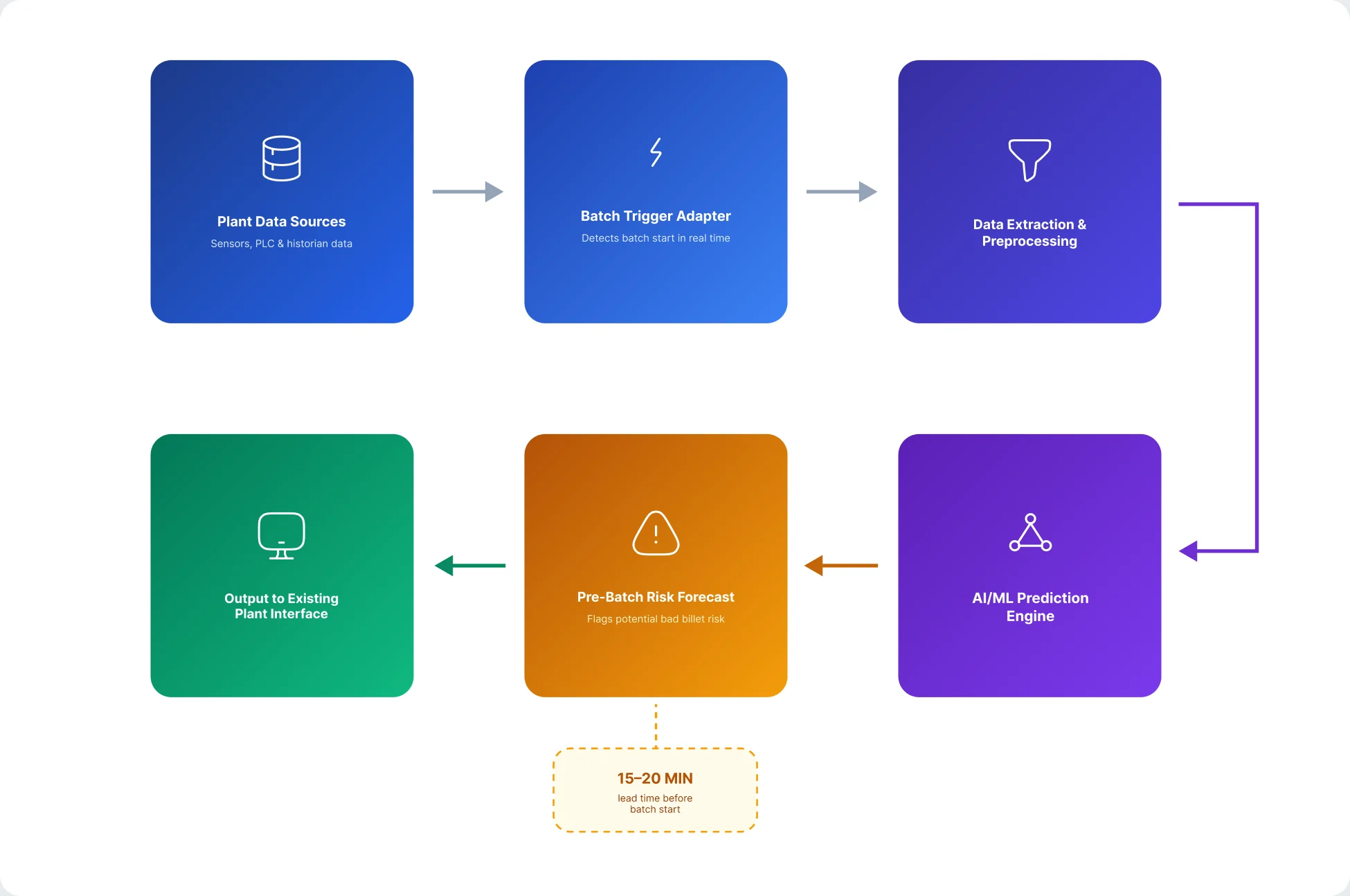
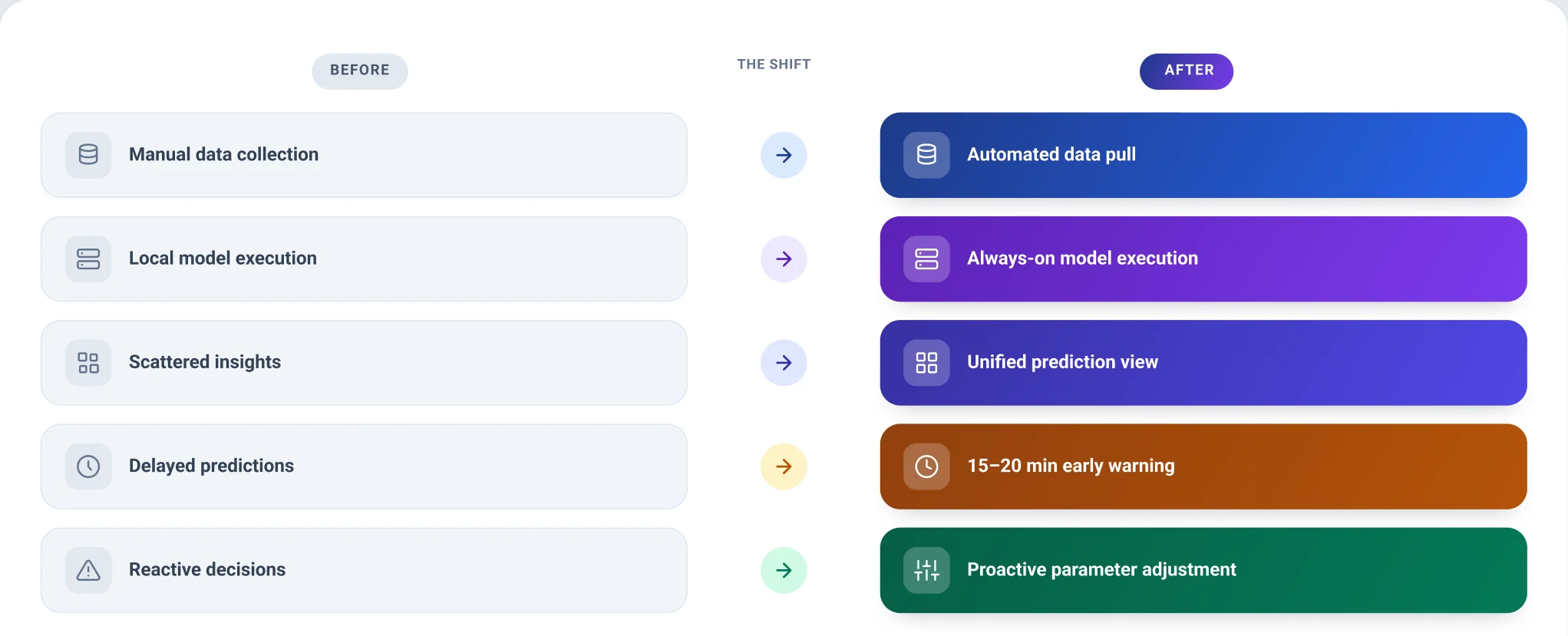
A global natural resources enterprise operating across India, South Africa, Liberia, and Namibia wanted to improve intelligence across its manufacturing operations. The organisation already had a custom plant management framework for real-time process data. But production insights were scattered and predictions were manual. The AI/ML workflow relied on local systems and human help. DigiWagon built a fully automated prediction engine. It connects plant data, batch triggers, AI/ML models, and output insights. It runs as one always-on intelligence layer.
The result was a scalable manufacturing intelligence platform. It helps plant teams detect risks earlier, reduce manual errors, and act before faulty output occurs. It also optimises resource use across production workflows.
Why it mattered
Why Manufacturing Intelligence Needed Automation
The client’s plant operations generated valuable process data, but the intelligence layer was not fully connected to production output. Teams had to collect data, run predictions, compare parameters, and interpret results through a fragmented workflow. This slowed decisions, increased the risk of human error, and limited the ability to act before production quality issues occurred. The organisation needed a system that could do more than display operational data. It needed to trigger, process, predict, and push insights back into the existing plant ecosystem without manual intervention.
Business Challenge
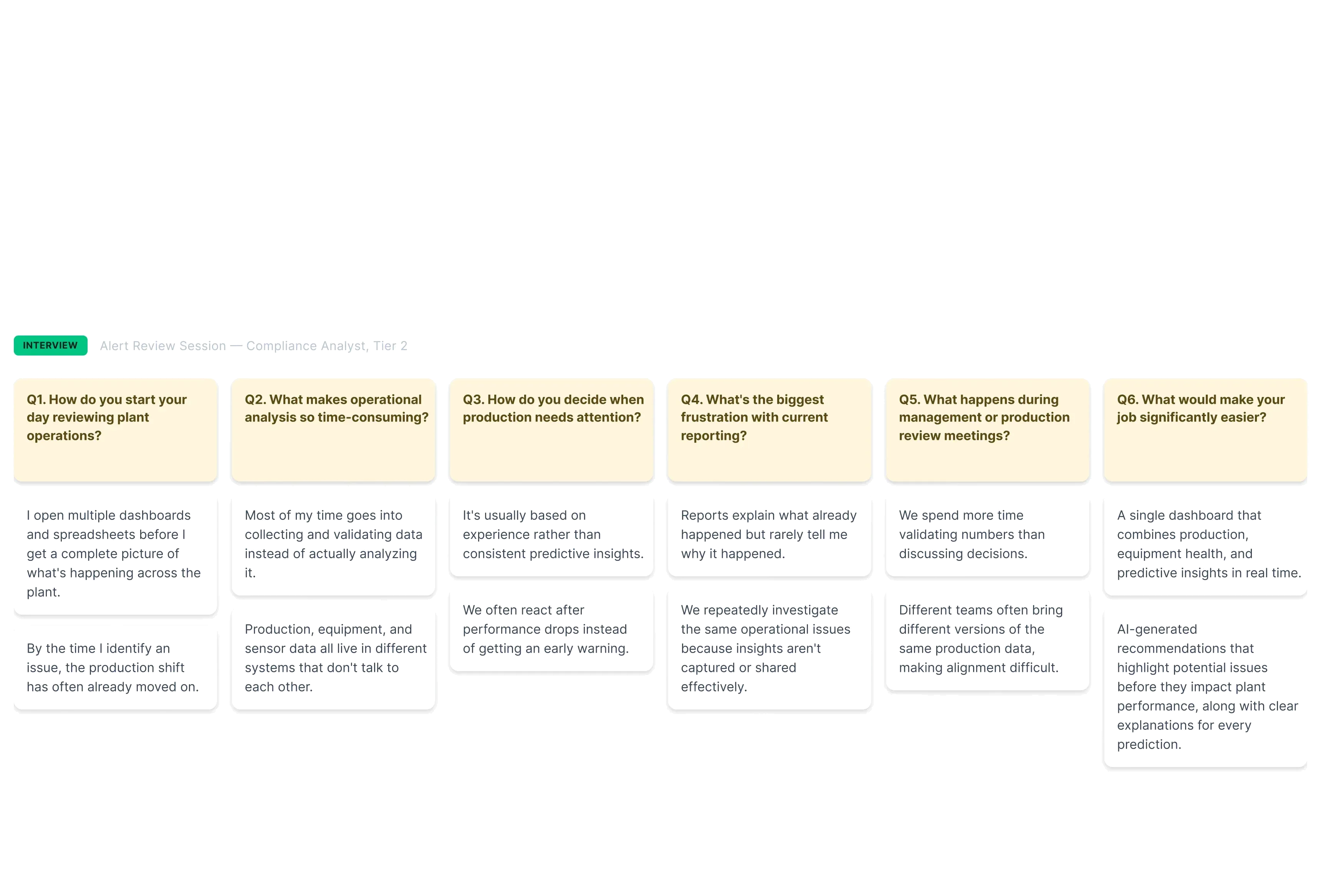
Production data was available, but predictive intelligence was disconnected from output workflows.
AI/ML models required manual execution, which increased delays and error risk.
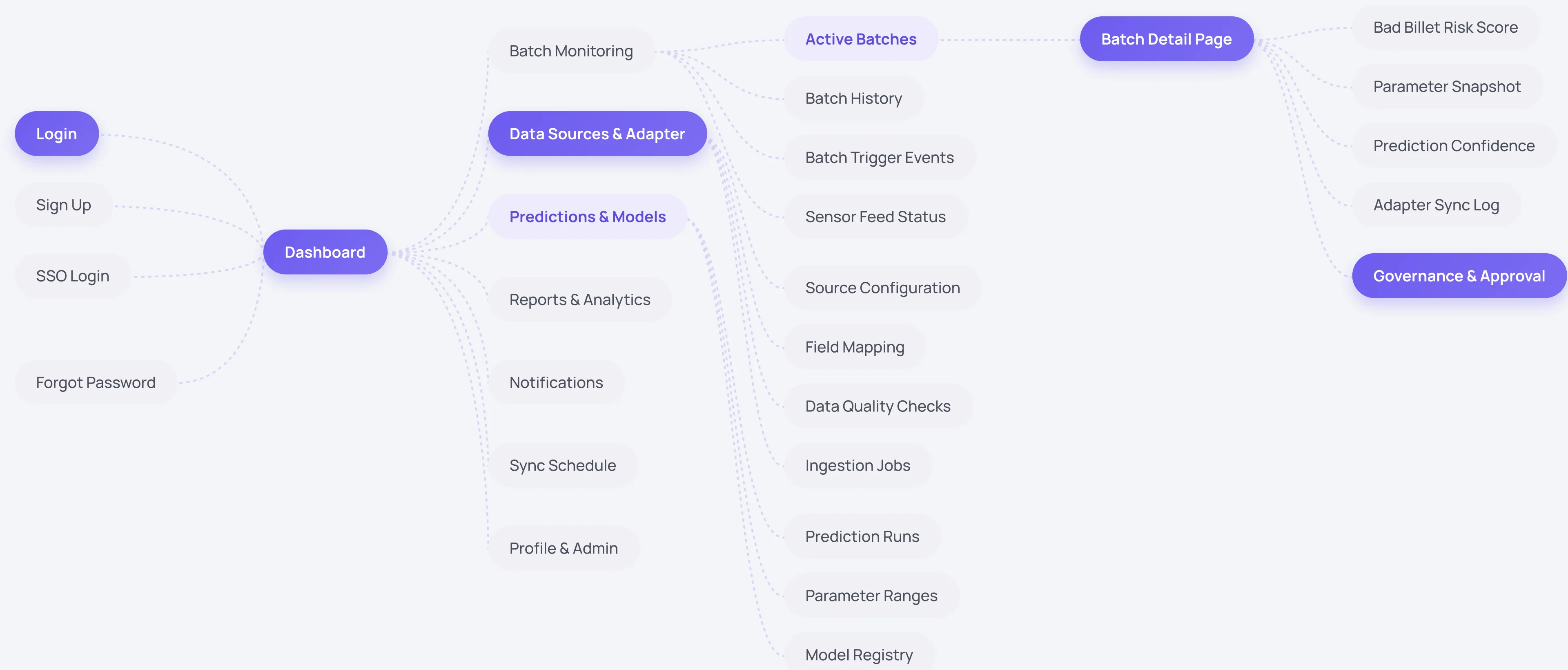
Teams lacked a unified operational view of predictions, batch status, and recommended actions.
Operators needed early warnings before a batch could produce poor-quality output.
Historical and live data needed to work together for better model execution.
The existing plant system needed an adapter layer to connect with the prediction engine.
The architecture had to scale across production lines, plants, and future data sources.
Decision-making needed to shift from reactive monitoring to proactive prediction.
Manufacturing Context
Modern manufacturing operations are moving from dashboards to decision intelligence.
Real-time plant data is useful. Its value grows when it triggers automated models, forecasts quality risks, and guides corrective action early. This helps stop issues before they affect production output.
For batch-driven manufacturing, even a 15 to 20 minute prediction window gives teams time to adjust settings. It helps reduce waste and improve production control.
User Problem
Operators needed faster visibility into batch-level risks.
Process engineers needed a reliable way to run predictions without local manual steps.
Operations teams needed one view of plant data, predictions, and performance signals.
Data teams needed a flexible adapter that could connect with changing data sources.
Plant managers needed confidence that insights were timely, accurate, and actionable.
Teams needed fewer manual dependencies between data collection, model execution, and output delivery.
How we delivered
How We Built the Prediction Layer
Connect
Linked plant data with prediction workflows
Real-time process data
Historical plant logs
Batch start and end events
Data integration system
Existing plant management framework
Automate
Removed manual execution from the AI/ML pipeline
Data extraction
Data preprocessing
Model execution
Prediction result generation
Output delivery
Predict
Enabled pre-batch quality forecasting
Parameter range analysis
Bad billet risk prediction
Batch-level forecasting
Early warning signals
Corrective action support
Scale
Built a future-ready adapter and architecture
Custom adapter layer
API-driven integration
Flexible model parameter handling
Scalable backend workflows
Multi-plant readiness
What we built
What DigiWagon Built for the Client
DigiWagon built an automated AI/ML prediction platform that connects production data, predictive models, batch triggers, and operational outputs into a unified intelligence loop. The system pulls data from live and past sources. It starts prediction workflows automatically and runs AI/ML models. It then sends results back to the existing plant software interface.
Built a fully automated AI/ML prediction engine for manufacturing operations.
Automated the complete pipeline from data extraction to prediction output.
Created a batch trigger system to detect batch start and completion events.
Enabled compatibility with real-time process data and historical production logs.
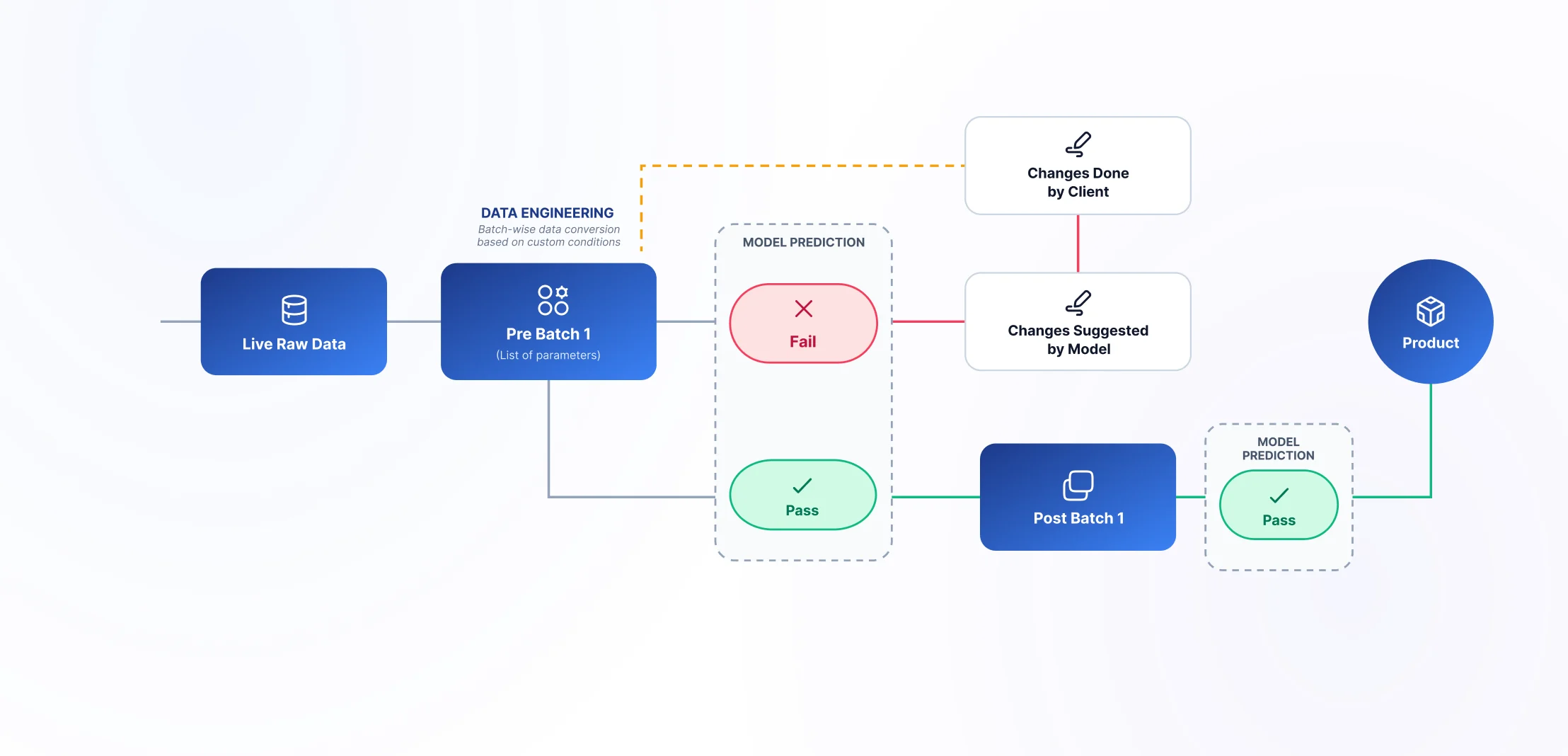
Built pre-batch prediction workflows to forecast potential bad billet outcomes.
Enabled prediction checks 15 to 20 minutes before batch execution.
Integrated model outputs back into the existing plant software interface.
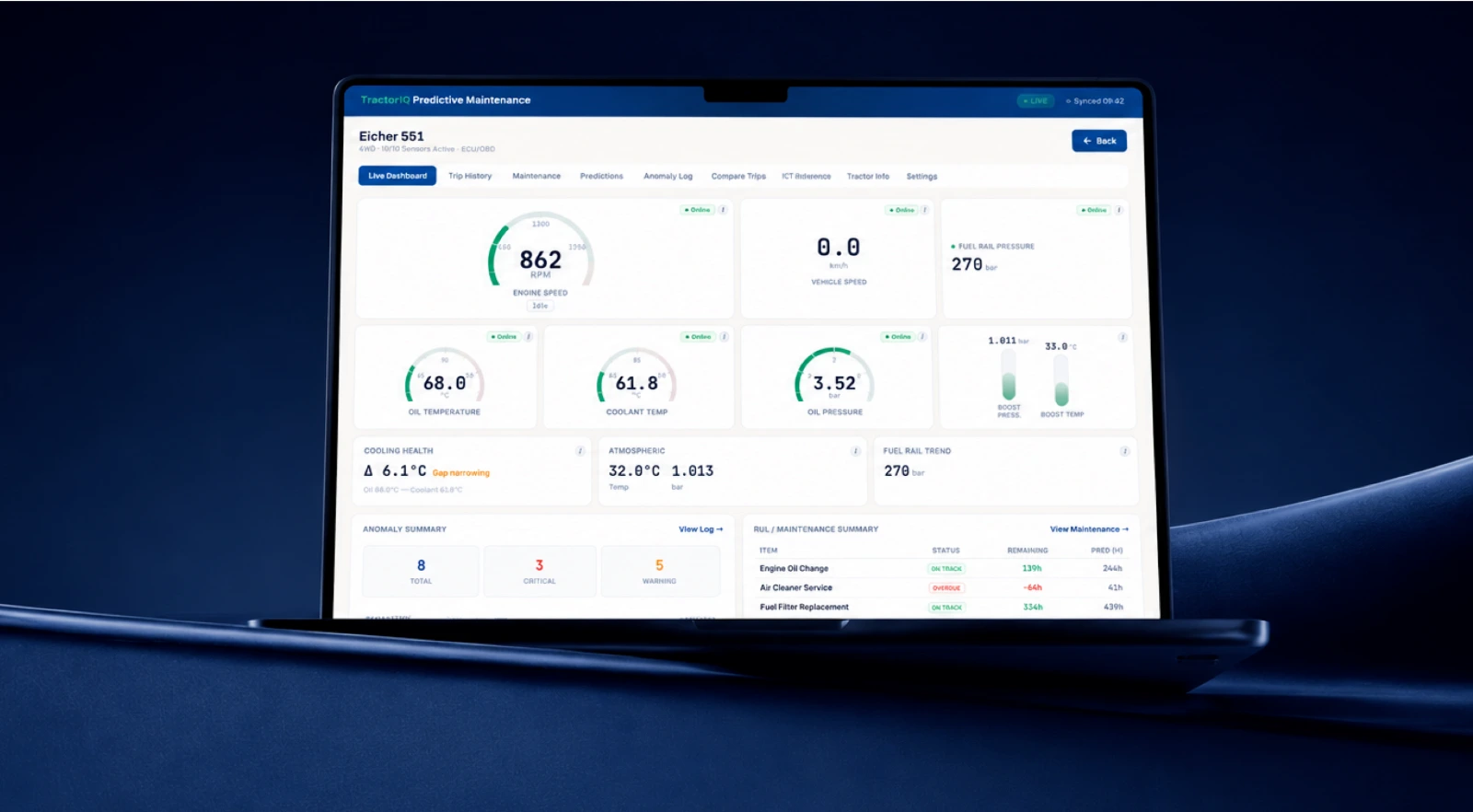
Created a unified view of predictions, performance signals, and suggested actions.
Built a custom adapter to connect with existing and future data sources.
Developed scalable backend APIs for industrial data processing.
Reduced dependency on local systems and manual model execution.
Delivered a secure and scalable foundation for future manufacturing intelligence.
Key features
Core Manufacturing Intelligence Experiences
Automated AI/ML Engine
Built an automated engine that manages data extraction, preprocessing, model execution, and output delivery.
Reduced manual intervention across the prediction workflow.
Improved consistency in how models were triggered and executed.
Helped teams rely on faster and more repeatable production intelligence.
Pre-Batch Prediction Workflow
Built forecasting workflows that run before batch execution.
Enabled predictions 15 to 20 minutes before a batch starts.
Helped detect potential bad billet outcomes based on critical parameters.
Gave operators time to adjust inputs before quality issues occurred.
Batch Trigger System
Created an adapter that detects when a batch starts or ends.
Automatically pulled relevant batch data for model execution.
Removed manual logging delays from the prediction process.
Enabled the system to respond to production events in real time.
Unified Data Output
Integrated prediction results back into the existing plant software interface.
Created one view for predictions, performance, and suggested parameter changes.
Reduced platform switching for plant teams.
Helped operations teams act faster on AI-generated insights.
Real-Time and Historical Data Compatibility
Enabled the platform to process live data feeds and archived production logs.
Supported flexible analysis across current operations and past performance.
Helped teams compare historical patterns with active batch conditions.
Created a stronger data foundation for predictive decision-making.
Customizable Adapter Layer
Built a flexible adapter to connect the prediction engine with the plant ecosystem.
Supported changing model parameters and new data sources.
Allowed the system to evolve with production workflows.
Created a future-ready integration layer for manufacturing intelligence.
Scalable and Secure Architecture
Developed API-driven backend workflows for large production datasets.
Built the foundation to scale across units, batches, plants, and production zones.
Supported secure data movement between systems.
Enabled long-term expansion without rebuilding the core architecture.
Technology
The stack behind this build.
Backend
Python
Django
QA
Postman
Cloud & DevOps
Git/GitHub/GitLab
Azure
Data
MySQL
Impact
What changed for the client.
The platform helped the client move from manual prediction workflows to an automated manufacturing intelligence system that supports faster decisions, earlier intervention, and better production visibility.
1
automated AI/ML pipeline built for production intelligence.
1
custom adapter layer created to connect the plant ecosystem with prediction workflows.
In closing
Where this leaves the product.
The global natural resources enterprise now has an automated manufacturing intelligence system that turns plant data into timely, actionable predictions. By linking batch triggers, real-time data, and past data, DigiWagon connected all key inputs. It linked AI/ML model runs and prediction outputs. It also integrated these with the plant software interface which replaced manual prediction work with an always-on intelligence layer. The result is a scalable prediction engine which helps people make faster decisions. It reduces manual work and improves operational visibility. It helps teams act before quality issues happen.
Pick a question, then the assistant you use. It opens in a new tab with this case study as its source.
The question it opens withRead https://digiwagon.com/case-studies/mining-intelligence-automating-insights-below-the-surface. Explain the problem, the approach and the result in plain language for a CFO. Stick to what the page says and mark anything you are not sure about.
The question it opens withRead https://digiwagon.com/case-studies/mining-intelligence-automating-insights-below-the-surface and tell me what would need to be true about my company, team and systems for a similar approach to work for us. Stick to what the page says and mark anything you are not sure about.
The question it opens withRead https://digiwagon.com/case-studies/mining-intelligence-automating-insights-below-the-surface and list the questions I should ask DigiWagon on a first call if I wanted a result like this one, based only on what the page says.