The Platform Economy in 2026
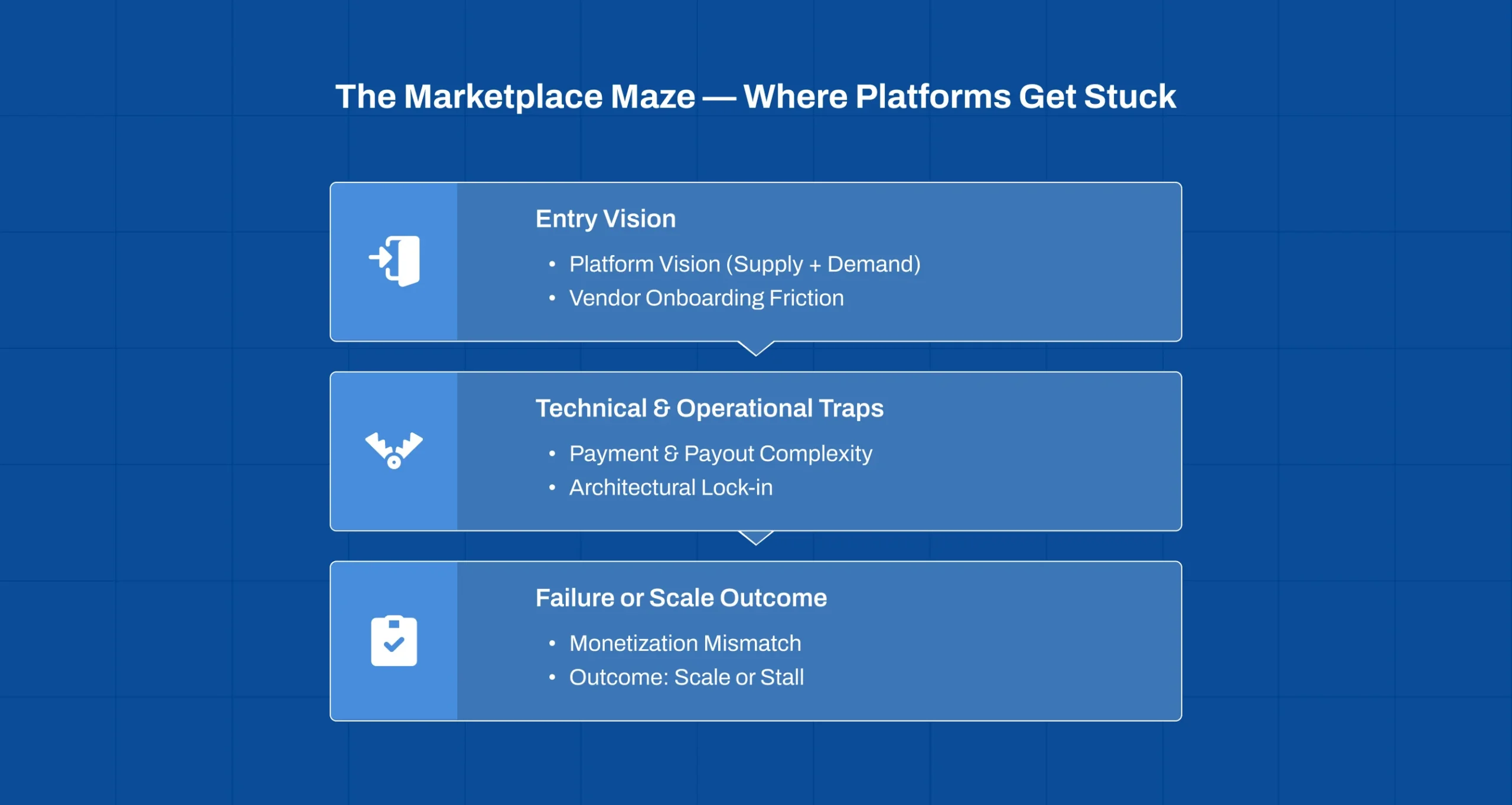
Launching a marketplace involves navigating architectural, operational, and financial complexity. Platforms fail when onboarding is slow, payments are manual, or the architecture can’t adapt, turning growth into friction instead of momentum. This is where robust eCommerce Development becomes essential, ensuring your marketplace is designed for scalability, automation, and seamless user experiences.
The “Marketplace Model” has become the gold standard for digital scalability. Whether you are a startup aiming to be the next industry disruptor or an enterprise looking to expand your ecosystem, building a marketplace allows you to scale without the overhead of inventory. However, the path to a profitable marketplace is a “maze” of technical and strategic hurdles.
For CTOs and Founders in the USA, UK, and UAE, the success of a platform isn’t just about listing products; it’s about the underlying architecture that manages the complex relationship between buyers, sellers, and the platform owner. Our core focus on Marketplace Development ensures your platform is built to scale from day one.
B2B vs B2C Marketplaces: Understanding the Architectural Divide
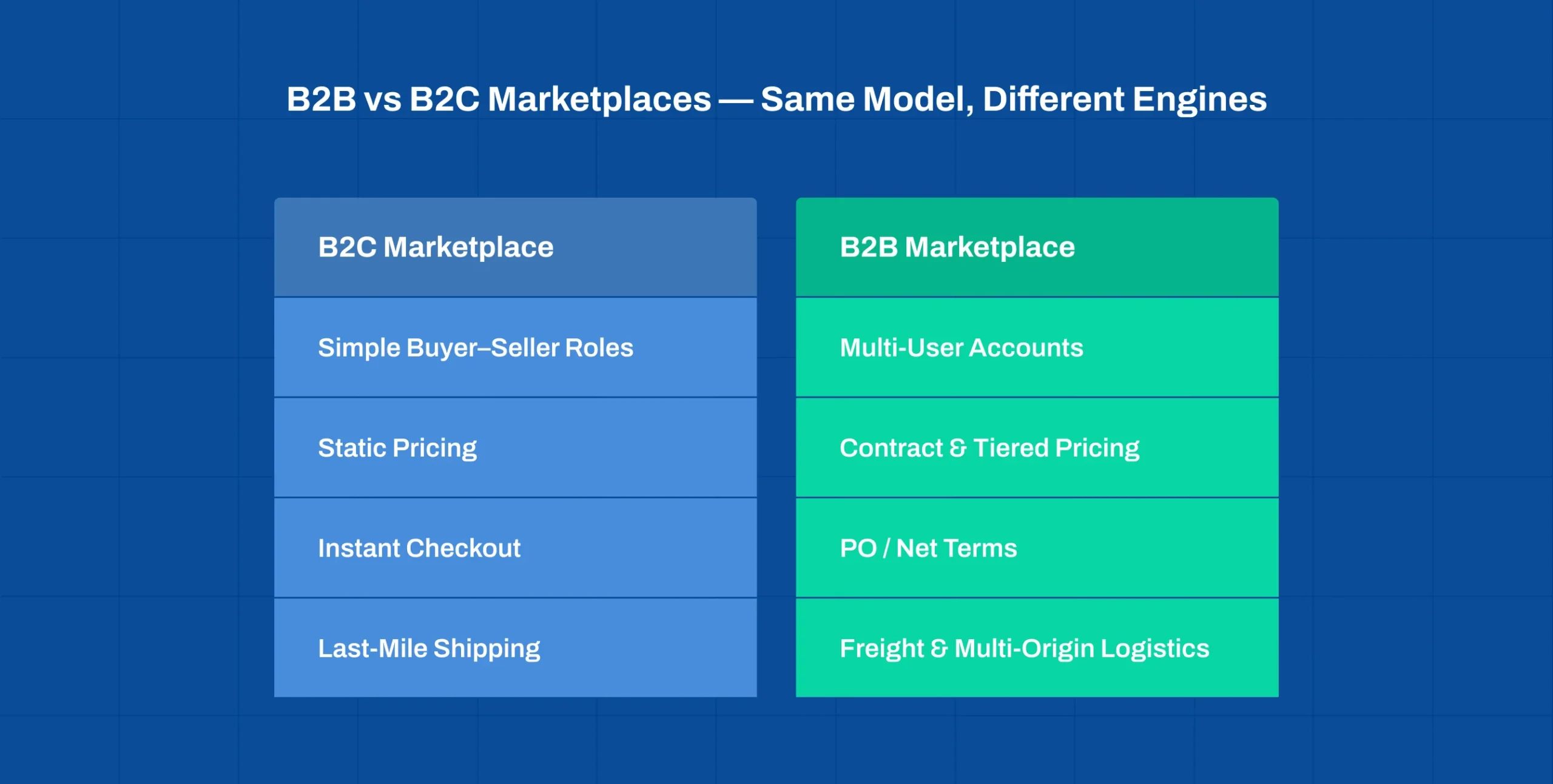
The difference between B2B and B2C marketplaces is who buys and how. A B2C marketplace sells to individual consumers: one buyer, list prices, card or wallet payment and an instant checkout. A B2B marketplace sells between businesses: several people per account with roles and approval limits, negotiated or tiered pricing, bulk and repeat orders, invoicing with credit terms, and integrations with the buyer’s procurement or ERP system. B2C competes on speed and discovery; B2B competes on accuracy, compliance and fit with how the customer already buys.
B2C marketplaces optimise for speed and simplicity. B2B marketplaces must handle enterprise purchasing logic, approvals, pricing contracts, and complex logistics, requiring a fundamentally different technical engine.
While the goal of both is to facilitate trade, the technical “engine” under the hood is vastly different. B2B marketplaces are inherently more complex due to the nature of enterprise purchasing.
| Dimension | B2C marketplace | B2B marketplace |
|---|---|---|
| Buyer | An individual consumer: one buyer, one seller | A company account with several users, roles and approval workflows |
| Pricing | One list price, promotions | Contract, tiered and negotiated pricing per account |
| Order pattern | Small baskets, impulse and one-off | Bulk, scheduled and repeat orders |
| Checkout | Instant, guest allowed | Quotes, approvals and purchase orders before payment |
| Payment | Card, wallet or UPI at purchase | Invoice, net terms, split payouts to vendors |
| Shipping | Standard last-mile parcel | Freight, LTL (less-than-truckload), multi-origin logic |
| Onboarding | Light seller verification | KYC, tax and compliance checks for every vendor |
| What wins | Discovery, speed and trust | Accuracy, workflow fit and integrations |
Decision #1: Choosing the Right Marketplace Architecture
One of the first and most critical Marketplace Development Decisions is choosing between a “Boxed” solution and a Composable approach.
Monolithic vs Composable Multi-vendor Systems
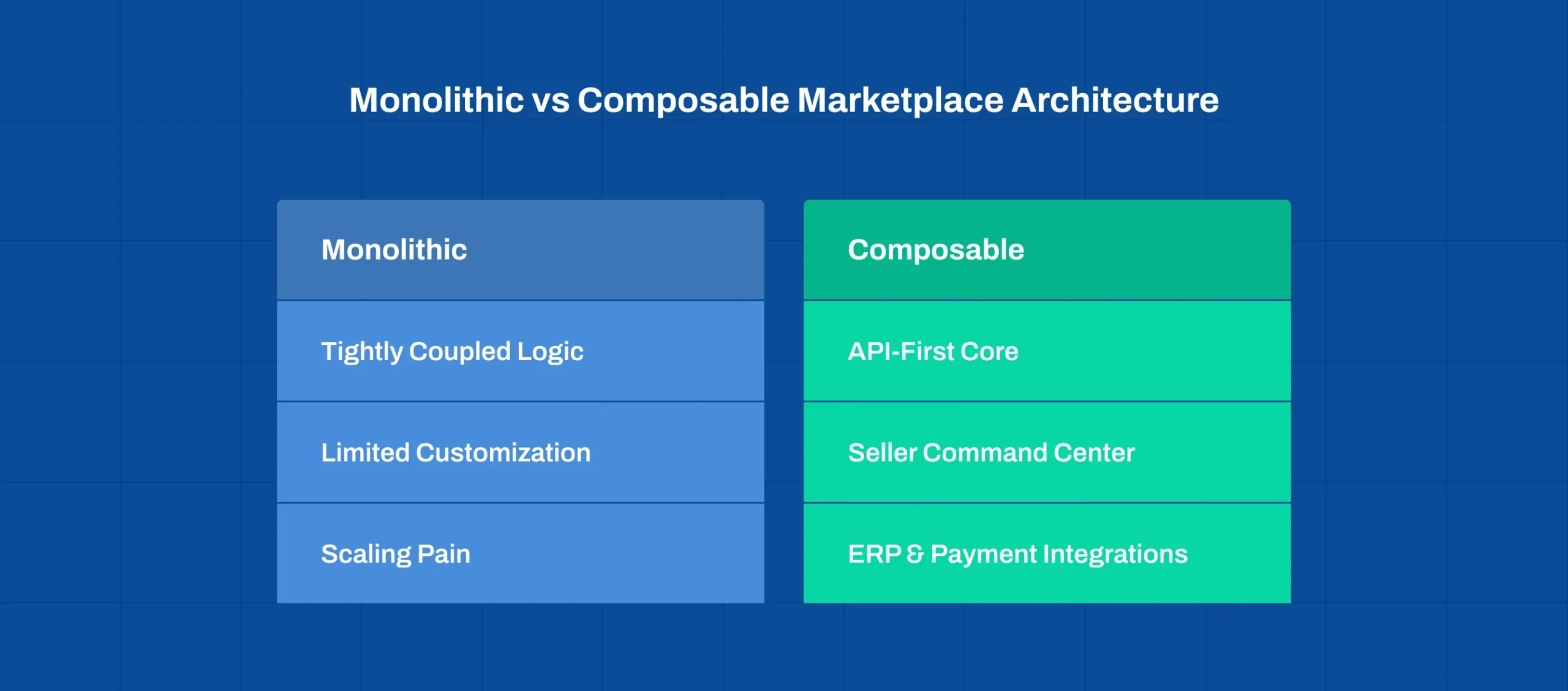
Composable architecture allows marketplaces to scale and customise without breaking core logic. Headless, API-first systems enable advanced vendor dashboards, ERP integrations, and future-proof expansion.
Traditional marketplace builders are often monolithic, everything is tightly coupled. While faster to launch, they often break when you need to customise vendor payout logic or integrate a specific B2B ERP. Modern marketplaces are increasingly adopting SaaS Product Development principles, utilizing Composable Architecture.
By using a headless approach, you can build a customised “Seller Command Centre” that allows vendors to manage their own catalogs while the core commerce logic remains centralised and stable.
Decision #2: Solving the Vendor Onboarding Friction
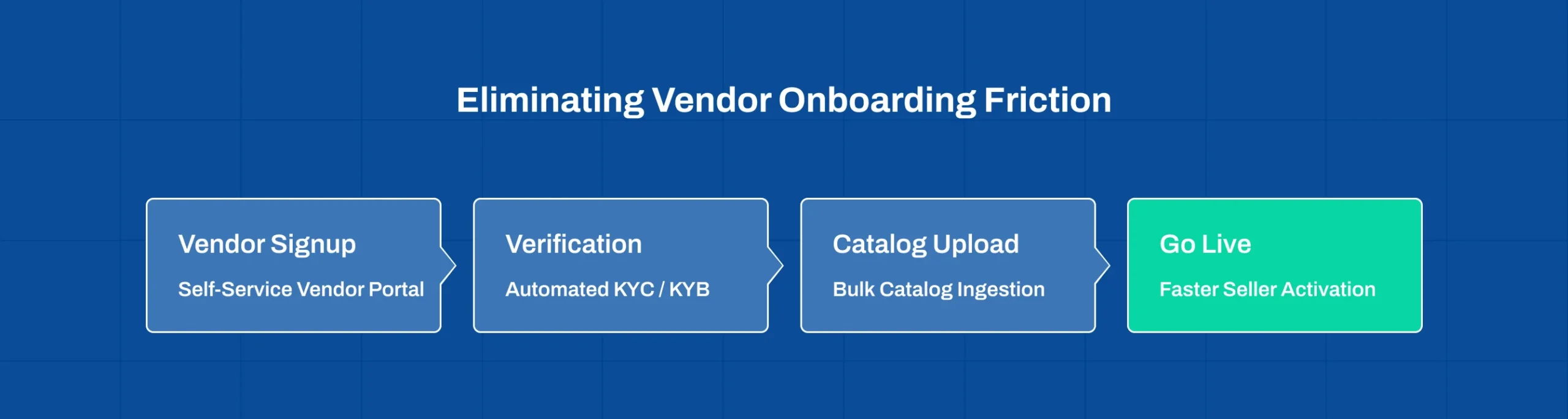
Automated onboarding removes the biggest barrier to marketplace growth. Self-service portals, instant KYC, and bulk data ingestion dramatically reduce seller activation time.
The “Chicken and Egg” problem of marketplaces is real: you need buyers to attract sellers, but you need sellers to attract buyers. The bottleneck is often the onboarding process.
Automated KYC and Self-Service Portals
In 2026, manual vendor verification is a growth killer. Launching a profitable marketplace requires:
- Automated KYC/KYB: Integrating services like Stripe Identity or Jumio to verify business credentials instantly.
- Bulk Data Ingestion: Managing thousands of vendors requires robust Data Engineering & ETL processes to map diverse vendor product feeds into your global catalog format.
Decision #3: Payment Orchestration and Payout Logic
Revenue in a marketplace is all about the “Flow of Funds.” You are not just taking a payment; you are orchestrating a multi-party financial transaction.
Split Payments and Escrow Services
Marketplace revenue depends on orchestrating complex financial flows, splitting payments, deducting commissions, calculating taxes, holding escrow, and automating payouts, without manual intervention.
The platform must handle Split Payments, where a single customer checkout contains items from three different vendors. The system must automatically:
- Deduct the platform commission.
- Calculate taxes based on the vendor’s location.
- Hold funds in Escrow until the buyer confirms delivery.
- Trigger automated payouts to the vendors’ bank accounts.
Decision #4: Choosing Your Monetisation Engine
Successful marketplaces rely on hybrid monetisation. Combining commissions, subscriptions, value-added services, and sponsored listings maximises revenue while aligning incentives across vendors and the platform.
Your development choices must support your revenue model. A profitable marketplace often uses a “Hybrid” monetisation strategy:
- Commission Model: Taking a % of every transaction.
- Subscription Fees: Charging vendors for “Pro” features or higher listing limits.
- Value-Added Services: Offering fulfilment (Ship-by-Marketplace) or insurance as an add-on.
- Sponsored Listings: Allowing vendors to pay for better search visibility.
The Role of AI in Marketplace Scalability
AI enables marketplaces to scale safely by automating moderation, fraud detection, discovery, and recommendations, maintaining trust and experience as vendors and SKUs multiply.
As your marketplace grows to thousands of SKUs and hundreds of vendors, human moderation becomes impossible. This is where AI & Machine Learning models provide automated moderation.
AI can automatically flag prohibited items, detect fraudulent reviews, and even suggest “Similar Items from Other Sellers” to prevent a bounce if a specific vendor is out of stock. Ensuring security and performance through rigorous Quality Assurance & Testing is essential to keep these AI features running smoothly.
Marketplaces that minimise friction, ensure trust, and leverage data unlock the network effect, where growth compounds naturally through better selection, experience, and intelligence.
Conclusion: Building for the Network Effect
Launching a marketplace is a marathon, not a sprint. The “maze” is navigable only when you prioritise a flexible, API-first architecture that can adapt as your network grows. At DigiWagon, we help businesses design scalable marketplace platforms that are built for long-term growth and operational efficiency. By focusing on automated onboarding, sophisticated payment orchestration, and AI-driven moderation, you transform a simple directory into a powerful, profitable ecosystem.
Related reading: B2B2C and hybrid marketplace models, B2B eCommerce architecture: custom vs composable vs platform, and our free Build vs Buy Advisor for the platform-or-custom question.