Cross-Platform Decision: Key Takeaways
- Cross platform app development pays off when one team must ship and own both Android and iOS apps.
- In India, Android dominates installs, so first ask whether the product needs iOS at all.
- Kotlin Multiplatform shares business logic module by module, which suits teams with mature native apps.
- Store SDK deadlines arrive every year; shared-UI frameworks add a framework upgrade track on top.
- RBI device-binding and version-retirement rules apply to every approach and move work into native modules.
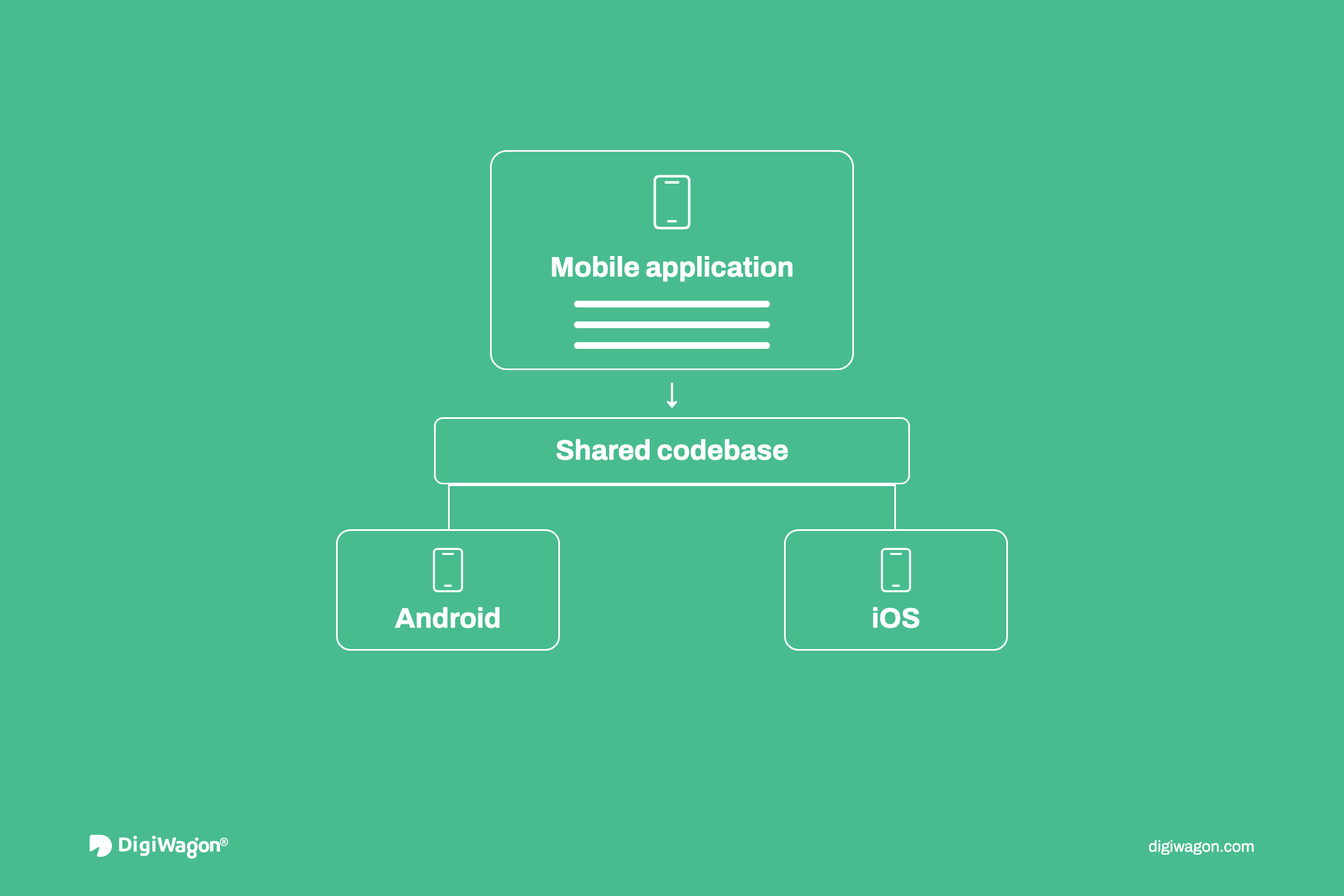
Cross platform app development is building Android and iOS apps from a shared codebase, using Flutter, React Native or Kotlin Multiplatform. It pays off when one team owns both apps and the product stays below native's hardware and background-execution thresholds. The result is one release train, with a single tested business-logic layer behind both store binaries.
Why the Cross-Platform Question Looks Different in India
India's mobile audience is lopsided. Android held 94.84% of the country's mobile operating system market in October 2026, against 5.1% for iOS (Statcounter, 2026).
A collections app on company Android phones may never need iOS. A retail banking app usually does, because its customers include iPhone users the business cannot leave out.
So the native vs cross platform decision is rarely about frameworks. It turns on whether the product needs two platforms, and whether the smaller one justifies a second native team.
When Does Cross Platform App Development Pay Off?
Cross-platform pays off for an enterprise app when three conditions hold. The product must ship on Android and iOS, and one team will own both apps. No core feature may depend on sustained background work or deep hardware access.
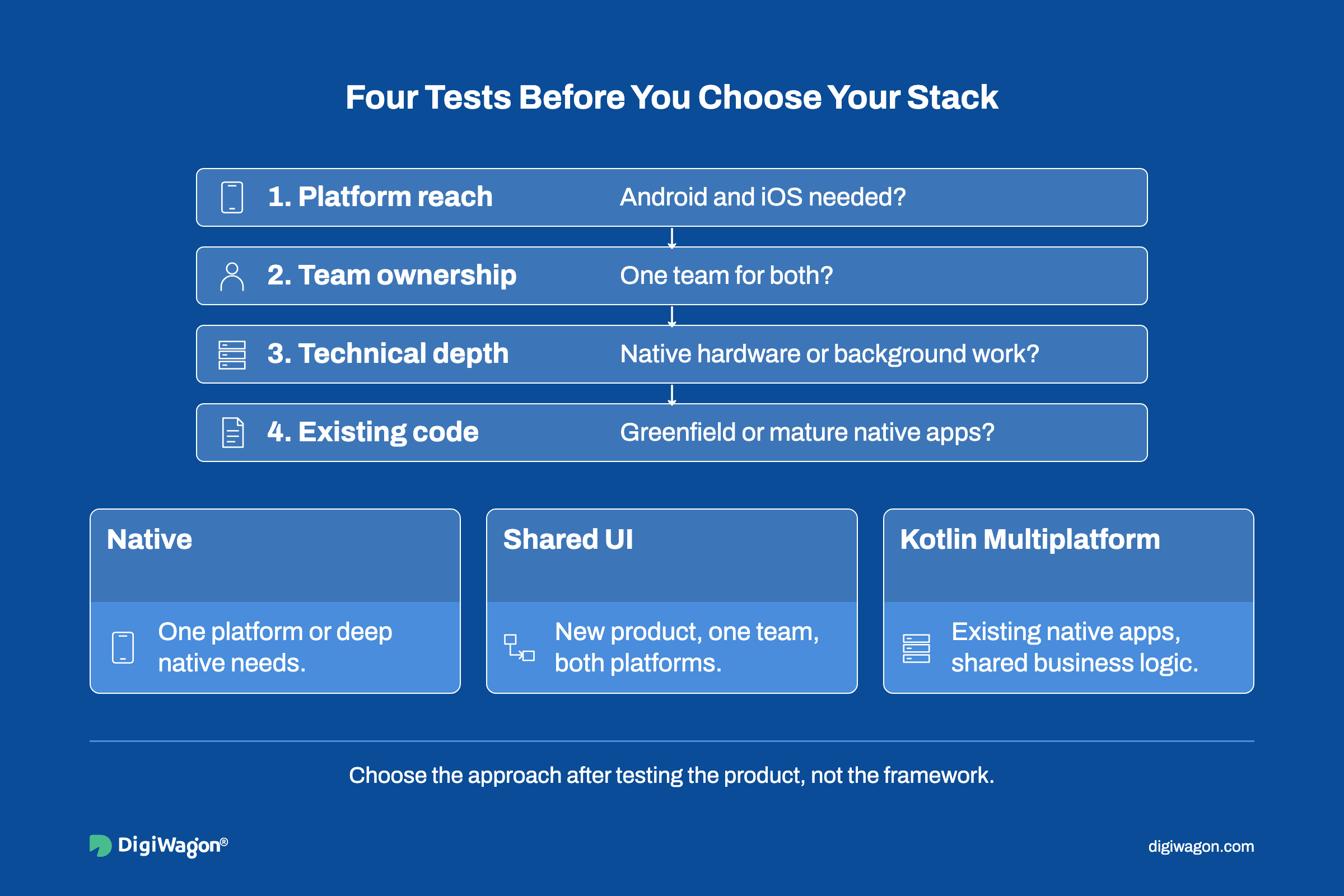
When any of them fails, native or Kotlin Multiplatform usually carries less maintenance over the app's life. Run four tests in order. The first three decide whether shared code fits; the fourth decides which kind.
- Platform reach. Does the product need iOS? If not, build a native Kotlin app and stop here.
- Team shape. Will one team own both apps? Native skills are the narrower pool. In the Stack Overflow Developer Survey 2025, 5.4% of respondents had worked extensively in Swift and 10.8% in Kotlin, against 66% in JavaScript.
- Hardware and background depth. The four-boundary enterprise mobile playbook names three thresholds where native earns its cost. They are sustained background execution, deep hardware access and OS features that ship before any framework supports them. Below them, a shared codebase means one set of fixes instead of two.
- Existing code. A team with a mature native Android app can adopt Kotlin Multiplatform for shared logic without a rewrite. A greenfield product with one team fits a shared-UI framework.
How Do Native, Cross-Platform and Kotlin Multiplatform Compare?
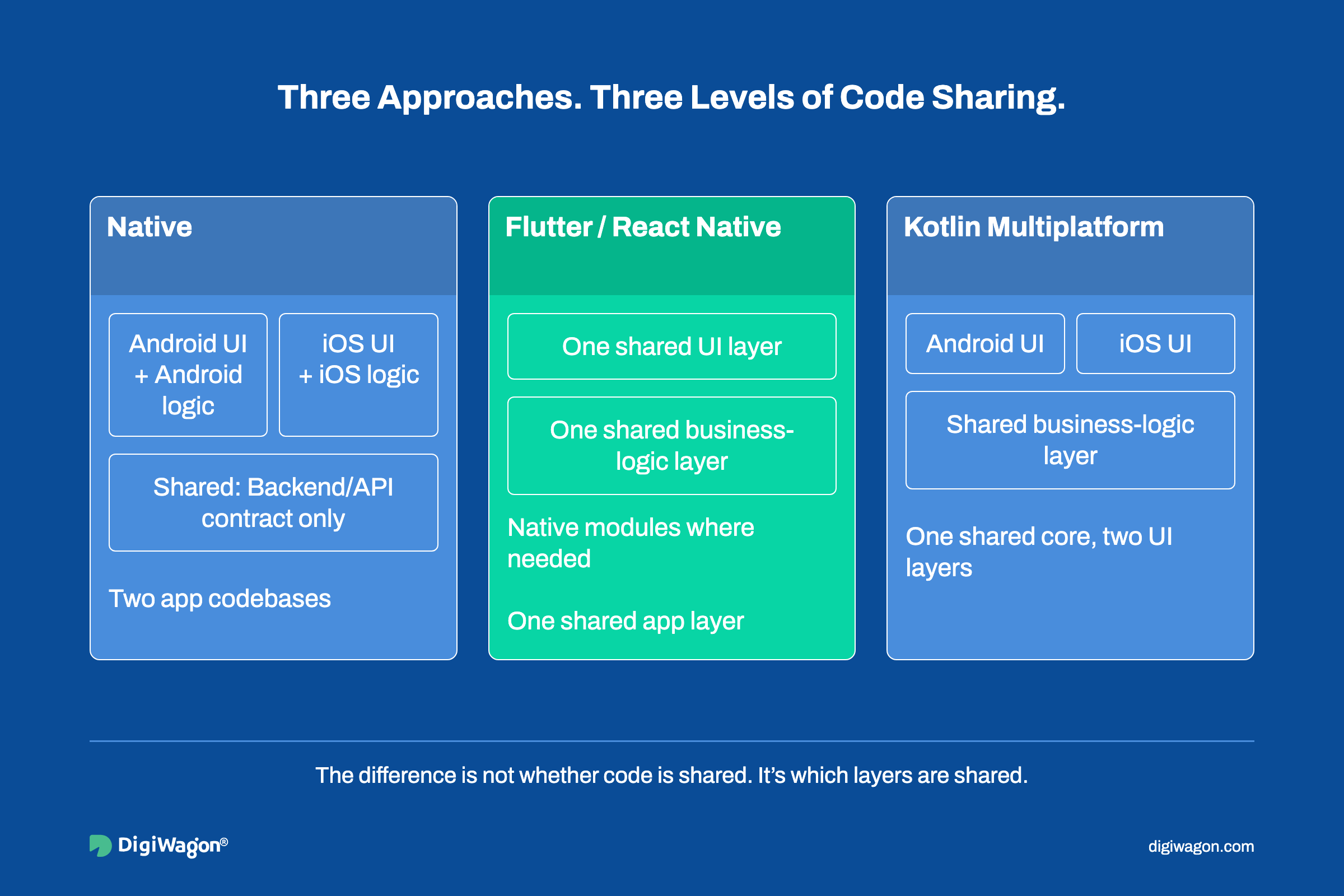
The three approaches differ in how much code they share.
| Decision factor | Native (Kotlin and Swift) | Shared-UI frameworks (Flutter, React Native) | Kotlin Multiplatform |
|---|---|---|---|
| What is shared | Backend and API contract only | UI and business logic | Business logic; UI optional |
| New OS APIs | Usable on release day | Through a plugin or a native module | Usable on release day from the native side |
| Codebases to maintain | Two apps | One app plus native modules | One shared core plus two UI layers |
| Team it fits | Separate Android and iOS engineers | One team in Dart or TypeScript | An Android team taking on iOS |
| Adoption path | New build or existing apps | New build or full rewrite | Module by module inside existing apps |
Google officially supports Kotlin Multiplatform for sharing business logic between Android and iOS and describes it as stable and production-ready (Android Developers, 2026). JetBrains declared Compose Multiplatform for iOS stable in May 2025 (JetBrains, 2025), so teams can extend sharing to the UI when they choose.
Choosing between Flutter and React Native is a separate, later step, covered in the Flutter vs React Native vs Swift guide.
What Does Each Approach Cost Over the App Lifecycle?
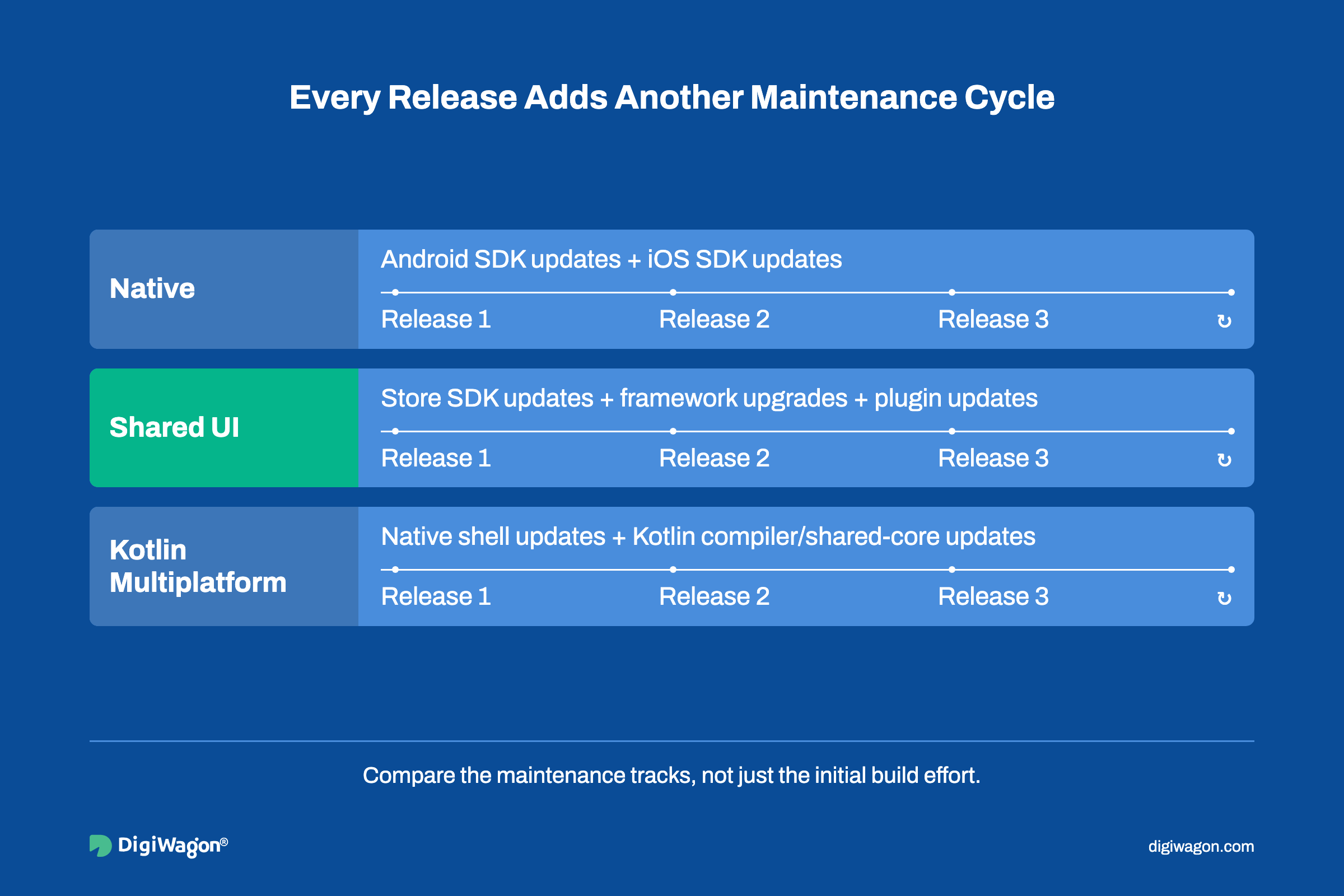
Build effort is the wrong figure to optimise. Both stores force an upgrade every year, whatever the stack:
- Google Play requires new apps and app updates to target Android 16 (API level 36) from 31 August 2026 (Google Play, 2026).
- Apple requires apps uploaded to App Store Connect to be built with Xcode 26 and the iOS 26 SDK from 28 April 2026 (Apple, 2026).
Native carries those upgrades across two codebases. Cross platform mobile app development carries them once, then adds a third track: the framework and every plugin the app depends on.
React Native 0.82, released in October 2025, removed the option to run the Legacy Architecture (React Native, 2025). Apps still on it had to migrate before taking later releases.
With Kotlin Multiplatform, native shells take the store upgrades and the shared core follows the Kotlin compiler. Before committing, confirm the payments, biometrics and device-security plugins are maintained against current SDK targets.
Teams planning a two-platform product can see how cross-platform application development services cover native and shared-code builds.
Which Teams and Constraints Rule Cross-Platform Out?
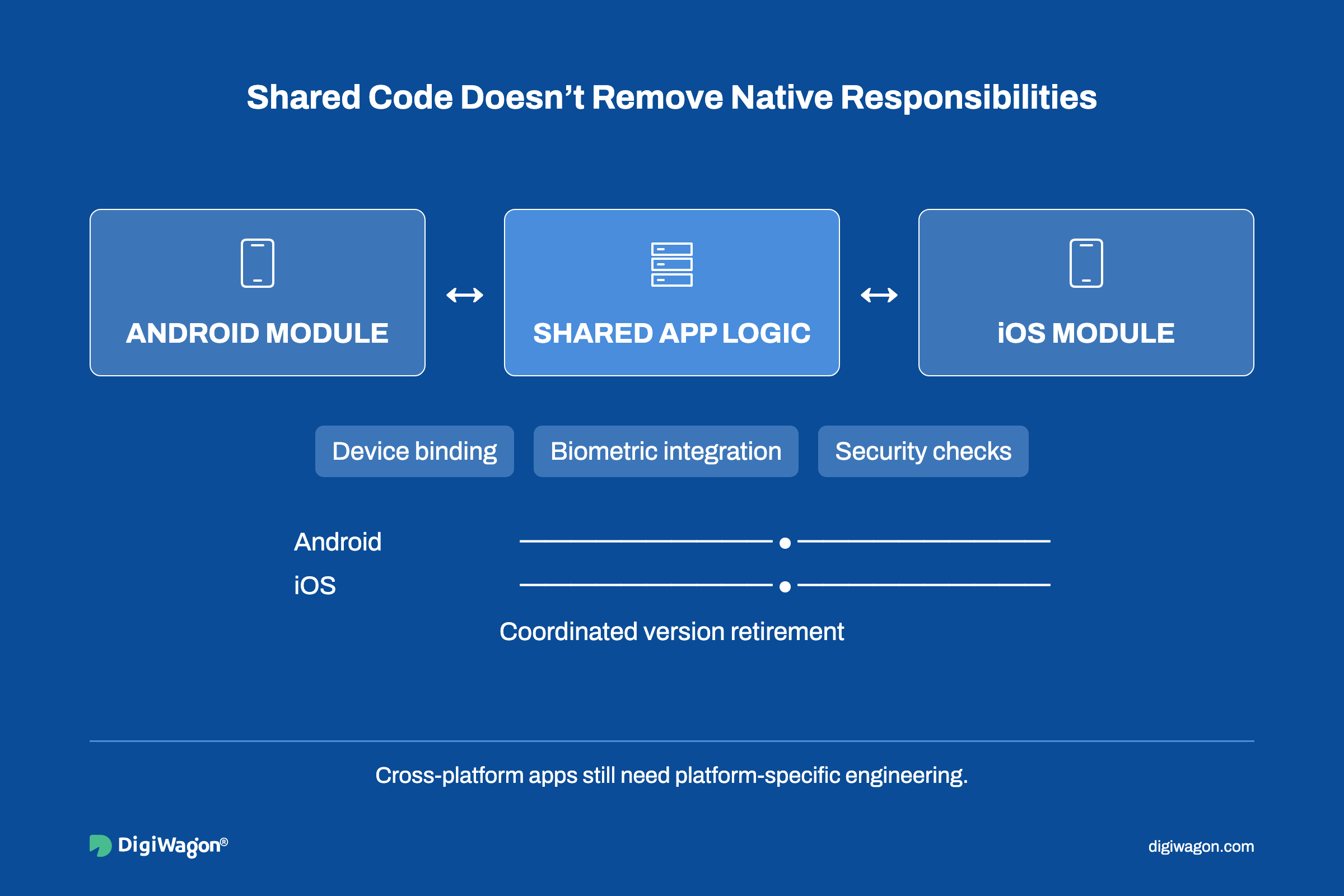
Regulated Indian apps add requirements below the UI. RBI's Digital Payment Security Controls Directions for commercial banks, issued in July 2026, require device binding of the mobile app (RBI, 2026). Older versions must be phased out within six months of a new release, leaving one active version per platform.
What Indian BFSI controls change
- Device binding and root detection. When the bank's security policy requires them, the architectural pattern is a thin native module per platform behind one interface the shared code calls.
- Version retirement. When both apps ship from one release train, the old version retires on one date instead of two schedules.
- Aadhaar biometric capture. Field KYC apps call a certified Registered Device service through Android intents (UIDAI, 2022). On a shared-UI framework, that is a platform channel the team owns.
- Security verification. OWASP MASVS controls are platform-agnostic, so the same checks apply whichever stack produced the binary.
Team setups where shared code backfires
- Platform-split roadmaps. Separate Android and iOS owners and release dates cannot share one codebase's roadmap.
- No owner for native code. Kotlin and Swift modules that nobody in-house can maintain after handover fail first.
- Handover to a different stack. A vendor-built shared-UI app inherited by an in-house Kotlin team starts with a skills gap. Choose for the team running the app in year three.
Lessons from Cross-Platform Lending Builds
The SmartLend personal loan engine we built runs a Flutter mobile app over Java, Spring Boot, Node.js and Express.js services, with MySQL and AWS EC2. The field-agent app in the MSME loan journey we digitised for a small finance bank runs on React Native. It sits beside a ReactJS customer portal and an Express.js backend.
The personal loan engine's case study records a multi-tenant architecture for brand-specific workflows, theming and loan rules. It also records retry and fallback logic around the eKYC/OKYC and CIBIL integrations. No framework supplies that; it has to be built whichever stack draws the screens.
Planning a Cross-Platform Build with DigiWagon
DigiWagon builds Android, iOS and cross-platform apps within its end-to-end software engineering practice.
- Flutter engineering for shared-UI apps
- React Native engineering on the New Architecture
- Kotlin Multiplatform for teams with mature native apps
- Native modules for device binding and biometric capture
Making the Cross-Platform Call
Settle whether the product needs both platforms before choosing a framework. Shared code wins when one team ships both stores and no core feature needs native depth; otherwise native or Kotlin Multiplatform holds up better. For a regulated app, the team also ships a device-binding module, an integration layer and a release train. Those carry the app through every later store deadline.