Application Rationalization: Key Takeaways
- Application rationalization fails when teams pick a disposition before they can prove it.
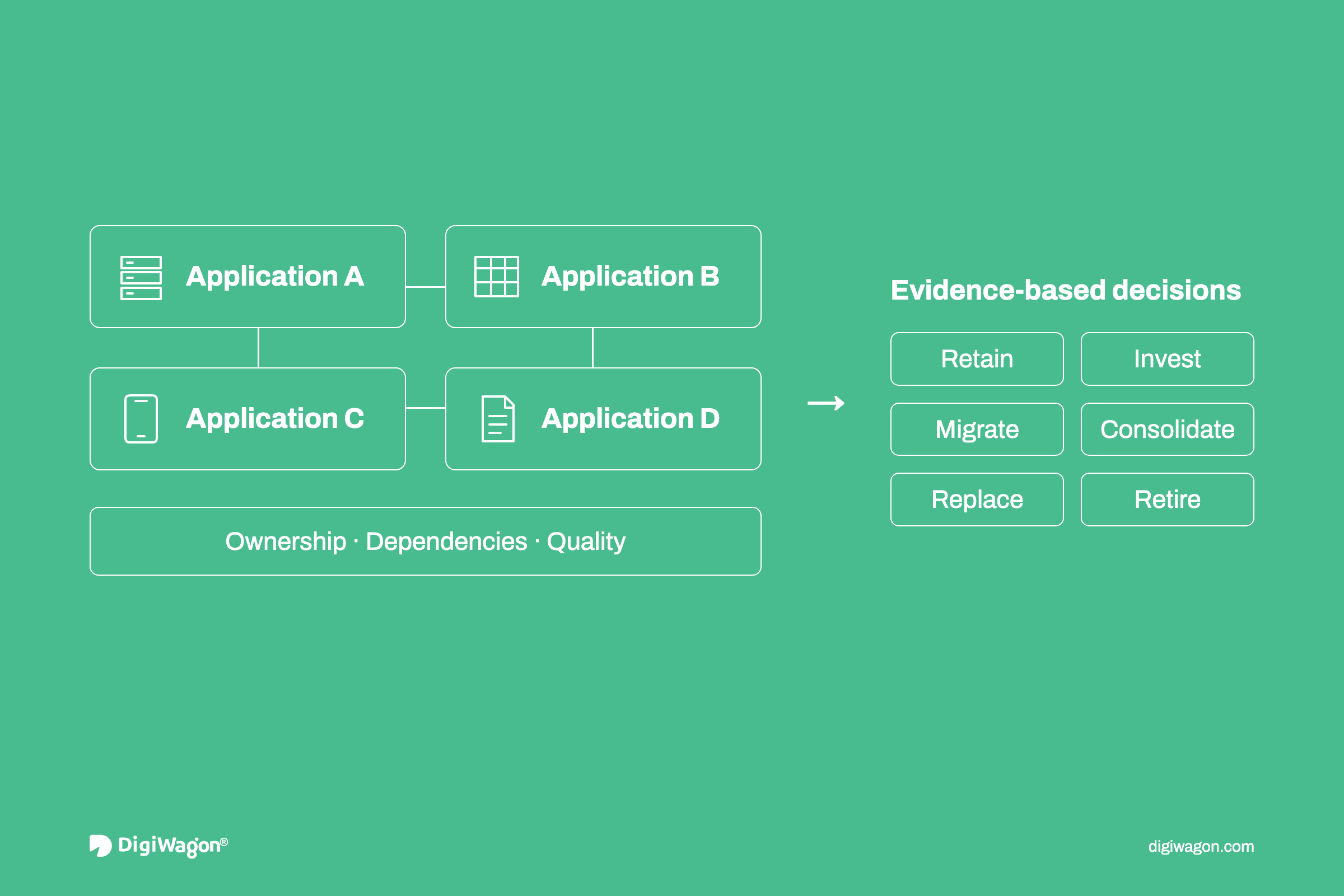
- Describe each app's owners, interfaces, data and quality before making any call.
- Each disposition needs its own proof: dependency proof to retire, quality proof to invest.
- When cost and dependency data disagree, trust the dependencies, since broken interfaces cause outages.
- Consolidate is the one call app-by-app models miss, since it spans several systems.
- Every disposition except retain is a build job, so rationalization is the first design step.
Application rationalization is the decision step within application portfolio management that gives each application one disposition: retain, invest, migrate, consolidate, replace or retire. It works from a map of how the estate fits together, not from survey opinion. The output is an ordered set of engineering work packages, each traced to the evidence behind it.
Why Application Rationalization Keeps Stalling
US federal agencies spend about 80 percent of their IT budgets keeping existing systems running (GAO, 2025). Rationalization is how you win that budget back.
The same GAO review looked at the 11 federal legacy systems most in need of an update. Only three had plans with all three parts GAO expects. One of those parts is what happens to the old system itself.
The choice to act was there. The proof and the follow-through often were not.
Enterprise architecture platforms hold an inventory and score it well. The method breaks on either side of the score. It breaks before the score, when the inventory is not yet a description, and after it, when a disposition must become a build.
Why Is a Disposition Undecidable Without an Architecture Description?
An application inventory lists what exists. An architecture description shows how the parts connect. Each disposition is a claim about what breaks when this app changes or goes away.
ISO/IEC/IEEE 42010:2022 sets out what a description must do. It names stakeholders and their concerns, and shows the architecture through views, each set by a viewpoint. It also records the reasons for key choices.
Hold a typical spreadsheet against that and the gap is plain. A row marked "retire" with no recorded reason is an opinion with a cell reference.
What a Rationalization-Ready Application Record Holds
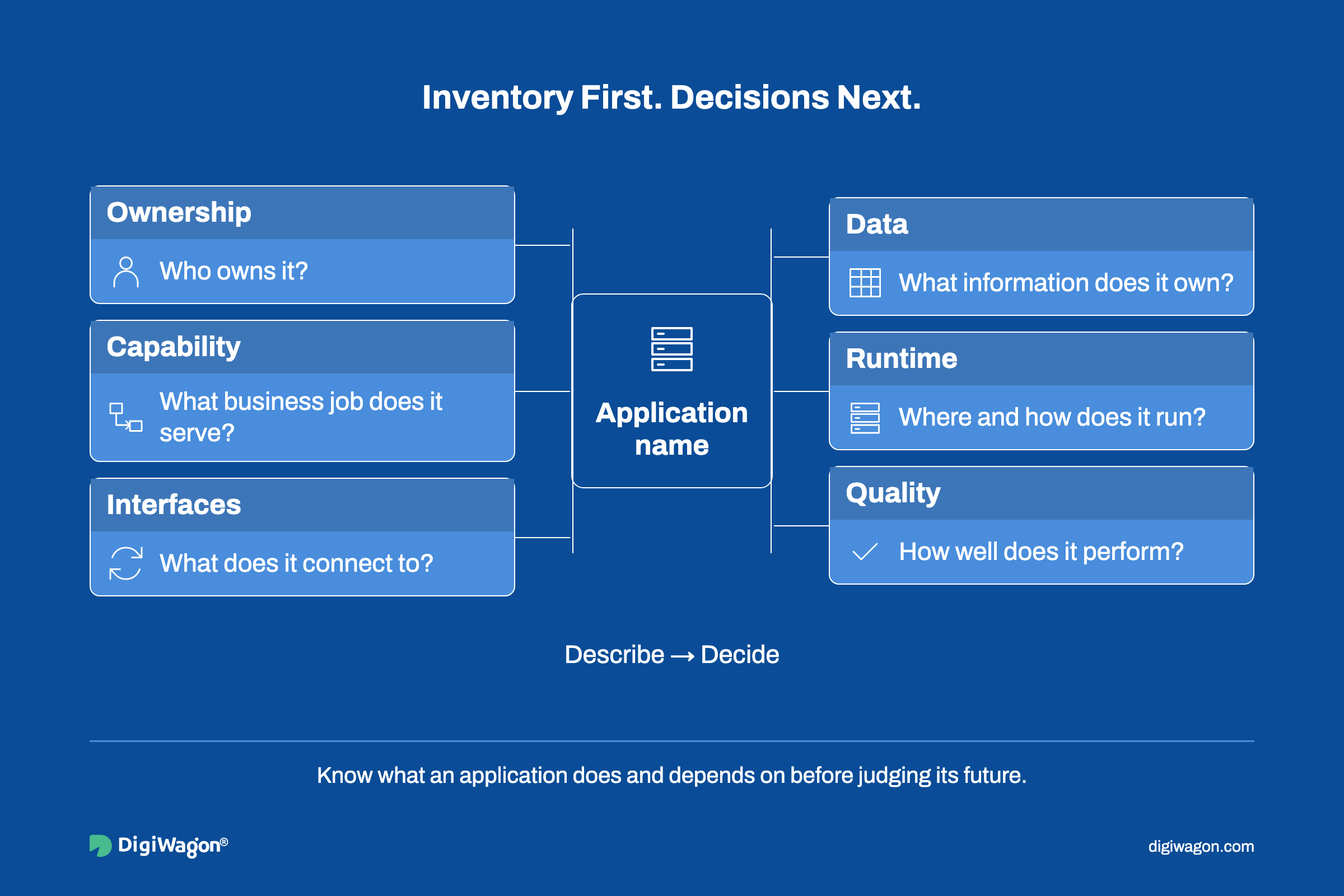
Application portfolio rationalization starts with one record per app, before any scoring:
- Ownership: a named business owner and tech owner, often two people
- Capability served: the business job it does, on a capability map
- Interfaces: every link in and out, including file drops and scheduled database reads
- Data mastery: the data it is the system of record for
- Runtime: hosting, language runtime and support status
- Quality scores: against a named quality model, not a survey
The GAO IT Investment Management framework (GAO, 2004) puts this work at Stage 2. That stage builds a store of basic facts about each IT asset. Portfolio criteria come at Stage 3.
The order is the lesson. Describe first, judge second.
What Evidence Does Each Application Rationalization Disposition Require?
In Phase E of the TOGAF Standard, architects sort every current system in scope. For each gap, they choose to build new, reuse a product or buy.
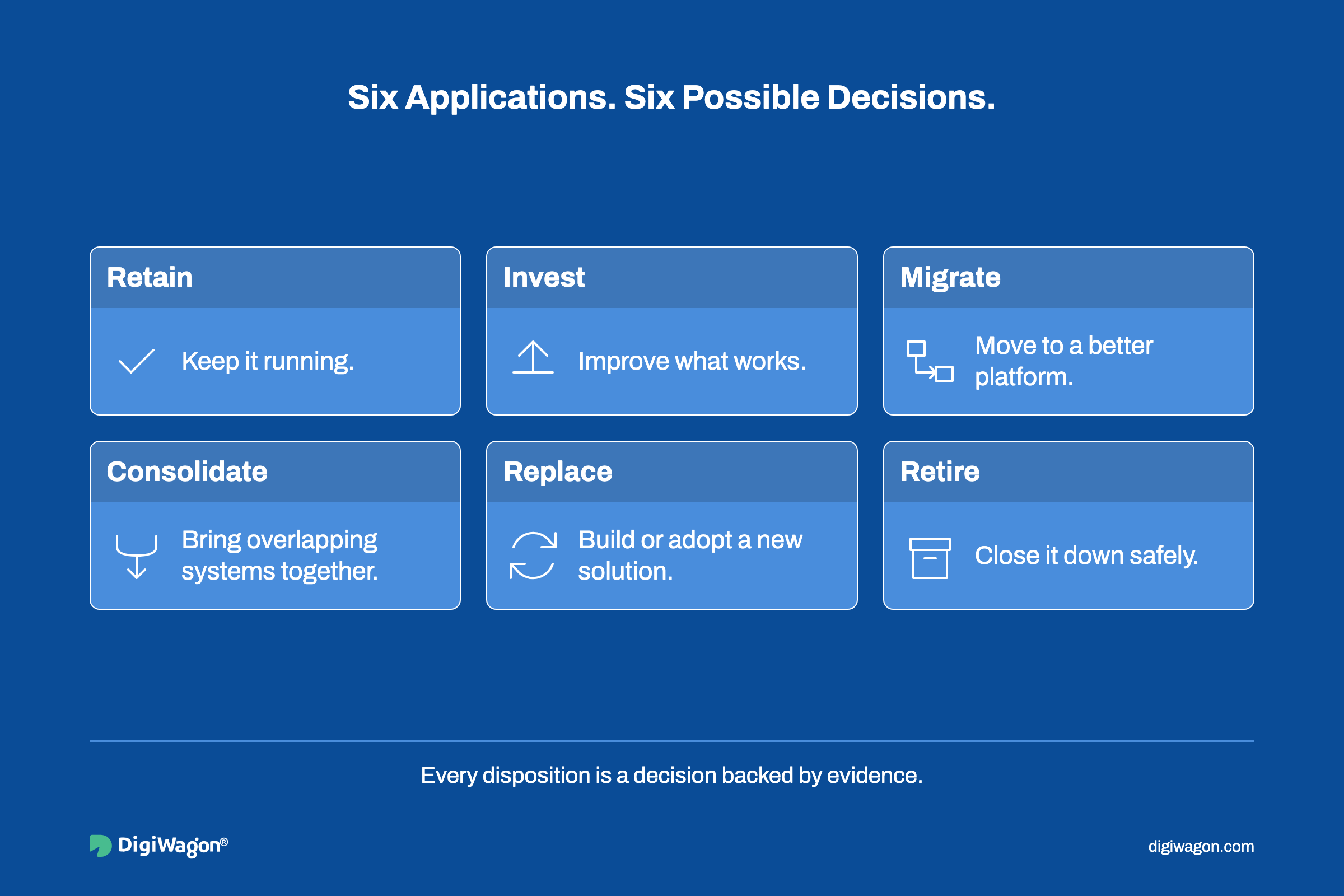
A disposition writes that call down, and each one carries its own burden of proof. The second column maps these six calls to the seven in the legacy system modernization blueprint. Consolidate has no match, because it decides several systems at once.
| Disposition | In the blueprint | Evidence for it | Evidence against it |
|---|---|---|---|
| Retain | Retain | Stable interfaces, supported runtime | Runtime past end of support |
| Invest | Refactor, in place | Growing use, easy to change | Each change risks a regression |
| Migrate | Rehost, relocate or replatform | Sound logic, failing platform | Defects that would move with it |
| Consolidate | None (it spans systems) | Overlapping data, one job | Data models that cannot match |
| Replace | Repurchase or new build | Still needed, many quality gaps | One fixable defect |
| Retire | Retire | No need, no live consumers | Any unexplained read of its data |
Why Quality Evidence Needs a Named Model
Keep-or-replace arguments turn into taste without a shared yardstick. ISO/IEC 25010:2023 defines nine product quality characteristics.
Score each app against the same ones. "The old system is bad" then becomes a claim someone can test.
Two rules keep the scores honest:
- Score only what the call depends on. A migrate case rests on flexibility and compatibility. An invest case rests on maintainability.
- Note the source beside each score. Code scans, incident logs and change-failure records age at different rates. A reviewer needs to know which one gave the number.
Teams ready to build can see how application modernization engineering covers the work that follows.
What Happens When Cost Data and Dependency Data Disagree?
Cost data is easy to get. Dependency data is not.
Total cost of ownership comes from contracts and invoices. Dependency data comes from runtime behavior. Different teams collect them at different times.
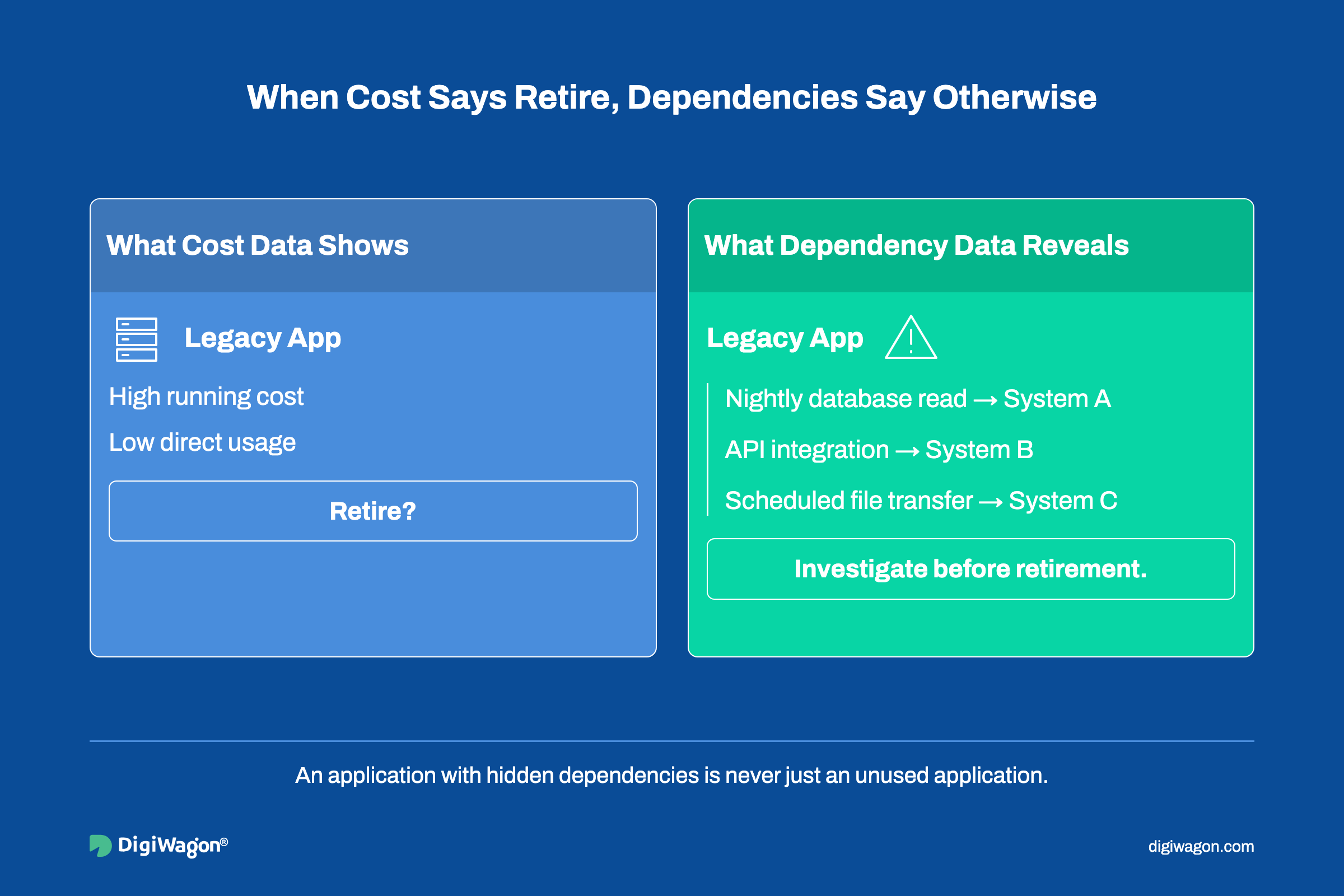
The classic clash is a costly, lightly used app that cost analysis marks to retire. Then a trace shows three downstream systems reading its database every night, through a service account nobody wrote down.
Why Dependency Evidence Wins
A cost error can be fixed in the next budget cycle. A retired data store with live consumers is an outage.
GAO's framework lists location, cost and ownership as facts an agency should know about each IT asset (GAO, 2004). Dependencies are the fact most estates lack. They live in runtime sources:
- API gateway and integration routes
- Database grants and service account logs
- Batch and file-transfer job schedules
- Network flow logs between hosting zones
When finance needs cost per app, the architectural response is to split shared platform cost along the dependency graph. Cost then follows the dependencies instead of fighting them.
What Does Each Disposition Commit You to Build?
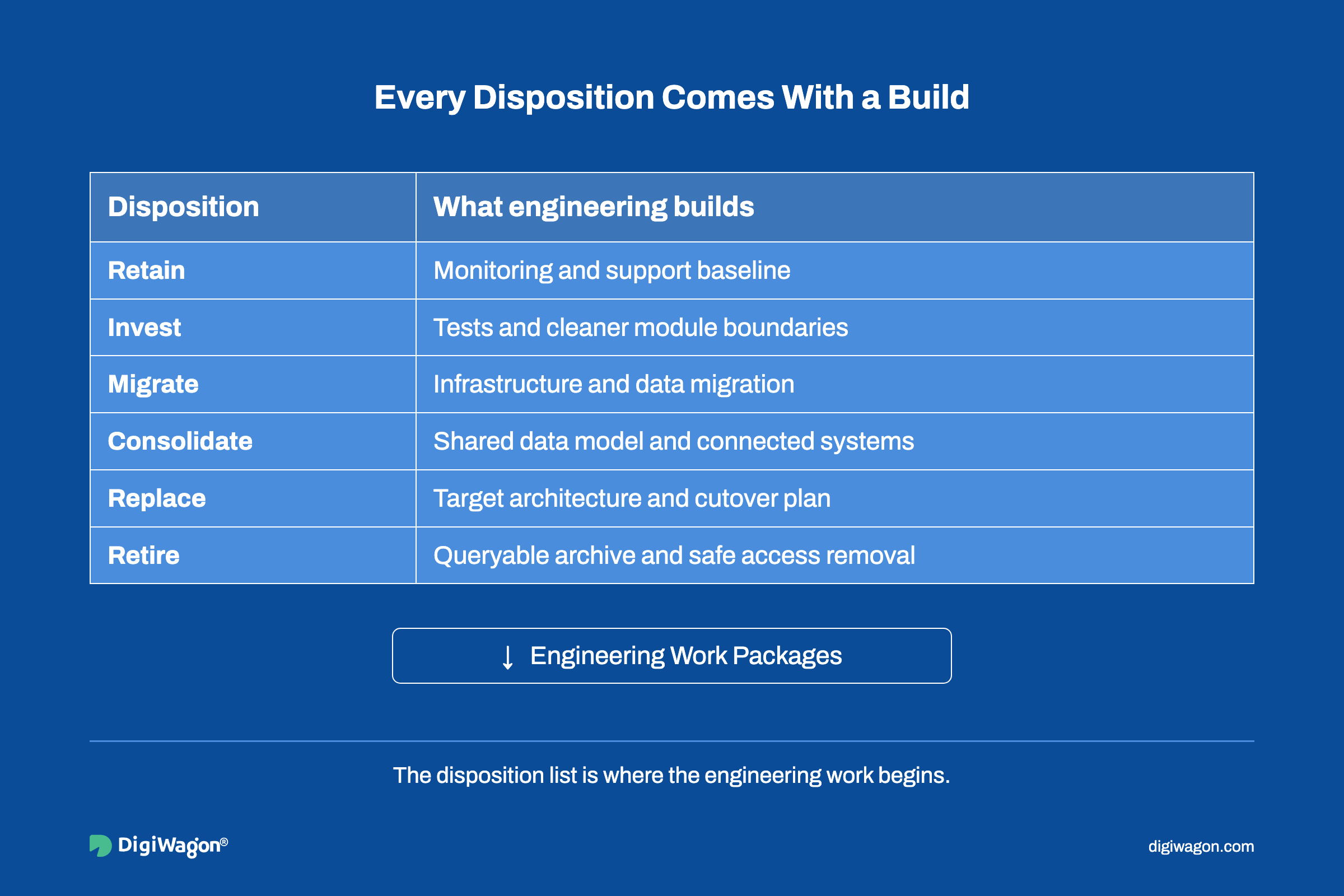
Portfolio tools usually stop at the disposition label. The build work starts there.
GAO's 2025 review makes what happens to the old system a required part of any update plan. Each disposition commits you to build something, even when the thing you build is an exit.
| Disposition | What you commit to build |
|---|---|
| Retain | Monitoring baselines, versioned API contracts, a support plan |
| Invest | Tests ahead of change, a clean module boundary |
| Migrate | Infrastructure as code, a data migration pipeline, a parallel-run harness |
| Consolidate | One matched data model, every consumer re-pointed |
| Replace | A target-state design, data migration, cutover facades |
| Retire | A queryable archive, removed interfaces, revoked access |
Replace Hides the Largest Commitment
Replace is the call most often written as one word and planned as a product swap. Whether it should beat refactor is its own evidence test, covered in the legacy system replacement decision.
Once replace stands, it raises a target-state design question. For anything platform-shaped, start with composable SaaS patterns. It also raises a buy-or-build question, which the product-or-custom choice answers next.
Retire Is Not the Same as Switch Off
When records must be kept after the app goes, the architectural pattern is a read-only archive store with its own access path. The data then outlives the runtime it came from. Access keys and firewall rules go last, once the trace has run clean for a full business cycle.
Engineering the Dispositions Your Portfolio Review Produces
DigiWagon's engineers pick up where the review stops. We build what each disposition commits the business to. Our software engineering practice covers:
- Finding live dependencies from logs and job schedules
- Moving or rebuilding apps, with parallel runs at cutover
- Merging apps onto one shared data model
- Retiring apps, with archives you can still query
Rationalization Is the First Design Decision
Application rationalization works when each disposition points at its proof and at the build it commits to. Describe the estate before you score it. Then let dependency data beat cost, and attach a build to every label. The list then becomes the first step in the decision sequence for legacy estates. Portfolios rationalized this way hand the build team work packages it can size and order on day one.