
Digital Transformation Strategy Consulting: Bottom Line
- Digital transformation strategy consulting defines the WHAT and WHY of a program before engineering teams define the HOW.
- Most failed transformation programs collapse on integration and sequencing, not on the underlying technology.
- Manufacturing enterprises in UAE and Germany typically need digital transformation strategy consulting before any code is written.
- A roadmap-first engagement protects budget by exposing dependency conflicts and integration debt early.
What Is Digital Transformation Strategy Consulting?
A manufacturing digital transformation roadmap is a phased engineering plan that bridges operational technology and IT systems, sequences pilots without disrupting production, and delivers an integrated data pipeline from shop floor to decision dashboard. The hard part is not the strategy slide deck — it is the OT-IT data model, the MES integration approach, and the rollout order that lets each plant migrate without halting throughput. Done right, a roadmap moves a multi-site operation from reactive to data-driven within four quarters.
Why Digital Transformation Strategy Consulting Determines Program Outcomes

McKinsey & Company’s research on transformation programs puts the success rate of large transformation programs at roughly 30 percent. The pattern repeats across industries. An enterprise commits capital to a platform, the build moves quickly, and integration with legacy systems falls behind. Operations teams are not aligned. Compliance was not consulted. The roadmap was a procurement document, not a transformation plan.
In manufacturing especially, the gap between intent and execution widens fast. Plant systems are heterogeneous. Suppliers integrate differently across geographies. UAE operators face different regulatory ground than German operators, even when running similar production lines. Digital transformation strategy consulting forces those constraints into the open before vendor decisions become irreversible.
What Does Digital Transformation Strategy Consulting Actually Cover?

A useful digital transformation strategy consulting engagement is narrow in scope and rigorous in output. It is not a multi-month workshop series. It is a structured diagnosis of the gap between current state and target state, ending in a sequenced plan.
Inside the Scope of Digital Transformation Strategy Consulting
- Current-state assessment of systems, processes, and data flows
- Stakeholder mapping across business, operations, IT, and compliance
- Technology architecture review and integration risk scoring
- Use-case prioritisation tied to business outcomes
- Vendor and platform evaluation criteria
- Phased roadmap with measurable milestones
- Operating model recommendations for delivery and governance
Outside the Scope
- Code, configuration, or platform deployment
- Vendor lock-in toward a specific platform partner
- Generic best-practice slideware
- Change management as a standalone deliverable
The deliverable is a document a board can sign off on and an engineering team can execute against. Anything more is consulting bloat. Anything less leaves gaps the build phase will pay for.
When Should an Enterprise Bring in Strategy Consulting Before Engineering?
Not every project needs digital transformation strategy consulting. Tactical builds, point integrations, and feature additions can move directly to engineering. The strategy phase earns its place when one or more of these conditions hold:
- Multiple business units will share the resulting platform
- Legacy systems must be replaced or wrapped, not extended
- Regulatory or audit posture changes as a result of the program
- Investment crosses fiscal years or board-level approvals
- The internal team has not previously delivered a program of this scale
If two or more of those apply, a discovery phase is cheaper than a course correction once the build is well underway.
The Discovery-to-Roadmap Workflow

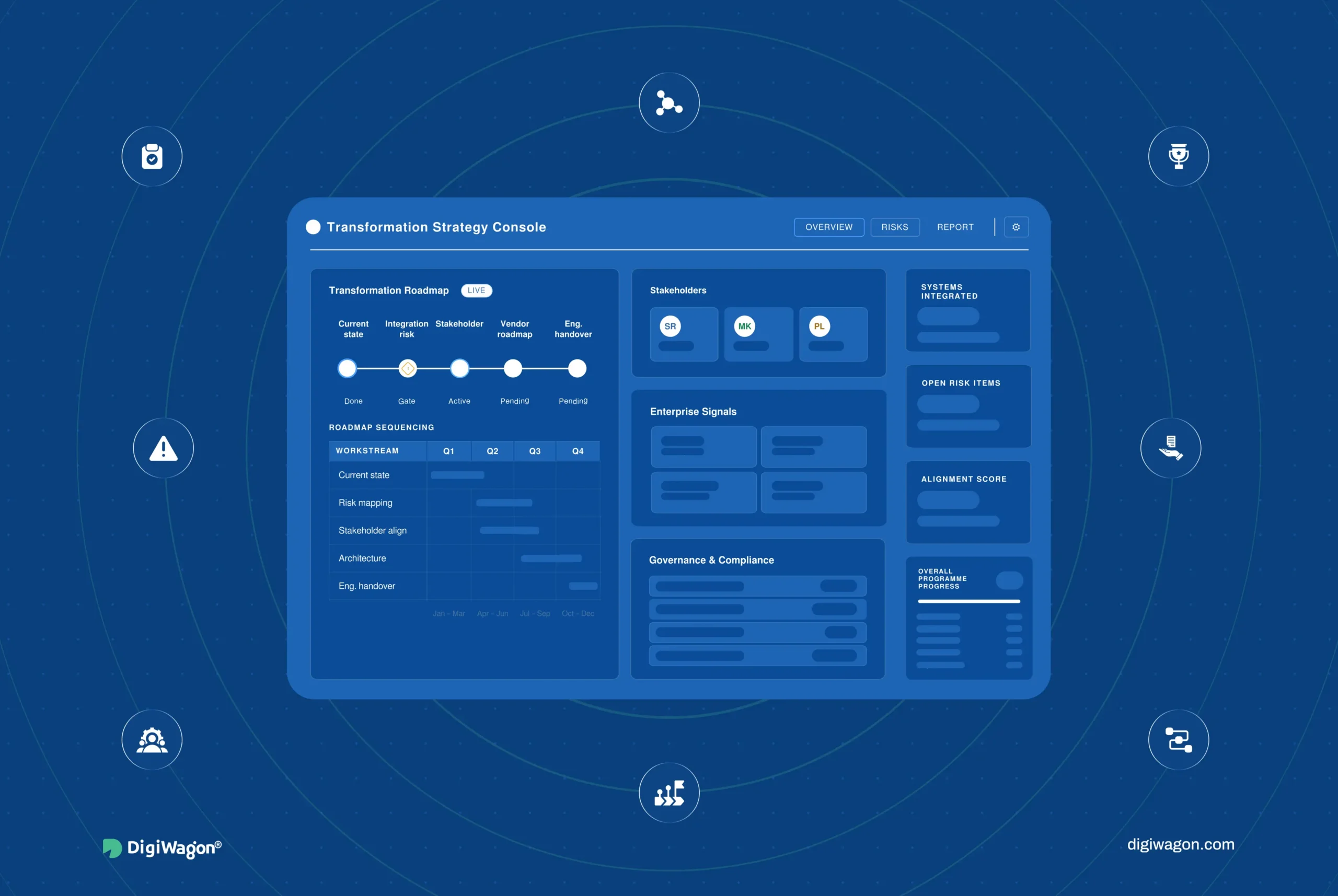
A disciplined digital transformation strategy consulting engagement runs through five stages, in order, with explicit exit criteria for each.
The Five Stages of Digital Transformation Strategy Consulting
- Diagnosis. Interviews, system inventories, data flow mapping, and document review. Output: a current-state map.
- Hypothesis framing. Working sessions with senior stakeholders to test assumptions about what the transformation should achieve. Output: a prioritised problem list.
- Solution shaping. Architectural options, vendor evaluation criteria, and integration scenarios. Output: 2 to 3 candidate roadmaps with trade-offs.
- Roadmap selection. Stakeholder alignment on the chosen path, sequencing, and governance model. Output: a board-ready roadmap.
- Handover to delivery. Engineering kick-off with the roadmap as the contract between strategy and execution. Output: a build plan that does not need to be relitigated.
The handover step is where most engagements fail. The strategy team leaves, the engineering team inherits a deck, and the assumptions inside the deck are never converted into engineering decisions. A digital transformation strategy consulting engagement that does not include a structured handover to the build team is a half-engagement.
For enterprises evaluating this kind of work, DigiWagon’s technology strategy consulting practice is structured around this exact workflow, with engineering leads embedded from stage 3 onward.
How Does Digital Transformation Strategy Consulting Differ in UAE vs Germany Manufacturing?
Manufacturing transformation programs in UAE and Germany share the same underlying technologies, but digital transformation strategy consulting looks different in each market.
In Germany, the program is usually anchored to Industrie 4.0 maturity benchmarks. Plant operators expect deep technical due diligence, vendor reference checks, and works council alignment before any platform decision is finalised. The strategy phase is heavier on documentation and longer on stakeholder alignment.
In UAE, manufacturing transformation is often tied to Operation 300bn or sectoral diversification mandates. Decision-making is faster, but the strategy phase has to map government incentives, free-zone implications, and cross-border data residency early. A roadmap that ignores those constraints needs rework.
A consulting partner that has only worked one of these markets typically underestimates the other. The vendor relationships, regulatory mappings, and operational benchmarks do not transfer cleanly across the two geographies.
For enterprises planning manufacturing software development programs across either geography, the strategy phase is where geography-specific risk gets surfaced.
Strategy-First vs Build-First Engagement Models
| Dimension | Strategy-First Engagement | Build-First Engagement |
|---|---|---|
| Starting point | Diagnosis and roadmap | Backlog or RFP |
| Vendor neutrality | High | Low |
| Suited to | Multi-system transformation | Tactical builds |
| Risk profile | Lower integration risk | Lower upfront commitment |
| Decision rigour | Forces trade-offs early | Defers trade-offs |
| Stakeholder alignment | Built into the process | Often skipped |
| Typical buyer | Board, CDO, CIO | Functional head |
Build-first works when the problem is well understood and the scope is contained. Digital transformation strategy consulting is necessary when the program crosses functions, systems, or geographies. Choosing the wrong engagement model is one of the most expensive procurement mistakes an enterprise can make. The Composable Enterprise approach, covered in The CTO’s Guide to Composable Enterprise, assumes strategy-first as a precondition: composability without sequencing turns into integration chaos.
Planning Your Digital Transformation Strategy Consulting Engagement
DigiWagon leads with digital transformation strategy consulting before engineering for enterprise programs that cross systems, functions, or geographies. Engagements include:
- Discovery and current-state assessment for manufacturing and industrial operators
- Vendor-neutral roadmap design with phased sequencing
- Regulatory and operational mapping for UAE, Germany, and India
- Embedded engineering leadership from roadmap to build handover, supported by our digital transformation services
Conclusion
The enterprises that get digital transformation right are not the ones with the fastest engineering teams. They are the ones that spend disciplined time on diagnosis before delivery. Digital transformation strategy consulting is the cheapest way to expose the integration, regulatory, and operational constraints that will otherwise show up mid-build. For manufacturing operators in UAE and Germany, where geography-specific risk is high and vendor decisions compound, the roadmap is not a slowdown. It is the contract between intent and execution.
Ready to Map Your Transformation Roadmap?
Our strategy team runs structured discovery engagements before any code is written.