
LLM Alert Triage: What Actually Matters
- LLM-powered triage assists the analyst; it drafts the triage note and surfaces context, but the accountable decision stays with a human in the chain.
- RAG over regulatory and watchlist context beats fine-tuning, because regulatory text changes faster than fine-tune cycles can absorb.
- Hallucination is controlled at the output layer with constrained schemas and reason codes, not by post-hoc validation of free text.
- Every LLM triage output binds to a model-version identifier, so an AI decision is reconstructable the same way a rule-based one is.
- The LLM sits downstream of screening and monitoring; it triages the alerts they raise, it does not replace the detection engines.
LLM-powered AML alert triage is the architecture that uses a retrieval-augmented language model to summarise an alert, assemble its regulatory and watchlist context, and draft a structured triage recommendation that a human analyst reviews. The output is a constrained, model-version-bound record, not free text, so every AI-assisted decision stays reconstructable.
What Does an LLM Actually Do in AML Alert Triage?
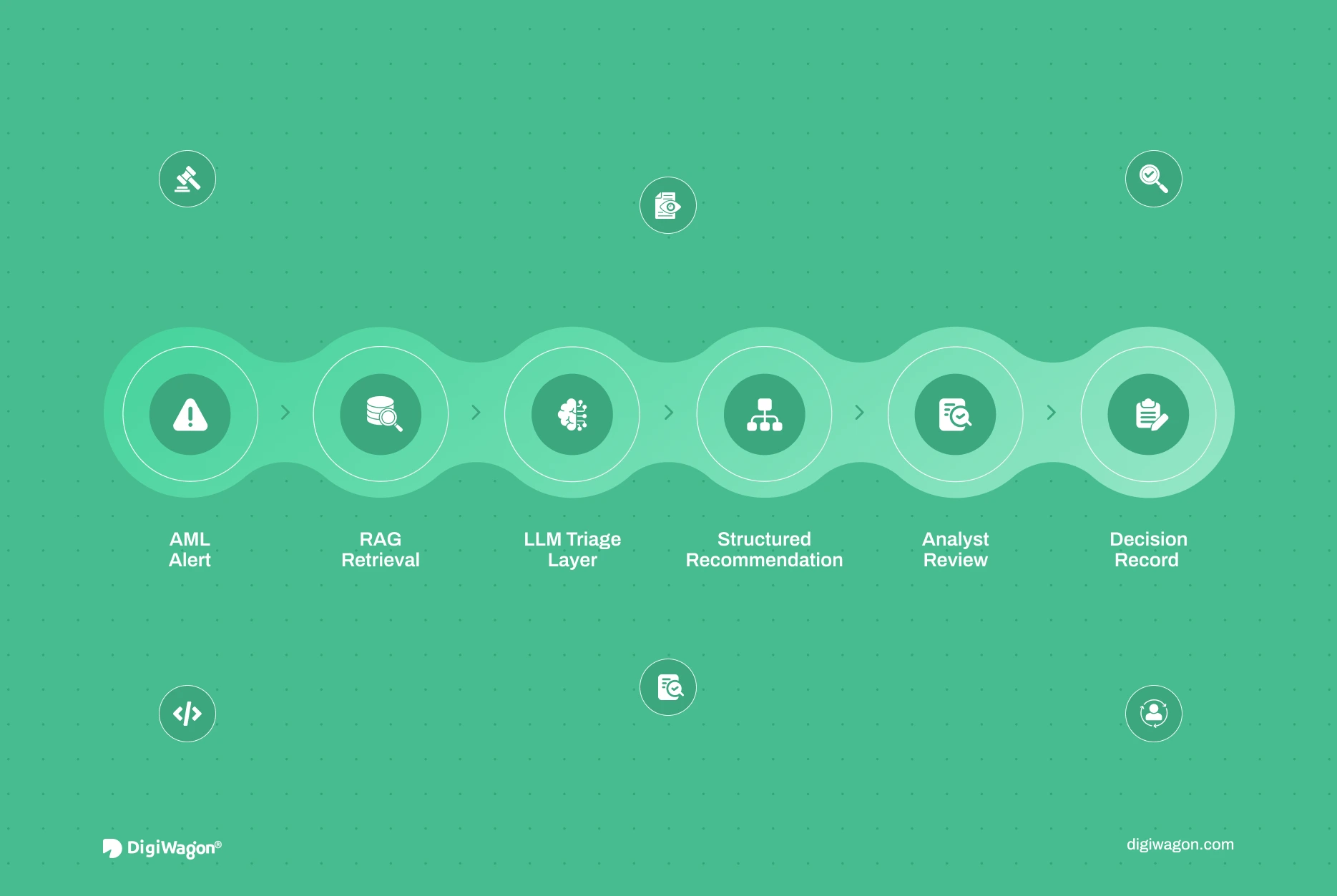
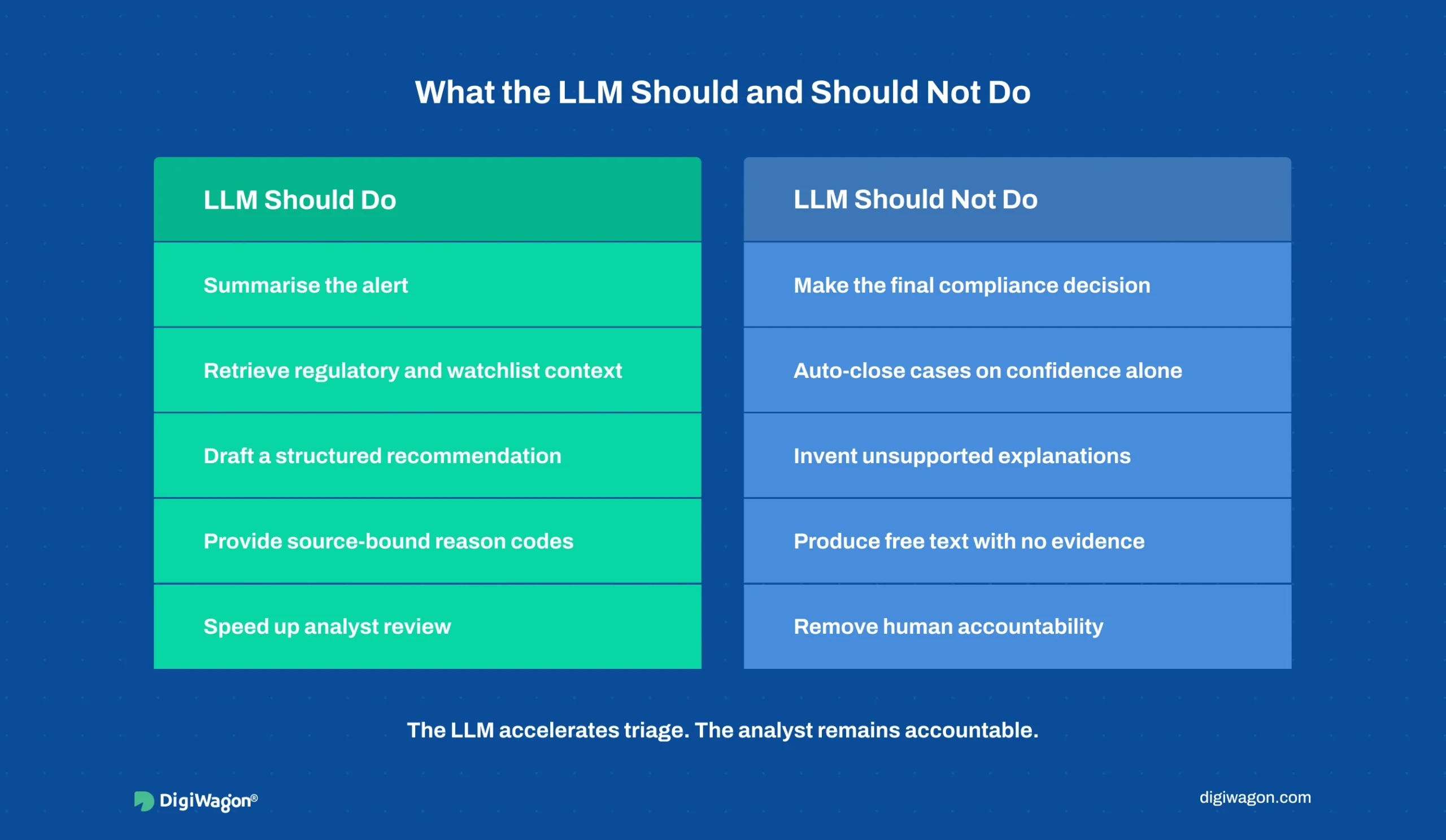
AML screening and monitoring engines raise alerts. A human analyst then triages each one: gathering context, checking the match, deciding whether to escalate, close, or file a report. At scale, triage is the bottleneck, and it is where an LLM earns its place.
The LLM does three things. It summarises the alert and the entity’s relevant history into a readable brief. It retrieves and assembles the regulatory and watchlist context the analyst would otherwise gather manually. It drafts a structured triage recommendation with reason codes. What it does not do is make the final, accountable decision; that stays with the analyst.
This distinction is the load-bearing architectural choice. The NIST AI Risk Management Framework, published in 2023, frames human oversight as a core control for AI in high-stakes contexts, and AML triage is high-stakes by definition. The LLM is a triage accelerator inside the AI and ML engineering practice, not an autonomous decision-maker. It sits downstream of the AML screening engine architecture, triaging the alerts that engine produces.
Why RAG Over Fine-Tuning for Regulatory Context?
The instinct with a domain-specific LLM task is to fine-tune the base model on regulatory and AML data. For triage, that is the wrong architecture.
Fine-tuning bakes knowledge into the model’s weights at training time. Regulatory text, sanctions guidance, and watchlist context change continuously, and a fine-tuned model is only as current as its last training run. Re-fine-tuning on every regulatory update is slow and expensive, and the model still cannot cite which document grounded a given statement.
Retrieval-augmented generation (RAG) is the architecture that fits. The base model stays fixed; relevant regulatory documents and watchlist context are retrieved at query time and injected into the prompt. The retrieval corpus updates the moment a regulation or list changes, with no retraining. The foundational RAG work ( Lewis et al., 2020, published at NeurIPS) established that grounding generation in retrieved documents improves factual accuracy on knowledge-intensive tasks over relying on the model’s parametric memory, which is exactly the property AML triage needs.
| Approach | Currency of Knowledge | Citability | Cost of Update |
|---|---|---|---|
| Fine-tuning | Stale as of last training run | Cannot cite source documents | High (retrain per update) |
| Prompt-only (no retrieval) | Limited to base model training cutoff | No grounding | Low, but inaccurate on current regulation |
| RAG | Current as of last corpus update | Cites retrieved documents | Low (update corpus, no retrain) |
The RAG corpus is the same canonical reference data governed by the AML watchlist data pipeline architecture; the pipeline that keeps watchlists current also keeps the triage model’s retrieval context current.
How Do You Stop an LLM From Hallucinating a Compliance Decision?
An LLM that fabricates a fact in an AML triage note is not a quality problem, it is a regulatory exposure. Controlling hallucination is an architectural concern, addressed at the output layer rather than after the fact.
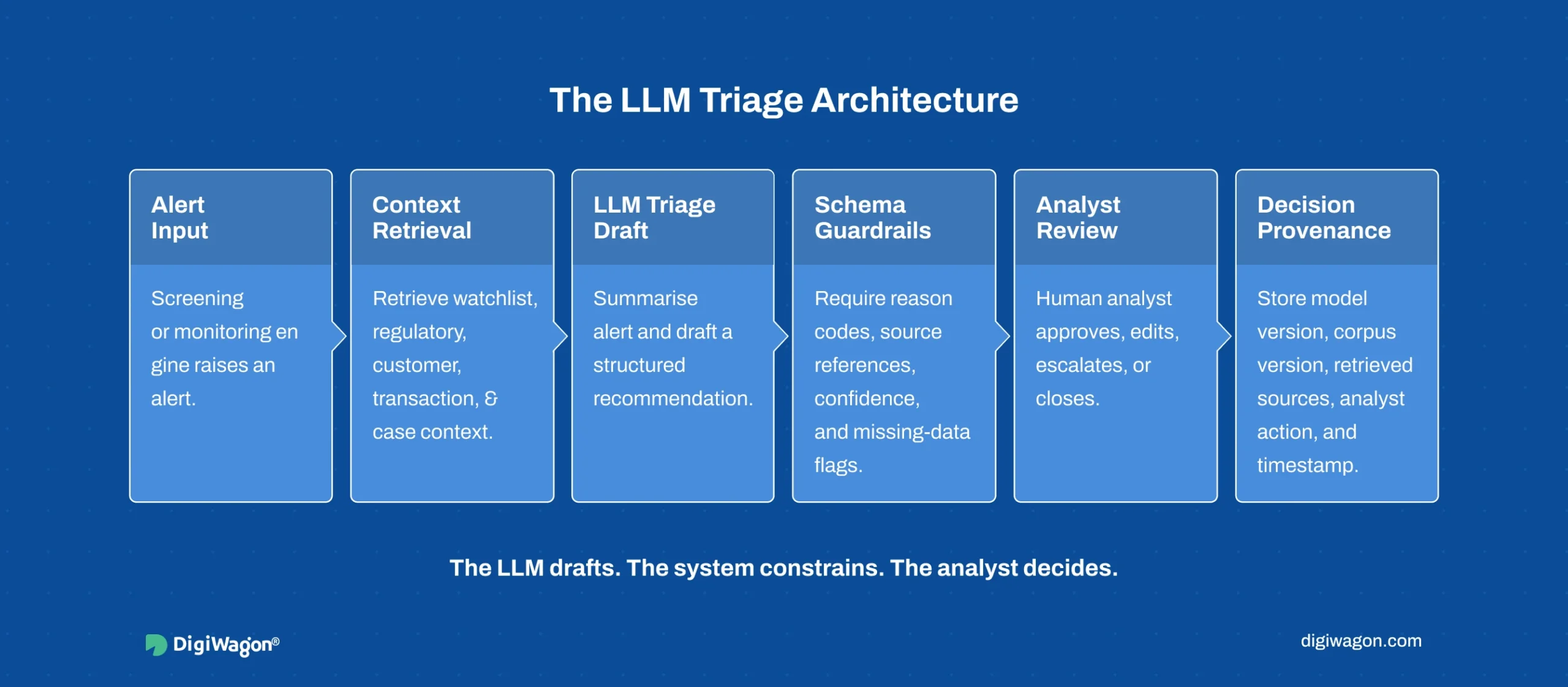
Post-hoc validation, generating free text and then checking it, is the weak pattern. It scales poorly and leaves the model free to produce unconstrained output that validation has to catch. The stronger architecture constrains the output at generation. The LLM emits a structured schema, not prose: defined fields for the recommendation, the reason codes, the retrieved documents that support each reason, and a confidence indicator. A reason code that cannot point to a retrieved source document is rejected by the schema before it reaches the analyst.
ISO/IEC 23894:2023 , the international standard for AI risk management, frames this as designing risk controls into the AI system rather than inspecting outputs afterward. When the architecture requires every assertion to bind to a retrieved source, the model’s room to hallucinate a compliance-relevant claim collapses, because an unsourced claim has no valid schema slot to occupy.
How Do You Keep an LLM Triage Decision Reconstructable for a Regulator?
A regulator reviewing an AML decision will ask how it was reached. For a rule-based alert, the answer is the rule and the data version. For an LLM-assisted triage, the answer has to be just as deterministic, which means two architectural properties.
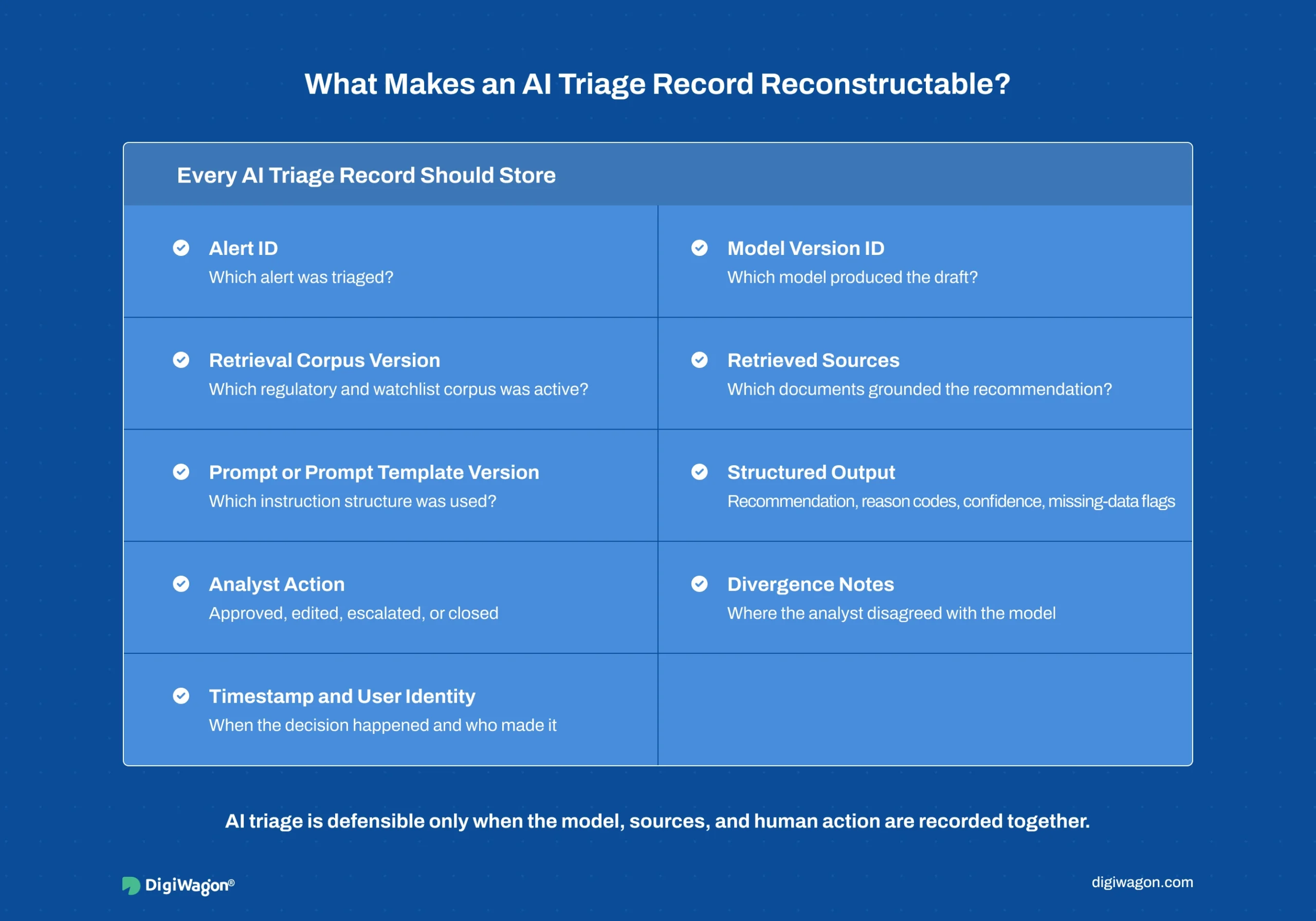
First, model versioning as an evidence concern. Every triage output binds to the identifier of the exact model version that produced it, alongside the retrieval corpus version. The RegTech integration architecture blueprint makes the general case that an AI model version is a Layer 4 evidence concern; in the triage stack, that means an alert’s record carries the model version the same way it carries the watchlist version, so a regulator’s “which model produced this” has a precise answer.
Second, the accountable human. The LLM drafts; a named analyst reviews and decides. The decision record captures the LLM’s recommendation, the analyst’s action, and any divergence between them. When the regulator expects an accountable human in the decision chain, the architecture routes every triage through a human review step rather than auto-closing on model confidence. The human-in-the-loop design is not a UX preference; it is the property that keeps the institution, not the model, accountable for the outcome.
Lessons from Building an AI-Powered AML Triage Stack
DigiWagon built the AI-Powered AML Screening Platform for a financial-crime compliance vendor, with an LLM triage layer over the screening and monitoring engines. Four architectural decisions defined it.
First, RAG over regulatory documents and watchlist context, chosen over fine-tuning the base model, because regulatory text changed faster than any fine-tune cycle could absorb; the retrieval corpus updated on regulation change with no retraining. Second, hallucination guardrails at the decision-output layer, constrained output schemas with reason codes bound to retrieved sources, over post-hoc validation, because regulator-facing decisions needed structured reason traceability, not free text that validation chased. Third, model versioning as a Layer 4 evidence concern: every triage decision bound to a model-version identifier, so reconstruction worked the same way it did for rule-based screening. Fourth, human-in-the-loop case routing with LLM-generated triage notes over fully autonomous triage, because the regulator expects an accountable human in the decision chain.
At the stack level, retrieval ran on a vector store fronting the regulatory and watchlist corpus, with embeddings chosen for multilingual coverage over a larger English-optimised embedding model, because the corpus and the entity data spanned multiple languages and scripts and embedding quality on non-English text mattered more than raw English benchmark scores.
DigiWagon’s Role in LLM-Powered AML Engineering
DigiWagon engineers LLM triage layers for AML compliance as production systems: RAG architecture over regulatory context, output-layer hallucination guardrails, model-version-bound provenance, and human-in-the-loop routing. The work draws on the RegTech software development practice.
- RAG architecture over regulatory and watchlist corpora
- Constrained output schemas with source-bound reason codes
- Model and corpus versioning for reconstructable AI decisions
- Human-in-the-loop triage routing with LLM-drafted recommendations
Planning an LLM Triage Layer for AML?
Our AI engineering team works through RAG architecture, guardrails, and model provenance with your compliance and engineering teams in one room.