
B2B UX Research: Key Takeaways
- B2B UX research captures workflow context, not user opinion. The unit of analysis is the job, not the preference.
- Consumer research methods break on professional users: recruiting fails, generic scripts generate noise, findings collapse under stakeholder challenge.
- Recruiting compliance officers, clinicians, and shift supervisors needs access strategies that paid-panel consumer recruiting cannot supply.
- Contextual inquiry in the work environment beats interview-room sessions, because professional behaviour is bound to its tools and constraints.
- Research earns its value when synthesis translates raw findings into architecture decisions: system ownership, audit cadence, engagement model, trust signals.
B2B UX research is the practice of capturing how professional users do their work, so design decisions rest on observed workflow rather than assumed preference. It recruits hard-to-reach roles, runs contextual inquiry in the real work environment, and synthesises findings into architecture decisions a stakeholder can defend. The output is evidence that survives challenge and feeds directly into what the team builds.
Why B2B Users Break Consumer Research Playbooks
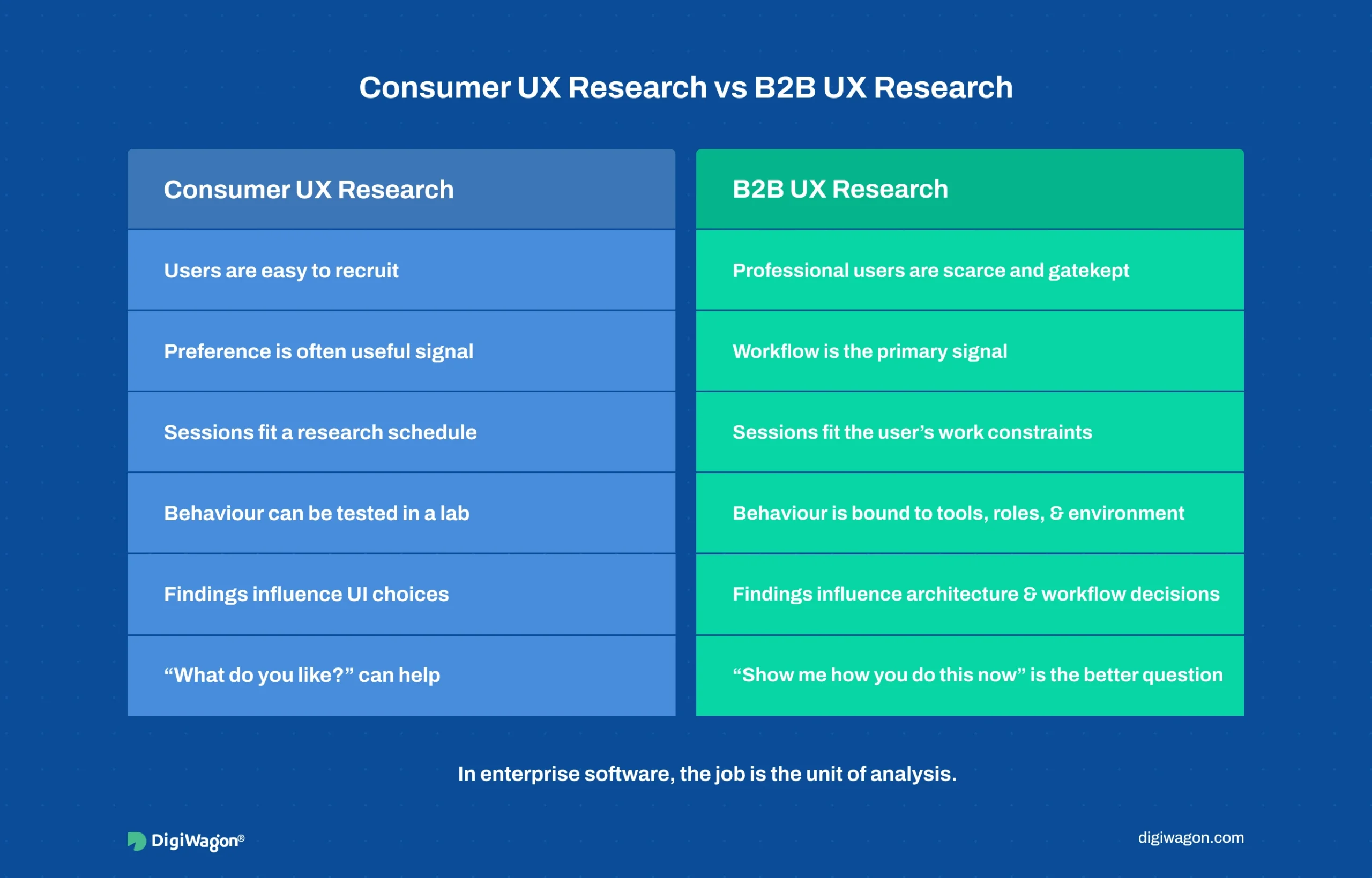
Most published UX research advice assumes a consumer context: a large pool of available users, opinions that matter, and behaviour observable in a one-hour session. Every one of those assumptions fails when the user is a compliance officer, a clinician, or a shift supervisor.
Professional users are scarce and expensive to reach. A compliance officer’s time is billable and gatekept. A clinician between patients has minutes, not an hour. A shift supervisor cannot leave the production floor for an interview room. The Nielsen Norman Group’s enterprise UX research (NN/g, 2024) repeatedly notes that the recruiting barrier alone derails more enterprise research than any methodology flaw.
The deeper break is what you are measuring. Consumer research often captures preference: which design does the user like. B2B research captures workflow: what the user actually does, under what constraints, with what consequences for getting it wrong. ISO 9241-210 (ISO, 2019) frames human-centred design around understanding the context of use, and in B2B that context is a regulated, high-stakes work process, not a shopping decision.
Three assumptions collapse in B2B: that users are easy to recruit, that opinions are the signal, and that behaviour is visible in an interview room. The sections below replace each one.
How Do You Recruit Hard-to-Reach Professional Users?
Recruiting is where B2B research most often fails before it starts. Consumer paid panels do not contain enough compliance officers, and the ones they do contain are rarely representative. The recruiting strategy has to change.
Four access patterns work in practice:
- Client-sponsored access. The product’s own customers are the richest source. A structured request through the client relationship reaches real operators using a real system, which paid panels cannot match.
- Role-specific professional networks. Industry associations, professional communities, and role-based forums reach practitioners who will not show up on a generic panel.
- Internal proxy with caution. When external access is impossible, internal staff who held the role recently can bridge a gap, with the clear caveat that a proxy is weaker evidence than a working operator.
- Incentive recalibration. A professional user is not motivated by a consumer gift card. Access often comes through professional relevance, early visibility into the product, or contribution to a tool they will use.
The recruiting plan also respects the constraint that defines the role. A clinician interview fits the gaps between patients. A shift supervisor session happens on the floor, in short windows. Designing recruiting around the user’s real schedule, not the researcher’s, is what separates a completed study from an abandoned one. Teams structuring this can see how a structured UX consulting approach sequences recruiting access before protocol design.
What Interview Protocols Capture Work Context?
A generic interview script generates generic noise. The protocols that work in B2B capture the work as it happens, not the user’s recollection or opinion of it.
Contextual inquiry is the highest-value method. Observing a compliance officer clear a screening queue, or a supervisor read a production dashboard mid-shift, reveals the workarounds, the second monitor, the printed cheat sheet, that no interview question surfaces. The BABOK elicitation techniques (IIBA, BABOK v3) formalise observation and document analysis as primary elicitation methods precisely because stated process and actual process diverge.
The protocols that hold up share three traits:
| Protocol Trait | Consumer Default | B2B Requirement |
|---|---|---|
| Setting | Interview room or remote call | The actual work environment, mid-task |
| Question focus | Preference and reaction | Task sequence, decisions, and failure points |
| Evidence type | What the user says | What the user does, plus the artefacts they use |
| Probing | Satisfaction and delight | Edge cases, exceptions, and the cost of error |
The single most useful question in B2B research is not “what do you think of this,” it is “show me how you do this now.” Stated process and real process differ, and the gap is where the design opportunity lives. The same rigour that makes a compliance decision reconstructable, covered in the E-E-A-T framework applied to UX, applies to capturing research evidence that holds up later.
How Does Synthesis Survive Stakeholder Challenge?
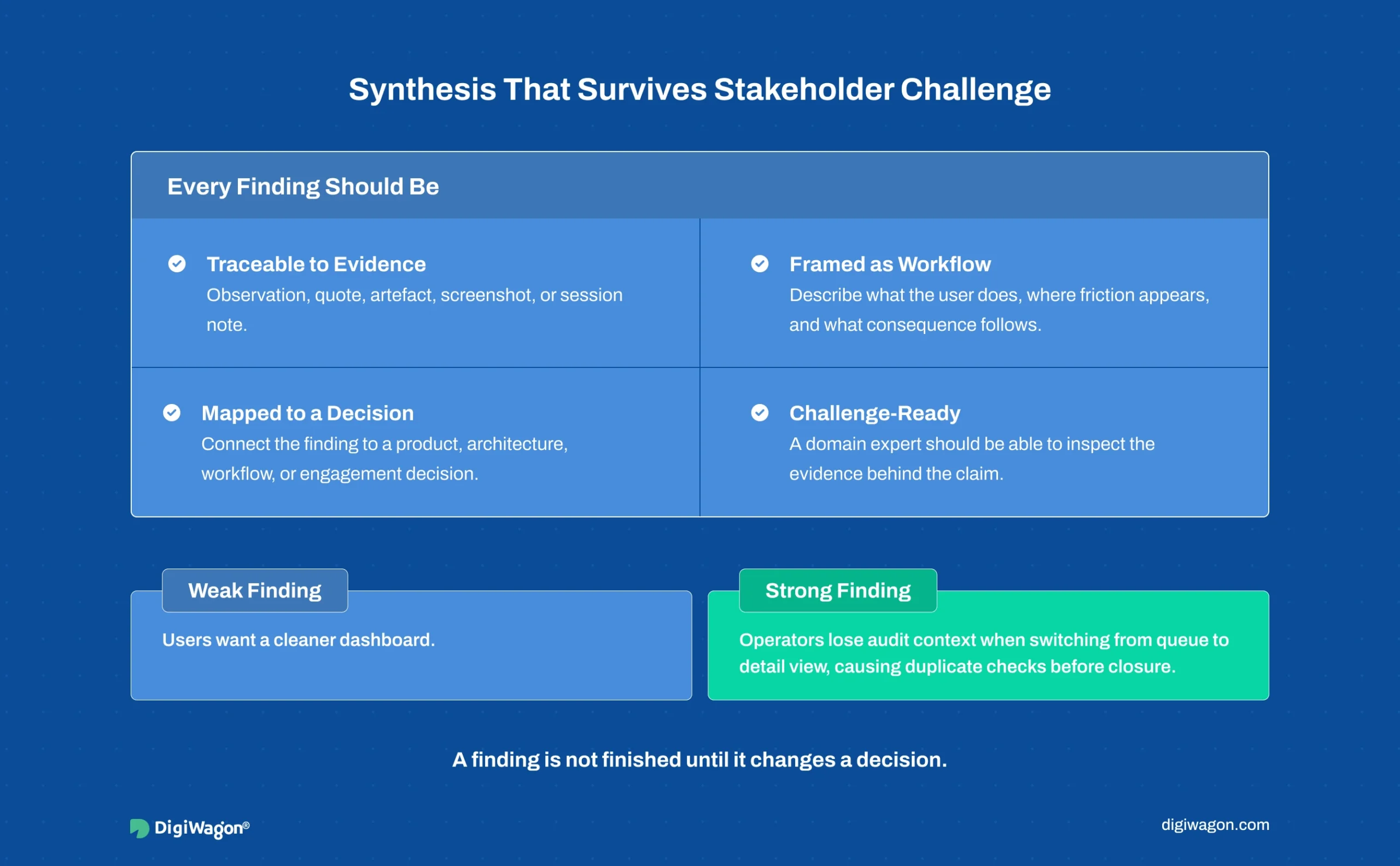
Raw findings do not change a product. Synthesis does, and B2B synthesis has a harder job: it must survive a stakeholder who knows the domain and will challenge any finding that does not hold. A compliance lead will dismiss research that misreads the regulation. A clinician will dismiss research that misreads the workflow.
Synthesis that survives challenge has three properties:
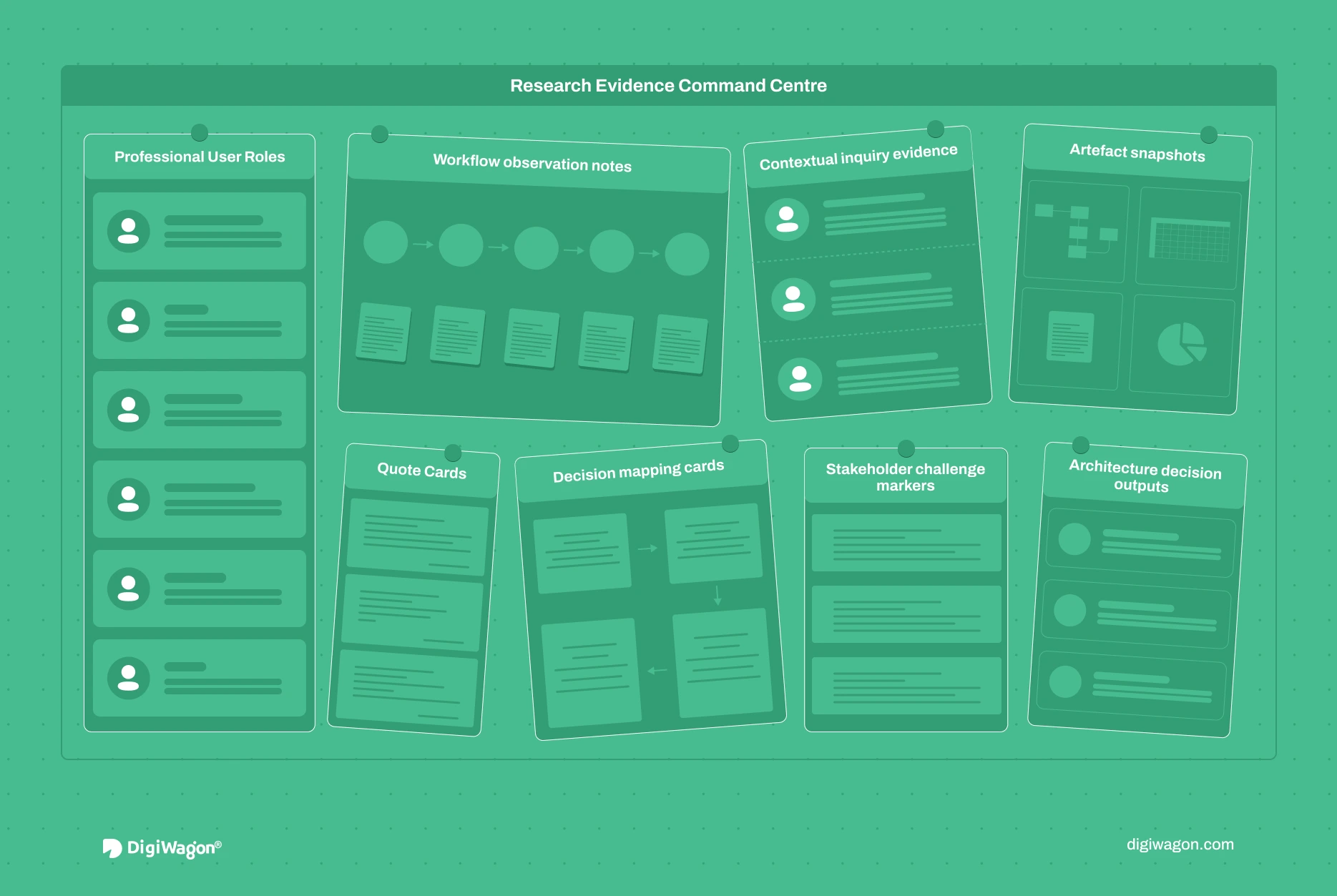
- Traceable to evidence. Every claim links back to an observation, a quote, or an artefact, so a sceptical stakeholder can follow the finding to its source rather than taking it on trust.
- Framed as workflow, not opinion. “Operators lose the audit context when they switch screens” is defensible. “Users prefer a cleaner layout” is not.
- Mapped to a decision. A finding that does not inform an architecture choice is trivia. The strongest synthesis routes each finding to one of the four enterprise UX decisions it should influence.
That last point is the through-line of this whole methodology. Research is not a deliverable that sits beside the build; it is the upstream activity that informs the enterprise UI/UX playbook and its four decisions. Findings about how operators handle audit context feed the trust-signal decision. Findings about how many roles touch a product feed the design-system ownership decision. Synthesis that does not reach a decision has not finished.
Which Research Engagement Model Fits Your Team?
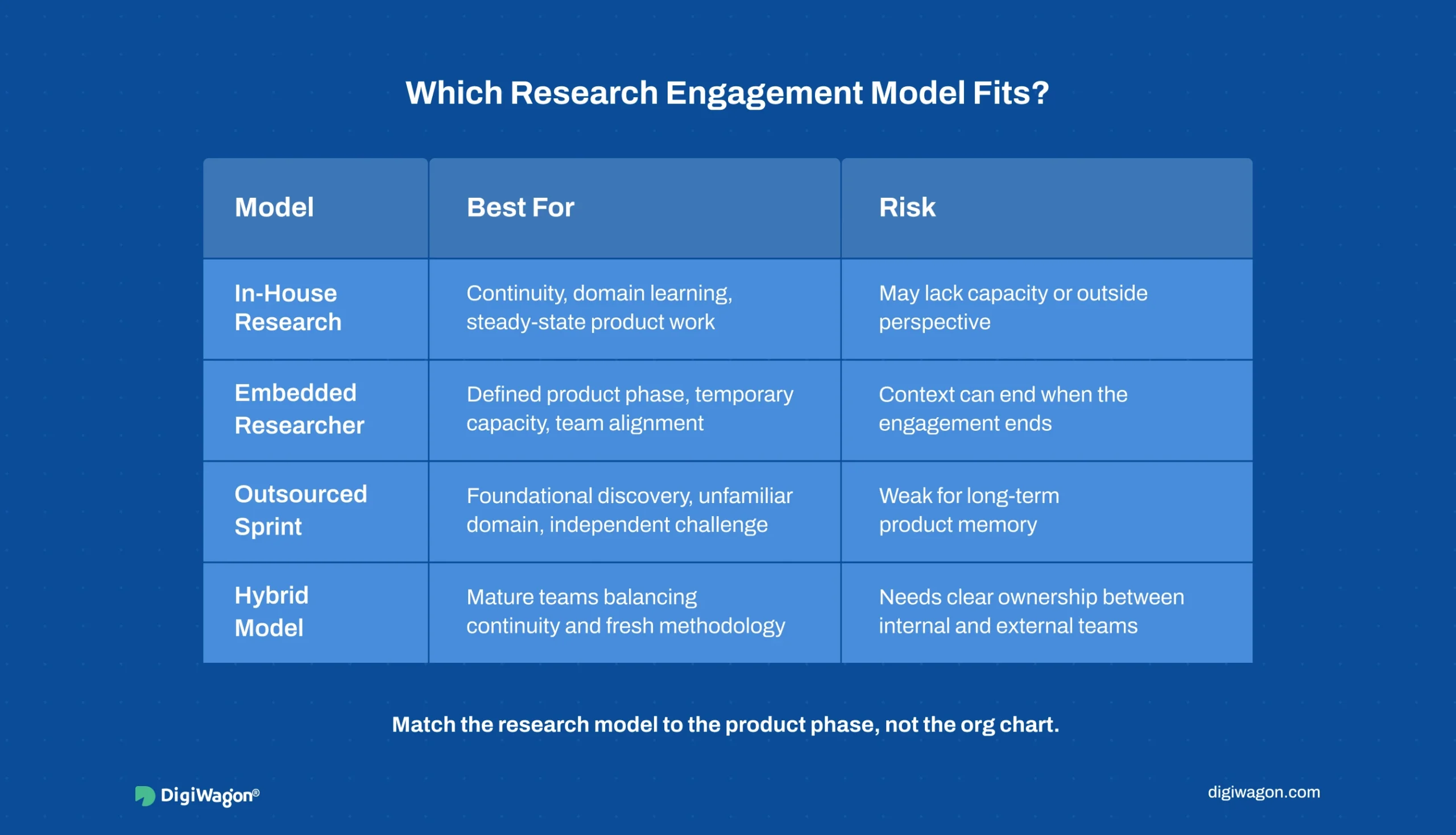
The last decision is who runs the research, and the trade-offs mirror the broader UX engagement question.
In-house research builds deep domain context over time and is strongest for steady-state product work, but is weak when a new domain or methodology is needed fast. Embedded research places a researcher inside the team for a phase, supplying capacity without the permanent hire. Outsourced research sprints bring methodology and outside perspective for a defined study, strongest for foundational discovery, weakest for ongoing context that compounds.
Most enterprises run a hybrid: in-house researchers for continuity, outside sprints for foundational discovery in unfamiliar domains. Forrester’s customer experience research (Forrester, 2023) finds that matching research model to project phase, rather than running one fixed model, materially improves the rate at which findings reach shipped decisions. The comparison between consultant and in-house economics details how these trade-offs shift with maturity.
Lessons from Researching Five Enterprise Products
The same methodology challenges recur across projects. Five examples make the recruiting and contextual-inquiry problems concrete.
Recruiting and Access (AML Screening)
For the RapidAML screening platform, the research population was compliance officers, a gatekept, time-scarce role. The decision was client-sponsored access over paid-panel recruiting, because real operators on a live screening queue were the only valid evidence source. We ran short, scheduled sessions around their review windows rather than asking for an hour block, which is what made the study completable.
Dual-Persona Research (Clinical Companion)
The C3 MedTech companion app needed research across two populations with opposed contexts: clinicians and patients. The decision was running two distinct protocols against one shared research question, because a single script could not serve both a time-pressured clinician and a low-confidence patient. The patient sessions used plain-language, low-literacy-aware prompts; the clinician sessions used task-sequence observation between consultations.
Contextual Inquiry on the Floor (Workforce Production Platform)
The Mining Intelligence workforce platform required understanding how shift supervisors read production data mid-shift. The decision was on-floor contextual inquiry over interview-room sessions, because supervisor behaviour was bound to the physical environment, the noise, the time pressure, the glance-and-move workflow. The observation surfaced glance-based reading patterns that no interview would have revealed.
Operator and Customer Research (Paperless FD Onboarding)
The Suryoday Bank onboarding journey needed both customer and operator evidence. The decision was researching both ends of the same flow, because the customer’s friction and the operator’s exception-handling were two halves of one workflow. Synthesis mapped each finding to a specific onboarding-step decision rather than a general satisfaction score.
Founder and Operator Interviews (Business Setup Software)
The Xanado business setup platform served founders and internal operators. The decision was structured interviews focused on task sequence and decision points rather than feature preference, because the design opportunity lived in where the existing process broke, not in what users said they wanted.
Building Research-Led Software With DigiWagon
DigiWagon runs UX research for B2B and regulated products where users are hard to reach and findings must survive domain-expert scrutiny. Our work covers:
- Recruiting strategies for compliance, clinical, and operational roles
- Contextual inquiry in regulated and industrial environments
- Synthesis that traces every finding to evidence and routes it to a decision
- Research outputs mapped directly to architecture and audit-prep choices
This blog is the research foundation beneath the four architectural decisions for enterprise UX. For the wider practice, see enterprise UI/UX design and engineering services, with particular relevance to RegTech compliance interfaces and healthcare software.
Research as the Upstream Decision
B2B UX research fails when it borrows consumer methods: easy recruiting, opinion as signal, behaviour read in an interview room. Replace those with client-sponsored access to scarce professional users, contextual inquiry in the real work environment, and synthesis that traces to evidence and routes to a decision, and research stops being a box-ticking phase and becomes the upstream activity that informs every architecture choice downstream. The question is never “did users like it.” It is “what does the work actually require, and which decision does that change.” Answer that with evidence a domain expert cannot dismiss, and the rest of the build rests on solid ground.
Need Research That Survives Stakeholder Challenge?
Our research team captures how professional users actually work and turns it into decisions your team can build against.