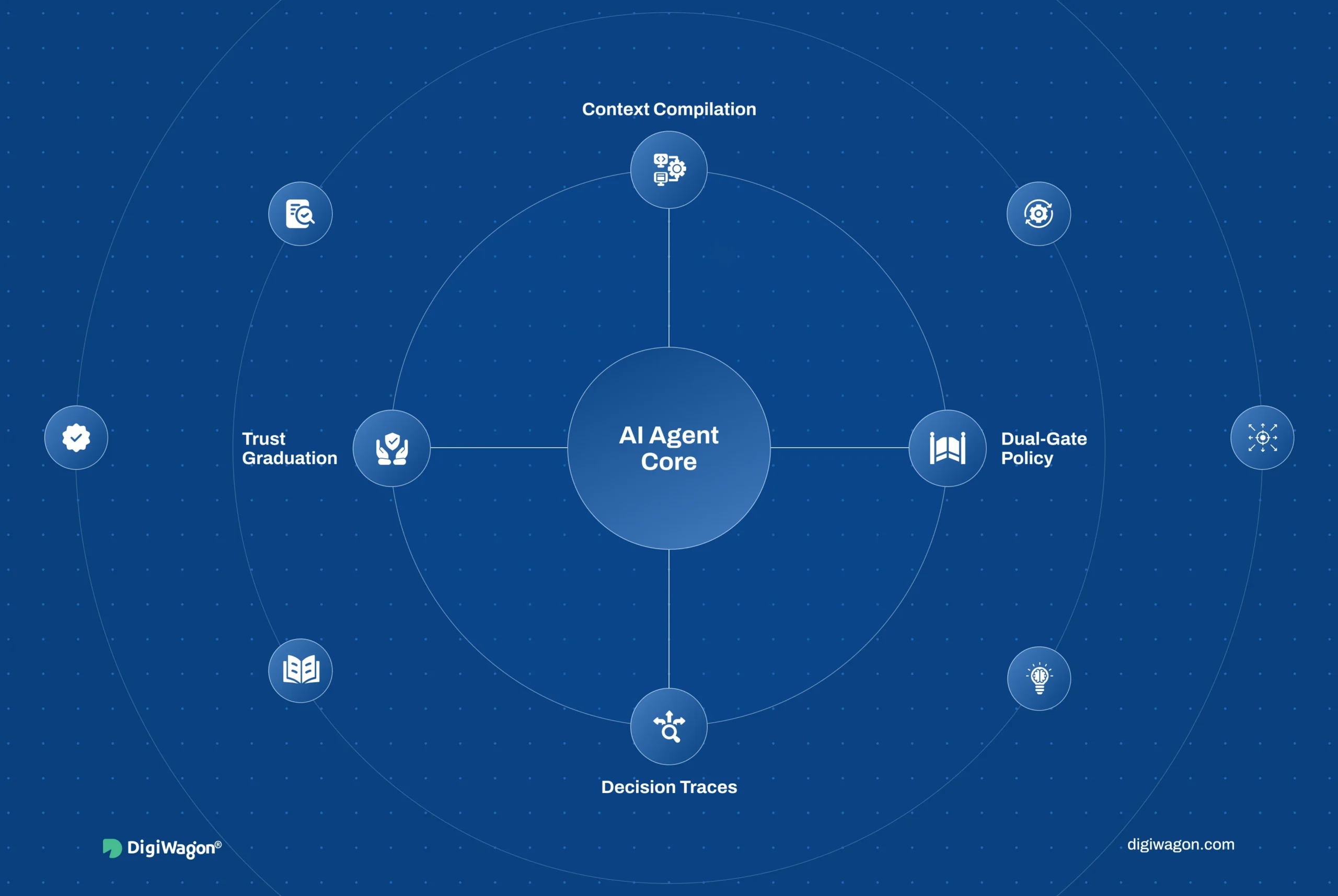
An AI agent works in a loop: it interprets a goal, plans the steps, calls the tools or data it needs, evaluates the result, and retries or escalates as required. Unlike a chatbot, it acts end-to-end instead of just replying, all inside guardrails you define.
Traditional automation follows fixed rules: if X, then Y. It breaks the moment reality does not match the script. An AI agent reasons through unstructured situations, handles exceptions, and decides the next step dynamically – automation that thinks rather than automation that just repeats.
A chatbot responds; an AI agent acts. Chatbots stop at language and single-turn replies. Agents plan, call APIs, complete multi-step workflows, and log what they did – living in the workflow rather than the conversation.
Agentic AI development is building autonomous, multi-step agents that pursue a goal on their own – planning, using tools, and self-correcting – rather than generating a one-off response. DigiWagon builds these agents to run under guardrails, proven in regulated workflows like AML and payment screening.
Yes, and it is built in from the start. Agents are shaped around your rules, tone, approval logic, and decision boundaries during development. The result behaves less like an external tool and more like a trained internal teammate who knows the playbook and sticks to it.
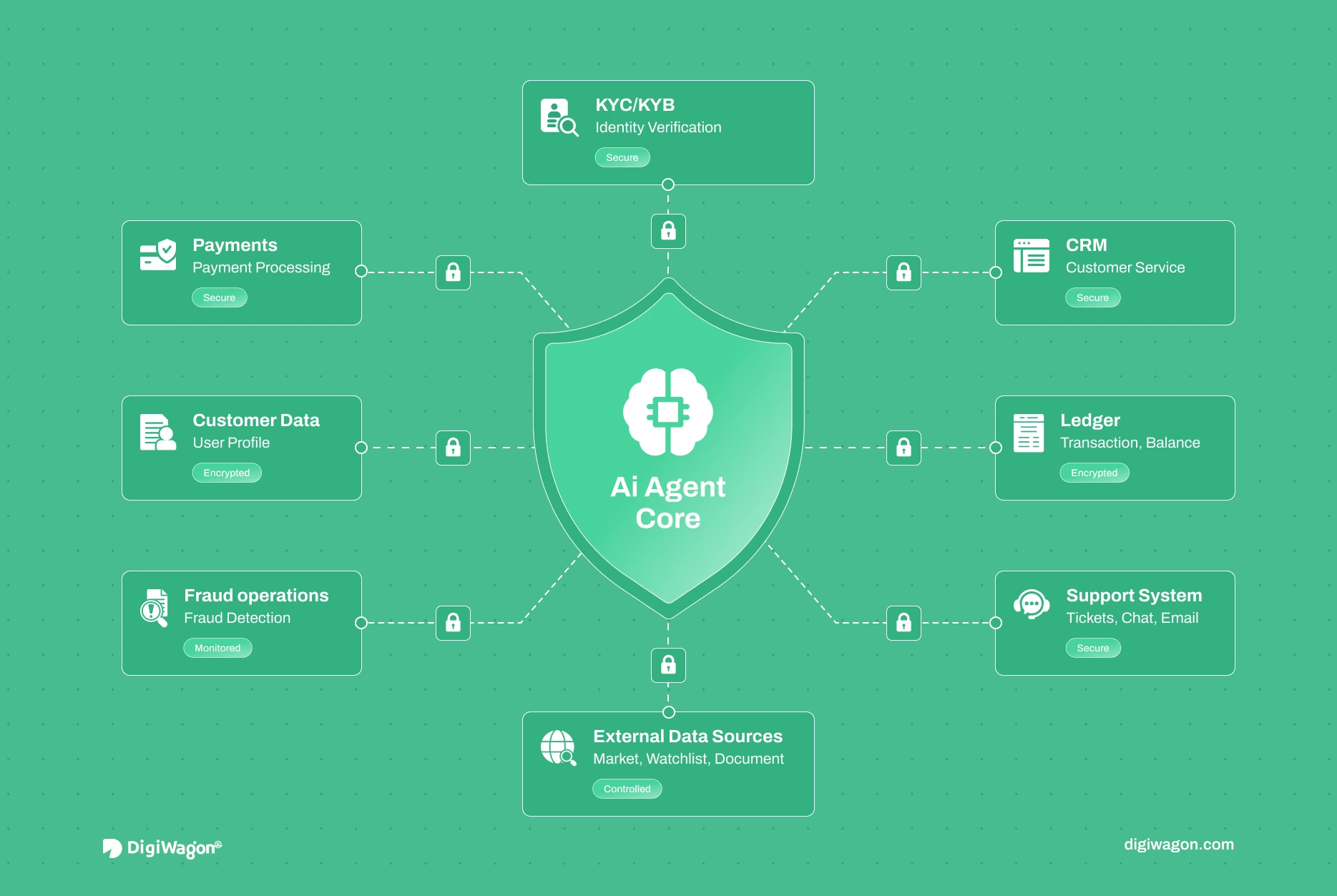
Hallucinations happen when an agent is forced to guess, so we do not let it. Every response is grounded through retrieval layers pulling from approved sources, with self-review and confidence checks. When something does not add up, the agent pauses, asks, or escalates to a human instead of improvising.
AI agent development cost depends on autonomy, integration depth, and governance requirements. A single-workflow agent with a defined scope sits at the lower end; a multi-agent system with several tool integrations, persistent memory, and custom reasoning runs higher; and an enterprise deployment with strict audit, access-control, and compliance requirements – typical in BFSI and RegTech – sits at the top. The main cost drivers are the number of systems the agent must integrate with, the depth of the audit and governance layer, and whether you need one agent or an orchestrated fleet. DigiWagon scopes each build against your actual workflow rather than a fixed package, so the estimate reflects the real work.
Generative AI produces content – text, code, images – in response to a prompt. Agentic AI development builds systems that act autonomously toward a goal: they plan, call tools, evaluate outcomes, and adjust across multiple steps without a human driving each one. Put simply, generative AI writes the report when asked; agentic AI decides the report is needed, gathers the inputs, drafts it, checks it against policy, and files it. Generative models are often the language engine inside an agent, but the agent adds planning, tool use, memory, and governance on top. Most enterprise value in 2026 sits in agentic systems because they remove the whole workflow, not just the typing.
Timeline scales with complexity. A focused single-workflow agent can reach production in a few weeks. A multi-agent system with several integrations, persistent memory, and a full reasoning loop typically takes one to a few months. An enterprise deployment with strict compliance, audit, and access-control requirements – the kind we build for regulated industries – runs longer because the governance layer and testing are as substantial as the agent itself. We work in staged releases so you see a functioning agent early and expand from there rather than waiting for a single big-bang launch.
Yes, and it is where DigiWagon does its strongest work. We have deployed governed agents into AML alert triage, real-time payment screening across 200+ jurisdictions, and lending workflows where every decision has to be explainable. The requirements in these settings – full audit trails, grounded retrieval so the agent never guesses, human escalation for sensitive actions, and data that never leaves your boundary – are exactly what our decision-harness architecture is built to satisfy. Our work is backed by ISO/IEC 27001:2022 and ISO 9001:2015 certification, and the architecture supports EU AI Act transparency and GDPR Article 22 obligations around automated decisions.



 Responds to input