
Skip to content
/
Data Governance Services

Data Governance Services

When the auditor asks where a number came from, you should answer in minutes, not months.

Governance you operate, not a tool you babysit

A cloud data warehouse is the architecture layer your analytics and AI actually run on, and most of them are built backwards. Teams rush data into Snowflake or BigQuery, skip the modelling, then wonder why dashboards disagree and models drift. DigiWagon builds the warehouse properly: the right platform for your workload, dimensional models that hold their shape as you scale, and query tuning that keeps both latency and the monthly bill predictable. We have done this for regulated, high-stakes data, including AML transaction-monitoring work for a RegTech compliance platform, where a sloppy model is not a performance bug but an audit failure. That is the standard we bring to a data engineering and ETL foundation: clean, well-modelled data that production systems can rely on.

The Anatomy of Our Data Governance Services

Data Governance Strategy & Operating Model

Most governance programs die because they start with 156 policies and no owners. We start with the painful gap that costs you money or risk, then build outward. DigiWagon designs the operating model: data owners, stewards, a working governance council, and decision rights mapped to your actual org. We document standards in a way your teams will use, not archive. For a regulated lending program, that meant risk-data definitions and ownership that held up under audit scrutiny. The result connects to your wider data and analytics services so governance supports delivery instead of blocking it.

Data Cataloging & Metadata Management

A catalog answers "what data do we have" and metadata answers "what does it mean and where did it come from." We consolidate both into one searchable layer across PostgreSQL, MySQL, SQL Server, and MongoDB sources, with semantic structure (RDF, RDFS, OWL, SKOS, JSON, XML) where a semantic layer earns its place. DigiWagon links glossary terms to physical assets so definitions are not theoretical. For analytics-heavy teams, a governed catalog is what makes business intelligence and data visualization trustworthy rather than a guessing game about which table is canonical.

Column-Level Data Lineage

Table-level lineage is the floor, not the ceiling. Column-level lineage is what BCBS 239 risk-data aggregation and real audits actually require: the ability to map a number in a regulatory report back to its raw source, transformation rules, and responsible owner. DigiWagon captures lineage across pipelines using Apache Kafka streams and Airflow or dbt transformations, surfaced through Power BI, Tableau, and Elasticsearch-backed search. On AML watchlist data, that traceability is the difference between a clean review and a finding. It plugs directly into the pipelines our data engineering and ETL services build.

Business Glossary & Data Definitions

Inconsistent definitions are where trust quietly leaks out of a data program. DigiWagon builds a business glossary that ties every term and metric to its physical data asset, so "active customer" or "net exposure" means one thing across the organization. We detect conflicting definitions, resolve them with the business owners, and keep the glossary linked to lineage and catalog entries. For BFSI and RegTech teams, consistent terminology across risk and compliance reporting is a prerequisite, not a nicety, and it feeds straight into data science and analysis work downstream.

Data Quality Management

Poor data quality does not announce itself; it shows up as a wrong risk assessment or a misfired AI model. DigiWagon implements quality rules and validation at the point of entry, anomaly detection across sources and time periods, and remediation workflows that route issues to the right owner. We also tackle accumulated quality debt rather than pretending it does not exist. Built on Python validation logic against PostgreSQL, SQL Server, and MongoDB stores, quality controls run continuously. For manufacturing and industrial teams, that means governed sensor and operational data their analytics can actually rely on.

Access Governance & Stewardship

Access governance is about accountability, not just locks. DigiWagon defines role-based access, assigns data ownership and stewardship, and builds approval workflows so access requests and exceptions route to the people responsible. We classify sensitive data for governance purposes, distinct from the encryption, masking, and DLP that belong to data security. For RegTech and HealthTech teams handling PHI and regulated records, demonstrable access accountability is what an auditor checks first. This connects naturally to RegTech software development where access controls are core to the compliance platform itself.

Compliance & Audit Readiness

Regulators increasingly want living governance, not declarations. DigiWagon maps your governance to the frameworks that bind you (BCBS 239, GDPR, the DPDP Act 2023, CCPA, HIPAA, FinCEN, and FINTRAC), maintains records of processing activities, and builds audit-evidence trails that show not only what was decided but how and why. Financial institutions spend an estimated 4-7% of IT budgets on data governance and compliance, so the work has to pay for itself in reduced audit risk. Our BFSI depth shows up here: governed watchlist and compliance-intelligence data, built on exactly this discipline for a regulated financial client.

Governance for AI Systems

AI adoption has outrun most governance frameworks, and 2026 is the year regulators catch up. DigiWagon governs the data your models learn from and act on: auditable lineage into training and inference data, accountability for automated decisions, and alignment to the EU AI Act, ISO/IEC 42001, the NIST AI Risk Management Framework, and GDPR Article 22. This is governing AI, not selling AI agents that govern. It builds on our published thinking in "The Governance Gap: Designing Auditable AI Systems for Compliance" and connects to FinTech software development where explainable, defensible models are becoming table stakes.

We Have Done This Inside Live AML Systems.

See how governed data held up across 200+ jurisdictions of regulatory scrutiny.

The Workbench for Data Governance Services

We Operate It, You Do Not

Platform vendors hand you a tool and a login. DigiWagon builds the governance function and runs it as a practice, which suits teams without a large internal data org. You get outcomes, not another dashboard to staff.

Banking-Grade by Default

Our governance discipline came from RegTech and BFSI work where a missing definition is a regulatory finding. We bring that rigor to every client, regulated or not, because audit-ready data is good data regardless of industry.

Column-Level, Not Table-Level

Most providers stop at table-level lineage. We trace at column grain, tied to data-owner accountability, because that is what BCBS 239 risk-data aggregation and serious audits actually demand. The grain is the whole point.

We Govern AI, Properly

Few governance pages mention AI at all. We govern the data behind AI systems with auditable lineage aligned to the EU AI Act and ISO/IEC 42001, so your models survive their first compliance review instead of failing it.

Certified Delivery

DigiWagon delivers on ISO/IEC 27001:2022 and ISO 9001:2015 certified processes. Governance built by a team that lives its own controls is governance you can point an auditor at without flinching.

Cost Structure That Makes Sense

Big-4 firms bill governance programs at Fortune-500 rates. We deliver regulated-grade governance at a focused consultancy's cost structure, which means Western-market quality without the Western-market invoice.

Why We’re Your Best Bet for Data Governance Services

Digiwagon-header-logo-v1.1
Company A
Company B
⌛ Experience
– – – – – – – – – –
Seasoned pros who’ve seen it all.
Experienced, but often by the book.
Miss the spark for complex projects.
💰 Estimation
– – – – – – – – – –
Honest timelines and budget, zero surprises.
Timelines that shift and swerve often.
Estimates come with ‘oops, missed that!
📄Documentation
– – – – – – – – – – – –
Clear, complete, no missing pieces.
Basic docs, you’ll fill in the gaps.
Sketchy notes, good luck finding info.
🧪 Testing
– – – – – – – –
Glitch-proof before you even see it.
Testing happens once the code is live! 
Testing? Or ‘testing patience?’
☎️ Support
– – – – – – – –
Still by your side, long after the launch.
Support fades after the honeymoon phase.
Support arrives after 10 reminders.

Stop Reconstructing The Past. Start Proving It.

Turn your data into something an auditor, a board, and an AI model can all trust.

Data Governance Services - FAQs

Data governance is the framework of policies, ownership, and accountability over your data. A data catalog is the searchable inventory of what data exists. Data lineage traces where it came from and how it changed. Governance is the rulebook; the catalog and lineage are tools that enforce it.
Data engineering builds the pipelines that move your data; our data engineering and ETL services cover that. Data security handles encryption, masking, and DLP, a separate page. Data governance is the accountability layer on top: who owns the data, what it means, and how you prove it.
We build and operate the governance function rather than handing you a platform to run yourself. We start with one painful, costly gap, solve it fast, prove the value, then expand. It is governance as an operated practice, which works well for teams without a large internal data organization.
We map governance to the frameworks that apply to you: BCBS 239 for bank risk-data aggregation, GDPR, the DPDP Act 2023, CCPA, HIPAA and HITECH for health data, plus FinCEN and FINTRAC for financial crime. For AI, we align to the EU AI Act and ISO/IEC 42001.
Governed data is what makes AI defensible. We provide auditable lineage into the data your models use, accountability for automated decisions, and evidence trails that show how and why decisions were made. That is the difference between a model you can explain to a regulator and one you cannot.
We implement and operate governance across the platforms that fit your stack, including catalog and governance tooling, with lineage captured through Apache Kafka, Airflow, and dbt, and surfaced via Power BI, Tableau, and Elasticsearch search. We work in AWS, Azure, and Google Cloud environments.

Related Services

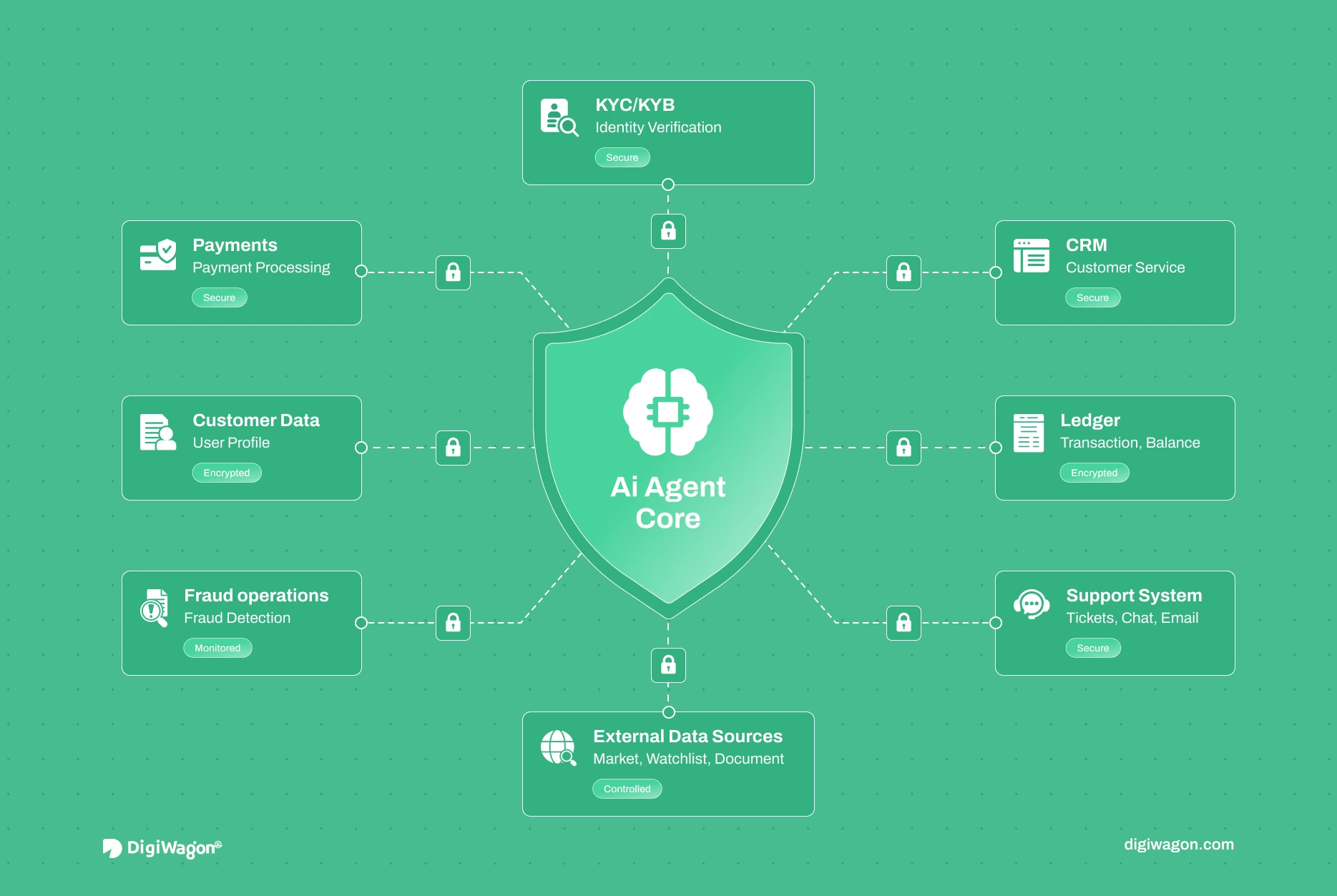
AI agent security for FinTech showing an AI agent protected by tool permissions, human approvals, sandboxing, monitoring, data boundaries, and audit controls.
blogs

AI Agent Security Guide for FinTech | DigiWagon

15 July 2026
Author Jigar
Jigar Vavadia
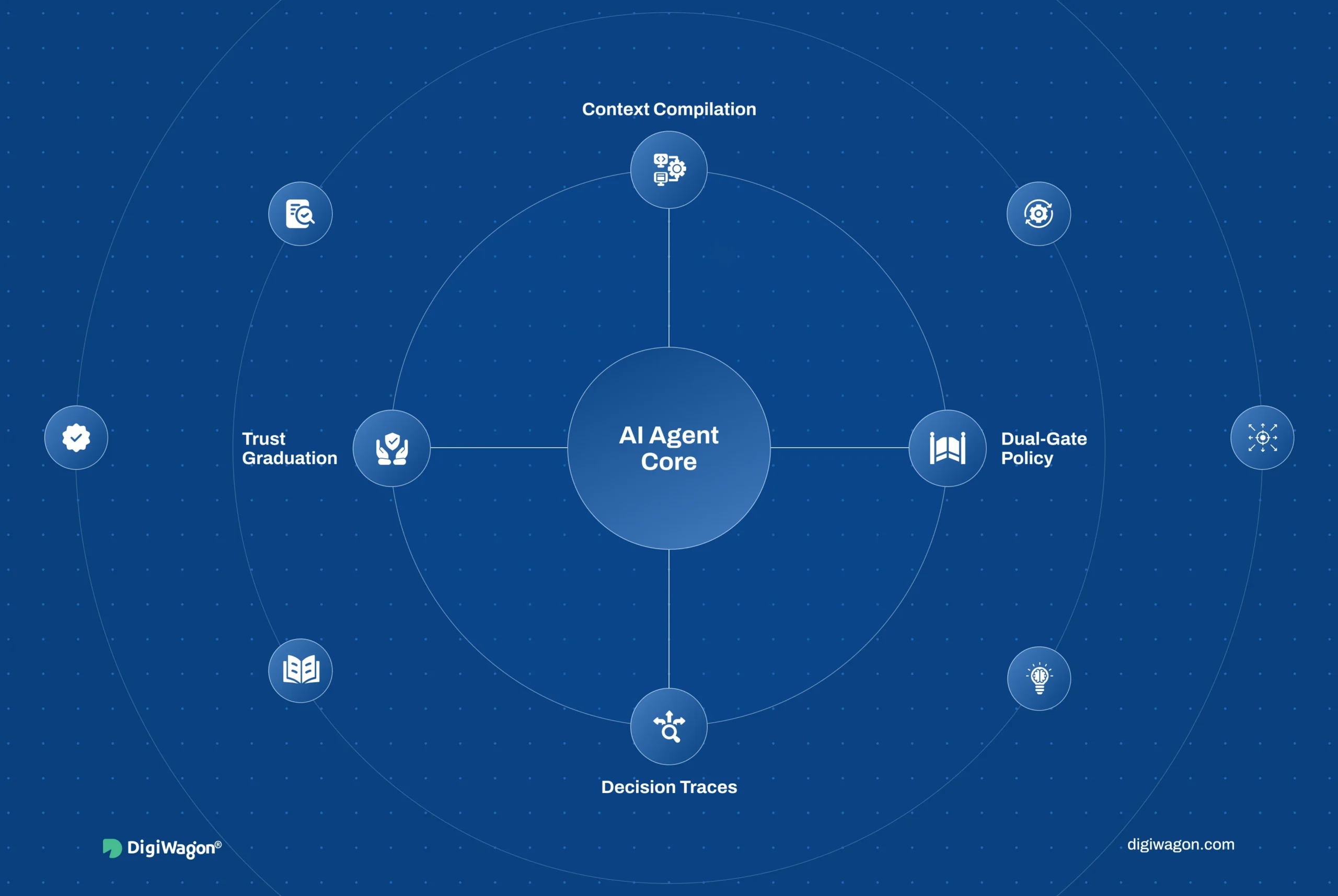
Feature image showing governed enterprise AI agents inside a decision-harness architecture with context compilation, dual-gate policy enforcement, decision traces, trust graduation, and audit-ready controls.
blogs

Governed Enterprise AI Agents: A Decision-Harness Architecture

26 June 2026
Author Kartik Gajjar
Kartik Gajjar
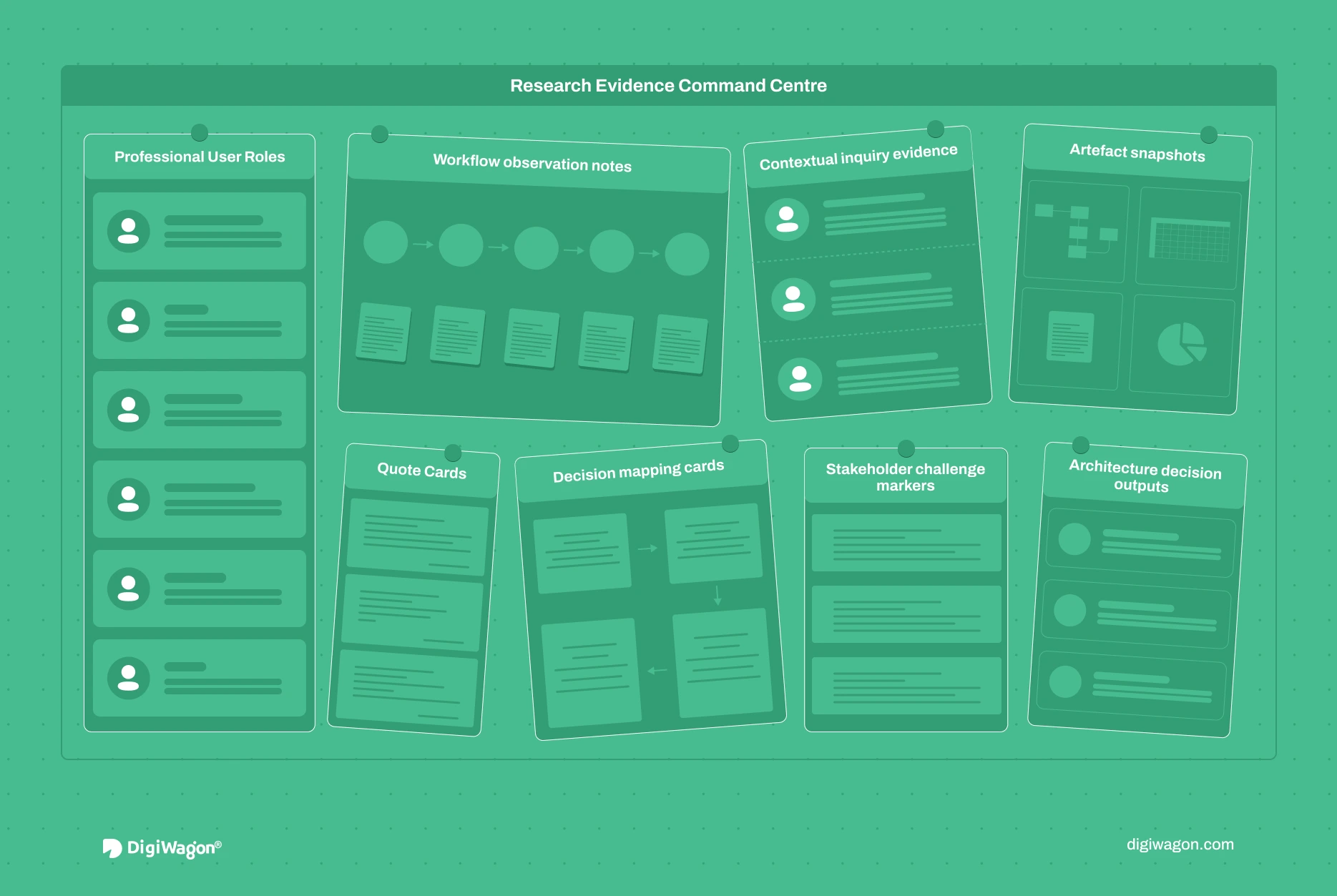
Cover image showing B2B UX research methodology with professional user recruiting, contextual inquiry, workflow evidence, research synthesis, evidence traceability, and product decision mapping.
blogs

B2B UX Research: A Field-Tested Methodology

17 June 2026
Pavan Chavda
Pavan Chavda
Download Whitepaper

Fill in your details to access the whitepaper

This field is for validation purposes and should be left unchanged.
Download Whitepaper

Fill in your details to access the whitepaper

This field is for validation purposes and should be left unchanged.
Download Whitepaper

Fill in your details to access the whitepaper

This field is for validation purposes and should be left unchanged.
Download Whitepaper

Fill in your details to access the whitepaper

This field is for validation purposes and should be left unchanged.