The Urgency of Now
The 15-minute delivery window—once a novelty for late-night snacks-is rapidly becoming an expectation across the B2B world, especially in Logistics & Supply Chain and specialised retail sectors (e.g., replacement parts, urgent supplies).
Quick Commerce (Q-Commerce) is a delivery model defined not just by speed, but by operational efficiency and hyper-local inventory strategy.
For CTOs and Founders in Retail and Distribution, this shift impacts every element of the supply chain, from inventory placement to final-mile technology. The promise of Q-Commerce is simple: meeting the urgent, non-plannable needs of the modern business buyer.
The Q-Commerce Reality for B2B Logistics and Retail
From Days to Minutes – The Evolution of Fulfillment Speed isn’t the innovation – precision is.
| Model | Infrastructure | Delivery Time | Technology Focus |
|---|---|---|---|
| E-Commerce | Centralised warehouses | 3-5 days | Storage optimisation |
| Same-Day Delivery | Regional distribution hubs | 12-24 hours | Inventory analytics |
| Q-Commerce | Dark Stores & Micro-Fulfillment Centers | 10-30 minutes | Real-time data + AI-driven routing |
Q-Commerce is not merely faster shipping; it’s a total re-engineering of the fulfillment model. It represents a pivotal element of Digital Transformation for retail enterprises, demanding a move away from centralised distribution.
| Feature | Traditional E-commerce Fulfillment | Quick Commerce (Q-Commerce) Fulfillment |
|---|---|---|
| Warehouse Type | Large, centralised Distribution Centers (DC) | Small, decentralised Dark Stores & MFCs |
| Delivery Radius | National/Regional (50+ miles) | Hyper-local (1-3 miles) |
| Fulfillment Goal | Ship in 1-2 days; Deliver in 3-5 days | Pick and Pack in 2 minutes; Deliver in 15 minutes |
| Technology Focus | Inventory storage optimisation | Real-time Inventory and Route Optimisation |
The goal is to eliminate the travel time within the warehouse and the last-mile distance to the customer.
Phase 1: The Hyper-Local Infrastructure Shift
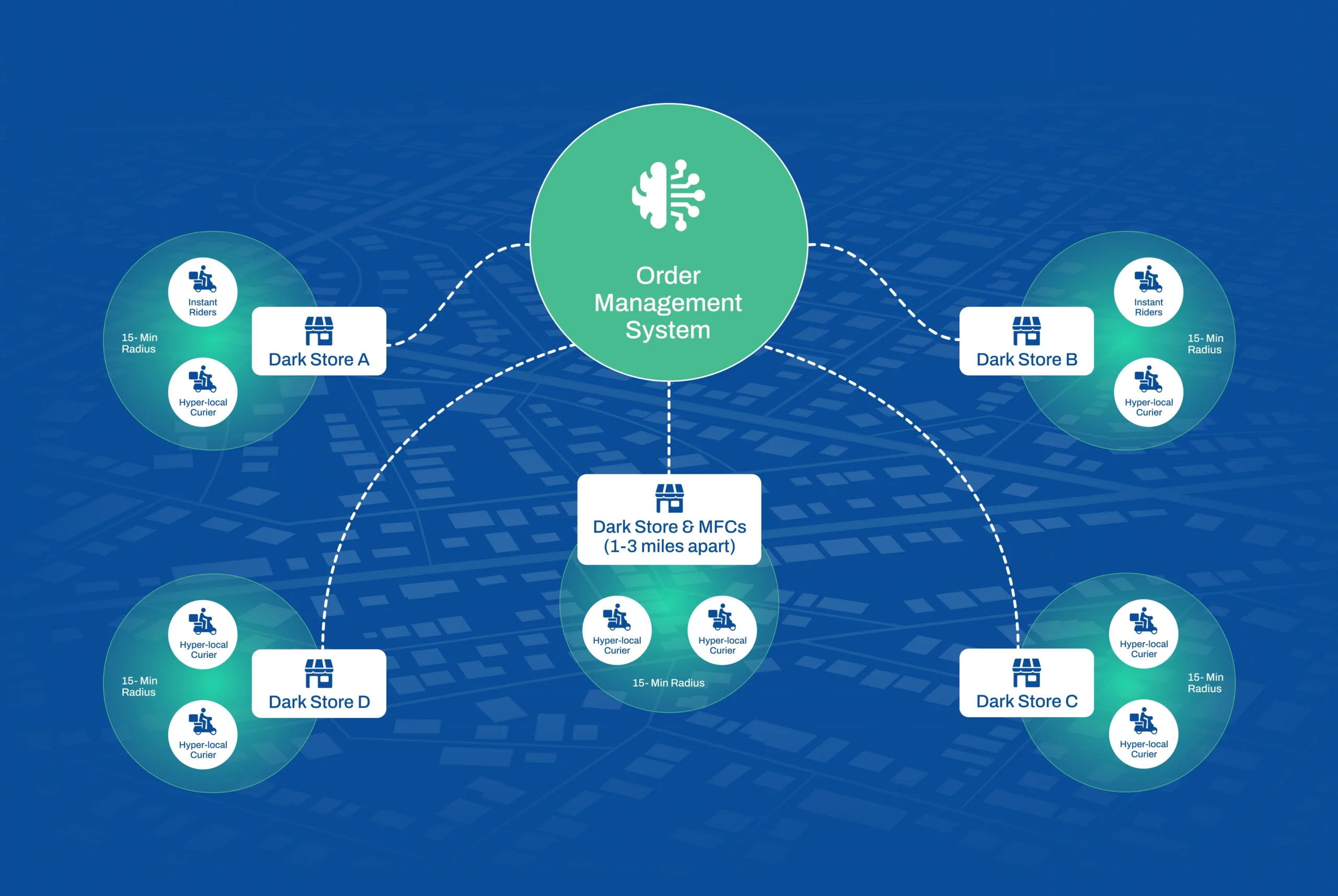
The Hyper-Local Network – How Q-Commerce Infrastructure Works Proximity is profit.
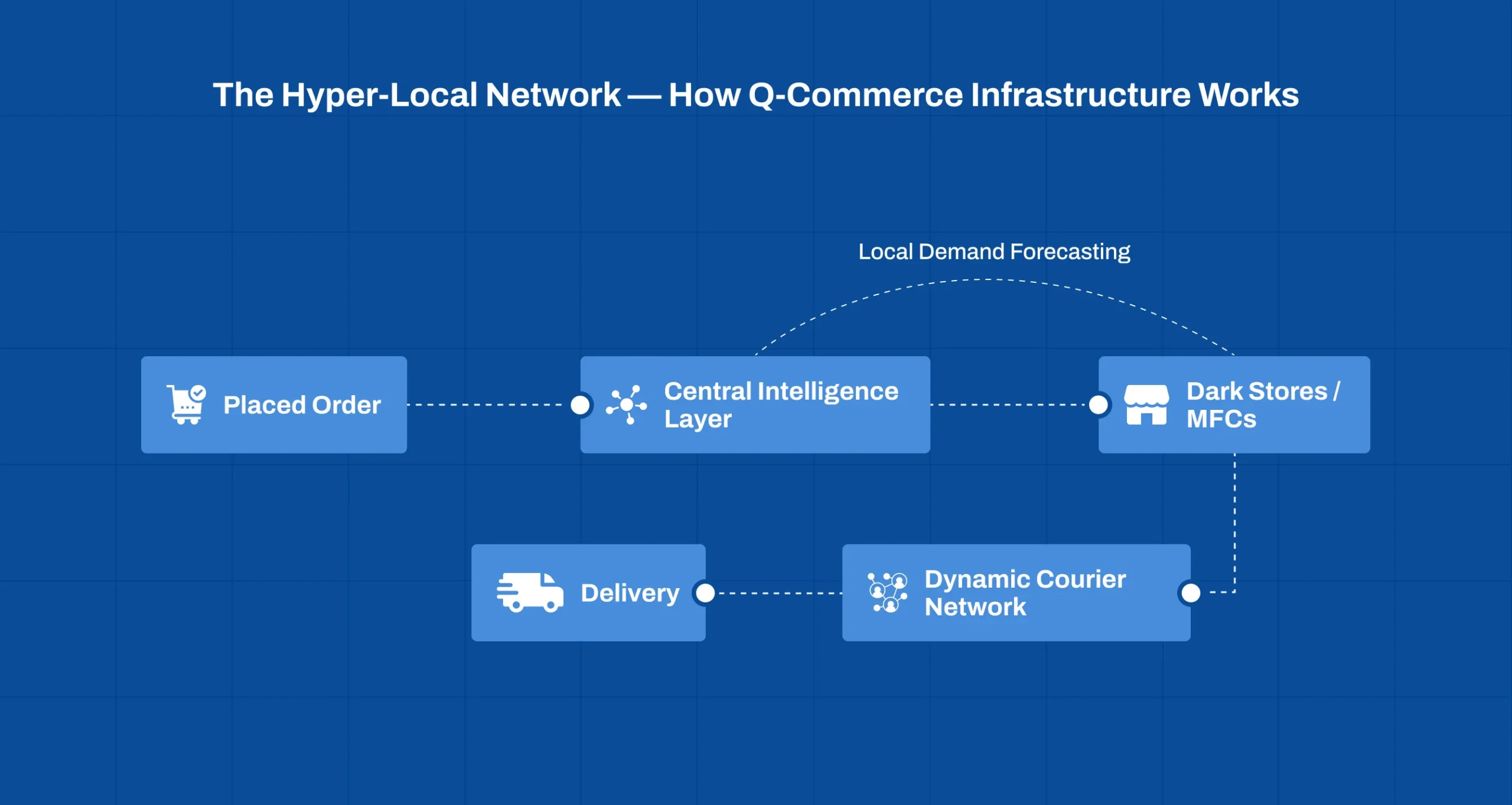
- Central Intelligence Layer: pERP + OMS integrates with dark store inventory and delivery apps via APIs.
- Dark Stores / MFCs: Small, strategically placed micro-hubs for under-2-minute picking.
- Dynamic Courier Network: Rider pool managed in real-time, routed automatically via AI dispatch.
- Local Demand Forecasting: AI predicts order surges per area, pre-positions stock accordingly.
The core challenge of Q-Commerce is getting the product within minutes of the buyer. This requires a physical infrastructure overhaul.
Dark Stores and Micro-Fulfillment Centers (MFCs)
Dark Stores are retail spaces or small warehouses closed to the public and dedicated solely to fulfilling online orders. Micro-Fulfillment Centers (MFCs) are similarly small hubs, often built in high-density areas (like city centers in the UK or the industrial hubs of the USA).
- B2B Use Case: For a construction materials distributor, placing MFCs near major job sites allows urgent delivery of tools or specialty components that stop work if missing.
- Efficiency Design: The layout of a dark store is optimised for speed-picking-high-demand items are placed along the shortest possible route, allowing workers to pack an order in under two minutes.
Product Assortment and Inventory Intelligence
You cannot stock every SKU. Q-Commerce success relies on Inventory Intelligence.
- Curated Assortment: Focus only on high-velocity, high-demand, non-plannable items. For a Retail company, this might be high-margin convenience items. For a B2B logistics firm, this might be urgent MRO (Maintenance, Repair, and Operations) supplies.
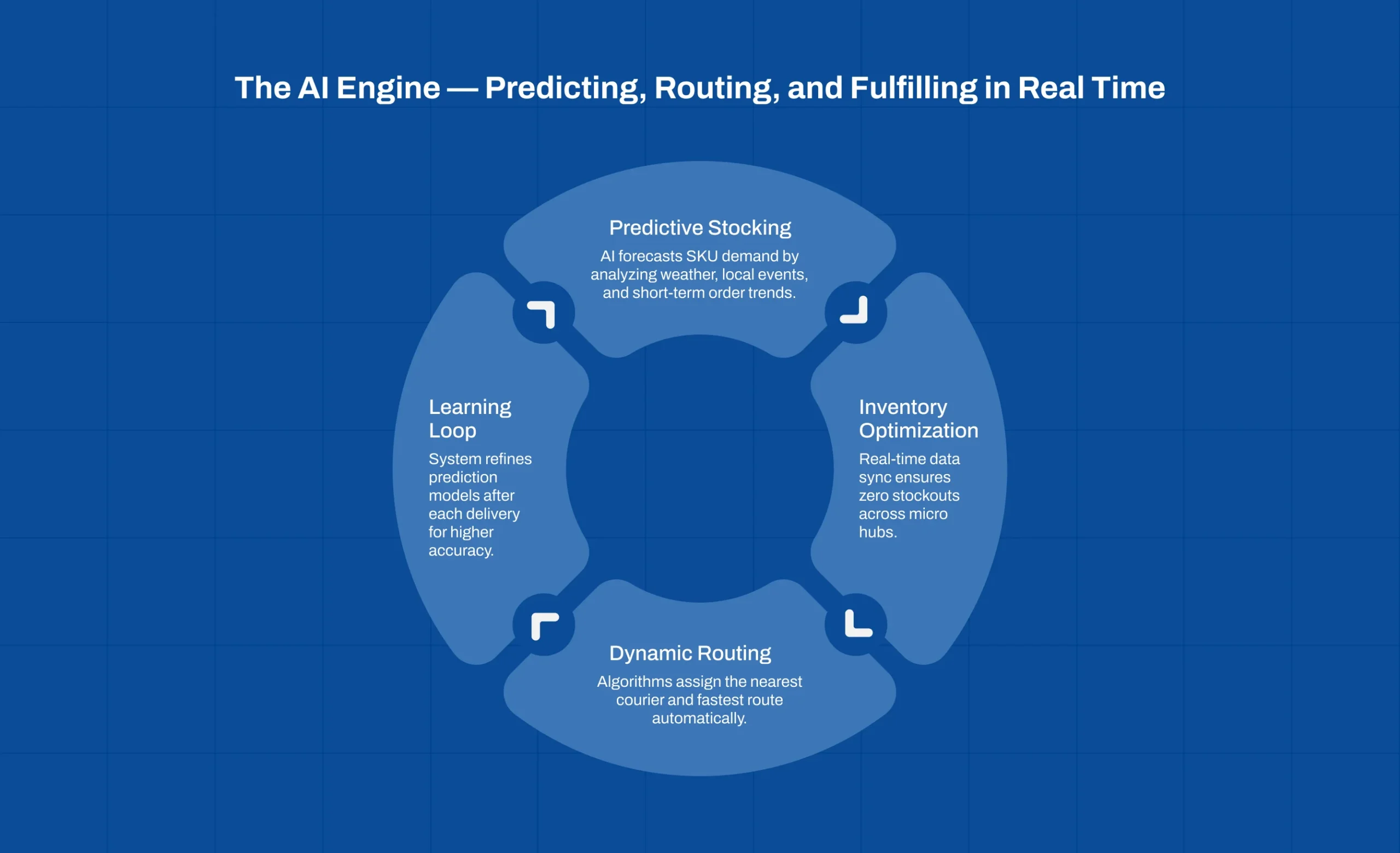
- Real-Time Sync: Inventory visibility must be 100% accurate and instantly synchronised across all channels. There is zero tolerance for stockouts in a 15-minute promise. This is where dedicated Data & Analytics solutions are critical.
Phase 2: The Technology Stack for Speed
The AI Engine — Predicting, Routing, and Fulfilling in Real Time From data collection to delivery direction in milliseconds.
The physical infrastructure only gets you halfway; the final mile is won or lost by technology. Enterprises require Custom Software solutions built for this new hyperlocal complexity.
AI for Dynamic Demand Forecasting & Routing
This is where AI & Machine Learning become the true engines of speed.
- Predictive Stocking: AI models analyse real-time data (weather, local events, time of day, past 1-hour sales data) to predict demand and ensure the right products are in the right dark store before the order is placed.
- Dynamic Routing: The moment an order is placed, an algorithm calculates the fastest route, factoring in current traffic, one-way streets, and rider location. It automatically dispatches the order to the nearest available courier, minimising manual intervention.
Seamless Order Management System (OMS) Integration
The central nervous system of Q-Commerce is a robust OMS that can orchestrate the entire process in seconds.
- API-First Fulfillment: The OMS must connect instantly via APIs to the e-commerce front-end, the Dark Store Inventory Management System, and the courier’s dispatch platform.
- Automated Verification: The system must verify customer location, inventory availability, payment, and dispatch within milliseconds to meet the 15-minute clock.
Measuring Success: Speed, Density, and LTV
From Speed to Scale – KPIs That Define Q-Commerce Success Measure what moves the business, not just the product.
| KPI | Definition | Target Metric |
|---|---|---|
| Pick & Pack Time | Order placement → handoff to courier | < 120 seconds |
| Order Density | Orders within a 1–3 mile radius | > 60/hr peak load |
| Delivery Accuracy | On-time, correct delivery % | > 98% |
| Customer LTV | Value of repeat, high-frequency buyers | +25–40% uplift |
Moving forward, B2B leaders must track metrics relevant to the Q-Commerce model:
- Pick-and-Pack Time: The time from order placement to hand-off to the courier (target: under 120 seconds).
- Order Density: The volume of orders within a single dark store’s 1–3 mile radius, which determines profitability.
- Customer Lifetime Value (LTV): Q-Commerce users are often highly valuable and loyal due to the reliability. High LTV justifies the increased operational cost.
Conclusion: The Race for the Last Mile
Q-Commerce is a high-stakes logistics game where a delay of sixty seconds can lose a customer forever. For B2B Logistics and Retail enterprises seeking to dominate their market in 2026, the strategic investment in hyper-local infrastructure and AI-driven logistics technology is the only way to transform the “click to cart” journey into a competitive, profitable, 15-minute reality.