Architecting the Agent Economy: Strategic Overview
- The future of SaaS is agentic: teams of specialized AI agents, not single co-pilots
- Multi-agent performance depends more on architecture than model choice
- Production orchestration requires patterns, shared memory, and standardized tool access via MCP
- Latency, cost, and agent sprawl demand circuit breakers and cost-aware routing
To the CTOs, Platform Architects, and Product Visionaries:
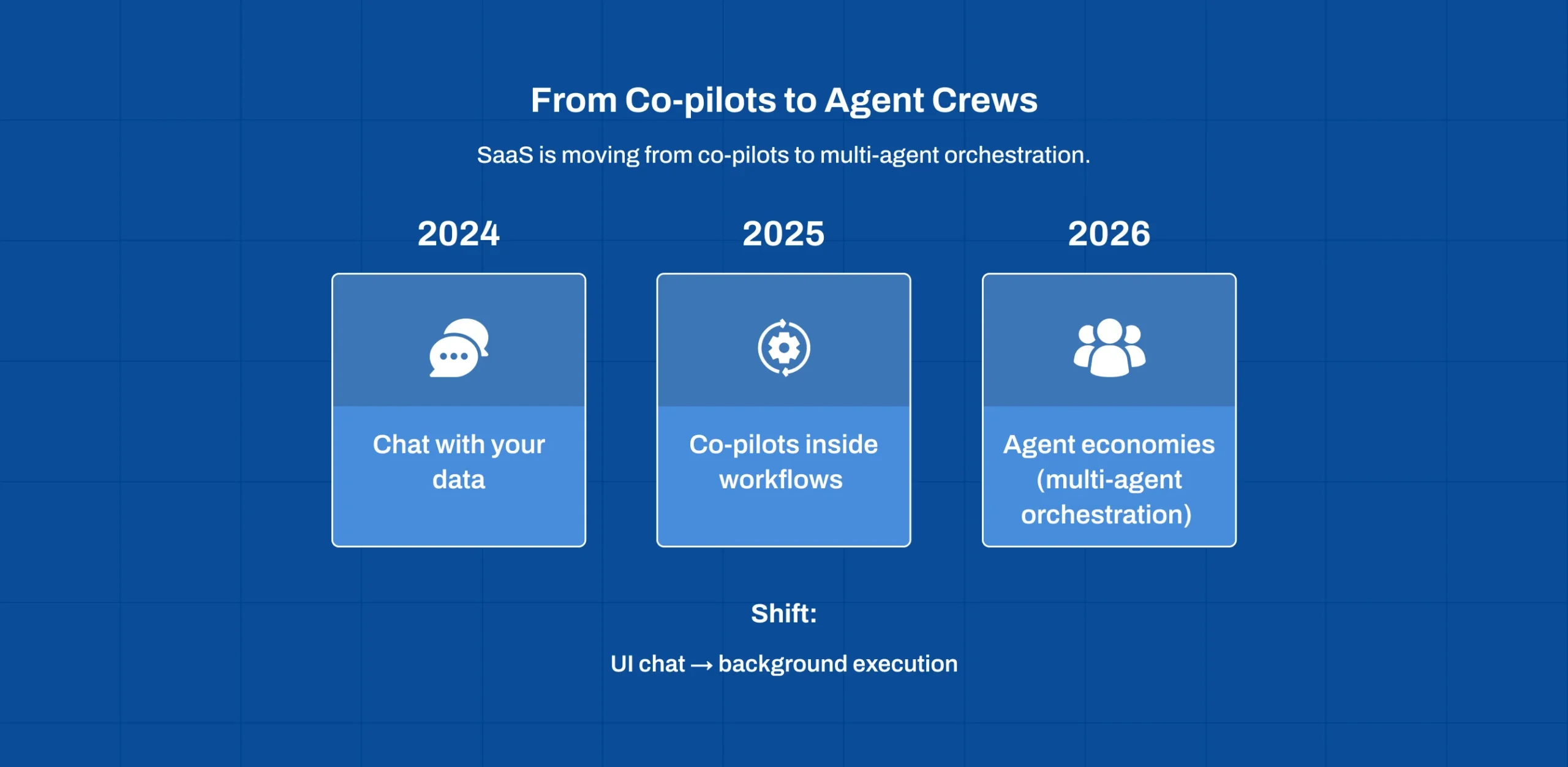
In 2024, we added “Chat with your Data.” In 2025, we gave users “Co-pilots.” But in 2026, the B2B SaaS landscape has reached its true “Agentic” era. We are no longer building software that waits for instructions; we are architecting Agent Economies, ecosystems where specialized AI agents collaborate, negotiate, and execute complex business processes with minimal human intervention driven by Custom SaaS product development services.
For tech leaders, the challenge has shifted from “Which LLM should I use?” to “How do I orchestrate ten different models to work as a high-performing team?”
Welcome to the era of Multi Agent AI Orchestration.
From Co-pilots to Crews: The Rise of the Agentic SaaS
The “single-prompt” era is over. Enterprise workflows are too messy for one model to handle. If you ask a single LLM to analyze a contract, check it against global regulations, and draft a summary, you get a “jack-of-all-trades, master-of-none” output high on hallucinations and low on precision.
Why Single-LLM Prompts Are Obsolete
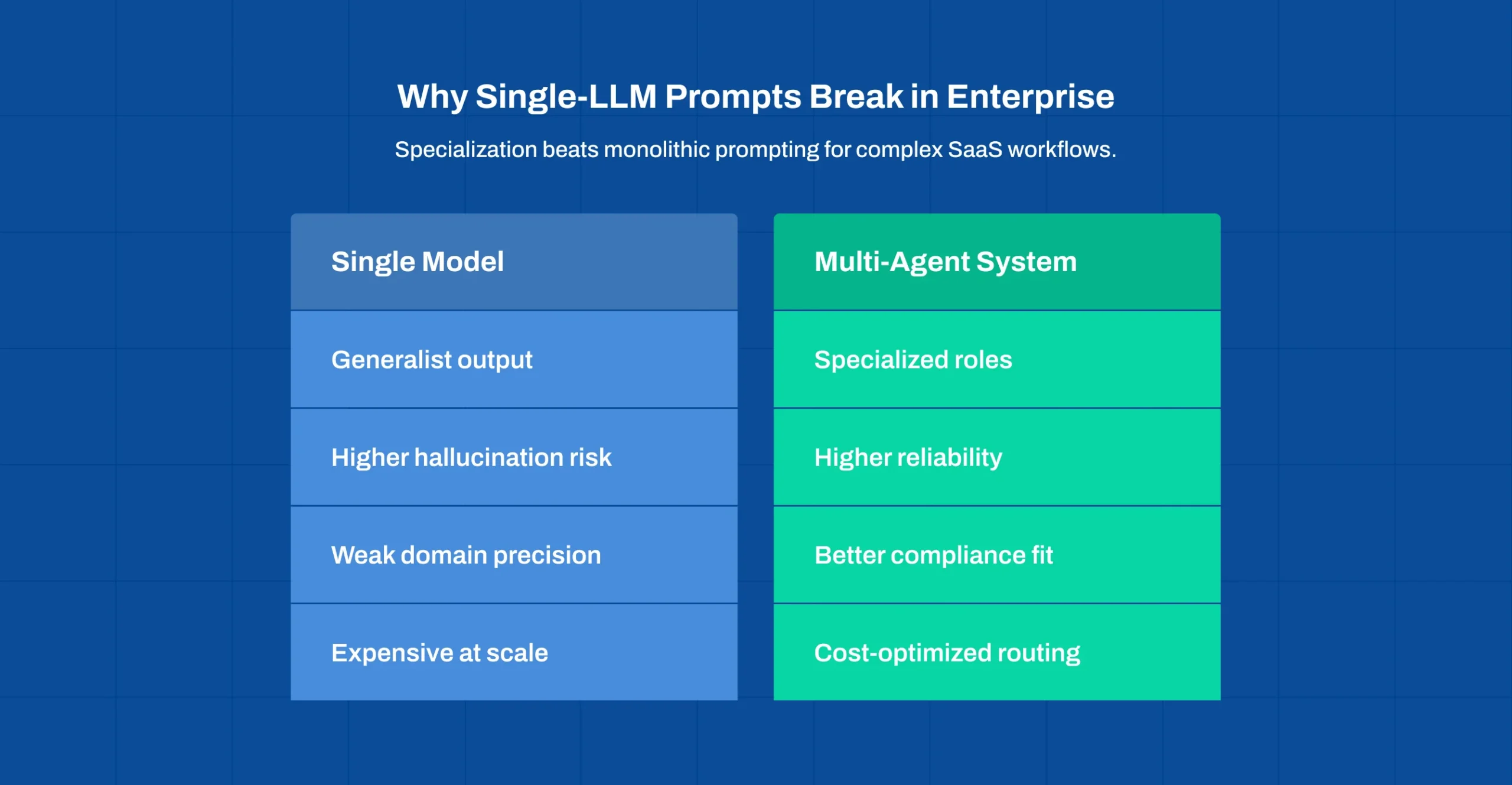
In 2026, we’ve learned that AI performance is 70% architecture and only 30% model choice. Complex SaaS tasks now require specialization. You don’t want a generalist; you want a “Researcher Agent” that handles RAG, a “Legal Agent” that knows GDPR, and a “Writer Agent” that maintains your brand voice.
The Shift from Chat-UI to Background Orchestration
Users no longer want to “chat” with their software for twenty minutes. They want to set a goal,”Onboard this client and ensure all FinTech compliance is met”, and let the background Agentic Workflows handle the dozens of micro-tasks required to reach that outcome.
Core Design Patterns for Multi-Agent Systems (MAS)
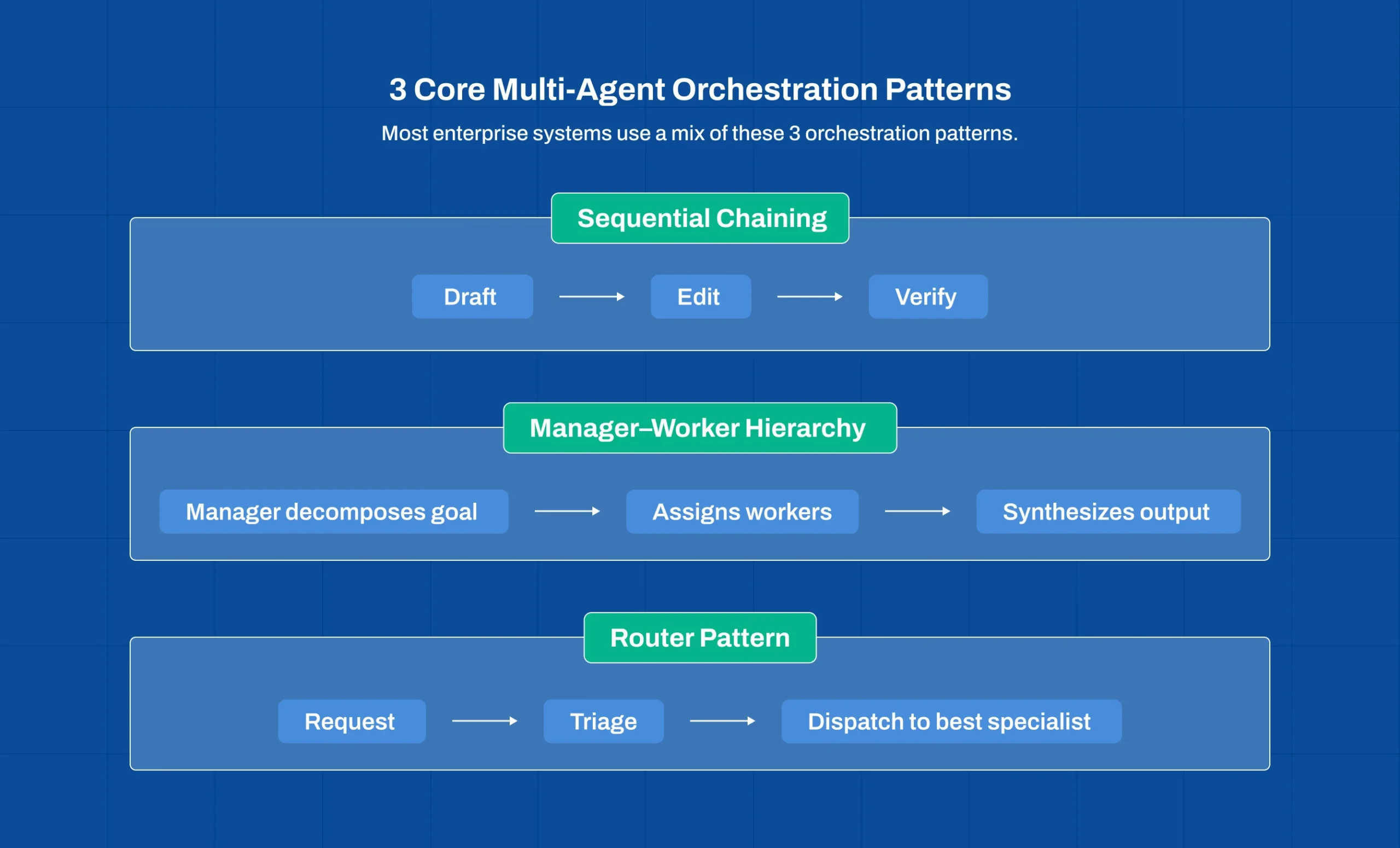
Architecting for agents requires choosing the right collaboration pattern. Just like a human team, how agents are managed determines their success.
Sequential Chaining vs. Hierarchical “Manager-Worker” Models
- Sequential Chaining: Best for “Draft → Edit → Verify” flows. Agent A passes its output to Agent B. It’s predictable and easy to debug using frameworks like LangGraph.
- Hierarchical Models: A “Manager Agent” (usually a high-reasoning model like GPT-5 or Claude 4) decomposes a user’s goal into sub-tasks and assigns them to “Worker Agents” (smaller, faster models). The manager then synthesizes the results.
The Router Pattern: Dispatching Tasks to Specialized Specialists
The Router Pattern acts as a traffic controller. It analyzes the incoming request and routes it to the specialist agent best suited for the task. This allows you to use a $0.01-per-million-token model for simple triage and reserve your $10-per-million-token reasoning model for the heavy lifting.
The Technical Blueprint: Building the Orchestration Layer
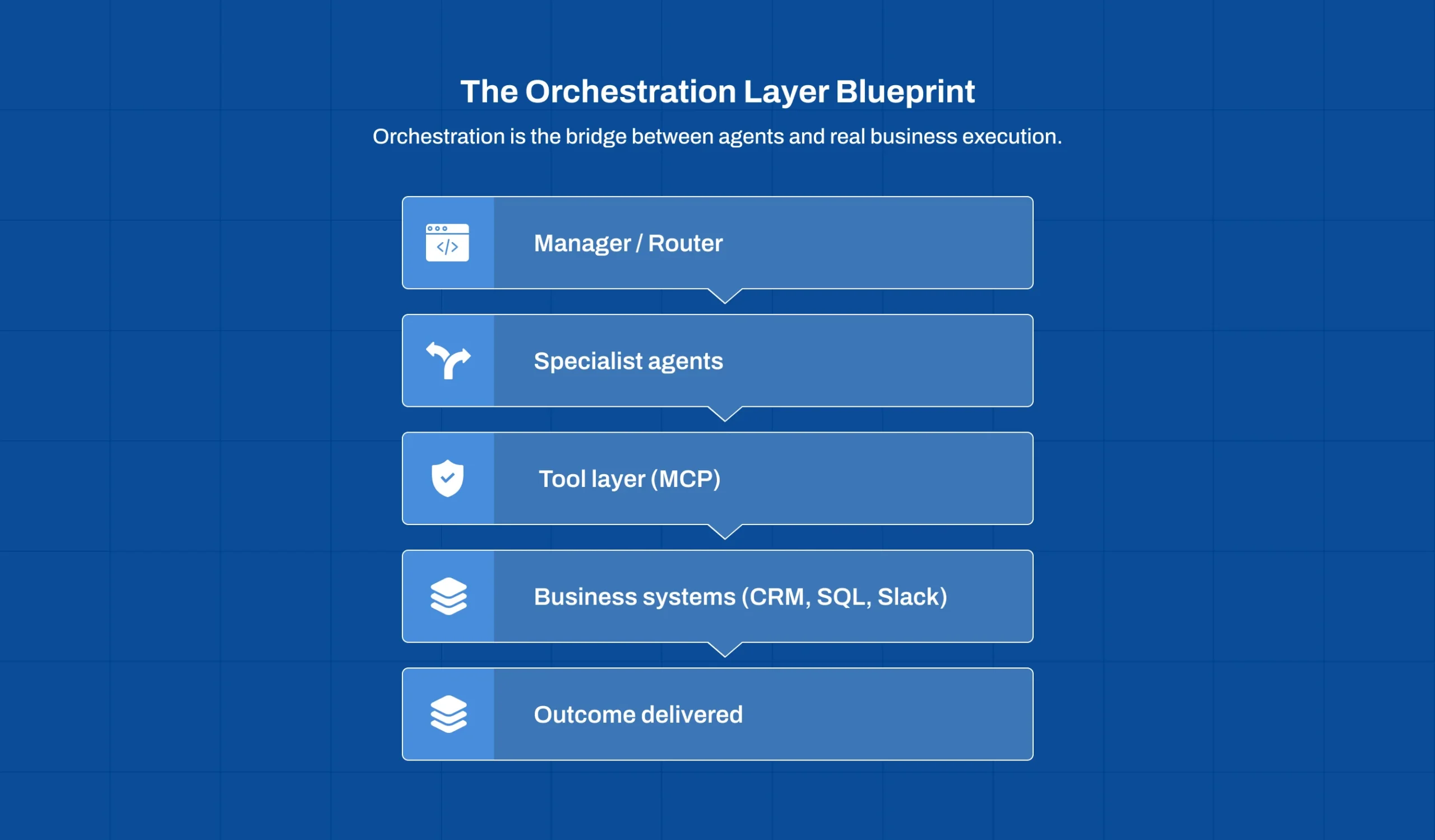
To move from an experiment to a production-ready SaaS Product, you need a robust orchestration layer that connects these agents to your existing business logic.
Standardizing Tools with Model Context Protocol (MCP)
The biggest hurdle in 2025 was “integration sprawl.” Every agent needed a custom connector for every API. In 2026, the industry has standardized on the Model Context Protocol (MCP). MCP allows your agents to discover and use tools (CRMs, SQL databases, Slack) using a unified, secure interface, drastically reducing the cost of SaaS Architecture refactoring.
Managing Shared Memory and State across Agent Transitions
When Agent A passes a task to Agent B, how do you ensure the context isn’t lost?
- Short-Term Memory: Managed via LangGraph or CrewAI state objects, tracking the current task progress.
- Long-Term Memory: Stored in a Vector Database (like Pinecone or Weaviate), allowing the agents to “remember” a customer’s preferences or previous decisions across different sessions.
Critical Challenges: Latency, Cost, and “Agent Sprawl”
Autonomy comes with risks. A multi-agent system can accidentally enter an infinite loop, or “hallucinate” a tool call that triggers a 50-step API cascade, leading to a massive bill.
Implementing Circuit Breakers for Autonomous Loops
Your orchestration layer must include Circuit Breakers. If Agent A and Agent B have been “debating” for more than 5 iterations without reaching a conclusion, the system should halt and trigger a Human-in-the-Loop (HITL) checkpoint.
Token Management and Cost-Aware Routing
Building in 2026 requires Cost-Aware Routing. Your orchestrator should automatically select the “smallest viable model” for each sub-task.
- Service Alignment: This is where Strategy Consulting meets AI-Powered Automation, designing systems that deliver 99% accuracy at 10% of the cost of a monolithic approach.
The Future: Composable Agentic Ecosystems
The future of SaaS is composable. We are moving toward a world where your “Supply Chain Agent” might need to talk to a third-party “Logistics Agent” from a different vendor. With DigiWagon building your platform with open standards like MCP and robust API-first principles is no longer optional, it is the prerequisite for participating in the global agent economy.
Architect Your Platform for the Agent Economy
Prepare your SaaS ecosystem for multi-agent orchestration with a scalable, future-ready architecture that supports AI-driven automation and interoperability.