
SWIFT Orchestration: What Actually Matters
- SWIFT orchestration is a message-integration problem; the architecture decides whether mixed MT and MX formats stay manageable or multiply complexity across every consumer.
- Canonicalising messages to one internal format at ingress removes duplicate per-format logic from every downstream system that reads SWIFT traffic.
- Payment screening runs against a hard latency SLA, so orchestration belongs on an event log, not a chain of synchronous REST calls.
- The ISO 20022 (MX) migration window is closing; an orchestration layer built today needs a CBPR+ readiness path, not just MT handling.
- A canonicalisation layer is the seam that lets MT-to-MX migration happen behind a stable internal contract, without rewriting every consumer.
SWIFT orchestration architecture is the integration layer that ingests MT and MX payment messages, canonicalises them to one internal format, and routes them through screening and downstream systems on a latency budget tight enough for real-time payment screening. The canonicalisation seam is what lets the MT-to-MX migration happen without rewriting every consumer.
Why SWIFT Integration Is an Orchestration Problem
A bank or payment platform connected to SWIFT receives a stream of messages in mixed formats: legacy MT messages and newer ISO 20022 MX messages, often simultaneously during the migration period. The naive integration reads each format where it is consumed, which means every downstream system, screening, reconciliation, reporting, learns to parse both MT and MX.
That duplication is the failure mode. Each consumer reimplements format handling, the implementations drift, and a change to message handling means touching every system. The orchestration problem is how to ingest mixed-format SWIFT traffic once and present a single, stable internal representation to everything downstream.
The ISO 20022 standard defines the structured MX message model that SWIFT is migrating toward, and SWIFT’s CBPR+ documentation sets the cross-border payments adoption profile and timeline. An orchestration layer built now sits in the middle of that transition, which is exactly why canonicalisation matters. This layer feeds the AML screening engine architecture and the transaction monitoring architecture downstream.
What Are the Core Layers of a SWIFT Orchestration Stack?
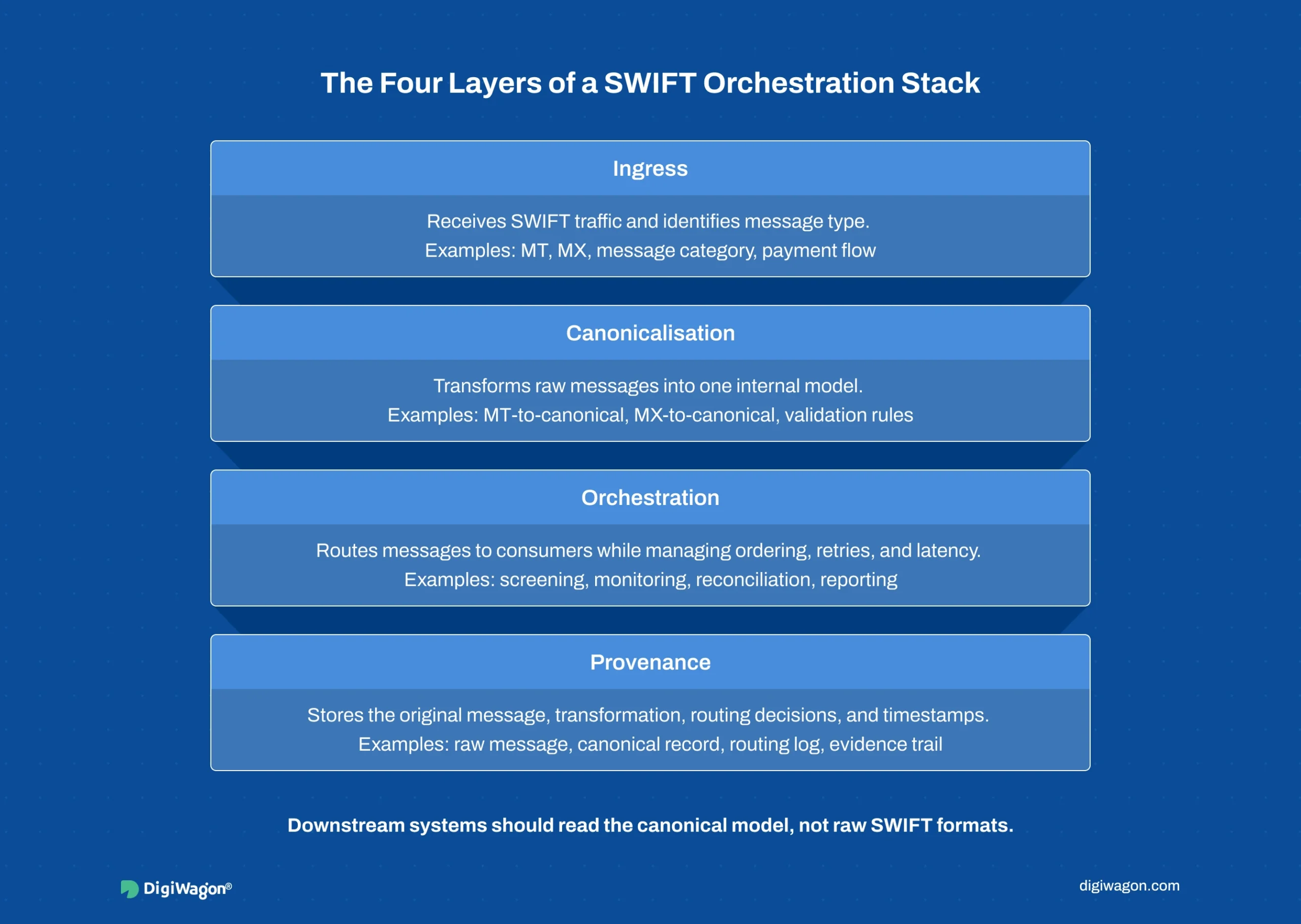
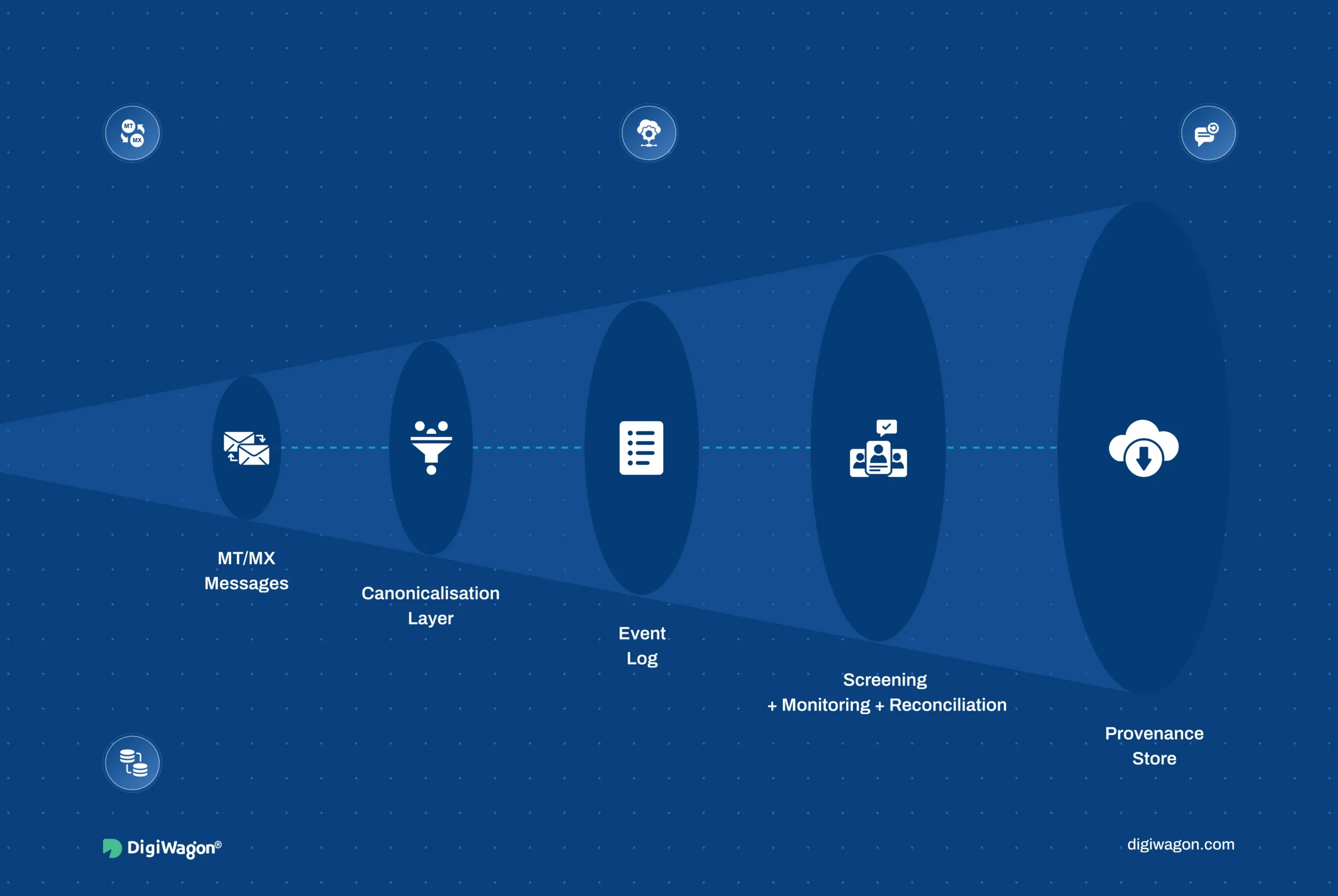
A production orchestration stack has four layers.
The ingress layer receives SWIFT traffic and identifies message type and format (MT vs MX, message category). It is the only layer that touches raw SWIFT formats.
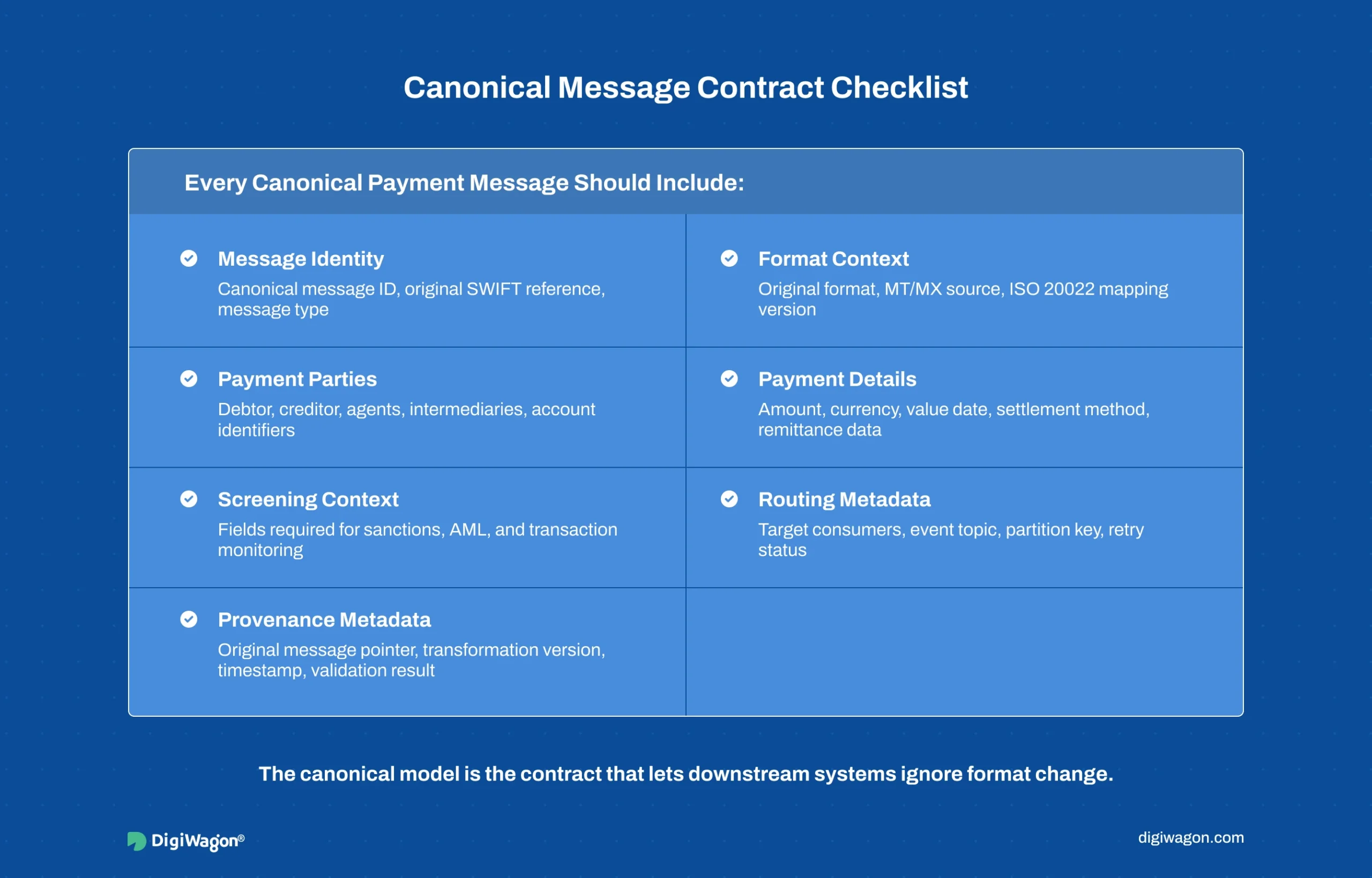
The canonicalisation layer transforms every message, MT or MX, into one internal canonical model. Downstream systems read the canonical model and never see raw SWIFT formats. This is the architectural seam that isolates format change from consumer logic.
The orchestration layer routes canonical messages to their consumers (screening, monitoring, reconciliation, reporting) and manages ordering, retries, and the latency budget. On an event-log substrate, this layer is where sub-second routing is engineered.
The provenance layer records the original message, the canonical transformation applied, and the routing decisions, so a payment’s full handling is reconstructable. For regulated payment flows, the original SWIFT message and its transformation are both evidence.
The orchestration layer’s design is the load-bearing choice, and it connects directly into the broader RegTech integration architecture blueprint four-layer pattern.
Why Canonicalise at Ingress Instead of Per-Consumer?
The single highest-leverage decision in a SWIFT stack is where format handling lives. Two options: handle MT and MX in each consumer, or canonicalise once at ingress.
Per-consumer handling looks cheaper at first because no canonical model has to be designed. It becomes expensive fast: the screening engine parses MT and MX, the reconciliation system parses MT and MX, the reporting system parses MT and MX, and each implementation is a place where the MT-to-MX migration has to be re-tested. The migration then touches every consumer.
Canonicalisation at ingress designs one internal model that both MT and MX map into. Every consumer reads only the canonical model. When MX adoption advances, the change is isolated to the canonicalisation layer; consumers do not change because the canonical contract they read does not change.
| Approach | Upfront Cost | Migration Cost | Drift Risk |
|---|---|---|---|
| Per-consumer MT/MX handling | Lower (no canonical model) | High (every consumer re-tested for MX) | High (parallel implementations diverge) |
| Canonicalisation at ingress | Higher (design canonical model) | Low (change isolated to one layer) | Low (single source of format truth) |
The canonical model is the seam that makes the ISO 20022 transition a contained migration rather than a platform-wide rewrite.
How Do You Hit a Sub-Second Latency Budget for Payment Screening?
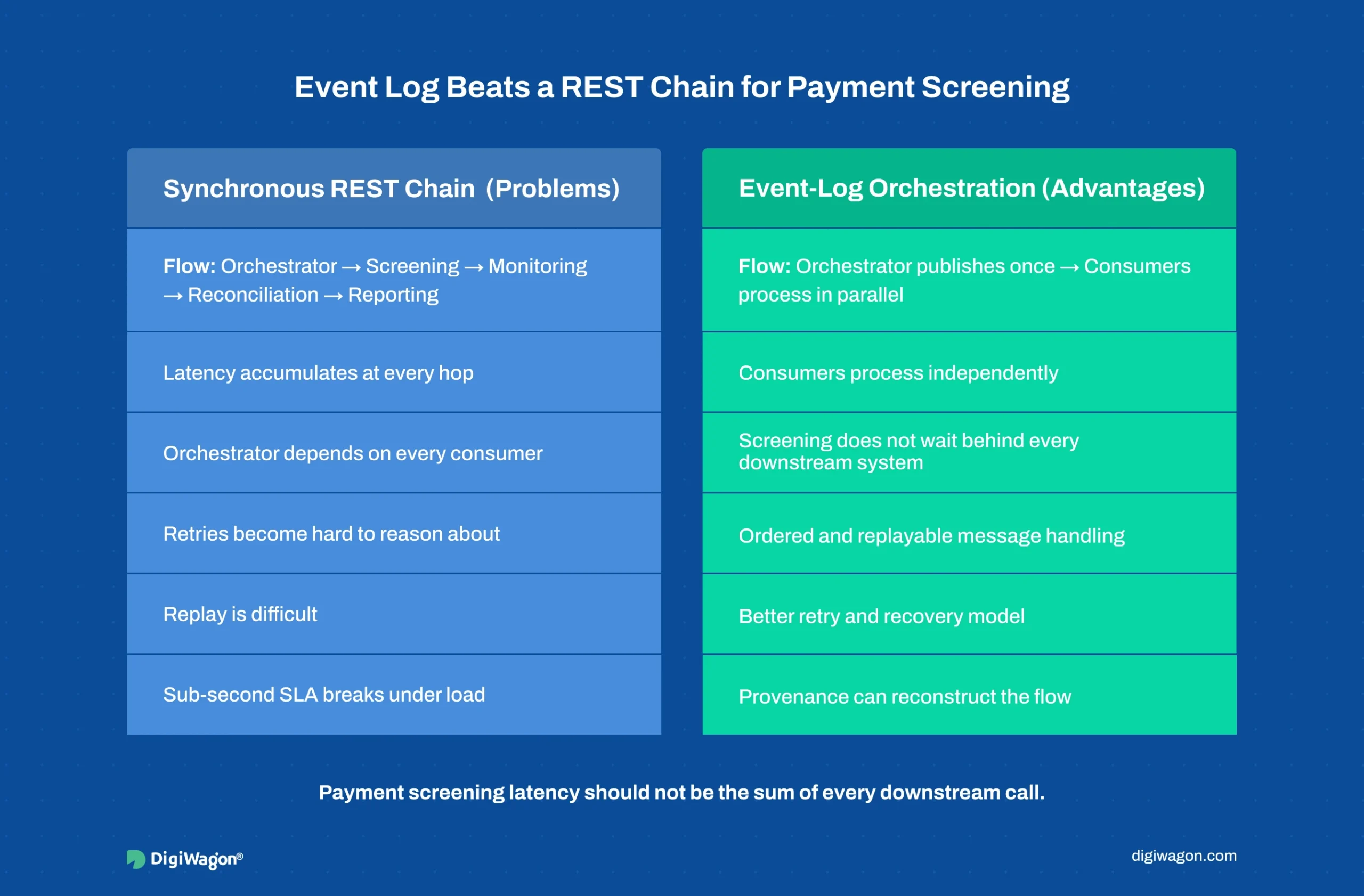
When SWIFT orchestration feeds real-time payment screening, the orchestration layer inherits a hard latency SLA: the screening decision has to return before the payment flow stalls. The Bank for International Settlements has documented how cross-border and instant payment systems compress the time available for in-flight checks, which makes orchestration latency a first-order design constraint, not an afterthought.
REST orchestration, where the orchestrator calls each consumer in a request-response chain, accumulates latency at every hop and couples the orchestrator’s availability to every consumer’s. It does not hold a sub-second budget under load.
The architecture that holds is event-log orchestration. Canonical messages are published to an event log; screening and other consumers subscribe and process in parallel rather than in a synchronous chain. The orchestrator publishes and moves on; the screening consumer reads, decides, and writes its result back to the log. Latency is the consumer’s processing time plus log overhead, not the sum of a synchronous call chain. The event log also gives ordered, replayable message handling, which the provenance layer depends on for deterministic reconstruction.
Lessons from Building a SWIFT Orchestration Layer
DigiWagon built the SWIFT Data Orchestration and Automation platform for a financial-messaging client, with the orchestration layer feeding a real-time payment screening integration. Three architectural decisions defined the build.
First, an MT/MX canonicalisation layer at ingress over per-format handling downstream, because mixed SWIFT traffic would otherwise force duplicate parsing logic into every consumer and make the ISO 20022 migration a platform-wide rewrite. The canonical model became the single internal contract.
Second, message orchestration on an event log over synchronous REST orchestration, because the payment-screening integration had a hard sub-second SLA that a synchronous call chain could not meet under production load. Publishing canonical messages to the log let screening and other consumers process in parallel.
Third, an ISO 20022 migration architecture with CBPR+ readiness, because the MT-to-MX transition window is closing and an orchestration layer that handled only MT would need rebuilding mid-migration. Designing the canonical model to express both MT and MX from the start made MX adoption a configuration and mapping exercise rather than a re-architecture.
At the infrastructure level, the event log was provisioned with partitioning keyed on message flow so ordering held within a payment’s lifecycle while parallelism scaled across flows, chosen over a single-partition log because single-partition ordering would have capped throughput below the payment volume the platform had to clear.
DigiWagon’s Role in SWIFT Orchestration Engineering
DigiWagon engineers SWIFT orchestration layers as production payment infrastructure: MT/MX canonicalisation, event-log orchestration for real-time screening, and ISO 20022 migration architecture. The work draws on the RegTech software development practice.
- MT/MX canonicalisation layer and internal canonical model design
- Event-log orchestration for sub-second payment screening integration
- ISO 20022 and CBPR+ migration architecture with MX adoption paths
- Message provenance for reconstructable payment handling
Engineering Orchestration That Survives the MX Transition
A SWIFT orchestration layer is judged by whether it holds its latency budget under load and whether the ISO 20022 migration stays contained. The architecture that delivers both is canonicalisation at ingress so format change touches one layer, event-log orchestration so screening clears its SLA in parallel rather than in a synchronous chain, and a canonical model built to express MT and MX from the start. Each is decided before the first message flows, because retrofitting canonicalisation onto a per-consumer stack, or moving a synchronous orchestrator onto an event log mid-flight, is a rebuild. Layers built to the pattern carry payment traffic through the MX transition without a platform-wide rewrite.
Planning a SWIFT Orchestration Layer?
Our engineering team works through canonicalisation, latency budgets, and ISO 20022 migration with your payments and compliance teams in one room.