Master Data Management Strategy: Key Takeaways
- A master data management strategy finishes when it covers only entities where a system clash costs money.
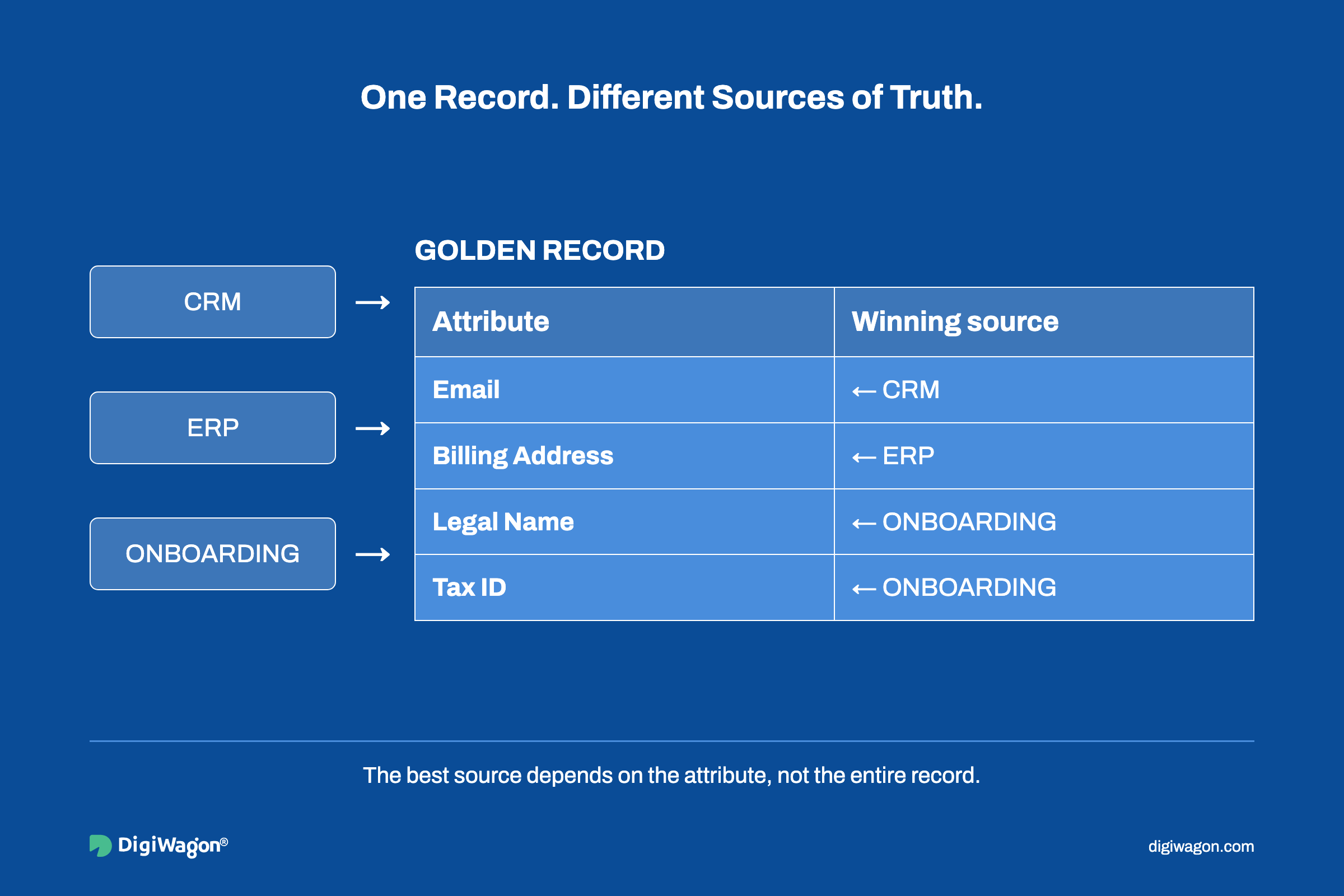
- Survivorship works per attribute: one source can win the email while another wins the tax ID.
- Every match engine leaves an uncertain middle band that needs a steward queue, not a lower threshold.
- A golden record that no operational system reads back stays a reporting copy.
- Track progress per entity, starting with how many source systems resolve to the master ID.
What Is a Master Data Management Strategy?
A master data management strategy is the set of design decisions that fixes which business entities get mastered and which source wins each attribute. It also sets how uncertain matches are resolved and where the golden record is written back. The output is one persistent identifier per real-world customer, supplier or product, which every consuming system resolves to.
Why MDM Programmes Stall Before the Golden Record Ships
Most MDM programmes stall at scope long before matching is the problem. A team tries to master customer, product, supplier, location, asset and employee at once. The match rules for six entities never converge.
That stall costs more now that AI reads live data. Organisations with successful AI initiatives invest up to four times more of their revenue in foundations such as data quality (Gartner, 2026).
Agents and RAG pipelines read those records directly. A duplicate customer now shows up in operations as well as reports.
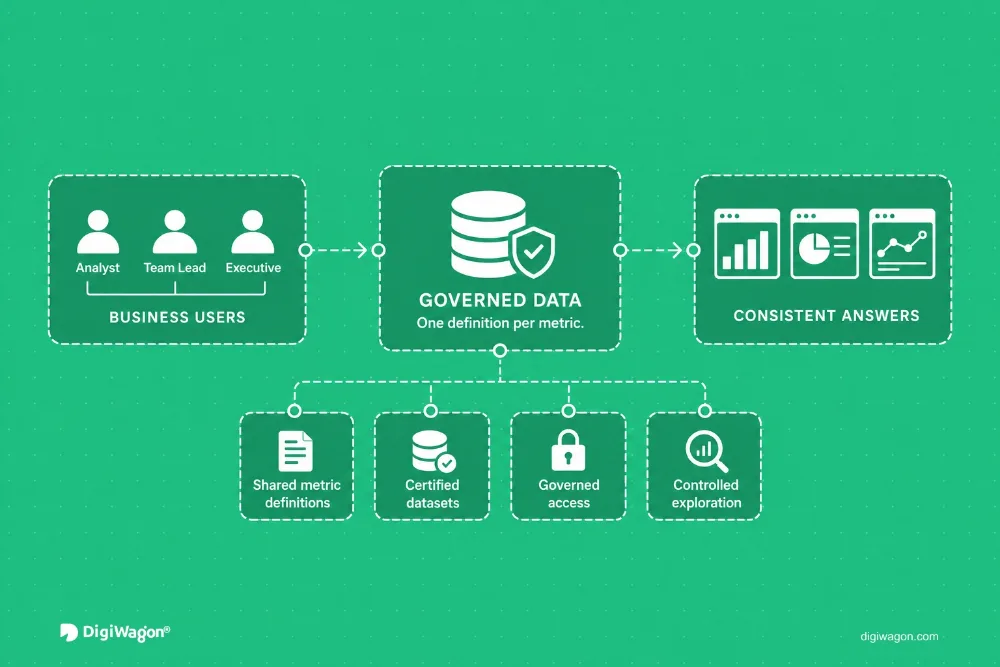
Master data sits under the warehouse and semantic layers in the modern data stack architecture guide. If this layer gives "Acme Ltd" and "ACME Limited" two IDs, every downstream join inherits the split.
Which Entities Belong in a Master Data Management Strategy?
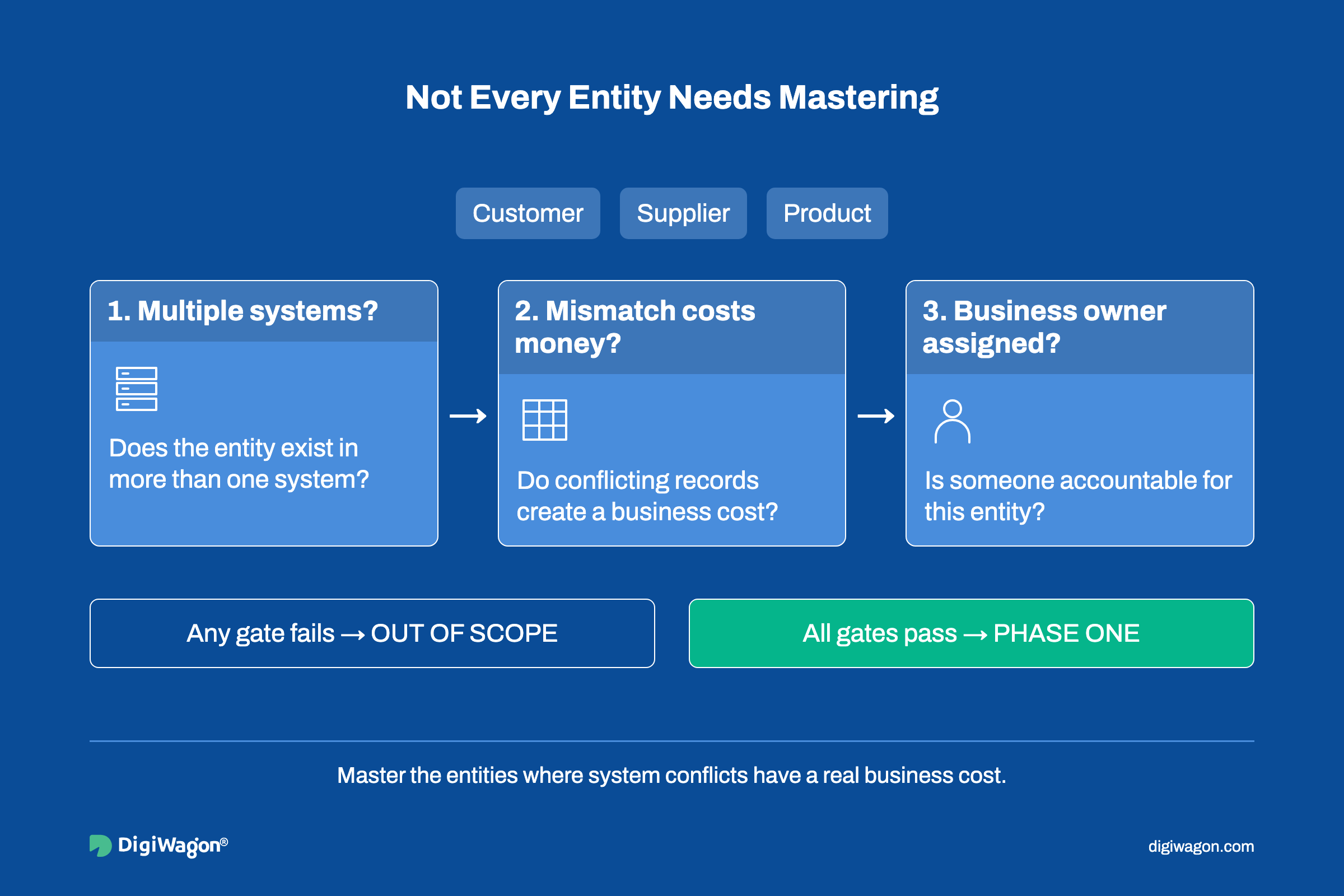
An entity enters phase one only if it passes every test.
The Master Data Management Strategy Scope Test
- Two or more systems create or update it. A product edited only in the PLM system has one writer and nothing to reconcile.
- A mismatch between those systems costs real money. Duplicate suppliers cause double payments, and duplicate customers split credit exposure.
- A named business owner will approve the rules. Without one, survivorship falls to whoever set up the pipeline.
The test usually leaves two or three entities: often customer, supplier and product.
Write the Definition Before the Matcher
A matcher can't be tuned until the entity has a written definition. A "customer" might be a legal entity, a billing account or a person with a login. Each choice gives a different match key.
ISO/IEC 11179-1:2023 sets out the framework for holding that definition in a metadata registry. The meaning of "customer" is then stored as data the pipeline reads, not as a wiki page.
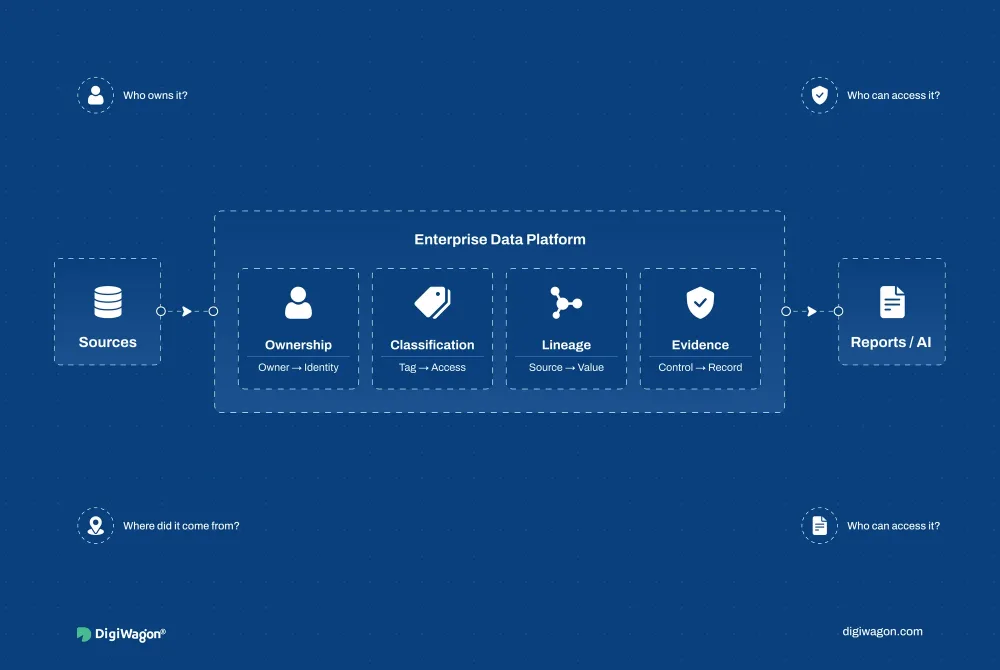
DAMA-DMBOK2 (DAMA International, 2017) treats Reference & Master Data as a knowledge area separate from Data Governance. The architecture follows the same split. Classification and lineage belong to the governance control layer, while entity resolution belongs in the master data layer.
How Should Survivorship Rules Decide Which Source Wins?
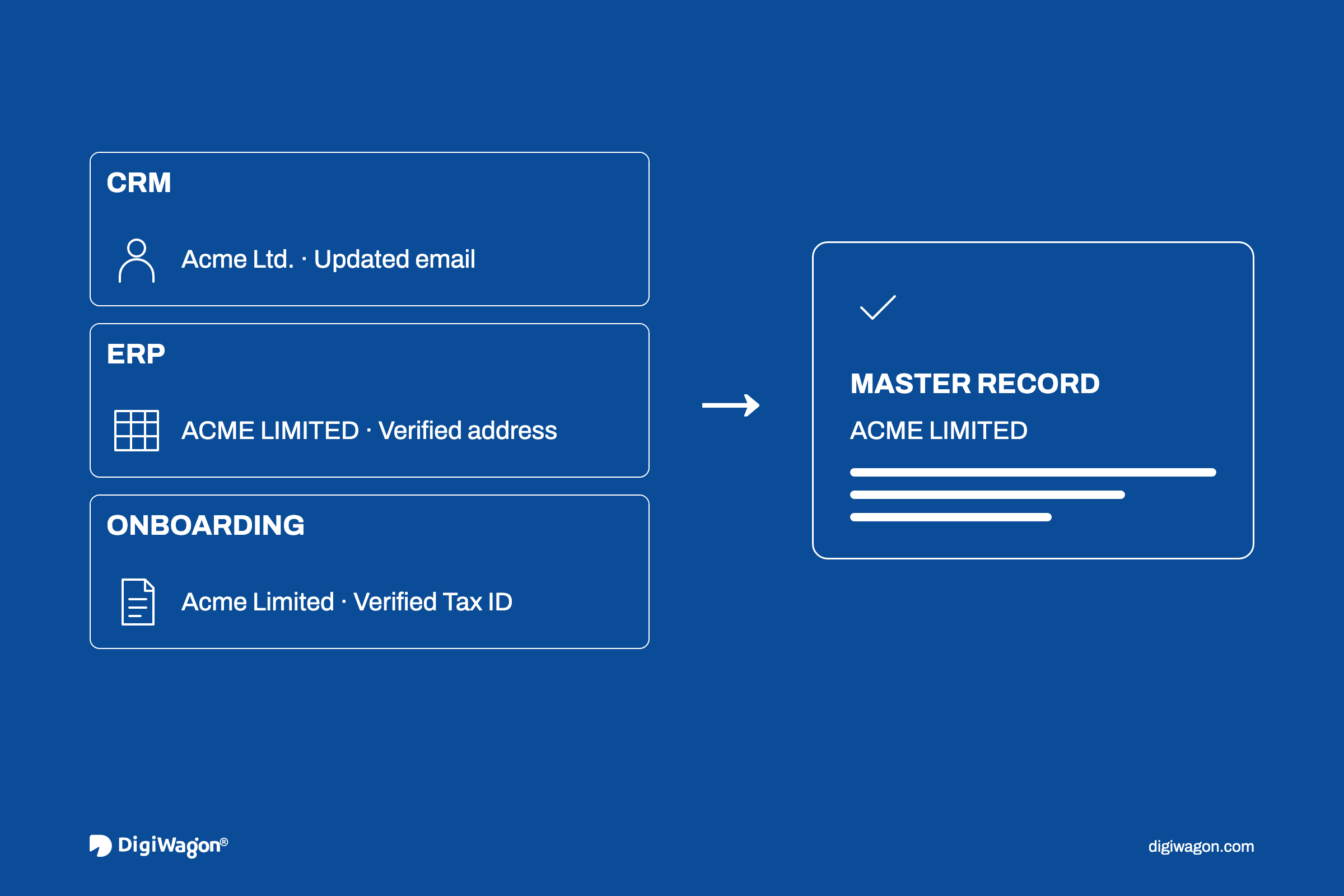
Survivorship picks which value a golden record keeps when sources disagree. The usual first try is record-level ("CRM wins"). It breaks on the second attribute.
CRM holds the freshest email, ERP the billing address invoices go to, and the onboarding system the verified legal name and tax ID. A record-level rule discards two of them.
ISO/IEC 25012:2008 defines 15 data quality characteristics, such as accuracy, currentness and credibility. The strategy picks the one that decides each attribute. It then writes that choice into the pipeline as a rule.
Survivorship Rule Types Compared
| Rule type | Decides by | Fits attributes like | Failure mode |
|---|---|---|---|
| Source priority | Ranked list of trusted sources | Legal name, tax ID | Stale value wins when the top source stops updating |
| Most recent | Latest update timestamp | Email, phone | Clock skew and bulk backfills look like fresh edits |
| Most complete | Fewest empty sub-fields | Postal address | A full but wrong address beats a partial correct one |
| Steward-confirmed | Human decision stored as a fact | Parent company, disputed hierarchy | A queue backlog stalls the record |
Suppose the finance owner requires invoices to use the address on the signed contract. The pattern is then source priority for billing address, with the contract system ranked first.
Store the winning source and rule beside every value. A changed rule can then be replayed against past records.
What Happens to Matches the Engine Cannot Decide?
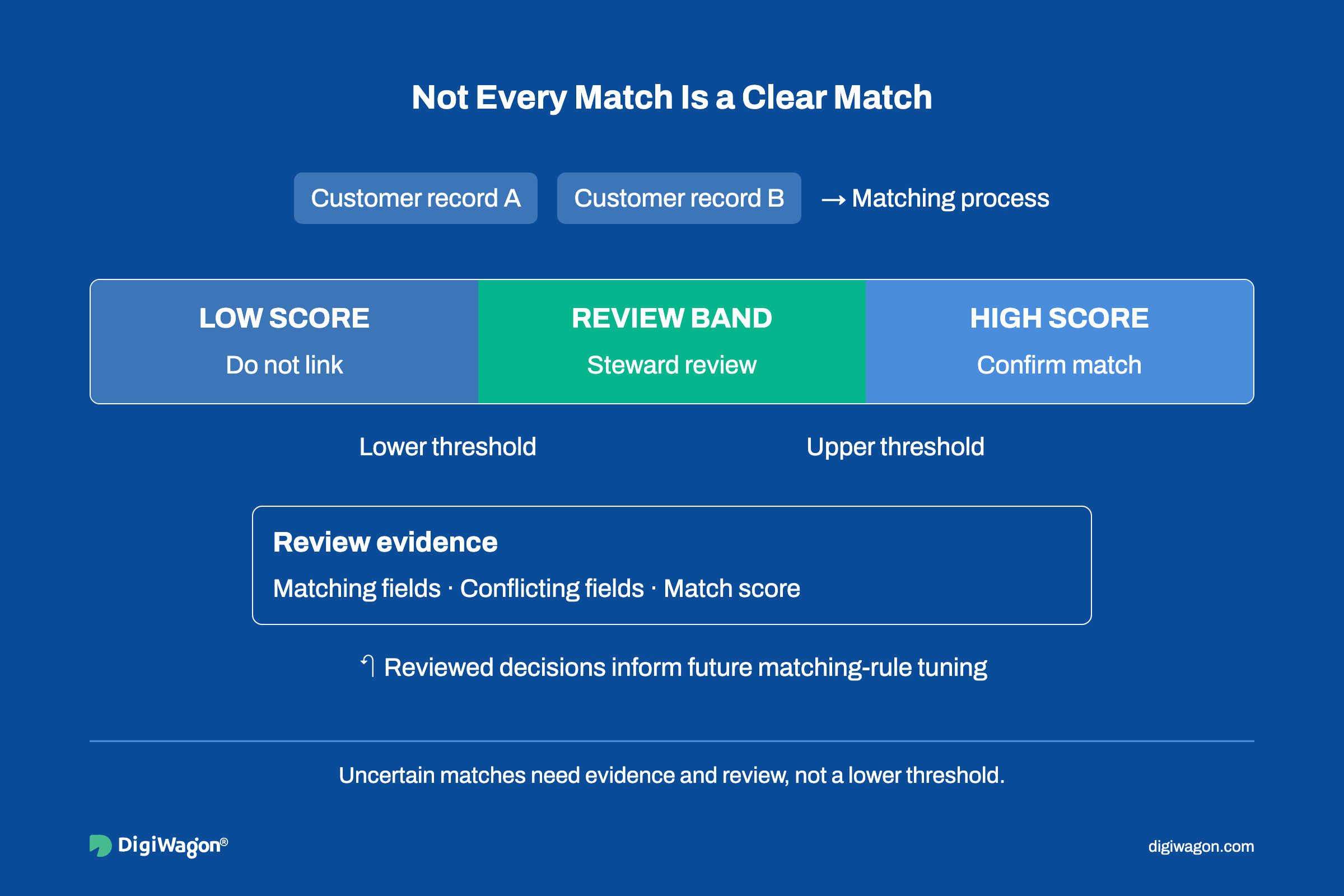
Match scores never split cleanly into yes and no.
Fellegi and Sunter formalised this in the Journal of the American Statistical Association in 1969 with two thresholds. Pairs above the upper one are links, and pairs below the lower one are non-links. Pairs in between are held as possible links for manual review.
Lowering the upper threshold shrinks that middle band but raises false merges. A false merge costs more than a duplicate. It fuses two customers' orders, consents or credit histories into one record.
Designing the Uncertain Middle
- Route, do not guess. Middle-band pairs go to a steward queue with the evidence: agreeing fields, clashing fields and the score.
- Record merges as events. Each merge writes an event with both source IDs. An unmerge then restores the originals without a database restore.
- Tune on labelled pairs. Set both thresholds on pairs stewards have already decided. Re-test them when a new source joins.
- Block before comparing. Blocking keys such as postcode plus name prefix keep candidate pairs to a set the engine can score.
Names across scripts are the hardest case. The hybrid phonetic and vector matching pattern built for sanctions screening transfers directly to customer and supplier names.
Teams wiring golden records back into ERP and CRM can see how event-driven systems integration handles publish contracts and conflicts.
Where Should the Golden Record Be Written Back?
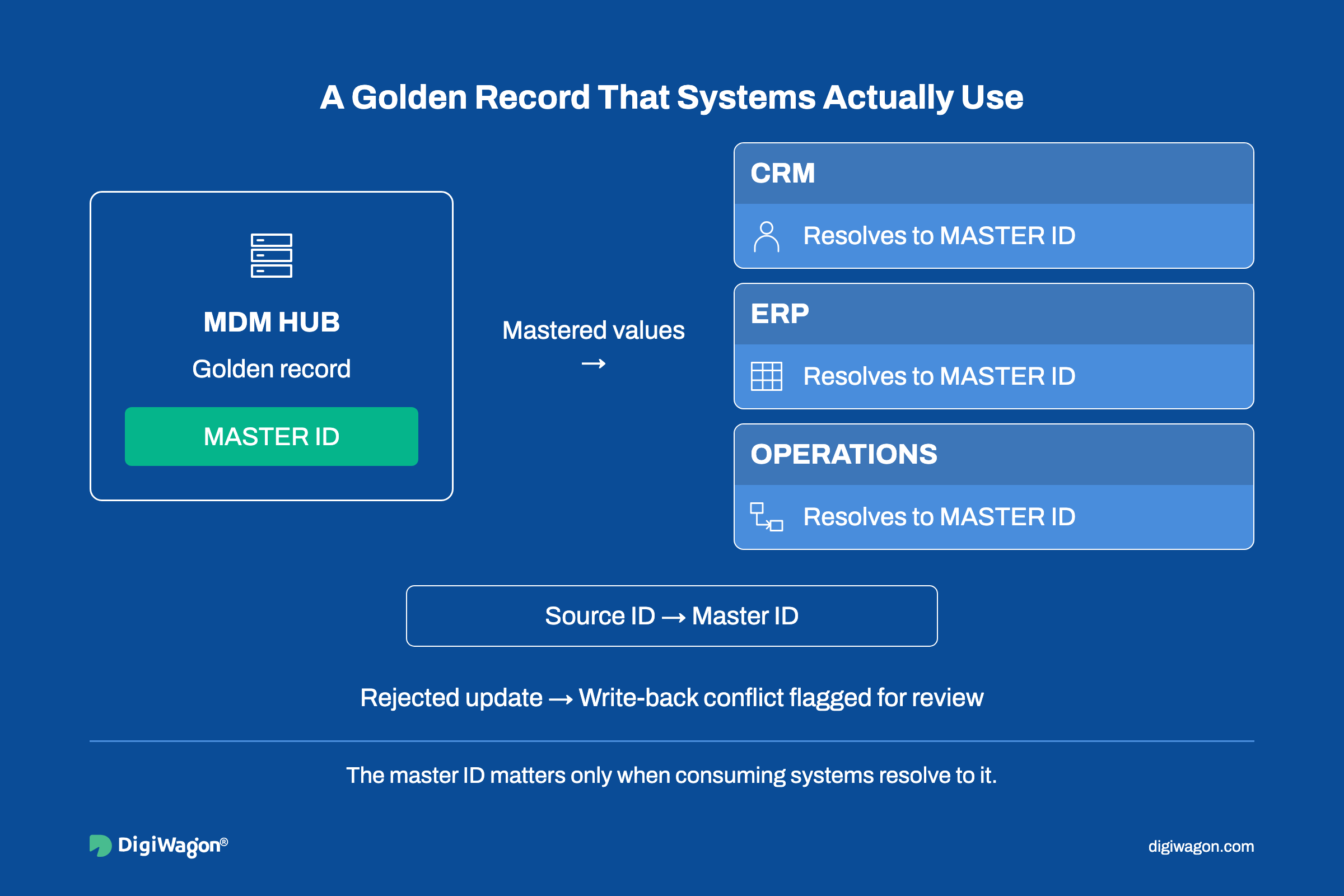
A golden record that no operational system reads is a reporting copy. Write-back turns it into master data. It decides which systems get mastered values and which get only the master ID.
Four MDM implementation styles answer that in different ways.
| Style | Where the golden record lives | Write-back to sources | Fits when |
|---|---|---|---|
| Registry | Source-ID index only; values stay in sources | None | Analytics needs a cross-reference for joins |
| Consolidation | A hub holds the merged copy | None; downstream reads only | Reporting needs one view; operations tolerate duplicates |
| Coexistence | Hub and sources both hold values | Mastered values published back | Sources keep authoring but must converge |
| Centralised | The hub is the only author | Sources subscribe to the hub | One team owns every create and update |
Start at registry or consolidation, then move to coexistence one entity at a time. A consolidation hub can sit in the current lakehouse, fed by the same lakehouse data engineering pipelines as the warehouse.
The master ID is the contract in every style.
ISO 8000-115:2024 sets rules for quality identifiers in master data exchange, including how an ID resolves back to the data it stands for. In practice, a cross-reference table maps every source key to one master ID. It publishes an event when a merge or unmerge changes it.
Write-back also needs a conflict rule. When a source rejects a mastered value, such as a field locked after invoicing, the pipeline flags it instead of retrying until it overwrites.
How Do You Know a Master Data Management Strategy Worked?
Four measures show whether the master data layer works:
- Duplicate rate per entity, confirmed by steward sampling after each new source joins.
- Steward queue age. A queue that grows faster than it drains means the thresholds or the staffing are wrong.
- Survivorship override rate, the share of golden values stewards correct by hand. A high rate points at a rule, not a person.
- Consumer coverage, the share of systems that resolve to the master ID.
Override rate and consumer coverage can be read against the credibility and consistency characteristics in ISO/IEC 25012. That gives engineers and the business owner one definition for each number.
Report each measure per entity. A programme that scoped three entities shows progress on each, while one that scoped twelve shows a blended figure nobody can act on.
Building a Master Data Layer with DigiWagon
DigiWagon's data and analytics engineering services team can design a master data layer around the steps in this guide. That runs from match services to write-back into operational systems.
- Entity scoping and definition registry setup
- Match and merge services with steward review queues
- Attribute-level survivorship with lineage
- Event-driven write-back and cross-reference publishing
Scoping Your First Mastered Entity
A master data management strategy is five decisions made in order: scope, survivorship, match confidence, write-back and measurement. The narrower the starting scope, the more likely MDM is to finish.
Master data layers built one entity at a time ship a persistent identifier that operational systems resolve to. That identifier keeps working after the programme team moves on.