Self Service Analytics Governance: What Matters
- Self service analytics fails on divergent metric definitions, not on low tool adoption or weak training.
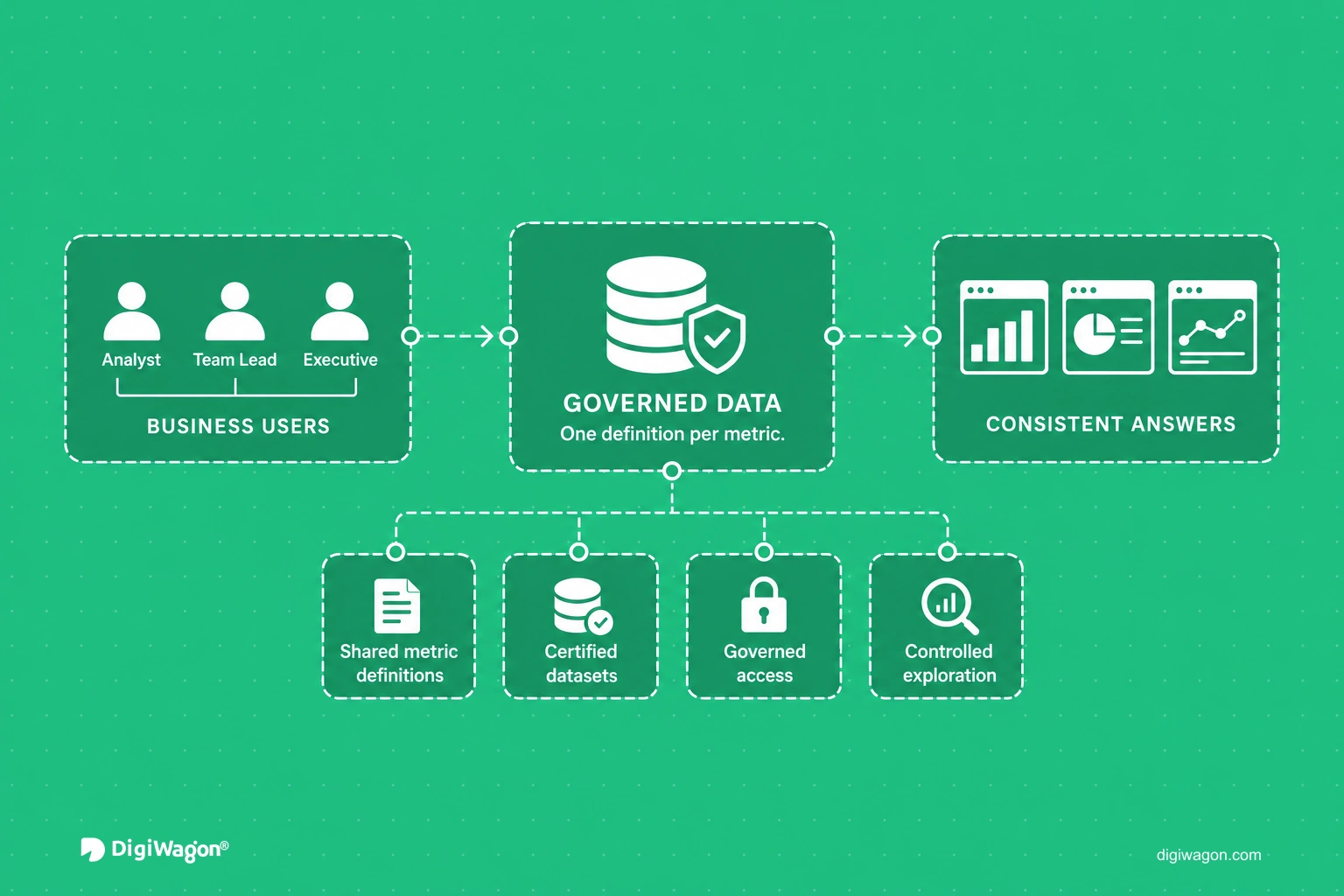
- A semantic layer turns each metric into one registered definition that every query and dashboard inherits.
- Dataset certification tiers tell users which tables are load-bearing and which are sandbox material.
- Access policy and compute limits belong in the platform contract, not in user discipline.
- Without a promotion path for new metrics, self-service quietly reverts to an engineering ticket queue.
Self service analytics is a platform model in which business users build their own queries and dashboards against governed data, without routing each request through an engineering ticket. A semantic layer, certified datasets, and inherited permissions sit beneath the BI tool. The result is deterministic: one metric name resolves to one computed value, whoever writes the query.
Why Governed Self-Service Matters Now
Most self-service programmes are judged on adoption: licences issued and dashboards created. Both numbers can climb while the organisation gets worse at agreeing on anything. Two analysts compute churn from the same warehouse, one excluding paused subscriptions and one including them. Both are correct inside their own query, and the leadership review spends its time on which number is real.
Gartner predicted that 80% of data and analytics governance initiatives will fail by 2027 (Gartner, 2024). Self-service is where that failure surfaces first, because it hands query authorship to people who were never told which definition is canonical.
The literacy side of this problem is covered in a separate playbook on why BI dashboards go unused. This post covers the other half: the platform contract that makes self-service safe to hand out, and where it sits inside a modern data stack architecture.
Why Does Self Service Analytics Break Down at Scale?
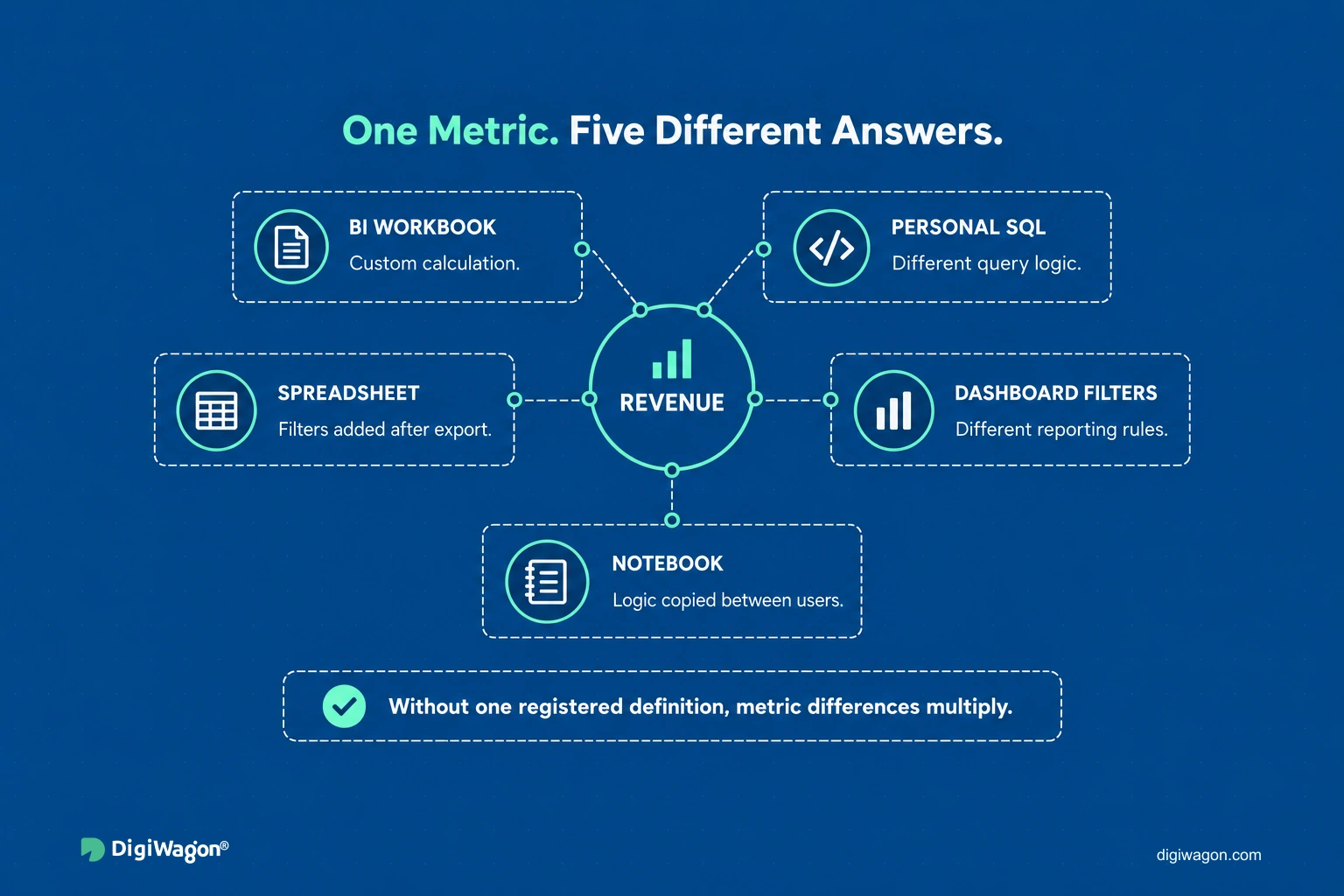
The failure is definition drift: the same metric name computed several ways, each one defensible, none of them shared.
DAMA-DMBOK2 treats Metadata Management as one of its 11 knowledge areas, separate from Data Quality, and that separation matters here (DAMA International, 2017). A metric definition is metadata. When it has no registered home, it gets copied into every tool that needs it, and every copy is a fork.
Where Forked Definitions Hide
- Calculated fields inside BI workbooks. Five workbooks with a field called "Revenue" is five definitions, not one.
- Personal SQL in notebooks. The join logic lives on one laptop and leaves with its author.
- Spreadsheet extracts. A filter applied after export changes the population, and nothing upstream knows.
- Dashboard-level filters. A default date range or excluded region silently redefines the metric for every viewer.
None of these is a user error; each is the system doing what it was built to allow. The architectural fix is to remove the places where a definition can fork, not to ask people to stop forking.
What Does a Semantic Layer Actually Guarantee?
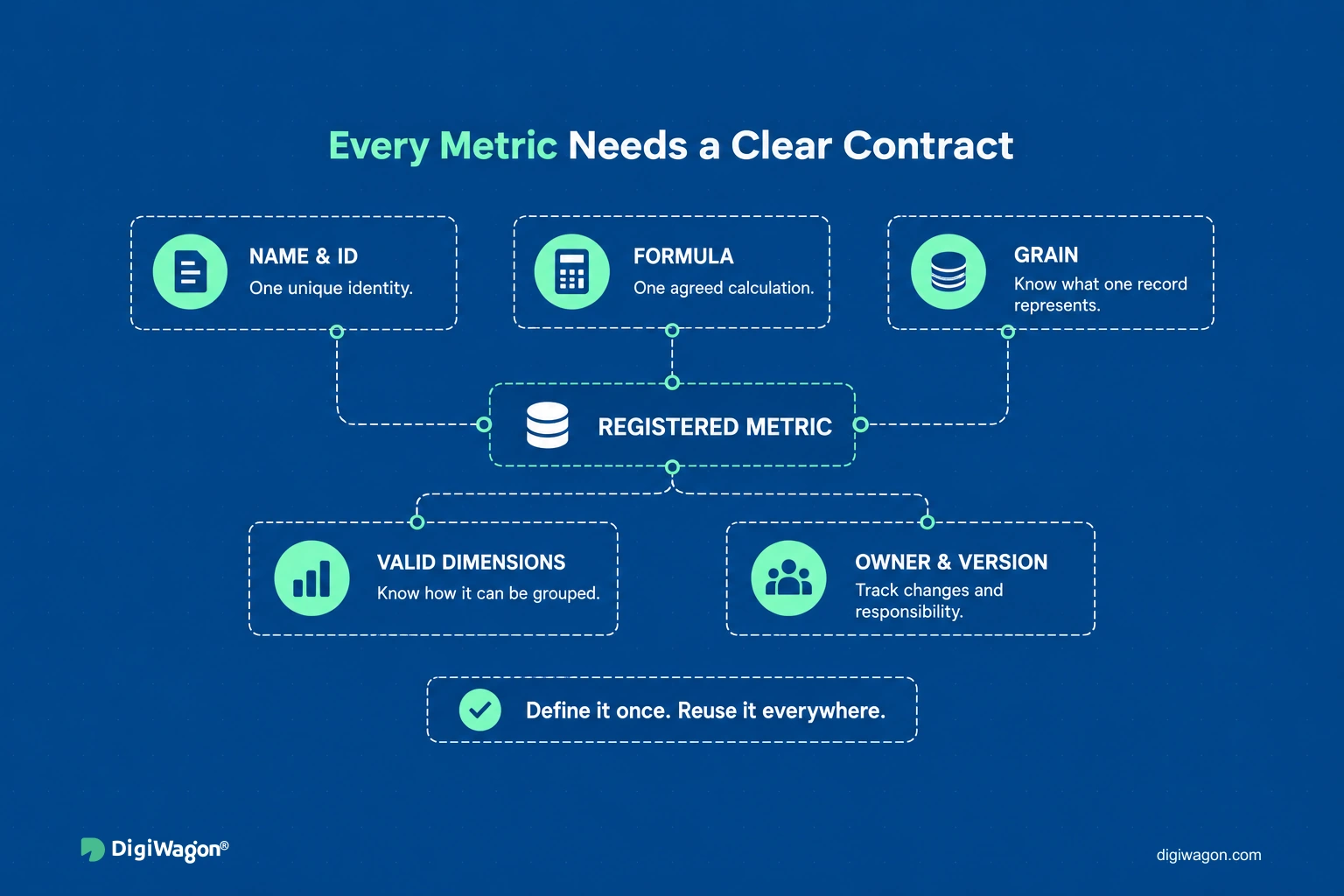
A semantic layer is the contract between warehouse tables and every consumer of them. Metrics are defined once, as version-controlled code, and compiled to SQL at query time. BI tools, notebooks, and APIs request a metric by name. They never touch the formula.
ISO/IEC 11179, the international standard for metadata registries, holds that a data element becomes reusable across systems only once it carries a registered definition, an identifier, and a responsible steward. A semantic layer is that registry, applied to business metrics.
What Goes in the Contract
Each metric entry in the layer should declare:
- Name and identifier, unique across the platform
- Formula, written once against certified tables
- Grain, so the layer can refuse aggregations that would double-count
- Allowed dimensions, the cuts that are valid for this metric
- Owner and version, so every change has a reviewer and a history
Where Should the Metric Definition Live?
| Where the metric is defined | Consistency across tools | Change control | Failure mode |
|---|---|---|---|
| BI workbook calculated field | None, per workbook | None | Forks multiply with every new dashboard |
| Warehouse view per metric | Consistent for SQL users only | Database migrations | Views proliferate and dimension combinations get pre-baked |
| Semantic layer (metrics as code) | Consistent across BI, notebooks, and APIs | Pull request review and versioning | Becomes a bottleneck if no promotion path exists |
When the business requires that revenue mean the same thing in the board pack and in an analyst's ad hoc query, the architectural response is a metric resolved at query time from one versioned definition. A naming convention people are asked to follow is not a contract.
How Should Datasets Be Certified for Self-Service Use?
A semantic layer answers "what does this metric mean." Certification answers "which tables can I build on." Users need both, and they need the second one visible at the moment they pick a dataset.
ISO/IEC 25012, the data quality model standard published in 2008, defines 15 quality characteristics, including completeness, consistency, and currentness. A certification tier is a promise that a defined subset of those characteristics is tested on every load.
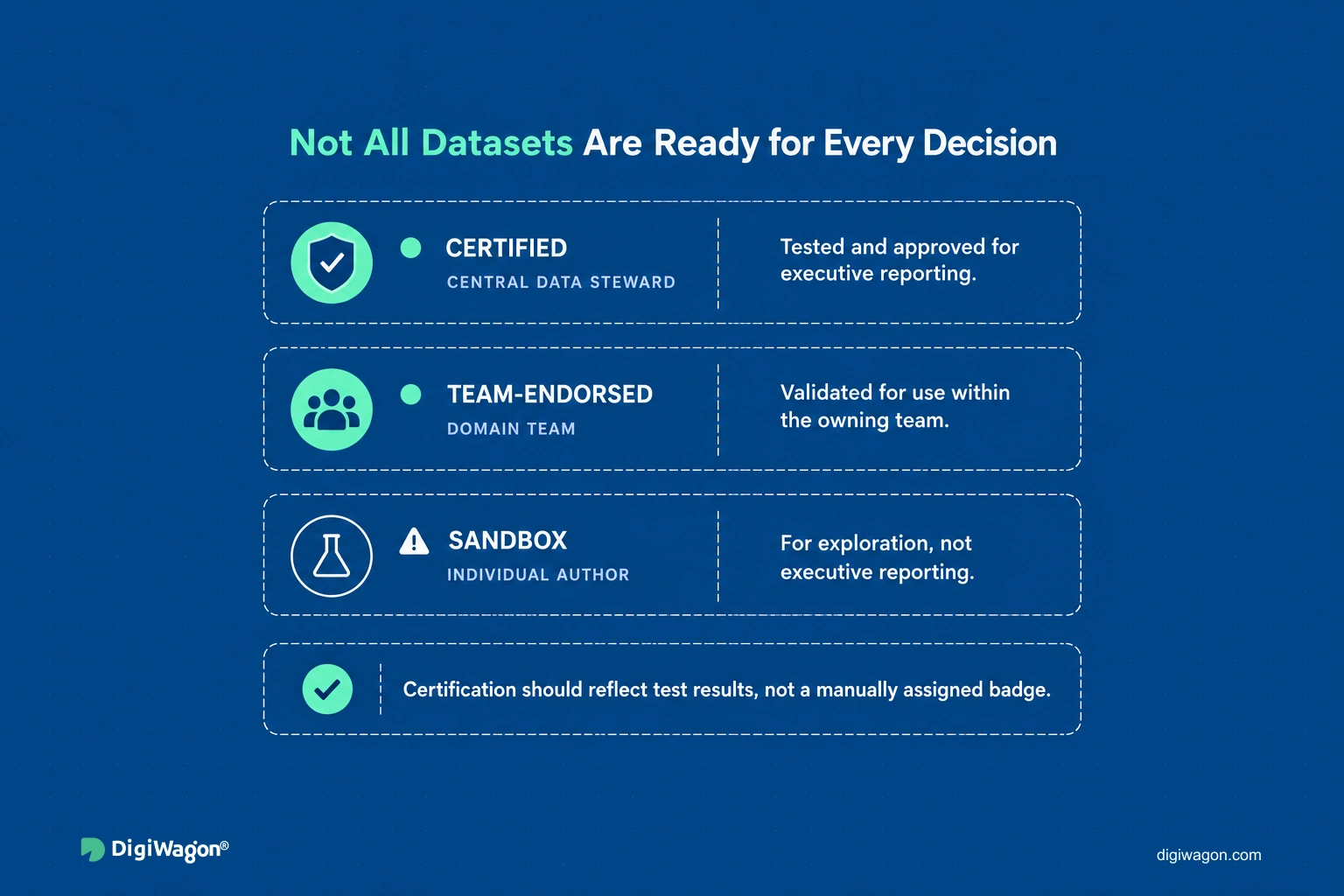
| Tier | Owner | Checks enforced on every load | Allowed in executive reporting |
|---|---|---|---|
| Certified | Named steward in the central data team | Schema contract, freshness, completeness, referential integrity | Yes |
| Team-endorsed | Domain team | Schema contract and freshness | Within the owning team only |
| Sandbox | Individual author | None | No, and content auto-expires |
Make the Badge Machine-Derived
The certified badge should be computed from test status, not set by hand. A badge that a person sets and no pipeline revokes is decoration. When a freshness or completeness test fails, the dataset drops to a warning state automatically, and every dashboard built on it shows the downgrade.
Teams planning a certification model can see how analytics and BI implementation covers semantic modelling through dashboard rollout.
How Do Access and Cost Guardrails Hold When Anyone Can Write a Query?
Self-service delegates query authorship. It cannot delegate accountability. ISO/IEC 38505-1, the governance-of-data standard (second edition, 2026), states that the governing body stays accountable for data use even when it delegates access, which means the controls have to travel with the data rather than with the dashboard. Evidencing that accountability to an auditor is the job of the data governance strategy this contract sits inside.
Push Access Policy Below the BI Tool
- Row-level and column-level policies enforced in the warehouse or the semantic layer, never in dashboard filters a user can remove.
- End-to-end identity propagation, so the warehouse sees the actual user rather than a shared service account.
- Masking for sensitive columns applied once at the policy layer and inherited by every tool.
The same principle shapes embedded versus standalone reporting architecture, where tenant isolation has to hold beneath the interface, not inside it.
Treat Compute as a Governed Resource
A business user writing their first query does not know a cross join from a lookup. The platform has to know for them.
- Workload isolation: a separate compute pool for self-service traffic, so an exploratory query cannot starve scheduled pipelines.
- Per-role limits: query timeouts and result-size caps scaled to the role, not one global setting.
- Pre-aggregated certified metrics: the most-requested metrics served from cached aggregates, so the common path is also the cheap path.
What Happens When Someone Needs a Metric That Does Not Exist Yet?
This is the step most governance models skip, and it decides whether the rest survives. A platform with no path back to engineering does not stay governed. Users rebuild the metric in a sandbox, share it, and before long the sandbox is the real system.
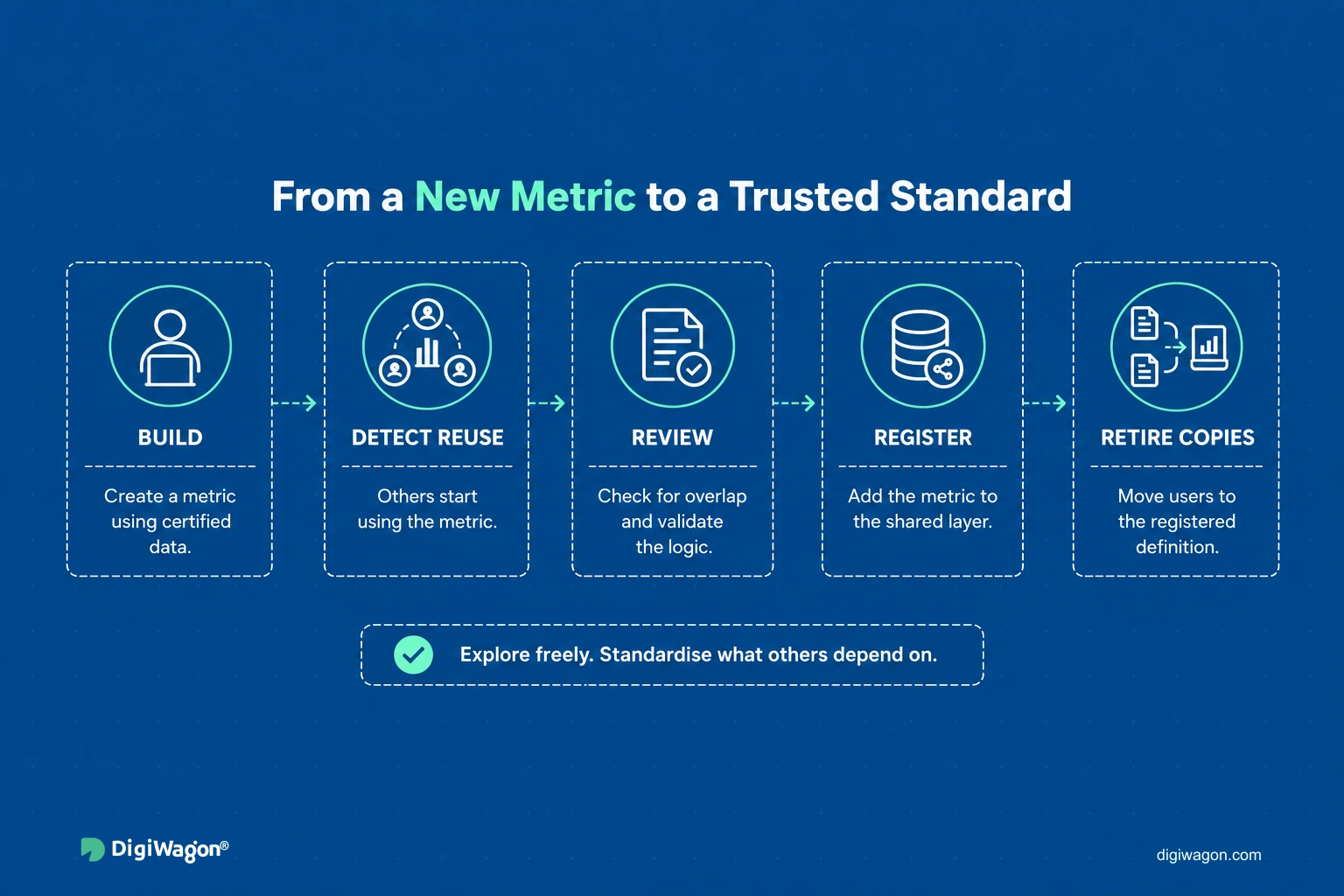
ISO/IEC 11179 defines a registration lifecycle for data elements, moving from Candidate through Recorded and Qualified to Standard. That lifecycle maps directly onto a self-service promotion path:
- Build in sandbox. The user creates the new metric against certified datasets only.
- Detect reuse. Usage telemetry flags any sandbox metric queried by people other than its author.
- Request promotion. The author submits the definition; the data team checks it against existing metrics for overlap.
- Register as code. The metric enters the semantic layer with a version, an owner, and tests.
- Deprecate the copies. Sandbox versions are redirected to the registered metric and then retired.
The promotion path is what keeps the semantic layer from becoming a bottleneck. Users are never blocked from asking a new question. They are only asked to promote the answer once other people start depending on it.
Designing a Governed Self-Service Platform with DigiWagon
DigiWagon engineers the platform layer beneath self-service BI, so business teams can query freely while every metric resolves to one definition. Our data and analytics engineering work covers:
- Semantic layer design with metrics defined as versioned code
- Test-driven dataset certification on top of governed data engineering pipelines
- Warehouse-level access policy and workload isolation
- Promotion workflows from sandbox to registered metric
Self-Service Is a Governance Design
Self service analytics succeeds or fails on whether the organisation can still agree on a number after everyone is allowed to compute one. That depends on five layers under the BI tool: a semantic layer for definitions, certification for datasets, access policy that travels with the data, compute limits that protect shared infrastructure, and a promotion path for metrics that do not exist yet. The tool choice is the least interesting decision in the stack. Platforms built to this contract let anyone ask a new question while every answer still resolves to the same registered definition.