
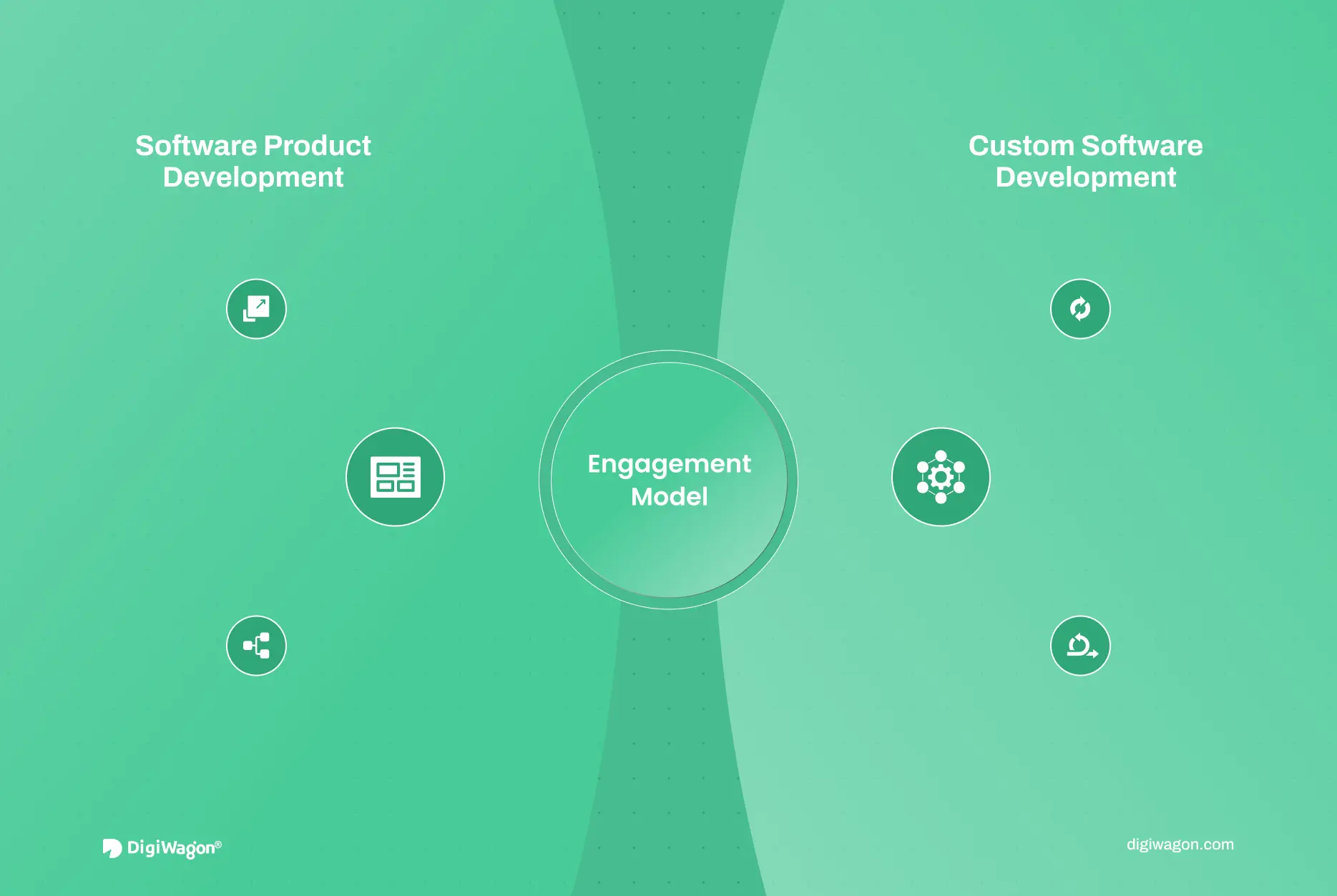
Development Model: Key Takeaways
- Software product development is used to build a reusable product for a broader customer segment, with continuous iteration, scalability, and long-term roadmap ownership.
- Custom software development is used to solve a specific business problem for one organisation, with architecture shaped around workflows, integrations, and operational fit.
- The right engagement model depends on what the software is expected to become after launch, not just what needs to be delivered today.
- If the software is meant to evolve as a market-facing product, the development approach should reflect product thinking. If it is built around one company’s processes, the engagement should reflect custom delivery.
- The wrong choice creates misalignment in architecture, release expectations, and post-launch ownership.
What is Software Product Development?
Software product development is the process of building software intended to serve a broader market or a repeatable customer segment.
The goal is not only to deliver working software. It is to create a product that can be launched, adopted, improved, and scaled over time. That usually means the work includes product strategy, user validation, reusable architecture, iterative releases, and a roadmap shaped by market feedback.
In this model, the software itself is a business asset. It is expected to evolve continuously as customer needs, product priorities, and market conditions change.
What is Custom Software Development?
Custom software development is the process of building software for the specific needs, workflows, and operating environment of one business.
The goal is to solve a defined internal or client-specific problem, not to create a reusable product for a broader market. The emphasis is usually on process fit, integrations, business rules, and implementation clarity.
In this model, the software supports the business. Its value comes from how well it fits one organisation’s operations, not from how widely it can be reused or scaled as a product.
Software Product Development vs. Custom Software Development

The difference between software product development and custom software development is not only technical. It affects the purpose of the build, the architecture behind it, and what the business expects after launch.
| Area | Software Product Development | Custom Software Development |
|---|---|---|
| Primary goal | Build a reusable product for a broader customer segment | Solve a specific business problem for one organisation |
| Business model | Market-facing, scalable, repeatable | Organisation-specific, workflow-driven |
| Architecture | Designed for configurability, reuse, and continuous iteration | Designed for operational fit, integrations, and business rules |
| Delivery mindset | Product roadmap and release evolution | Project delivery and implementation fit |
| Post-launch model | Continuous improvement, feature releases, product ownership | Maintenance, change requests, and process improvements |
| Example | A multi-tenant compliance platform used by multiple financial institutions | An internal operations dashboard built around one company’s ERP and reporting workflows |
Simple rule of thumb
If the software is meant to serve many customers through a repeatable product model, it is product development. If it is designed around the needs of one business, it is custom software development.
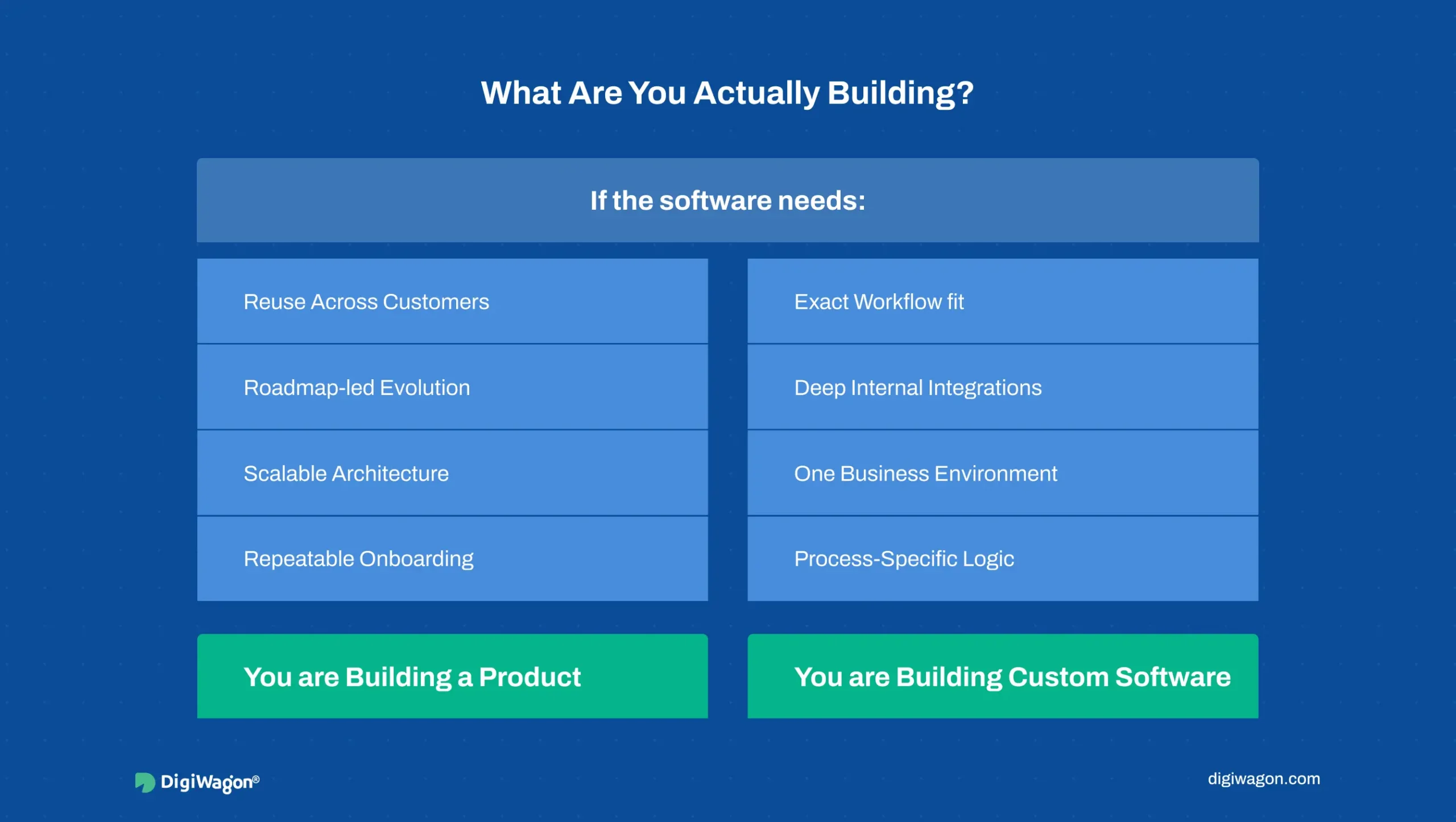
How Do You Choose? A Five-Question Framework
The difference becomes clearer when the decision is treated as a business-model question, not just a delivery choice.
These five questions help determine whether the initiative is really a product build or a custom software engagement.
1. Who is the software being built for?
If the software is intended for a broader customer segment or multiple paying users, it is likely a product. If it is being built for one business unit, one enterprise client, or one internal workflow, it is likely custom software.
2. Will the software be reused across customers or teams?
Product development assumes repeatability. The same core system should support multiple users, customers, or markets with configuration and iteration. Custom development is usually designed around a single environment and does not depend on reuse.
3. What happens after launch?
If launch is the start of an ongoing roadmap, product iteration, and release cycle, the engagement is closer to product development. If launch is mainly the point at which the business starts using the system operationally, the engagement is closer to custom software.
4. Is the architecture expected to support flexibility or exact fit?
Product development usually requires architecture that supports change, reuse, and scale across different customer needs. Custom software is more often optimised for exact workflow fit, integration depth, and business-specific logic.
5. Is the team building software for a market or for an operation?
If the software is expected to create revenue, user adoption, and product growth, it should be treated as a product. If it is expected to improve efficiency, reporting, or internal workflows for one organisation, it should be treated as custom software.
How to read the answer
If most answers point toward reuse, scale, iteration, and a broader customer base, the initiative is product development. If they point toward one business, one environment, and one set of workflows, it is custom software development.
What Changes After Launch?
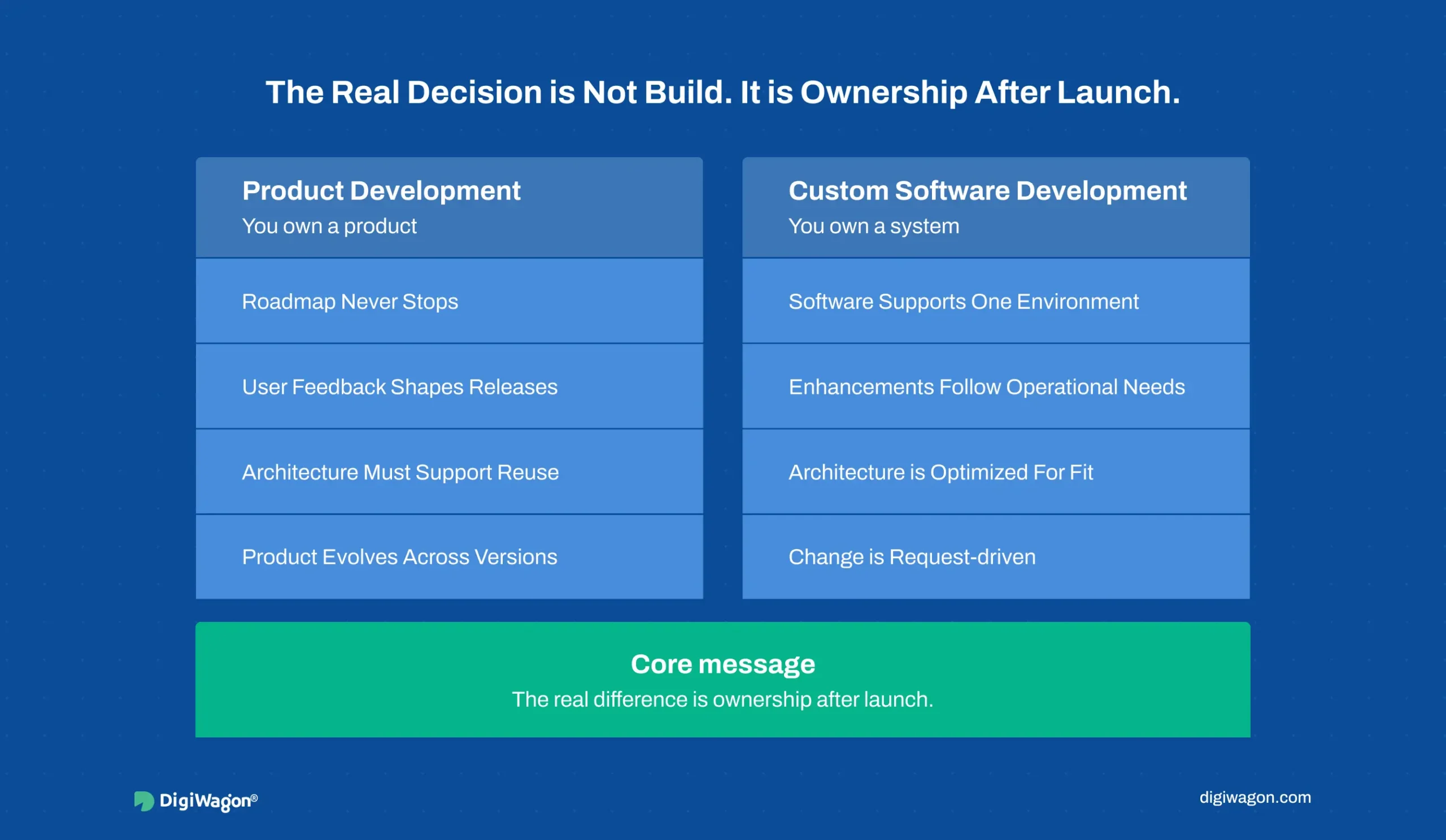
The most important difference between product development and custom software often appears after the first release.
In a custom software engagement, launch usually marks the transition from implementation to support. The system is expected to do its job inside one organisation, and future work tends to focus on maintenance, enhancements, and workflow adjustments.
In product development, launch is only the beginning. The product is expected to learn from users, adapt to market needs, and improve continuously through future releases. Discovery does not end at launch. It continues through roadmap decisions, product feedback, and iteration cycles.
This difference affects everything:
- How the software is architected
- How release planning is handled
- How success is measured
- How the team should be structured over time
A team building a product without a post-launch iteration model is usually not building a product. It is funding a custom project with product language around it.
What This Looks Like in Practice
A compliance platform designed for multiple financial institutions, each with configurable workflows, role-based access, and ongoing product enhancements, is a software product. Its architecture, delivery model, and post-launch expectations all depend on continuous iteration and reuse.
A reporting or operations platform designed around one organisation’s approvals, integrations, and internal decision-making is custom software. It may be sophisticated and strategically valuable, but it is still shaped around one operating environment rather than a repeatable market-facing product model.
This distinction matters because teams often assume they are funding product development when they are actually commissioning custom delivery. The mismatch usually becomes visible after launch, when roadmap expectations, architecture decisions, and ownership models begin to diverge.
How DigiWagon Supports the Right Development Model
DigiWagon helps businesses choose the right development model based on what the software is expected to become after launch.
That includes evaluating whether the initiative is being shaped as a reusable product, a custom operational platform, or something in between. The distinction affects architecture, release planning, integration design, and long-term ownership.
DigiWagon adds value through:
- Product-model assessment Clarifying whether the initiative should be treated as a market-facing product or a business-specific software system.
- Architecture and delivery planning Aligning the engineering approach with the expected level of reuse, configurability, scalability, and iteration.
- Workflow and integration analysis Assessing how operational complexity, business rules, and system dependencies shape the right engagement model.
- Post-launch planning Helping teams think beyond initial delivery to what support, enhancement, and product evolution will require over time.
The goal is not just to deliver software. It is to choose the model that fits the business, the lifecycle, and the kind of ownership the software will need after go-live.
Conclusion
Software product development and custom software development are not interchangeable labels. They represent different assumptions about purpose, architecture, reuse, and what the software is expected to do after launch.
Product development is the right model when the software is meant to evolve as a reusable, market-facing asset. Custom software development is the right model when the software is meant to fit one organisation’s specific workflows and operating environment.
The right decision comes from being clear about what the software is meant to become, not just what needs to be delivered first.
Choose the Right Development Model
Clarify whether your software initiative is a product build, a custom system, or something in between.