
The Convergence of Digital Channels
For enterprise leaders in manufacturing, retail, and wholesale distribution across the USA, UK, and Europe, the digital sales environment is no longer linear. Where businesses once chose between B2B (selling to distributors) and D2C (selling directly to consumers), the reality of 2026 is a complex tapestry of hybrid models, notably B2B2C (Business-to-Business-to-Consumer).
A manufacturer must now sell large volumes to a dealer, small volumes directly to the end-user, and manage the dealer’s own customer relationship, all simultaneously. This paradigm shift requires a serious commitment to Digital Transformation. The challenge is migrating from fragmented, siloed platforms to a unified e-commerce platform capable of orchestrating all these models seamlessly.
Decoding the Hybrid Models: D2C, B2B, and B2B2C
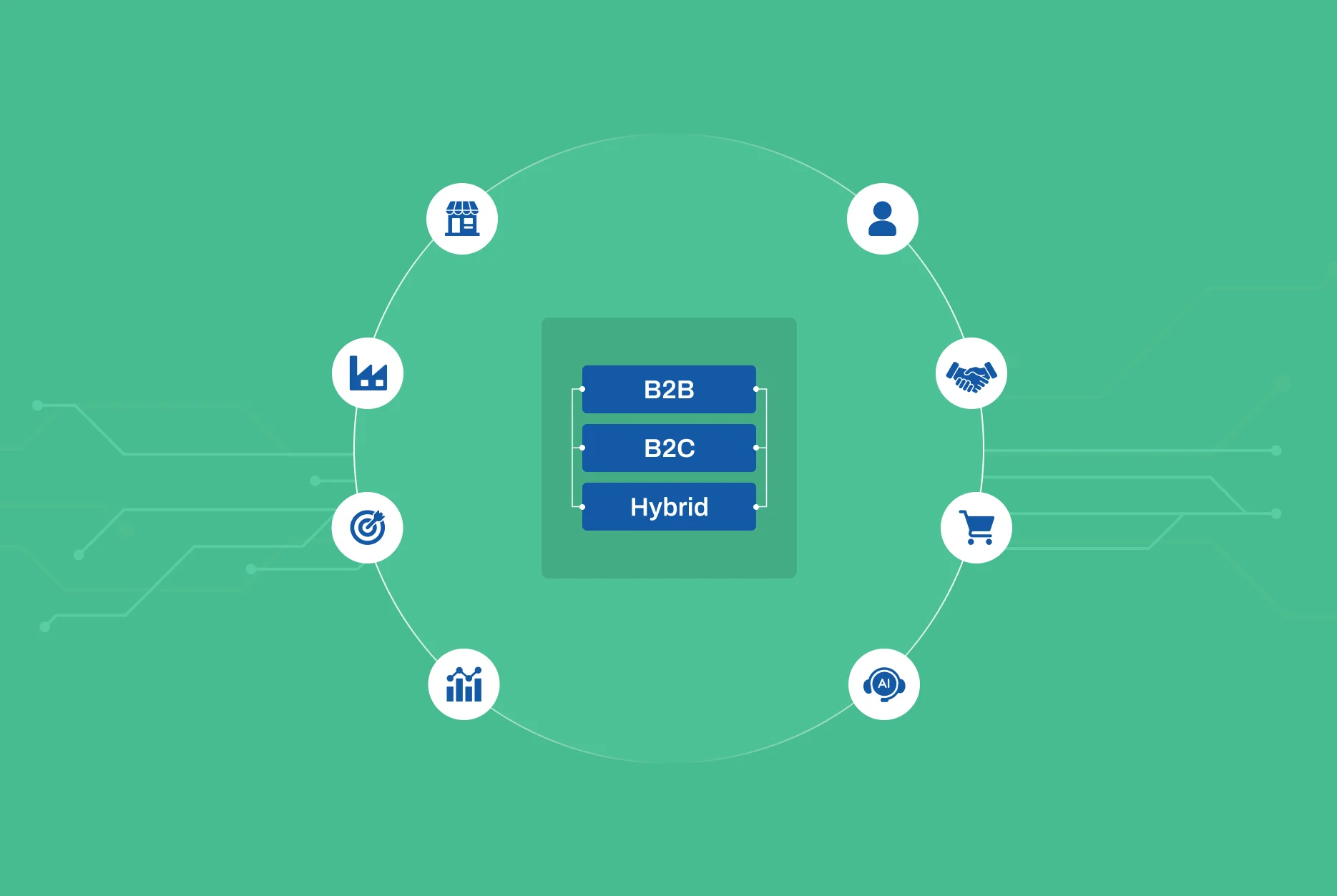
The Hybrid Commerce Landscape – Understanding D2C, B2B & B2B2C Three models. One unified platform.
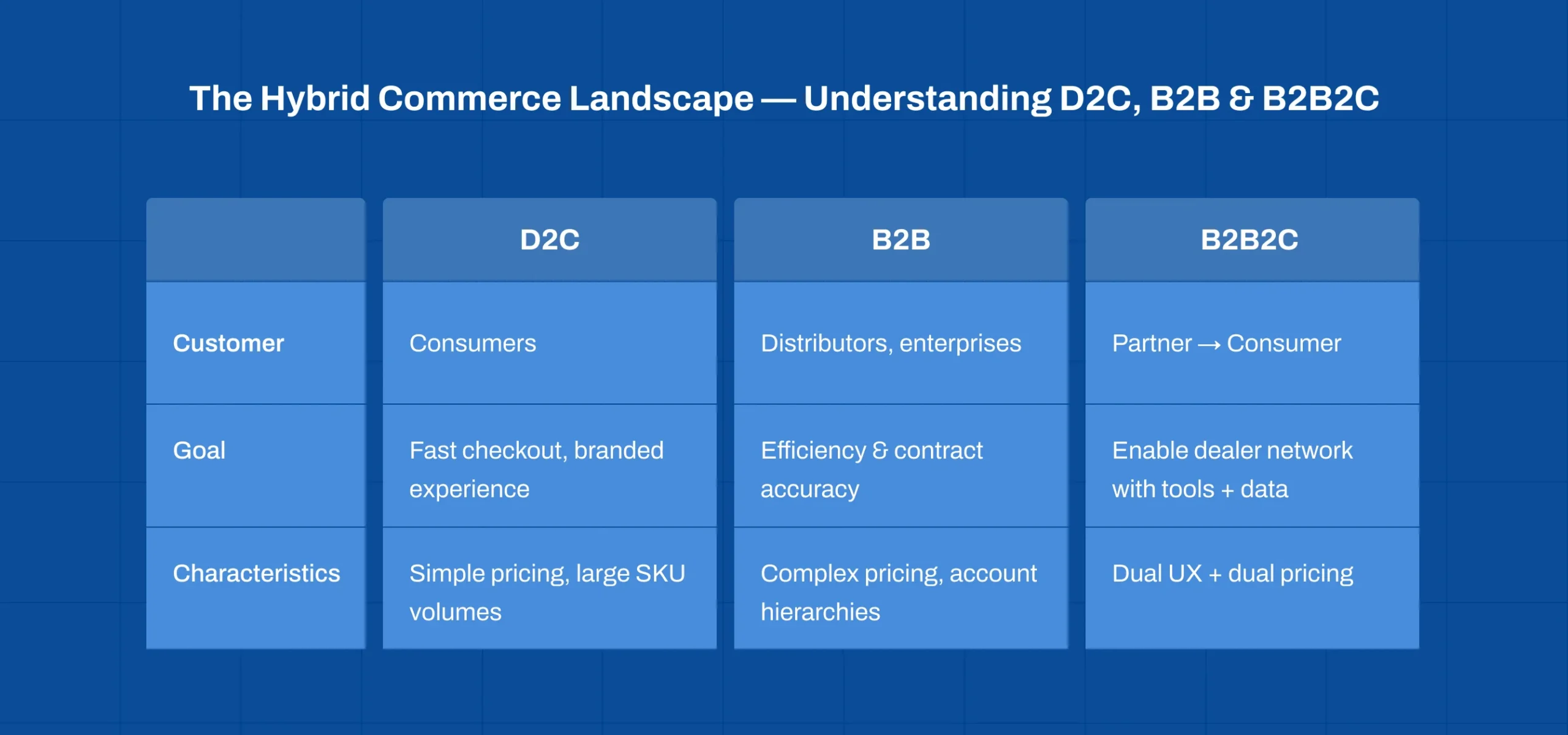
Hybrid commerce demands a unified digital engine.
Understanding the distinction is the first step toward successful unification. The core difference lies in the final customer and the complexity of the transaction.
| E-commerce Model | Primary Customer | Key Transaction Goal |
|---|---|---|
| D2C (Direct-to-Consumer) | End User/Individual | Simple, high-volume transactions; focus on brand experience. |
| B2B (Business-to-Business) | Distributor/Enterprise | Complex, negotiated transactions; focus on efficiency and contract adherence. |
| B2B2C (Business-to-Business-to-Consumer) | Dealer/Partner selling to End User | Enables partner network with digital tools; focus on channel enablement and speed. |
The B2B2C E-commerce Model is particularly challenging because it requires managing two distinct customer groups, the business partner and the final consumer, within a single technological environment.
The Challenge of Platform Fragmentation
Many enterprises attempting to manage hybrid models today use separate, independent platforms for each channel: an expensive, proprietary system for B2B, a quick SaaS solution for D2C, and maybe a manual portal for dealers.
The Hidden Costs of Siloed Systems
The Hidden Costs of Platform Fragmentation Fragmentation scales costs, not revenue.
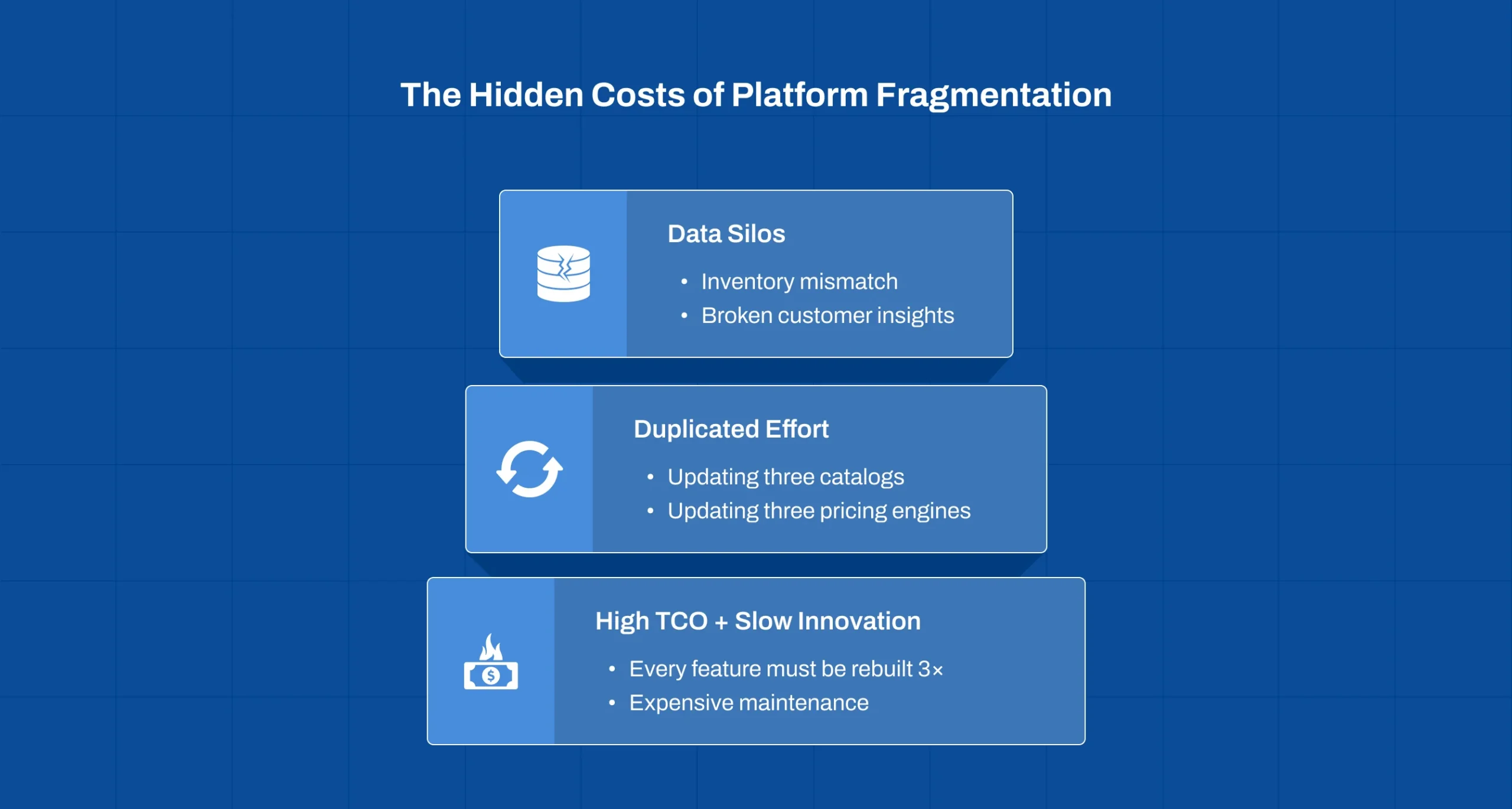
Unification cuts cost and accelerates innovation.
- Inconsistent Data: Separate systems lead to data silos, making accurate inventory forecasts, personalized marketing, and reporting nearly impossible.
- Duplicated Effort: Teams must manually update product information, pricing, and promotions across multiple databases.
- High TCO (Total Cost of Ownership): Licensing, integrating, and maintaining three different stacks is exponentially more complex and costly than managing one.
- Slow Innovation: Making a new feature available requires simultaneous development across all three platforms, halting agility.
The Unified Solution: Composable and Headless Architecture
Unified Architecture Blueprint – Composable + Headless Commerce Central logic. Infinite front-ends.

Composable architecture = long-term scalability.
The only architecture robust enough to handle the complexity of hybrid models is Composable Commerce, built on the principles of Headless and API-First Design.
Centralised Commerce Logic with Shared Services
A unified platform centralizes core, non-differentiating services (like Product Information Management, Inventory, and Order Logic) into a single engine. This modularity is a hallmark of modern SaaS Product Development and design.
- Single Source of Truth: All channels draw from the same, real-time product data and inventory pool, eliminating stockouts and data discrepancies.
- Microservices: Core features are broken down into independent services, allowing one team to update the core “Subscription Service” without affecting the B2B portal’s complex pricing logic.
Personalised Experiences via Headless Front-Ends
Headless architecture is critical for a unified platform. It separates the core back-end logic from the presentation layer (the front-end “head”). This allows for:
- Multiple Fronts, Single Back: You can deploy an engaging, image-heavy D2C storefront and a technical, data-driven B2B portal using completely different front-end technologies (e.g., React vs. Vue.js), while both connect to the same central commerce engine via APIs.
- Channel-Specific UX: This ensures the B2B user gets complex quote tools, while the B2C user gets a one-click checkout, all powered by the same infrastructure.
Key Capabilities of a Unified B2B2C Platform
Core Capabilities of a Unified B2B2C Commerce Platform One engine powering many channels.
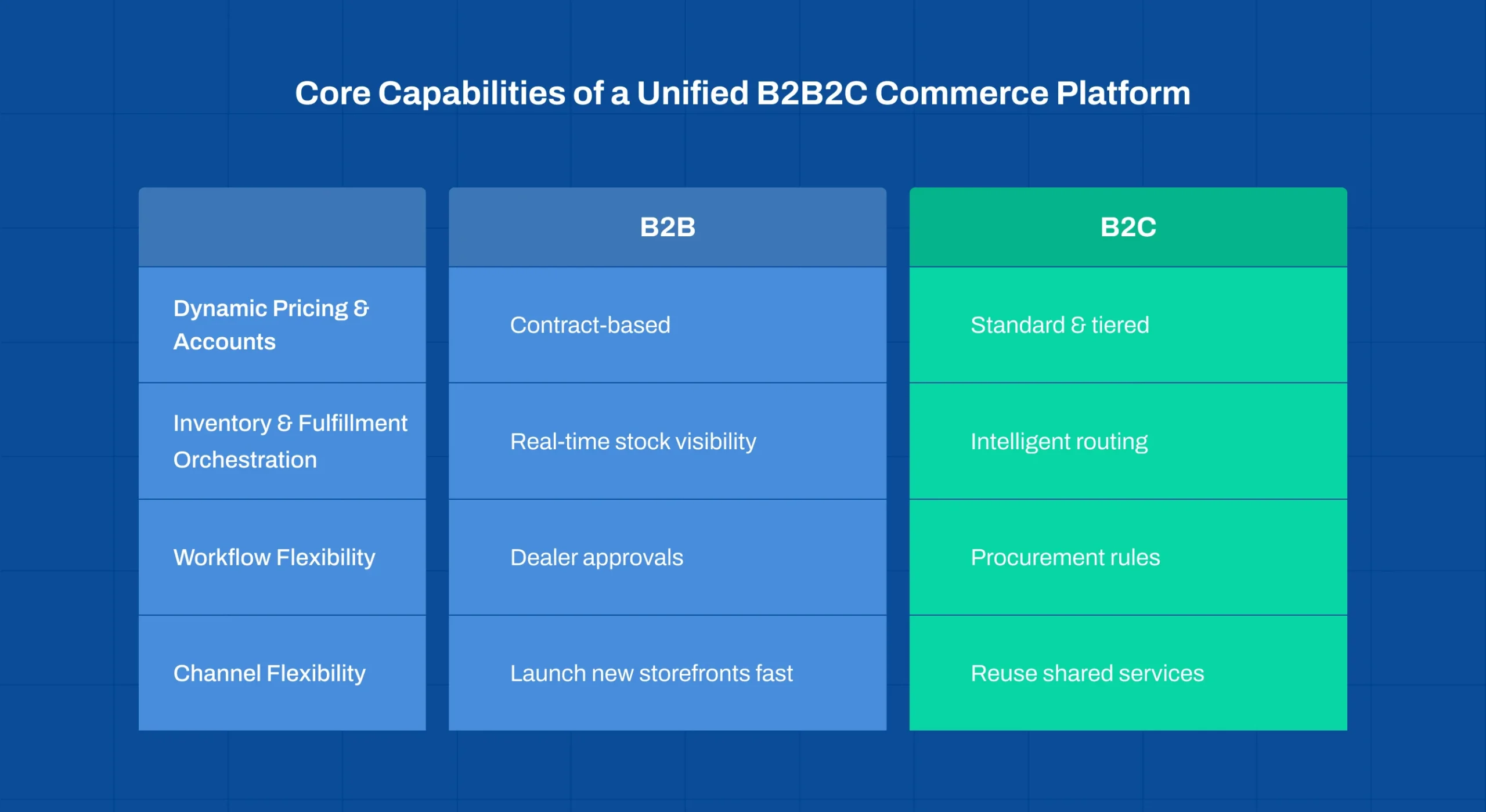
Design once, deploy everywhere.
A successful hybrid platform for 2026 must be engineered with capabilities that manage dual complexity:
Dynamic Pricing and Account Management
The key is managing the complex pricing and account needs of the B2B eCommerce buyer alongside the simple, fixed prices of the D2C shopper.
- Account Hierarchy: Supports complex organizational structures where procurement managers, site supervisors, and finance teams all have different purchasing limits and approval roles.
- Contract Pricing: Automatically applies contract-specific, negotiated pricing for B2B accounts, while serving standard tiered pricing for B2C/D2C customers.
Seamless Inventory and Fulfillment Orchestration
A true unified platform is the backbone of any successful Omnichannel strategy.
- Universal Cart: Allows customers (both B2B and B2C) to see inventory from all available fulfillment points (e.g., warehouse, distribution center, or even a dealer’s stock) and choose the fastest or cheapest option.
- Intelligent Routing: The system uses real-time logic to route the order based on the channel: a small D2C order goes to the closest store for quick fulfillment, while a large B2B order goes to the main DC.
Strategic Roadmap for 2026
The Unified Commerce Roadmap – Your 2026 Playbook Unification is a journey, not a migration.
- Audit & Simplify: Standardize core systems first.
- Adopt API-First: Replace monoliths piece-by-piece.
- Optimize for B2B/B2B2C First: Solve the hardest workflow; D2C becomes easy.
- Expand Into New Channels: Add marketplaces, partner portals, or D2C clones in weeks.
Future-proof your digital sales ecosystem now.
Building a unified platform is a strategic journey, not a migration. This is where expert Strategy Consulting is non-negotiable.
- Audit and Simplify: Identify which core services can be standardized (PIM, Inventory) and which require channel-specific customization (Pricing, Account Management).
- Adopt API-First: Commit to a composable architecture, replacing monolithic components one-by-one, starting with a Headless CMS or a central PIM.
- Prioritize the Toughest Customer: Design the core logic to handle the most complex workflow first (usually B2B or B2B2C partner logic); the simpler D2C model will then be easier to deploy.
Conclusion: Future-Proofing Your Digital Sales
The convergence of B2B, D2C, and B2B2C is the definitive reality of e-commerce in 2026. Enterprises that remain shackled to fragmented, monolithic systems will struggle with rising costs and slow innovation. The unified, composable platform is the strategic asset that not only solves today’s complexity but future-proofs your digital sales against tomorrow’s inevitable channel evolution.