
Accuracy Before Fluency
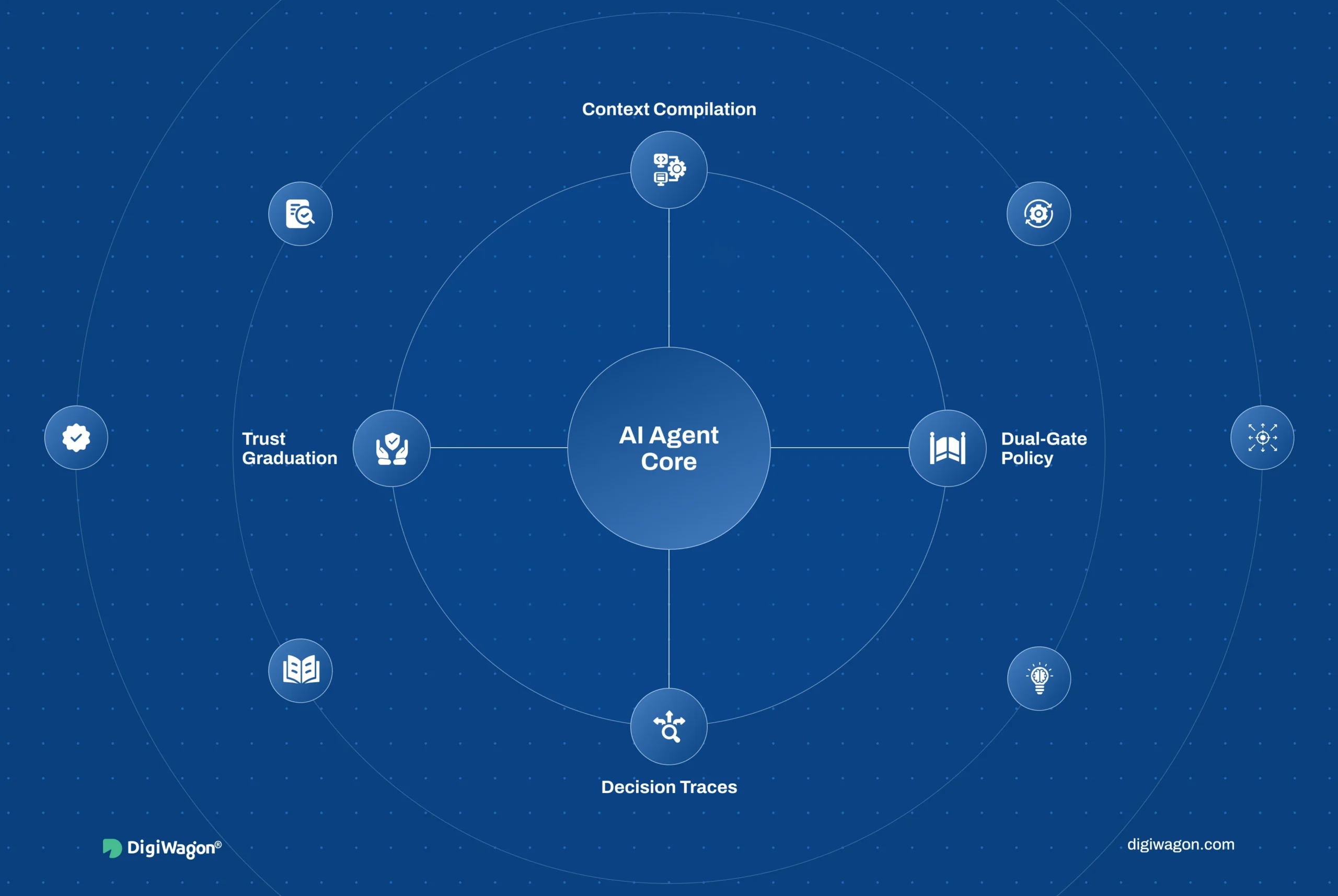
Fluent answers are easy; correct answers are harder. We prioritise grounding, validation, and context awareness through RAG so outputs stay useful in real scenarios, not just convincing on a first read.
Menu
Technologies
Resources
Company
Need Different Solution? Talk to our experts!
Less manual, more magical. AI that understands the assignment.
Most generative AI development services stop at a wrapper around someone else's model. DigiWagon builds the whole system. We design production generative AI and LLM solutions that understand your business context, connect to your data, and run reliably inside real workflows - not standalone demos that impress in a pitch and stall in production. Our RAG pipelines pair generative models with real-time access to your internal knowledge base, so responses stay grounded, accurate, and auditable rather than confidently wrong. We have built this for regulated settings where a hallucinated answer is a compliance event, including GenAI-powered AML alert triage across financial-crime workflows. If you want AI that moves a metric on your dashboard instead of a slide, that is the work. For agents that act on these models, see our AI agent development.
Custom LLMs Trained on Brand Voice
Brand voice shows up everywhere your company communicates, but a generic model has never read any of it. We build custom LLM solutions that learn your voice from real communication history and apply it as a constraint on every generation. Using fine-tuning and retrieval-augmented generation over your approved content, the model produces output that matches your tone rather than defaulting to generic AI chatter. For a FinTech client, that means customer communications that stay on-brand and on-policy at once. The voice becomes a repeatable asset, not a prompt someone has to remember to paste in.
Language-Driven Workflow Automation
Language is where most work begins, and it is exactly where a capable LLM earns its keep. Instead of stopping at a reply, our systems read intent and carry it into action. A team member notes that a client needs a revised proposal; the LLM pulls the latest data, drafts the document, updates the CRM, and routes it for review. We build this with orchestration frameworks like LangChain and tool-calling APIs so the model can act across your stack. It is the connective tissue between a request and a completed task, and it pairs directly with our AI-Powered Automation work.
Production RAG Pipelines
Retrieval-augmented generation is the difference between an AI that sounds right and one that is right. We build production RAG pipelines that retrieve from your internal knowledge base before the model generates, so responses are grounded in verified information rather than the model's best guess. The stack uses vector databases like Pinecone and Weaviate for retrieval, with LlamaIndex and LangChain orchestrating the flow. This is what powers virtual assistants and internal search that hold up under enterprise scrutiny. In a compliance setting, grounded retrieval is what lets an AML analyst trust the answer enough to act on it.
Multi-Modal Intelligence
Real business data arrives as PDFs, screenshots, product catalogs, audio notes, diagrams, and charts, not tidy paragraphs. Our enterprise generative AI solutions parse each input with modality-specific models and align them into a shared context layer, so the system reasons across formats instead of treating each in isolation. During inference it connects a figure in a chart to a clause in a document to a line in a spreadsheet. For document-heavy industries like finance and healthcare, this turns a pile of mixed-format files into a single queryable source the model can actually reason over.
Enterprise-Grade LLM Governance
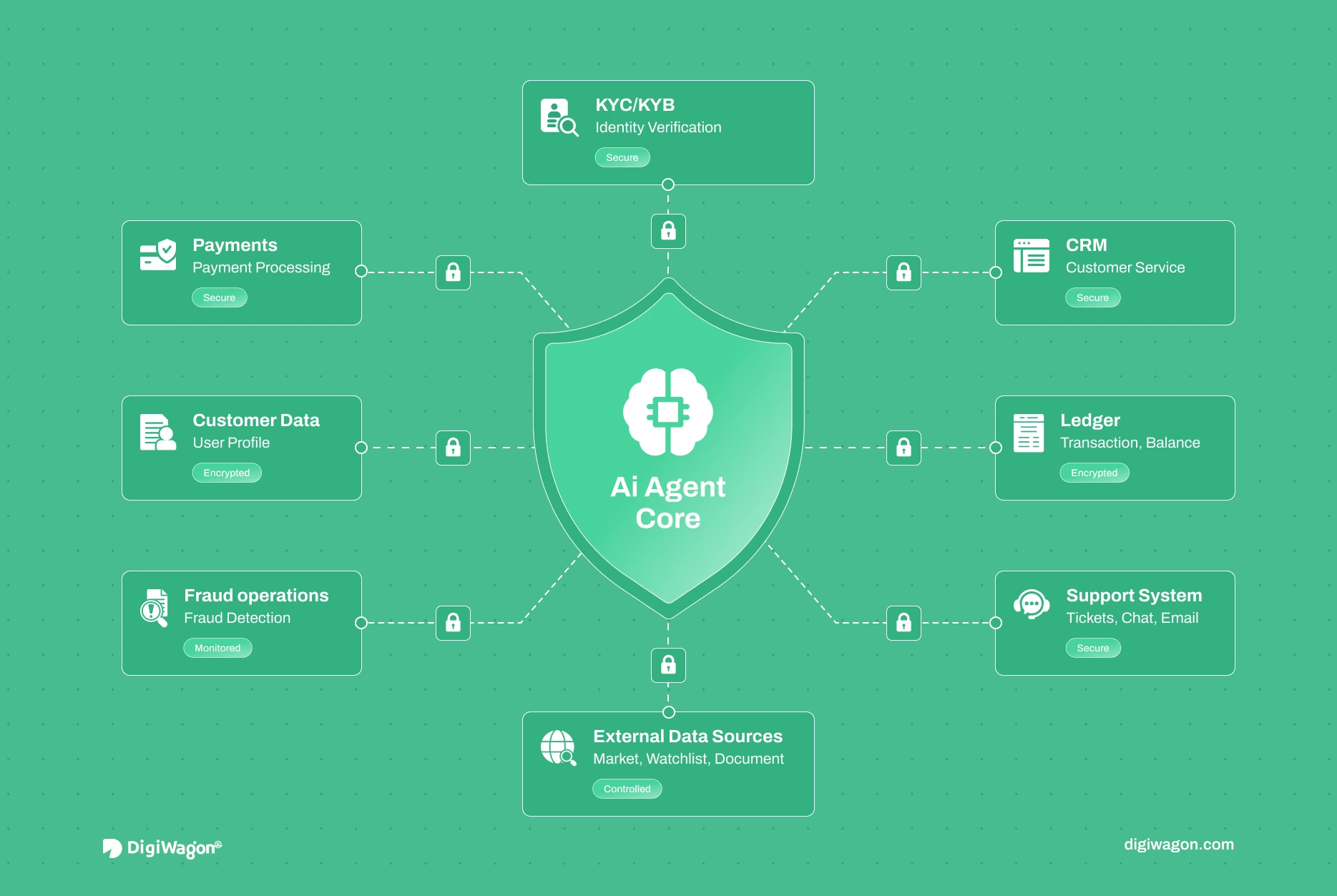
An ungoverned model is a liability the moment it touches a regulated workflow. We wrap every deployment in a governance layer: custom safety rules, role-based access boundaries, response filters, and compliance logic that keep outputs inside your policy. This supports secure LLM deployment across enterprise environments where auditability is not optional, aligned with ISO/IEC 27001:2022 controls and EU AI Act transparency obligations. The result is an AI system that operates confidently within business rules without introducing operational or compliance risk. It is the same governance discipline behind our regulated-industry agent work.
Scalable Generative AI Content Systems
A content system that works at ten pieces a week breaks at a thousand unless it was designed for the load from the start. We build scalable generative AI content systems that keep tone, structure, and accuracy consistent as volume grows across campaign material, product narratives, training resources, SEO pages, and internal documentation. Distributed inference and caching layers keep performance steady under load. The structure carries the quality, so scale does not become a quiet decline in standards. This is content infrastructure, not a one-off generation script.
There is a difference between buying an LLM and building with one. Our LLM development services cover the full build: model selection, fine-tuning on your domain data, RAG architecture, evaluation pipelines, and deployment into your infrastructure. We work with both large frontier models and smaller private models you can run on-prem, matching the choice to your data-sensitivity and cost constraints rather than defaulting to whatever is loudest this quarter. The engineering stack - LangChain, LlamaIndex, vector databases like Pinecone and Weaviate - is chosen for the workload, not the headline. For teams that have outgrown API calls and need an LLM system built around their actual data, this is where DigiWagon starts. It is also the model layer that our AI agent development builds on top of.
Most generative AI vendors treat data governance as a checkbox. In BFSI, RegTech, and healthcare, it is the whole game. We build generative AI systems where your data never leaves your boundary: private model deployments, encrypted retrieval pipelines, role-based access, and isolated execution environments. No client data is sent to public models, and nothing is reused for external training - a hard requirement under data-residency rules. This is the layer that let us deploy GenAI into AML alert triage, where the model summarises and prioritises financial-crime alerts while every input and output stays inside the client's infrastructure and every decision remains auditable. Backed by ISO/IEC 27001:2022 and ISO 9001:2015 certification, this data-governance discipline is what separates a production GenAI system in a regulated industry from a demo that could never pass review.
Intelligence Without Control Is Risk.
We design enterprise-ready LLM integrations with governance built in.
Fluent answers are easy; correct answers are harder. We prioritise grounding, validation, and context awareness through RAG so outputs stay useful in real scenarios, not just convincing on a first read.
No new habits to force, no extra platform to babysit. Our LLM solutions sit inside the tools your teams already use and enhance how work flows rather than interrupting it. Adoption sticks because nothing changes for the user.
We have deployed GenAI into AML and financial-crime workflows where a leaked record or a wrong answer is a reportable event. That experience, backed by ISO/IEC 27001:2022 certified architecture, separates our systems from generic model wrappers.
Large frontier models or smaller private ones; cloud, on-prem, or hybrid. The choice stays open. DigiWagon fits the deployment to your data-sensitivity, latency, and cost constraints instead of forcing one default.
Our work is led by engineers who have seen how AI behaves outside a controlled demo. That experience helps us anticipate failure early and design systems that hold up under real usage and real data.
Your Data's Been Waiting for This.
Make your processes cleaner, faster, and grounded in what you actually know.
Yes. We embed LLMs directly into your environment and configure them to work with your internal data – documents, SOPs, CRM records, historical tickets, product manuals – without sending anything to public models. Your data stays inside your infrastructure throughout.
Hallucinations are a known risk when models operate without constraints, so we do not let them. We design LLM systems with guardrails, validation layers, RAG retrieval, and fallback logic. When the model is uncertain, it verifies sources or asks instead of guessing – reliability over creativity for business-critical use.
We follow a privacy-first approach to secure LLM deployment: encrypted pipelines, role-based access controls, and isolated execution environments. The model does not transmit or reuse your information outside your system, and all processing stays within your infrastructure to maintain compliance and integrity.
RAG retrieves reliable data from your approved sources first, then uses it to generate the response. This grounds every output in verified information rather than the model’s best guess, which is what makes GenAI safe to use in fact-sensitive and compliance settings.
Yes. Our LLM solutions connect with CRMs, ERPs, support systems, marketing platforms, ticketing tools, databases, and custom internal applications. In practice the LLM becomes an intelligence layer that connects and enhances your entire software stack rather than a standalone tool.
Generative AI development cost depends on scope: a focused RAG assistant over a defined knowledge base sits at the lower end; a custom fine-tuned LLM with multi-modal inputs and several integrations runs higher; and an enterprise deployment with private model hosting, strict governance, and compliance requirements – typical in BFSI and RegTech – sits at the top. The main cost drivers are model strategy (API vs fine-tuned vs private-hosted), the number of data sources and integrations, and the depth of the governance and audit layer. DigiWagon scopes each build against your actual data and workflow rather than a fixed package.
Timeline scales with complexity. A production RAG assistant over a defined knowledge base can go live in a few weeks. A custom fine-tuned LLM with multi-modal inputs and workflow integrations typically takes one to a few months. An enterprise deployment with private model hosting, full governance, and compliance sign-off runs longer because evaluation and security hardening are as substantial as the model work itself. We ship in staged releases so you see a grounded, working system early rather than waiting for a single launch.
Generative AI produces content in response to a prompt – a summary, a draft, an answer. Agentic AI acts autonomously toward a goal: it plans, calls tools, evaluates results, and completes a multi-step task without a human driving each step. Generative AI writes the report; agentic AI decides the report is needed, gathers the inputs, drafts it, checks it, and files it. The two are layered: generative models are the language engine, and agents add planning, tool use, and governance on top. DigiWagon builds both – this page covers the generative and LLM layer; our AI agent development page covers the agents built on it.
Yes. LLM architectures can be tuned for both. For high-volume enterprise workloads, distributed inference, caching layers, and optimised pipelines handle thousands of queries per minute. For smaller or more sensitive use, compact domain-specific models deploy privately for faster performance, lower infrastructure cost, and tighter data control. The same system can also support multilingual operations, translating and generating across languages while preserving brand tone and terminology. We match the architecture to your volume, latency, and data-residency needs rather than forcing a single deployment shape.
Autonomous, governed agents that act on the models and RAG pipelines built here.
Process automation where language-driven LLM workflows complete tasks end-to-end.
Artificial Intelligence & Machine Learning
The parent practice spanning model development, data, and applied AI.

Insights
Fill in your details to access the whitepaper