

To the Chief Technology Officers and Chief Risk Officers operating within, or exporting to, Europe: the regulatory clock is ticking. The EU AI Act, a landmark piece of legislation, isn’t just a list of rules; it’s a fundamental change to how Enterprise Software and AI & Machine Learning systems must be engineered.
In the immediate aftermath of the Act’s introduction, the competitive differentiator won’t be who has the best algorithm, but who has the most auditable AI system. The “governance gap”, the space between a brilliant proof-of-concept and a fully compliant, production-ready system, is now the greatest bottleneck to scaling AI across your organisation. For every high-risk AI application, compliance with the Act demands auditability by design.
The Post-Act Reality: Why Governance is the New Innovation Hurdle
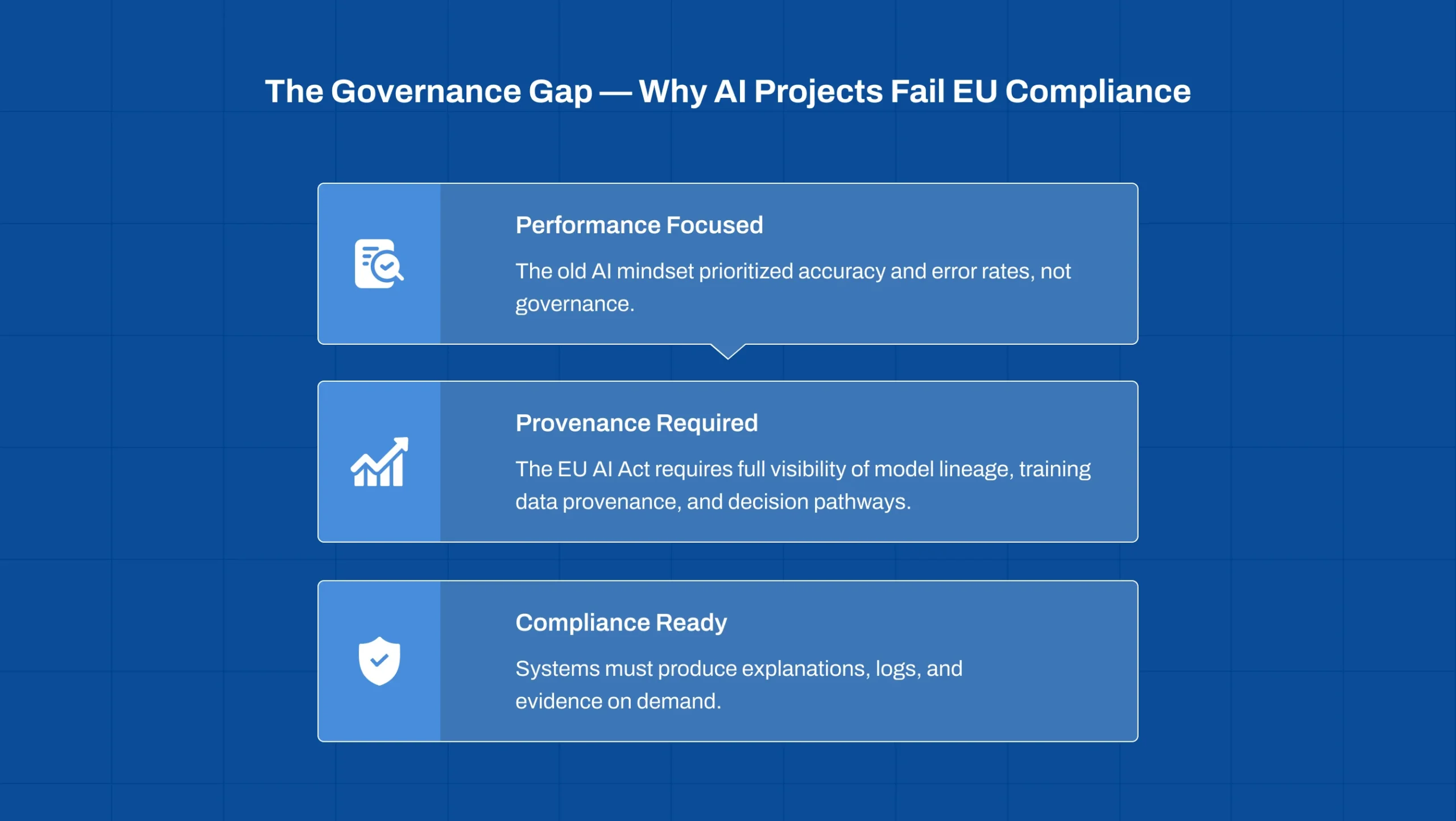
The Governance Gap: Why AI Projects Fail EU Compliance Accuracy alone doesn’t pass an audit; traceability does.
Governance is now an engineering priority, not a legal afterthought.
For years, the goal of an AI project was simply performance, higher accuracy, lower error rates. Now, that is only half the battle. The European market, with its focus on consumer trust and ethical technology, requires evidence that your AI decisions are fair, traceable, and subject to oversight.
Shifting from Model Performance to Model Provenance
The focus has moved to Model Provenance. This means knowing the full history of the AI system, including:
- The source, quality, and biases of the training data.
- Every change and version of the model architecture.
- The exact reasoning path that led to a specific decision (the “why”).
Without this complete, verifiable audit trail, your AI system cannot be certified for use in high-risk categories in the EU.
The EU AI Act’s Core Demand: Auditability by Design
The EU AI Act takes a risk-based approach, imposing stringent requirements on systems deemed “High-Risk.” For these systems, auditability is non-negotiable.
Defining the “High-Risk” System Category
The EU AI Act High-Risk Categories – A CTO Snapshot If it impacts rights, access, or safety – it is High-Risk.
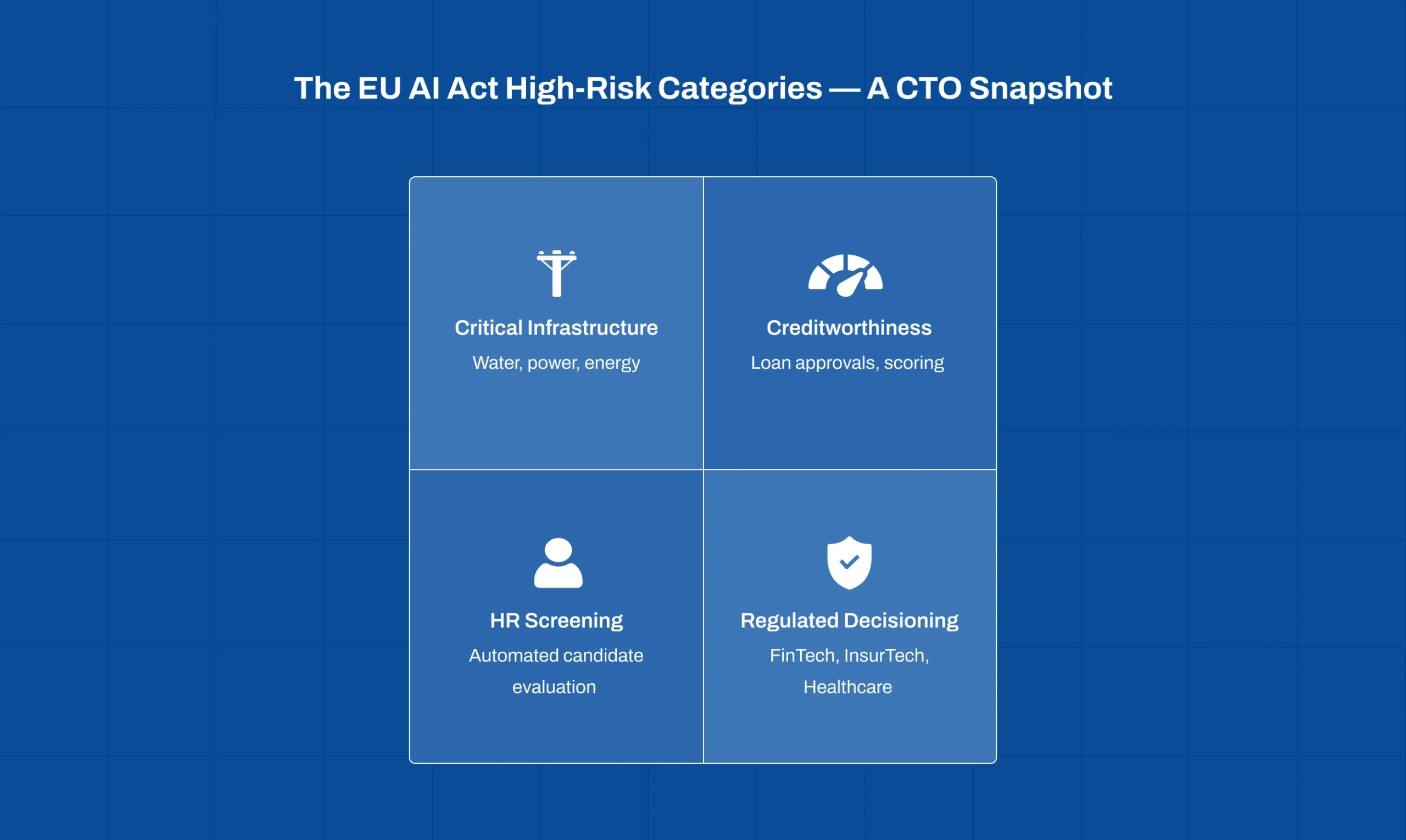
High-risk = mandatory auditability. No exceptions.
While the full list is extensive, in the B2B IT space, systems are generally High-Risk if they involve:
- Critical Infrastructure: AI used to manage water, gas, or electricity networks.
- Creditworthiness: AI systems assessing loan applications or affecting access to financial services.
- HR Management: Tools used to filter or evaluate candidates for employment.
- Regulated Decision-Making: Any system deployed in a regulated environment (like FinTech & InsurTech or Healthcare Transformation) that significantly impacts individuals’ fundamental rights.
For these systems, compliance requires designing the AI architecture from the ground up with specific auditability components, moving beyond simply attaching a compliance document at the end of the project.
The Blueprint: 4 Pillars of an Auditable AI System
The 4 Pillars of an Auditable AI System Compliance = transparency + traceability + fairness + testing.
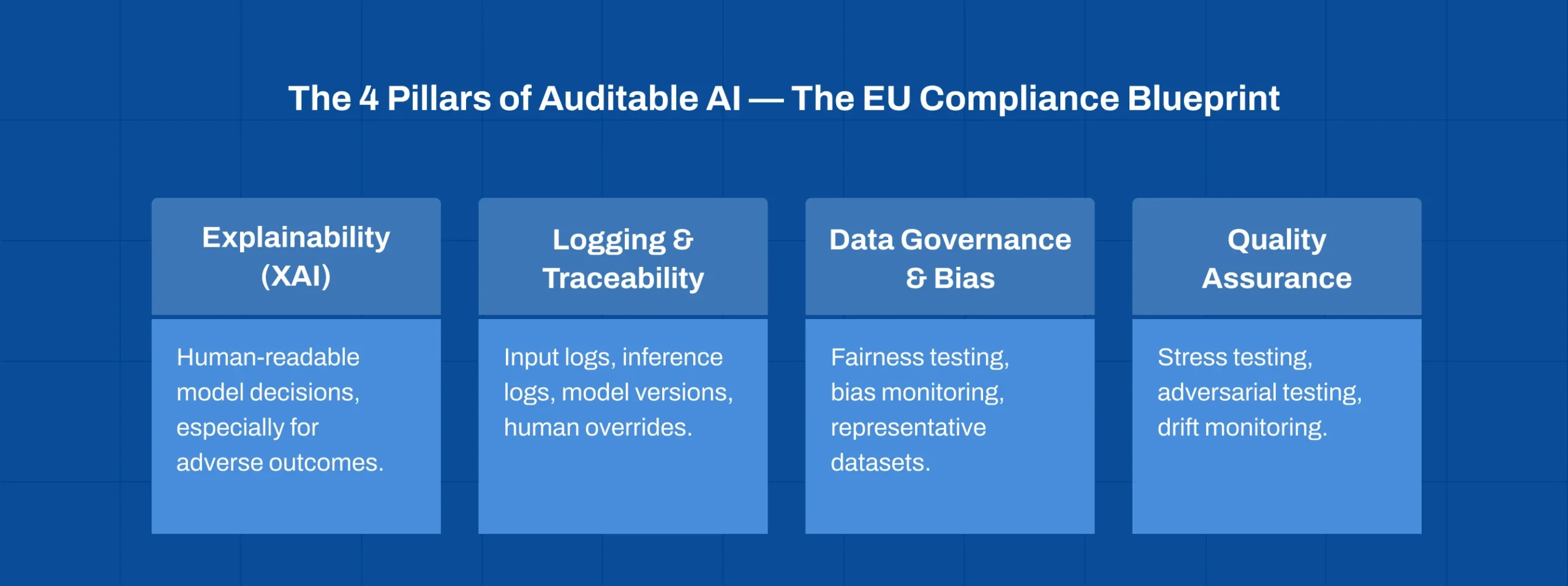
Embed auditability into the architecture , not the documentation.
Achieving compliance in 2026 requires engineering the following four pillars into your Advanced Software Solutions.
1. The Explainability Layer (XAI for Transparency)
Regulators must be able to understand how the AI arrived at a decision. Explainability (XAI) moves beyond simple feature importance to provide local, human-readable explanations.
- Action: Implement XAI techniques (like SHAP or LIME) that generate a transparent rationale for high-risk outcomes.
- Audit Requirement: Providing the user (or the auditor) with a clear, context-specific reason for an adverse decision (e.g., “The loan was denied because the model weighted current debt levels higher than collateral assets”).
2. The Comprehensive Logging and Traceability Framework
The AI Audit Trail Framework – Logging & Traceability Architecture If it isn’t logged, it didn’t happen – legally speaking.
- Logs every input, inference, model version, rule, and override
- Links prediction → model ID → training dataset → regulatory context
- Provides auditors with a chronological decision trail
- Enables rapid investigation of errors or incidents
Build systems that can explain every decision , automatically.
This pillar creates the digital paper trail required by the Act’s mandated record-keeping.
- Action: Establish a dedicated logging service that captures every input, inference, system intervention, human override, and model version used for every single prediction.
- Audit Requirement: The system must be capable of generating a full, chronological record of any decision made by the AI, linking the output back to the specific training data set, the model ID, and the regulatory environment at the time of inference. This is crucial for RegTech.
3. Data Governance and Bias Mitigation
Biased data leads to biased outcomes, which is a key violation of the Act’s fairness provisions.
- Action: Implement continuous monitoring of training data for sensitive features (e.g., gender, ethnicity, location) and perform fairness testing to ensure performance parity across protected groups.
- Audit Requirement: Documenting a formal Data Governance strategy, including how training data was curated, cleaned, and validated to prove that it is representative and free from systematic discriminatory bias.
4. Robust Quality Assurance & Testing
The AI Act mandates rigorous testing before deployment and continuous monitoring thereafter.
- Action: Move beyond standard functional testing to include stress testing (testing the model near its decision boundaries) and adversarial testing (trying to trick the model). Implement monitoring dashboards to track model drift and data drift in real-time once in production.
- Audit Requirement: Maintaining records of all testing results and demonstrating that the system’s performance remains consistent with the declared reliability metrics across different time periods and user groups.
Bridging the Gap: A Strategic Roadmap for CTOs
CTO Roadmap – Closing the Governance Gap Before 2026 Compliance must be operationalized, not improvised.
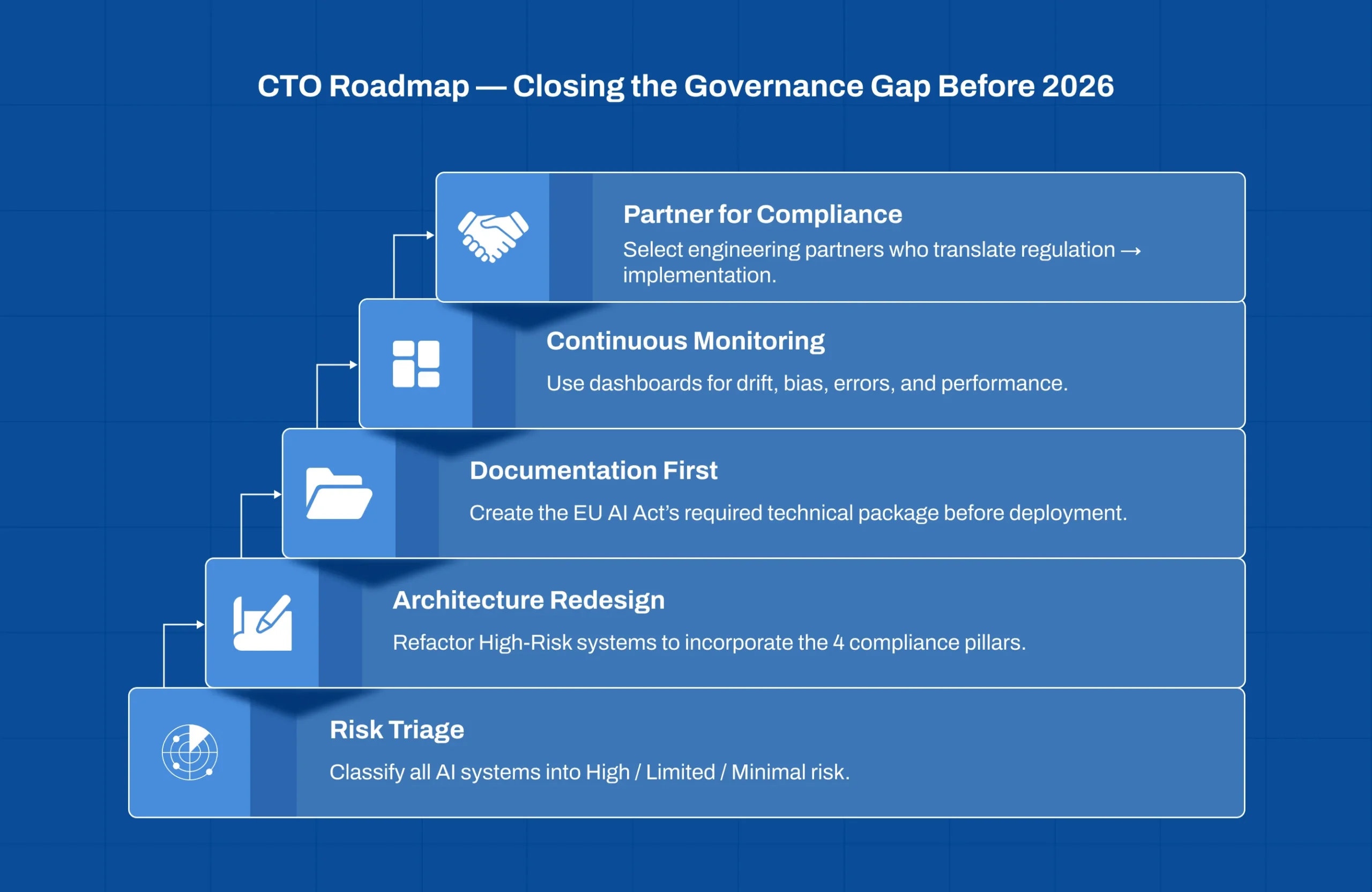
Compliance becomes a competitive advantage when built early.
Compliance is not a checkbox; it is a cultural and architectural shift. To bridge the governance gap, CTOs must integrate these compliance steps into the core Software Product development lifecycle (MLOps/DevOps).
- Risk Triage: Immediately classify all current and planned AI systems into High-Risk, Limited Risk, or Minimal Risk categories.
- Architectural Re-design: For High-Risk systems, initiate a re-design focused on implementing the four pillars (XAI, Logging, Governance, Testing).
- Documentation First: Create and maintain the technical documentation package required by the Act before deployment.
Partnering for End-to-End Compliance
The complexity of the EU AI Act necessitates specialised expertise that combines deep understanding of regulatory requirements with advanced SaaS Architecture and AI Consulting capabilities. Your strategic partner must be able to translate legal text into executable engineering blueprints.
Conclusion: Turning Compliance into a Competitive Edge
The EU AI Act is Europe’s entry barrier, but for proactive enterprises, it is also a powerful competitive advantage. By embracing the mandate for Auditable AI Systems, you not only mitigate fines and risks but also build a foundation of trust and transparency that is increasingly valued by B2B clients and consumers globally. The governance gap is an invitation to solidify your position as a trusted, responsible AI leader.