
Executive Summary
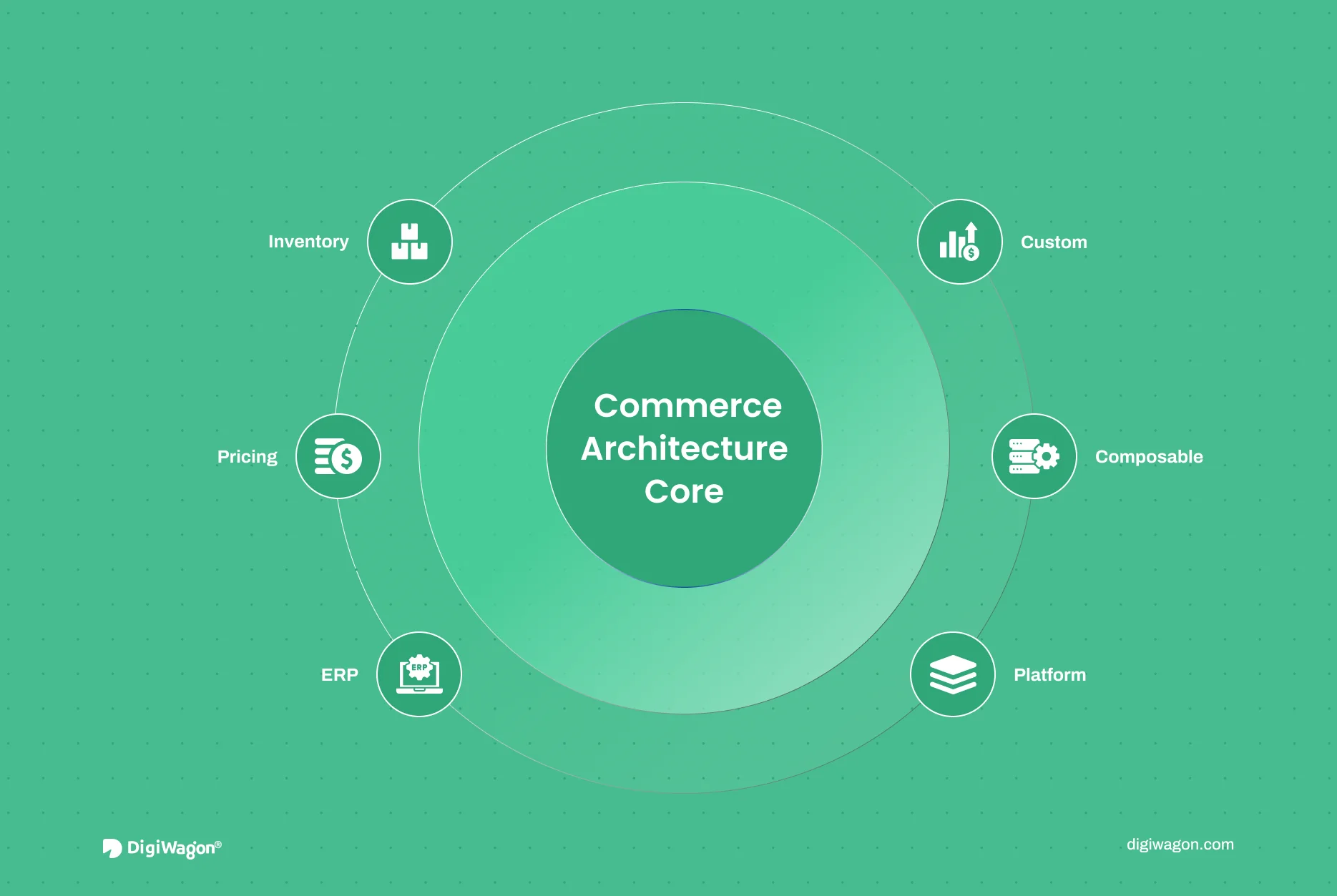
- B2B eCommerce architecture affects more than the storefront. It shapes catalog complexity, pricing logic, ERP integration, and long-term platform flexibility.
- Custom architecture is the right fit when the business needs deeper control, complex workflows, and tightly integrated operations.
- Composable architecture works best when modularity, phased growth, and long-term adaptability matter more than an all-in-one stack.
- Platform-led approaches are stronger when speed, simplicity, and lower implementation overhead are the priority.
- The right decision depends on integration depth, product and pricing complexity, and the internal engineering capacity required to support the system after launch.
What is B2B eCommerce Architecture?
B2B eCommerce architecture is the structural blueprint that defines how a business-to-business commerce system handles catalogs, pricing, ordering, and integrations across its technology stack. It determines how the storefront, business logic, and backend systems communicate. Unlike B2C architecture, where the transaction is simple and the user is anonymous, B2B architecture must support contract pricing, multi-role approval workflows, bulk ordering, and deep ERP connectivity.
Why Architecture Decisions Matter More in 2026
If you are a CTO or VP of Engineering at a manufacturing enterprise, the pressure to digitize procurement has never been higher. According to the International Trade Administration, the global B2B eCommerce market will reach $36 trillion by 2026, growing at a 14.5% CAGR. A McKinsey Global B2B Pulse survey found that 39% of B2B buyers now spend over $500,000 per order through self-service digital channels, up from 28% two years ago.
That is not a trend. That is a structural shift in how industrial buyers expect to purchase.
The problem? Most B2B eCommerce implementations fail because the architecture was chosen before the requirements were understood. A manufacturer that picks Shopify Plus on an agency’s recommendation will spend 18 months hitting walls around tiered pricing, approval chains, and ERP sync. A different manufacturer that commits to a full custom build for a simple parts catalog will burn budget on problems a platform already solved.
The architecture decision is a bet on your operating model.
Industry Context: Manufacturing’s Unique B2B Requirements
Manufacturing B2B commerce is distinct from general wholesale or distribution. You are dealing with complex BOMs (Bills of Materials), configurable products with interdependent options, region-specific pricing tied to distribution agreements, and compliance requirements around export controls and material safety documentation. A manufacturing distributor selling industrial pumps across India and the USA needs a system that can enforce different unit pricing per customer tier, restrict product visibility by geography, and generate GST-compliant or IRS-compliant invoices from the same catalog.
This is why architecture matters more in manufacturing than in most verticals. The software solutions for manufacturing enterprises must account for these constraints before a single line of frontend code is written.
What Are the Three Architecture Paths for B2B eCommerce?
The three dominant approaches in 2026 are custom-built, composable (headless/MACH), and platform-led. Each involves different trade-offs in cost, speed, control, and long-term flexibility.
Custom-Built Architecture
A custom-built B2B eCommerce system means your engineering team owns every layer: frontend, business logic, data layer, and integrations. This is the domain of custom eCommerce platform development. You build the catalog service, the pricing engine, the checkout flow, and the order management pipeline from scratch or from open-source components. The tech stack is typically React or Next.js on the frontend, Node.js or Python/Django on the backend, and PostgreSQL or MongoDB for data, deployed on AWS or GCP.
When custom makes sense:
- Your pricing model is non-standard (e.g., negotiated contract pricing with volume rebates that recalculate mid-order)
- You need to integrate with 3+ enterprise systems (ERP, PIM, CRM, WMS) with bidirectional data sync
- Your approval workflows involve multi-level, role-based chains that no off-the-shelf system supports
- You expect the commerce system to become a competitive differentiator, not a cost center
When custom is overkill:
- You sell fewer than 5,000 SKUs with standard quantity-based pricing
- Your buyer journey is straightforward: browse, add to cart, submit PO
- You do not have 2+ dedicated full-stack engineers for post-launch maintenance
Composable Commerce (Headless / MACH)
Composable commerce follows the MACH principles: Microservices-based, API-first, Cloud-native, Headless. (For a broader look at how composable thinking applies beyond commerce, see our CTO’s guide to composable enterprise architecture.) Instead of building every layer from scratch, you assemble your stack from specialized services. A typical composable B2B build in 2026 might combine commercetools for catalog and order management, Algolia for search, Stripe for payments, Contentful for CMS, and a custom React frontend.
The key difference from custom: you are choosing pre-built backend services for each capability and connecting them via APIs. You still own the frontend. You still control the experience. But you are not writing the cart logic, the inventory sync, or the payment processing from zero.
When composable makes sense:
- You need flexibility but lack the team to build and maintain every backend service
- You operate across multiple geographies with different catalogs, currencies, and tax rules
- You want to swap individual components (search provider, payment gateway) without re-architecting the whole system
- Your technical team is strong enough to manage API orchestration and multi-vendor dependencies
When composable adds unnecessary complexity:
- You only sell in one market with one currency
- Your team has no experience with API-first development
- Your total commerce revenue does not justify the $50,000-$150,000+ annual cost of enterprise composable platforms
Platform-Led Architecture
Platform-led means adopting a commercial B2B eCommerce product that bundles frontend, backend, and admin tooling into a single managed service. In 2026, the leading options are Shopify Plus (B2B features added 2023-2024), BigCommerce (native B2B with customer groups and quote management), OroCommerce (purpose-built for B2B), and Adobe Commerce (Magento, enterprise-grade with deep B2B modules).
When platform makes sense:
- You need to launch within 3-6 months
- Your B2B workflows are standard: customer-specific pricing, purchase orders, basic approval chains
- You prefer operational expense (subscription fees) over capital expense (engineering headcount)
- You have limited internal engineering and rely on agency or vendor support
When platform becomes a constraint:
- Your business logic outgrows the platform’s extension system
- You need real-time bidirectional ERP sync that the platform’s native integration cannot handle
- You want to own your frontend experience without the platform’s theming limitations
How Do You Choose Between Custom, Composable, and Platform?
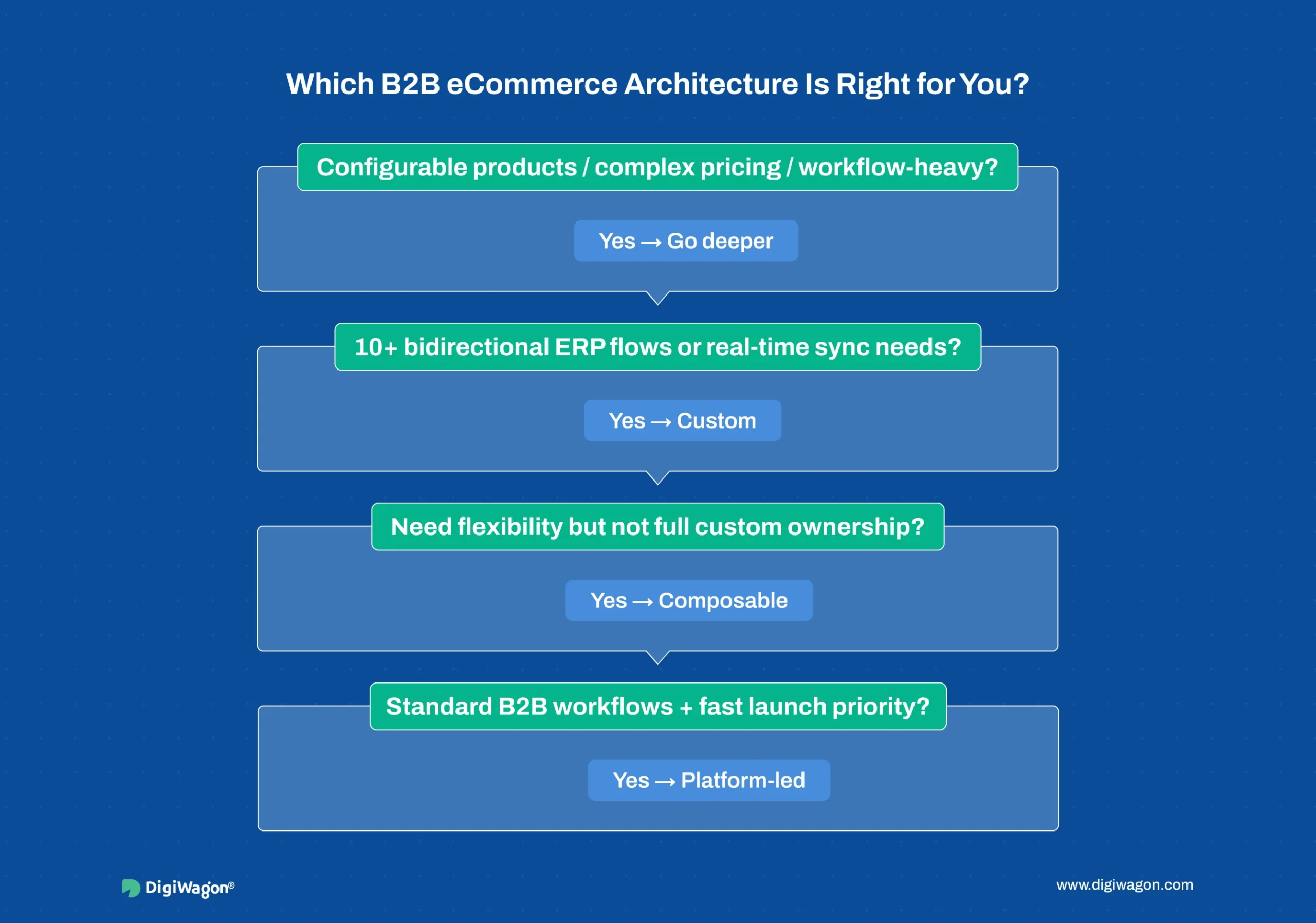
The decision is not about which architecture is “best.” It is about which architecture fits your constraints. Here is a decision framework based on three variables.
| Decision Factor | Custom-Built | Composable (MACH) | Platform-Led |
|---|---|---|---|
| Catalog complexity (configurable BOMs, interdependent options) | Best fit | Good fit (if catalog service supports it) | Weak fit (workarounds needed) |
| Integration surface (ERP, PIM, CRM, WMS) | Full control | Good via APIs (vendor dependent) | Limited to native connectors + middleware |
| Time to first order | 6-12 months | 4-8 months | 2-5 months |
| Post-launch engineering need | 2-4 FTEs ongoing | 1-3 FTEs + vendor management | 0.5-1 FTE + agency retainer |
| Vendor lock-in risk | Zero | Medium (per-service lock-in) | High (platform migration is painful) |
| Scalability ceiling | Unlimited (you own it) | High (scales per service) | Capped by platform’s architecture |
| Best for | Enterprises with unique workflows and in-house engineering | Mid-to-large businesses wanting modularity without full custom | SMBs and mid-market with standard B2B needs |
The ERP Integration Test

Here is a practical way to pressure-test your choice. Map out every data flow between your commerce system and your ERP (SAP, Oracle, Microsoft Dynamics, Tally, or whatever you run). List every entity: customer records, pricing tiers, inventory levels, order status, invoice data, credit limits.
If you count fewer than 5 bidirectional data flows, a platform with a middleware layer (Celigo, MuleSoft, or custom webhook handlers) will probably work. If you count 10+, and especially if any of those flows need real-time sync (not nightly batch), you are looking at either composable with a dedicated integration layer or full custom.
Most B2B implementations underestimate integration complexity by 2-3x. The catalog is the easy part. The hard part is getting your SAP pricing condition records to match your storefront pricing in real time when a buyer changes quantities mid-checkout.
How DigiWagon Supports B2B eCommerce Architecture Decisions
DigiWagon helps B2B businesses choose architecture based on how the platform will perform after launch, not just how it looks during implementation.
That means evaluating more than storefront requirements. The decision is shaped by catalog complexity, ERP integration depth, pricing logic, workflow requirements, and the internal engineering capacity needed to support the platform over time.
We adds value through:
- Architecture fit assessment Evaluating whether a custom, composable, or platform-led approach matches the business’s operational complexity and long-term product direction.
- Integration-first decision-making Treating ERP, pricing, inventory, and workflow dependencies as core architecture inputs rather than secondary implementation tasks.
- Maintainability and scale planning Looking beyond go-live to how the system will handle future change, team ownership, and ongoing enhancement.
- Implementation realism Helping teams choose the option they can not only launch but also sustain as product and business requirements grow.
The goal is not just to recommend an architecture. It is to make sure the business chooses one it can operate, extend, and evolve with confidence.
What Does the B2B eCommerce Tech Stack Look Like in 2026?
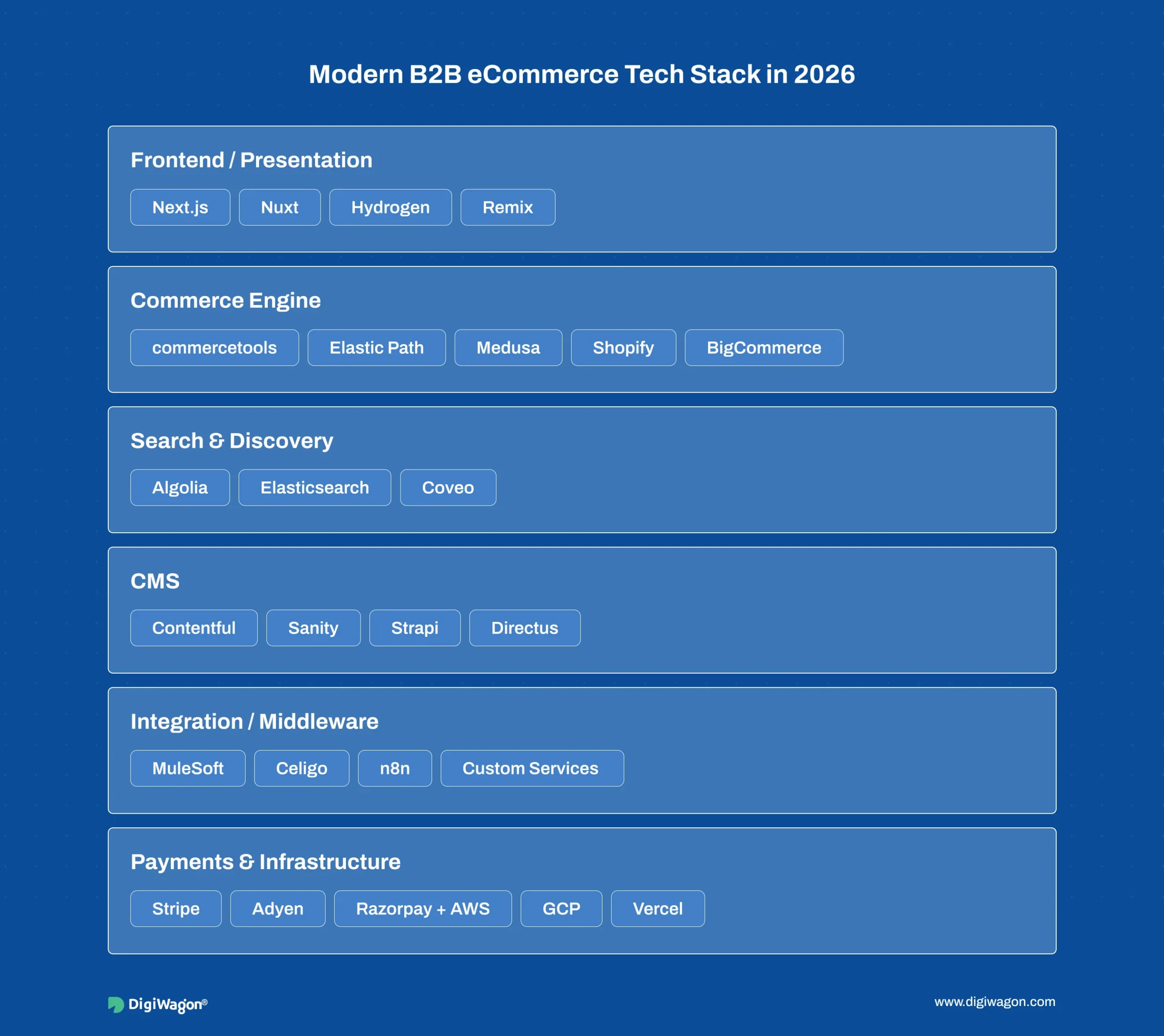
A modern B2B eCommerce tech stack, regardless of architecture path, typically involves these layers:
- Frontend / Presentation Layer: Next.js, Remix, or Nuxt.js for server-rendered, SEO-friendly storefronts. Hydrogen (Shopify’s React framework) if you are on Shopify Plus.
- Commerce Engine: Commercetools, Elastic Path, Medusa JS (open-source), or the platform’s built-in engine (Shopify, BigCommerce, OroCommerce). If you are building a composable stack, the commerce engine is essentially a SaaS product in its own right, with multi-tenant considerations, API versioning, and uptime SLAs.
- Search & Discovery: Algolia, Elasticsearch, or Coveo for faceted search across complex catalogs.
- CMS: Contentful, Sanity, Strapi, or Directus for product content and marketing pages decoupled from the commerce layer.
- Integration / Middleware: MuleSoft, Celigo, n8n, or custom Node.js/Python integration services for ERP, PIM, and WMS connectivity.
- Payments: Stripe, Adyen, or Razorpay (India). B2B-specific: net terms via Resolve or Balance.
- Infrastructure: AWS (ECS/EKS), GCP (Cloud Run), or Vercel/Netlify for frontend hosting.
Actionable Takeaways
- Map your integration surface before selecting architecture. List every data entity flowing between commerce, ERP, PIM, CRM, and WMS. Count the bidirectional flows. That number determines your architecture path more than any other variable. Then simulate 100 concurrent orders through that integration during QA, not after go-live.
- Run a 2-week “order shadow” study. Follow 20 real B2B orders from inquiry to fulfillment. Document every manual step, email, and phone call. The gap between your current process and what a platform handles natively is your custom development scope.
- Budget for Year 2, not just Year 1. The upfront build is 40% of total cost. A $150K custom build with no maintenance budget is more expensive than a $60K platform with a $30K/year agency retainer.
- Start with a single buyer segment. Launch with your top 50 accounts and most-ordered 500 SKUs. Validate against real buyer behaviour before migrating the full catalog.
- Separate your pricing engine from your catalog service. B2B pricing is the single most complex component in any manufacturing commerce system. Contract pricing, volume tiers, regional adjustments, and currency conversion should live in a dedicated service that can be updated independently.
Choose the Right B2B Commerce Architecture
Evaluate custom, composable, or platform-led models based on integration depth, product complexity, and long-term maintainability