

The Generative Leap: Why Wireframes Alone Can’t Scale Modern SaaS
Beyond Wireframes – How Generative AI Reframes SaaS Design From static sketches to intelligent, self-optimising interfaces.

Design faster, smarter, and more human-centric with Generative AI.
For years, the design process for SaaS Products has followed a predictable, sequential path: user research, wireframes, mockups, prototypes, and then development. This structure, while reliable, struggles to keep pace with the modern demand for hyper-personalized and adaptive software.
Today’s CTOs and Product Heads-especially those building next-gen SaaS platforms—recognise that the core challenge isn’t just what to build, but how fast they can iterate and how relevant they can make the experience for every single user. This is where Generative AI (Gen AI) steps in, fundamentally changing the role of UI/UX Design & Engineering from a sequential art form to an accelerated, data-driven science.
Gen AI is moving the design conversation Beyond Wireframes. It’s about generating complex, user-tested concepts in minutes, not days, allowing design teams to spend less time on manual component creation and more time on high-level strategy and human-centered problem-solving.
The 3 Power Zones: Where Gen AI Accelerates the SaaS UX Process
The 3 Power Zones – Where Gen AI Accelerates SaaS UX Amplify speed, intelligence, and scalability across the design lifecycle.

1. Speed Multiplier – Rapid Ideation & Prototype Generation
- Text-to-UI: Generate dashboards or layouts in seconds.
- Sketch-to-Code: Convert rough ideas into editable digital prototypes instantly.
- Impact: 10× faster concept iteration.
2. Intelligence Layer – Predictive Design & Flow Optimisation
- AI identifies friction points via analytics.
- Generates contextual microcopy and user flows.
- Impact: 20% fewer user drop-offs, smarter user journeys.
3. Efficiency Engine – Design System & Code Handoff
- Auto-detects inconsistencies and generates production-ready code.
- Maintains pixel-perfect uniformity across SaaS interfaces.
- Impact: 30% faster developer integration, scalable quality assurance.
Turn your UX process into a high-velocity, insight-driven design engine.
Generative AI doesn’t replace the designer; it acts as a force multiplier, optimising three critical phases of the B2B design lifecycle.
1. Rapid Ideation and Prototype Generation (The Speed Multiplier)
Traditional low-fidelity wireframing is time-consuming. Gen AI flips this by allowing designers to bypass the initial blank canvas and generate design starting points instantly.
- Text-to-UI: Tools like Uizard or Galileo AI enable designers (and even Product Managers) to input a simple prompt “Generate a B2B project management dashboard for a Logistics company in the USA”and receive multiple, editable layout concepts. This capability drastically reduces the time spent on the foundational structure.
- Sketch-to-Code: By uploading a hand-drawn sketch or an image, Gen AI converts it into an editable digital prototype, complete with basic components from your Design System.
- The Strategic Shift: Our teams now explore 10x more design variations in the same amount of time, ensuring we validate against a broader set of user scenarios before committing to a single direction.
2. Predictive Design and User Flow Optimisation (The Intelligence Layer)
This is where Gen AI moves from being a creative assistant to a strategic consultant. It leverages Data & Analytics to anticipate user behavior and optimise flows.
| Gen AI Application | Traditional UX Process | Business Impact |
|---|---|---|
| Micro-Content Generation | Manually writing tooltips, error messages, and onboarding text. | AI generates contextual microcopy, leading to a 20% reduction in user confusion and support tickets. |
| Anomaly Detection | Analysing heatmaps and click paths manually to spot pain points. | AI proactively identifies friction points in user journeys, suggesting optimal flows to reduce drop-off in the sign-up or checkout process (crucial for Subscription Commerce). |
| Adaptive UI | Designing multiple layouts for personalisation. | AI dynamically adjusts interface elements (e.g., hiding or promoting certain modules) based on the user’s role, recent activity, and historical data, driving true Personalization at Scale. |
3.Design System Maintenance and Code Handoff (The Efficiency Engine)
Scaling a SaaS Product requires a hyper-consistent Design System and seamless developer handoff. Gen AI ensures consistency and quality at scale.
- Automated Component Audits: Gen AI can scan your code base and UI against the central Design System, instantly flagging inconsistencies in padding, color, or font use, ensuring a single source of truth and boosting your Authoritativeness.
- Code Generation: Generative tools are now capable of converting high-fidelity designs into production-ready frontend code snippets (e.g., React, Vue), cutting the developer handoff time by up to 30%. This is critical for accelerating Modern Application Development.
GEO: Designing Your SaaS for the Generative Search Era (2025/2026)
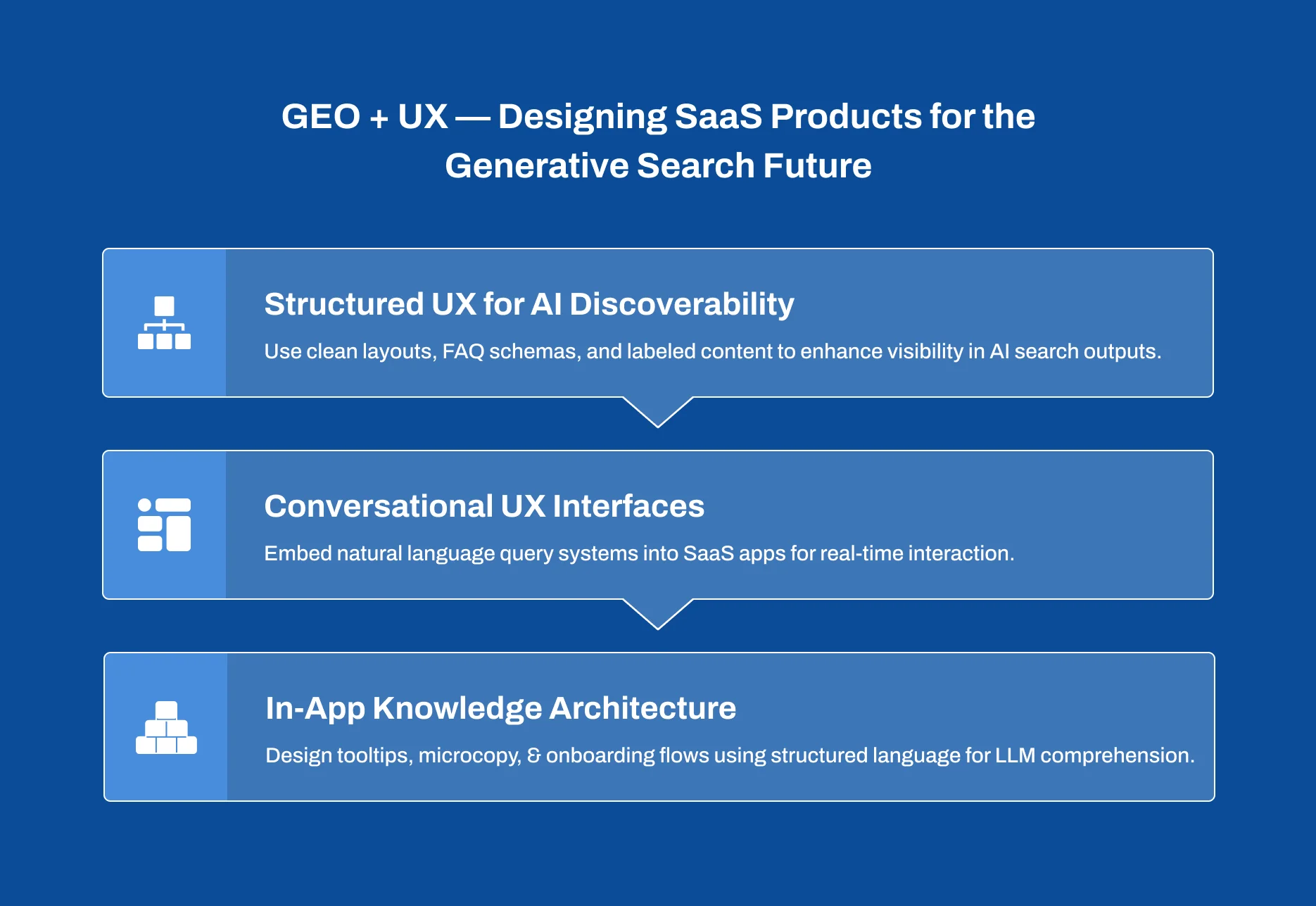
GEO + UX – Designing SaaS Products for the Generative Search Future Your UX is now part of your discoverability strategy.
Prepare your SaaS for the GEO era – where design meets discoverability.
The rise of AI-driven search (Generative Engine Optimisation or GEO) means your software’s design must contribute to your overall visibility and authority.
When a user asks a large language model (LLM) a question related to your industry (e.g., “What is the best way to process a B2B payment in the USA?”), the AI’s answer, or AI Overview, is highly likely to cite sources with strong E-E-A-T that are clearly structured and authoritative.
- UX Alignment with GEO: Your SaaS product itself is a repository of expertise. Ensure your interactive website development and in-app help documentation are structured with clear H-tags, definitional language, and schema-friendly formats (FAQ schema is essential).
- The Conversational Interface: Embed Gen AI within your product (e.g., an AI agent for data querying) and design the UX around natural language prompts. This prepares your product for the conversational future of software interaction, where users expect to talk to their application.
The New Role of the UX Leader: From Maker to Conductor
The New UX Leader – From Maker to Conductor Human intuition meets machine intelligence.
| Traditional UX Designer | AI-Driven UX Leader |
|---|---|
| Focus on creating wireframes & mockups | Focus on orchestrating human-AI design ecosystems |
| Works in silos | Collaborates across data, AI, and engineering teams |
| Measures efficiency | Measures intelligence, adaptability, and user impact |
| Refines pixels | Refines prompts and AI models |
Lead with vision, design with intelligence – the future of UX leadership starts now.
The promise of Gen AI in UX is not to eliminate designers, but to elevate them into more strategic, impactful roles:
- Focus on the Human: Designers shift from perfecting pixels to deeply understanding complex user problems (especially in regulated fields like FinTech & InsurTech) that require human empathy and judgment.
- Master the Prompt: The new skill is prompt engineering-learning how to provide AI with the right constraints, context, and user data to generate genuinely valuable outcomes.
- The Ethical Compass: As an AI-generated UI can unintentionally propagate bias, the designer becomes the ethical guardian, ensuring transparency and fairness in AI-driven experiences.
If you are a CTO looking at Digital Transformation, leveraging Generative AI in design is no longer a futuristic concept-it’s the core strategy for building intelligent, user-adaptive, and highly scalable SaaS products in the next decade.
Conclusion: The ROI of Intelligent Design
For enterprise leaders, investing in Gen AI-driven design is the path to building intelligent, user-adaptive, and highly scalable SaaS products in the next decade.