

As a CTO in the highly competitive SaaS landscape, you know this truth: data is your product. Whether you sell subscription commerce tools, FinTech platforms, or supply chain intelligence, the reliability, speed, and intelligence of your service are directly tied to your underlying data architecture.
The challenge for 2026 isn’t just migrating to the cloud; it’s unifying fragmented cloud data into a predictable, scalable asset that supports both millions of users and the rise of Generative AI. The solution is the Modern Data Stack (MDS), redesigned for hyperscalable SaaS Product Development and growth.
This is your guide to moving beyond the buzzwords and building a truly unified, cloud-native data backbone.
The Architecture Mandate: Why Legacy Stacks Can’t Scale SaaS
The Scalability Crisis – Why Legacy Stacks Break in Modern SaaS Why 2026 SaaS growth demands cloud-native data architecture.

Break the bottlenecks. Unify cloud data at scale.
Traditional SaaS data models often struggle under the weight of exponential user growth and feature development. The bottlenecks are predictable:
The Triad of Scalability Blockers
- Monolithic Databases: Relying on a single relational database for both transactional and analytical workloads creates latency and single points of failure, directly impacting customer experience.
- Brittle ETL Pipelines: Custom-scripted Extract, Transform, Load (ETL) jobs break frequently, especially with constant schema changes in core application data, leading to data downtime and frustrated Product Managers. This highlights the failing of traditional Data Engineering & ETL.
- Siloed Multi-Cloud Data: Whether you use AWS, Azure, or GCP, data frequently lives in separate environments for development, production, and analytics, making a unified customer view impossible.
The modern SaaS product requires a flexible, decoupled architecture that champions the ELT (Extract, Load, Transform) paradigm, prioritising loading data quickly into a central cloud-native reservoir for transformation at scale.
Phase 1: The Core Foundation – Cloud-Native ELT and the Data Lakehouse
The 2026 Modern Data Stack – The Cloud-Native Foundation A unified, elastic, AI-ready data backbone.

Invest in the stack built for speed, cost-efficiency, and scale.
The shift to ELT is the most fundamental architectural change in the MDS. It’s driven by the elasticity and cost-effectiveness of modern cloud compute.
The ROI of the Data Lakehouse
At the center of your 2026 stack should be the Data Lakehouse (e.g., Snowflake, Databricks, Google BigQuery). This architecture offers the best of both worlds:
- Data Lake Flexibility: Stores all data types (structured, unstructured, semi-structured) cheaply and scalably.
- Data Warehouse Structure: Provides ACID compliance and high-performance querying using standard SQL, making it immediately accessible for your BI tools.
For data ingestion, the choice is increasingly “buy” over “build.” Managed SaaS solutions for Data Engineering & ETL (like Fivetran or Airbyte) significantly reduce the development cost and the time-to-market for new data connectors, enabling your engineers to focus on product-specific features rather than pipeline maintenance.
Phase 2: Building Intelligence and Democratisation
Data as a Product – The Heart of the Modern Data Stack From raw data to reusable, governed, self-service assets.

Treat data like a product – not a project.
Once data is unified in the Data Lakehouse, the focus shifts to making it a usable asset for every part of your organisation.
Unlocking Data as a Product
The transformation layer is where raw cloud data becomes a reusable asset – a data product. Tools like dbt (data build tool) allow analysts and engineers to define, model, and test data transformations using modular SQL code, embracing engineering best practices (like version control and CI/CD).
- Self-Service Analytics: Instead of analysts waiting for an engineer to pull data, well-defined data products (e.g., core_customer_metrics) are published to a central layer, empowering teams across sales, marketing, and product to perform their own predictive analysis.
- Decoupled Development: The application database is free to focus on transactions, while the Data Lakehouse is used for reporting and generating insights. This is critical for Scalable SaaS Product Development.
Phase 3: The CTO’s Critical Path – Governance and GenAI Readiness (2026 Imperatives)
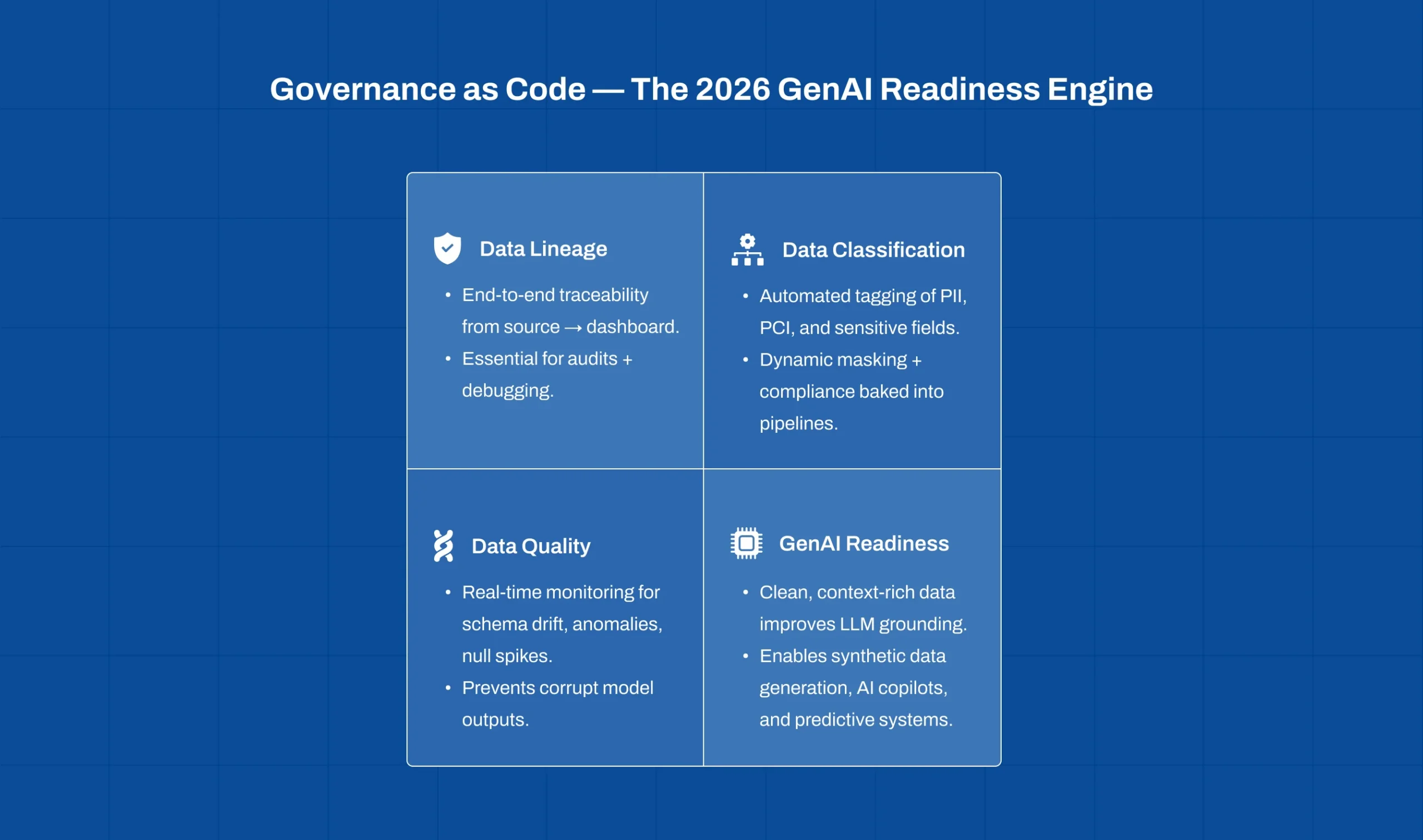
Governance as Code – The 2026 GenAI Readiness Engine Compliance, trust, and AI success depend on governed data.
If your data isn’t governed, your AI isn’t ready.
The final, and most crucial, step in 2026 is embedding Governance as Code to support AI and compliance without sacrificing speed.
Governance: The Non-Negotiable Layer
The composable nature of the MDS introduces tool sprawl and risk. The solution is an Active Metadata Management (AMM) layer that automatically governs the entire stack:
| Governance Function | AMM Capability | Strategic E-E-A-T Impact |
|---|---|---|
| Data Lineage | Automatically tracks data from source (API) to dashboard, providing a traceable audit trail. | Trustworthiness for regulators and internal teams. |
| Data Classification | Automatically tags sensitive data (PII, PCI) on ingestion and applies dynamic masking policies. | Compliance and risk mitigation, supported by proactive Security Testing. |
| Data Quality | Monitors pipelines in real-time, detecting schema drift or anomalous values before they corrupt models. | Expertise and reliability of product outputs. |
GenAI Readiness is Data Readiness
Generative AI and LLMs thrive on clean, context-rich data. Your MDS must serve this new intelligence layer.
- GenAI Copilots: By 2027, AI assistants are predicted to reduce manual data integration by 60%. Your modern data stack must be the single source of truth that grounds these AI & Machine Learning tools, preventing the infamous “hallucination.”
- Synthetic Data:The MDS facilitates the creation of high-quality synthetic data for training models, allowing you to innovate in areas like risk modeling without compromising real customer privacy.
Beyond the Debate: Making the Strategic Decision
The CTO Decision Matrix – Build Fast or Scale Smart?
Strategic clarity for a multi-cloud SaaS world.
If Speed > Cost → Buy
- Managed ingestion
- Managed transformations
- Rapid GTM
If Control > Speed → Build
- Custom pipelines
- Deep system control
- Specialized transformations
If Both Matter → Hybrid
- Buy ingestion
- Build transformations
- Govern everything centrally
Choose based on value, not hype.
For the CTO steering a scaling SaaS product, the decision is not if you need a Modern Data Stack 2026, but how fast you can implement it and ensure its reliability.
We leverage Strategy Consulting expertise to align your technical roadmap with business ROI, helping you navigate the complexity of multi-cloud environments and the build vs. buy decisions inherent in modern data architectures. Investing in a unified cloud data strategy now is the only way to ensure your SaaS product remains scalable, compliant, and intelligent through 2026 and beyond.