

The choice of a mobile development framework is one of the most critical technology decisions a business will make. It directly impacts your budget, time-to-market, and the end-user’s experience. This guide provides a strategic, in-depth comparison of the two leading cross-platform frameworks, Flutter and React Native, benchmarked against the gold standard of native iOS development with Swift. We’ll analyze the key differences to help you make an informed decision that aligns with your business goals.
An Introduction: The Strategic Choice Behind Your App
In today’s mobile-first world, an application is often the primary touchpoint between your brand and your customers. The technology you choose to build it with is therefore not just a technical detail, but a foundational business decision. The central debate for many businesses revolves around a key question: do we build separate native apps for iOS and Android, or do we use a cross-platform framework to build once and deploy everywhere? This guide will explore the two leading cross-platform contenders, Flutter and React Native, and compare them to the performance and quality of a native Swift application for iOS.
The Contenders: A Brief Overview
1. Flutter
Developed by Google, Flutter is a UI toolkit for building natively compiled applications for mobile, web, and desktop from a single codebase. It uses the Dart programming language and is known for its high performance and expressive, flexible UI.
2. React Native
Created by Facebook (Meta), React Native is a framework that allows developers to build mobile apps using JavaScript and React. Its primary value proposition is allowing web developers to leverage their existing skills to create mobile applications that use native UI components.
3. Swift (The Native Benchmark)
Developed by Apple, Swift is the modern, powerful, and intuitive programming language for building native applications across all Apple platforms, including iOS, iPadOS, and macOS. It offers the highest possible performance and the deepest integration with the device’s hardware and features. We use it here as the “gold standard” to measure the cross-platform frameworks against.
The Core Comparison: A Detailed Breakdown
Choosing the right framework requires a balanced analysis of their strengths and weaknesses across several key dimensions.
Performance
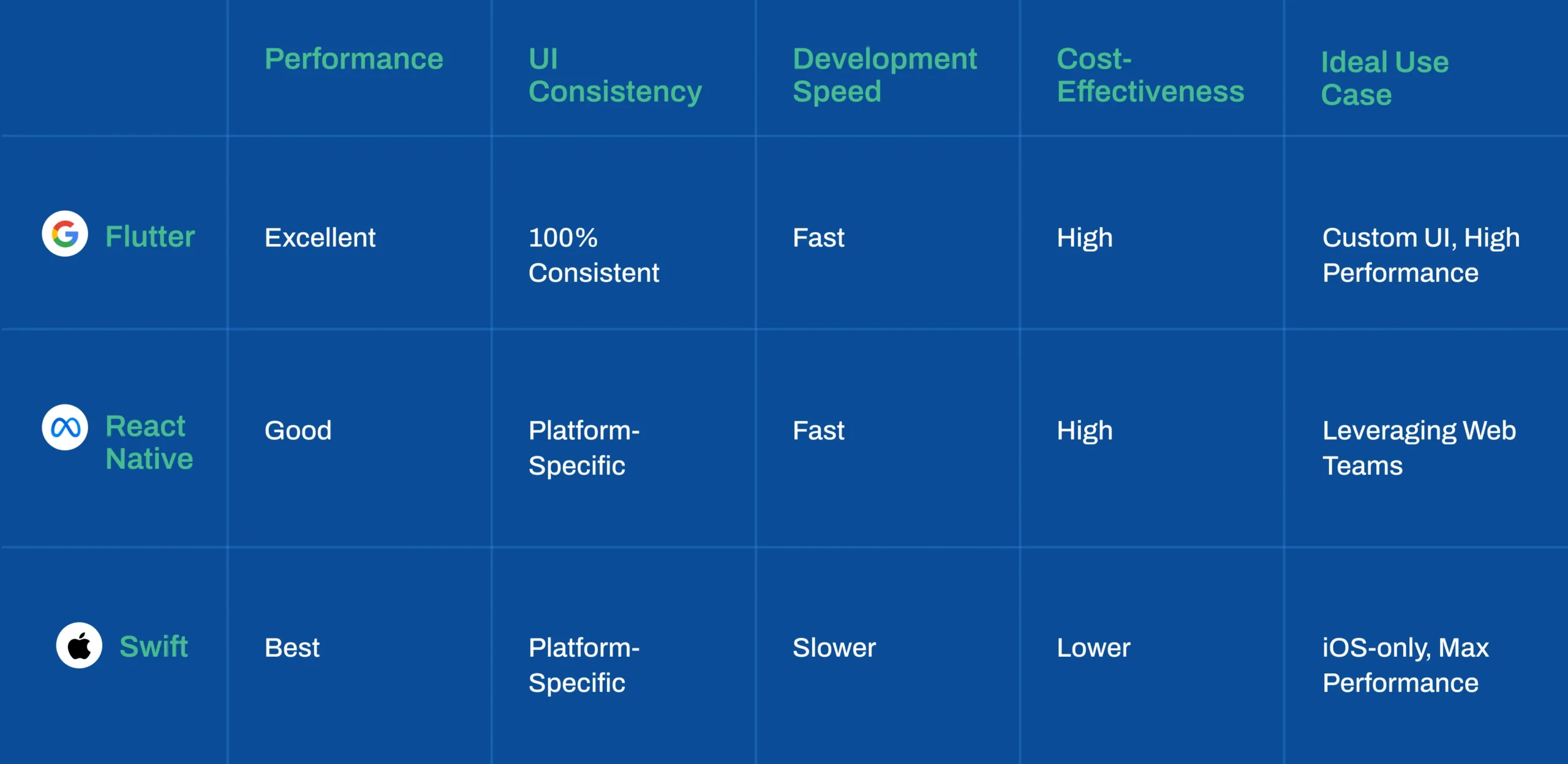
- Swift: As a native language, Swift offers the best possible performance with direct access to device hardware and zero layers of abstraction.
- Flutter: Compiles directly to native ARM code, resulting in superior performance that is very close to native, especially for complex animations and graphics.
- React Native: Uses a JavaScript bridge to communicate with native modules, which can sometimes create performance bottlenecks in highly complex applications.
User Interface (UI) & User Experience (UX)
- Swift: Provides direct access to the full suite of Apple’s UIKit and SwiftUI frameworks, offering the most authentic and feature-rich iOS user experience.
- Flutter: Uses its own extensive library of customizable widgets, giving developers complete creative control and ensuring a highly consistent look and feel across both iOS and Android.
- React Native: Uses actual native UI components, which allows the app to look and feel exactly like a native app by default, respecting platform conventions.
Development Speed & Cost
- Flutter & React Native: Both offer significant advantages by maintaining a single codebase for both iOS and Android, which dramatically reduces development time and overall cost.
- Swift: Requires a dedicated iOS development team (and a separate team for Android), making it the most resource-intensive option for multi-platform development.
The Verdict: When to Choose Which Framework
Choose Flutter When:
- Your app requires a highly customized, brand-centric user interface.
- High performance for complex animations and graphics is a top priority.
- You want to ensure a perfectly consistent look and feel on both iOS and Android.
Choose React Native When:
- You want to leverage the vast and expert developer ecosystem of JavaScript and React.
- You want your app’s UI to use the platform’s default native components for an authentic look and feel.
- Access to a massive ecosystem of third-party libraries and a large developer community is important.
Choose Swift (Native iOS) When:
- You are only targeting the Apple ecosystem (iPhone, iPad, Mac).
- Your app requires the absolute best performance, security, and the latest iOS features.
- Your app needs deep integration with device hardware like the camera, sensors, or ARKit.
Why Partner with DigiWagon for Your Mobile Strategy?
Making the right technology choice is complex. At DigiWagon, we act as your strategic partner for Mobile App Development, helping you navigate this decision. Our Mobile Application Development services are technology-agnostic.
- An Expert Recommendation: We recommend the framework based on your specific business goals, not just what’s trending.
- Custom Builds: We don’t follow a one-size-fits-all model. Every app is mapped to your unique business logic and user needs.
- A Focus on World-Class UI/UX: Regardless of the framework, our UI/UX Design team ensures your app is intuitive, engaging, and delivers a world-class user experience.
- Future-Proof Architecture: We architect mobile applications that are scalable, maintainable, and ready to grow with your business.
Conclusion: The Right Tool for the Right Job
There is no single “best” framework. The debate between Flutter, React Native, and Swift is not about picking a winner, but about understanding the trade-offs. The right choice is the one that best serves your unique business strategy, user expectations, and long-term vision.
Ready to build a mobile application that delivers real business results?
Contact us for a complimentary mobile strategy session. Let’s discuss your vision and determine the perfect technology to bring it to life.