Healthcare Software Development Company for Clinical and Compliance Workflows
Clinical software built for the compliance officer.
DigiWagon designs and builds patient, clinical and operational software for hospitals, clinics, digital-health and MedTech companies in the United States, the United Kingdom and India. Every platform is engineered for the privacy officer’s questions as carefully as the clinician’s.
Pick the situation closest to yours. We’ll show what we would build for it, where it sits in the healthcare services below, and which regulation shapes it.
Pick what your platform has to prove
What it has to prove
A Patient Journey That Has to Work on a Phone and Pass an Audit
Patients expect appointments, results, treatment plans and messages on their phone; the privacy officer expects consent, access logs and minimum-necessary data behind every screen.
What we would build
What you could end up with
A patient app and clinician console on one clinical record
Consent, access and audit logs written as the journey runs
Reports and plans a patient can reach without a phone call
What it works with
Your EHR, practice management and scheduling systems
Identity, messaging and payment providers
The consent and retention rules of each market you serve
Labs, imaging, devices, the EHR and a dozen departmental tools each hold part of the patient, and the information-blocking rules now expect the whole record to move on request.
What we would build
What you could end up with
FHIR APIs over the systems you already run
HL7 v2, DICOM and device feeds normalized into one record
An integration layer documented for the auditor and the next vendor
The hospital information system still runs admissions and billing, but every change takes a quarter, the vendor is gone, and the security assessment found what it found.
What we would build
What you could end up with
An API layer that lets new products ship without touching the core
A migration sequence that never takes the ward offline
Modules retired one at a time, each with a rollback
Imaging, Reports and Notes Nobody Has Time to Read
Scans queue for review, reports arrive faster than clinicians can read them, and any model that helps has to explain itself to the clinician and to the regulator.
What we would build
What you could end up with
Triage and detection models with documented performance and limits
Explanations a clinician can check against the image or the note
Monitoring that shows drift before it reaches a patient
What it works with
PACS, DICOM archives and reporting systems
Your clinical governance and validation process
The device-software rules that apply where the model influences care
Healthcare software development services for providers, digital-health and MedTech companies, from HIPAA compliant software development to medical software development for connected devices: the platforms, integrations and models below, each linked to the DigiWagon practice that builds it.
01
Digital Health Product Strategy & Discovery
A digital-health product is a regulated thing before it is a feature list: whether it is a medical device under FDA or MDR rules, which data it holds and under which law, which systems it must exchange records with, and what the clinician will actually do differently. Discovery settles those with you before a roadmap exists, then scopes a first release whose consent model, audit trail and integration surface will survive the security assessment and the second market. It is the difference between a healthcare software development company and a vendor that builds screens for clinicians to work around.
Regulatory classification (SaMD or not)Data and consent model designInteroperability scopeMVP definition with compliance costed
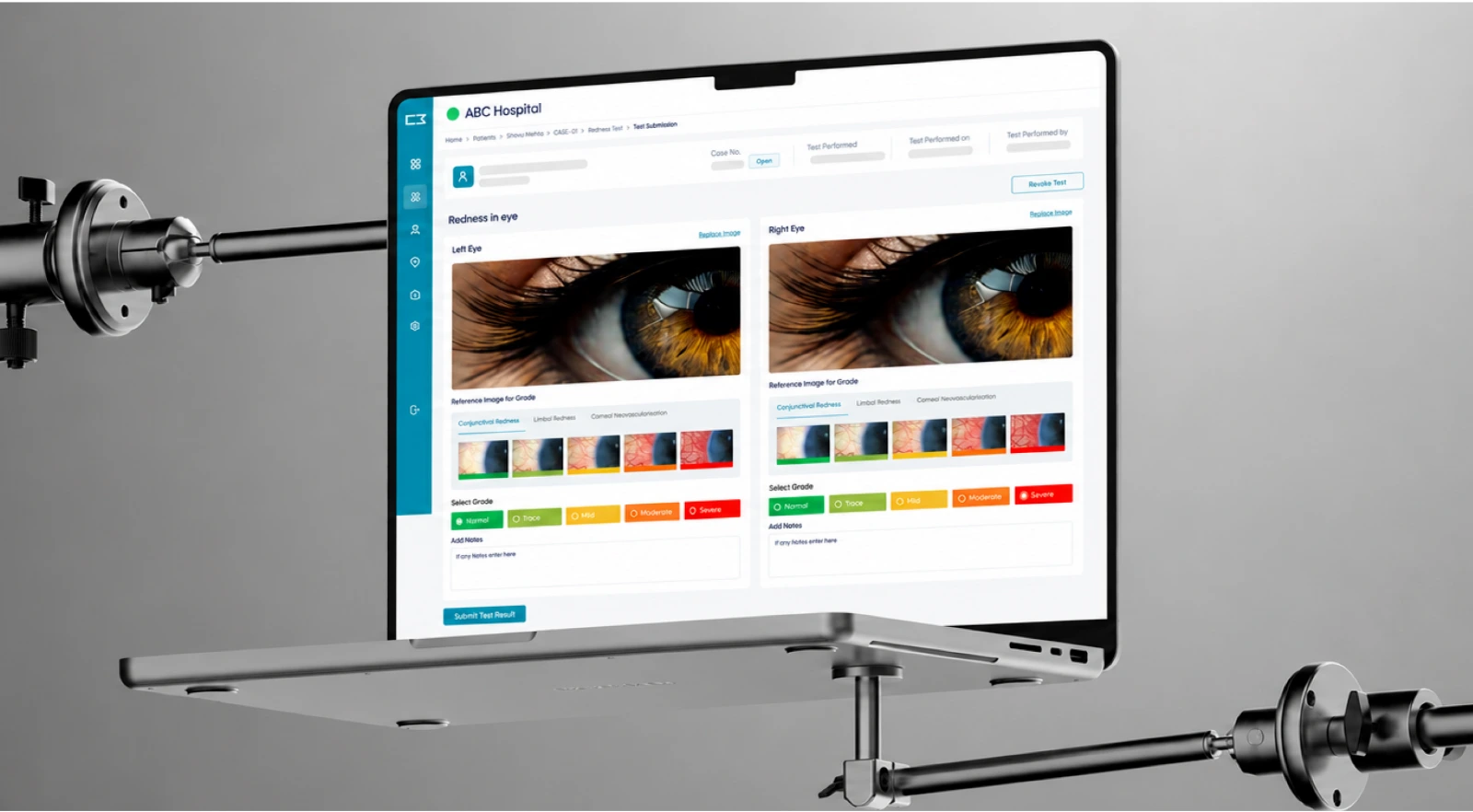
Appointments, results, treatment plans, reminders and secure messaging on the patient’s phone, running on the same clinical record the care team uses. For an eye-care MedTech company we built a mobile-first clinical companion — patient app, clinician console and treatment-plan workflow — that made patient report access 40% faster and the patient journey 35% smoother. Consent, minimum-necessary data and access logging are designed into every screen, accessibility is built to WCAG 2.2 AA because patients are not a uniform audience, and the app is engineered in Flutter or native code depending on how much of the device the care model needs.
Patient portals and mobile appsTelehealth and remote monitoringTreatment plans and remindersConsent and access logging
Scheduling, intake, clinical documentation, orders, referrals, billing and reporting built around how a clinic or a hospital department actually works, rather than around a vendor’s module list. The clinician console we built for eye-care clinics digitized treatment planning and reporting so that clinicians and administrators worked from one record instead of paper and spreadsheets. Role-based access, maker-checker on sensitive actions and an audit trail on every clinical and administrative event are the architecture, not add-ons, and the same record feeds the patient app, the analytics layer and the interfaces to the systems around it.
Clinical documentation and ordersScheduling, intake and referralsPractice and department administrationRole-based access and audit trails
EHRs, laboratory and radiology systems, PACS, devices, payers and national exchanges each speak their own standard and fail in their own way. We build the integration layer that makes them one record: HL7 FHIR R4 APIs over the systems you already run, HL7 v2 and DICOM feeds normalized and validated, device and remote-monitoring data ingested with provenance, and the information-blocking obligations of the Cures Act treated as API design requirements rather than a policy. Every interface is certified in a test environment before it carries patient data and documented for the auditor and for the next vendor.
HL7 FHIR R4 APIsHL7 v2 and DICOM integrationDevice and remote-monitoring feedsPayer and registry connectivity
Detection and triage models for images, risk scores from clinical and operational data, and assistants that find the right document in a compliance archive, built to be explained to a clinician and to a regulator. Where a model influences care it is treated as software as a medical device: documented intended use, performance and limits, clinical validation the governance committee can read, and monitoring that shows drift before it reaches a patient. The retrieval platform we built for a global consumer-goods company’s R&D and compliance teams made information retrieval 70% faster and cut manual knowledge discovery by 60%; the same architecture serves a clinical research library.
Medical image analysis modelsClinical risk scoringKnowledge retrieval for clinical and compliance teamsModel documentation and monitoring
Outcomes, utilization, capacity and quality measures depend on patient, encounter and cost data that reconciles across systems and can be traced back to source. We build the pipelines, warehouses and dashboards that give clinical, operations and finance teams one version of the numbers, with lineage a regulator or an accreditor can follow from a reported measure to the encounter behind it. De-identification and consent are designed into the data layer, so research and analytics run on the minimum data they need, and the same governance we applied to compliance data platforms — where duplicate records fell by 40% — applies to master patient and provider data.
Clinical and operational data pipelinesQuality and outcomes reportingDe-identification and consent-aware dataMaster patient and provider data
Scheduling, eligibility checks, prior authorization, coding support, claims follow-up and patient communication are rule-bound, exception-heavy workflows that consume staff time and generate denials when they slip. We automate the rule-bound parts and route the exceptions to people, with every action logged. On a compliance data platform, automating ingestion, validation and format standardization removed 60% of the manual spreadsheet work; the same design principle applies to a revenue cycle: the automation produces the audit evidence as a by-product of doing the work, so the payer audit is a query rather than a project.
Scheduling and reminder automationEligibility and prior authorizationClaims and denial workflowsException routing with audit logs
Hospital information systems, departmental applications and practice software age badly: interfaces nobody documents, batch jobs that run overnight while care runs around the clock, and a security assessment that found what it found. We modernize without a rewrite the ward would notice: an API layer first, so patient apps and new modules ship against the old core; then modules re-platformed one at a time, each run in parallel and reconciled before the old path is retired. Data migrations are proven against the source record before cutover, and the change-control evidence your compliance team expects is produced by the process itself.
Clinical core API enablementModule-by-module re-platformingParallel-run data migrationChange control and evidence
A clinician has seconds between patients and a patient may be anxious, elderly or reading in a second language; interfaces that hide the next step cost both of them and the organization its adoption rate. We design clinical consoles and patient journeys in which the record, the plan and the consent are legible on the screen, measured against real task times rather than opinions, and built to WCAG 2.2 AA from the first wireframe. Redesigning an enterprise compliance platform this way made onboarding 35% smoother and cut training burden by 30%; the eye-care companion app’s 35% smoother patient journey came from the same method applied to patients.
Clinician console designPatient journey and onboarding UXWCAG 2.2 AA accessibilityDesign systems for regulated products
The HIPAA Security Rule, the NHS Data Security and Protection Toolkit and India’s DPDP Act all ask for controls with evidence behind them. We build the cloud estate and delivery pipeline so the controls are structural: PHI scope kept narrow by design, encryption and key management, access by role with break-glass logging, segregated environments, signed releases, immutable audit logs and business-associate obligations mapped to the components that carry them. Where a market requires patient data to stay in-country, the architecture keeps it there. The evidence for SOC 2, ISO 27001 and HITRUST assessments is generated as the platform runs, not assembled before the assessor arrives.
PHI scope and BAA mappingSecure CI/CD and change controlData residency by marketAudit-ready logging and evidence
The building blocks behind the platforms above, grouped the way a clinical product team scopes them. Pick a group to see what we have built inside it.
01 / 05
Patient Experience & Engagement
01Patient portals and mobile apps
02Telehealth and virtual visits
03Remote patient monitoring
04Treatment plans, reminders and messaging
05Patient intake and consent
06Accessible, multilingual journeys
02 / 05
Clinical & Practice Operations
01Clinical documentation and orders
02Scheduling, referrals and intake
03Hospital and department information systems
04Practice management and billing
05Pharmacy and e-prescribing workflows
06Role-based access and audit trails
03 / 05
Interoperability & Integration
01HL7 FHIR R4 APIs
02HL7 v2 and CDA document exchange
03DICOM, PACS and imaging integration
04Laboratory and device feeds
05Payer, registry and exchange connectivity
06Information-blocking-compliant record access
04 / 05
Clinical Intelligence
01Medical image analysis models
02Clinical risk and deterioration scoring
03Knowledge retrieval and clinical assistants
04Quality and outcomes analytics
05De-identified research datasets
06Model documentation and monitoring
05 / 05
Compliance, Security & Consent
01PHI scope and BAA mapping
02Consent and minimum-necessary data
03Encryption, access and break-glass logging
04Data residency by market
05SaMD and device-software controls
06Evidence generation for HIPAA, SOC 2 and ISO 27001
Who we build for
Healthcare Segments We Serve
Five kinds of organization, each answerable to a different regulator and accreditor. The clinical-record, consent and interoperability patterns transfer between them; the obligations do not.
Hospitals & Health Systems
Departments, wards and administration running on a clinical core that cannot pause, under HIPAA, the NHS toolkit or state health authorities. We modernize through APIs and parallel runs, integrate the systems around the core through FHIR and HL7, and build the patient and clinician surfaces on the record that results.
Clinics & Specialty Care Networks
Specialty practices whose workflows no general EHR fits. For an eye-care network we built the clinician console, treatment-plan workflow and patient companion app as one platform, making patient report access 40% faster and the patient journey 35% smoother.
Digital Health & HealthTech Companies
Product companies whose platform is examined through their customers’ audits. Multi-tenant architecture, per-market consent and residency, FHIR-first integration and evidence packs each customer’s compliance team can hand to an assessor.
Medical Device & MedTech Companies
Companion apps, clinician portals and cloud services around a device, where the software may itself be a medical device. Intended use, validation and change control are designed under IEC 62304 and the FDA and MDR rules that apply, so the software release does not surprise the regulatory file.
Pharma, Biotech & Life Sciences
Research, compliance and quality teams with knowledge spread across millions of documents and records that must stay traceable. Retrieval platforms, data pipelines and audit-ready workflows built for Part 11 expectations, as the R&D knowledge assistant we built for a global consumer-goods company was.
Compliance by design
Compliance Is Architecture
Healthcare software is examined by the privacy regulator, the accreditor and, where it influences care, the device regulator. We treat each framework as a set of design constraints: what data is protected, who may see it and when, what must be exchanged on request, and what evidence the system produces on its own. Every framework below binds at least one of the services above, because that is where it is implemented.
01
HIPAA Privacy and Security Rules, HITECH Act (2009) and the Omnibus Rule (2013)
Protected health information: minimum-necessary use, access controls, audit logging, breach notification and business-associate obligations for every component that touches PHI.
21st Century Cures Act — ONC Final Rule on information blocking (2020)
Patient and provider access to electronic health information through standardized FHIR APIs; the reason interoperability is an API design requirement here, not a policy.
The exchange and coding standards a clinical record moves in; every interface is validated against them before it carries patient data.
InteroperabilityClinical systemsData platforms
04
FDA Software as a Medical Device guidance, 21 CFR Part 11 and IEC 62304 (2006, A1:2015)
Intended use, software life-cycle controls, validation and electronic-record integrity where software influences diagnosis or treatment, or holds regulated records.
Device classification, technical documentation and quality management for medical-device software sold in Europe and the UK.
MedTech platformsProduct strategy
06
NHS Data Security and Protection Toolkit and DTAC (2021)
The security, clinical-safety, interoperability and accessibility criteria a digital health product meets to be used in the NHS.
Security engineeringPatient platformsUX and accessibility
07
India’s DPDP Act 2023, Ayushman Bharat Digital Mission (2021) and the MoHFW EHR Standards (2016)
Consent-based personal data processing, ABHA-linked health records and the interoperability standards for digital health in India.
InteroperabilityPatient platformsData platforms
08
GDPR and UK GDPR, Article 9 special-category health data
Lawful basis, explicit consent, data-protection impact assessments and subject rights for health data in Europe and the UK.
Patient platformsData platforms
09
WCAG 2.2 AA (2023) and Section 508
Accessibility for patient-facing and clinician-facing software, designed in from the first wireframe rather than audited in afterwards.
UX and accessibilityPatient platforms
10
ISO/IEC 27001:2022, SOC 2 Type II and HITRUST CSF
Information security management and evidenced controls. DigiWagon holds ISO/IEC 27001 and ISO 9001 certification; the platform’s pipeline generates the evidence for the other assessments as it runs.
Every engagement
Certification is a claim we make only about ourselves. For everything else on this list, the platform is built for the framework and the evidence is produced with the code.
Healthcare
Healthcare in practice
A clinical companion for eye-care clinics.
Challenge
A HIPAA-compliant platform designed to help patients manage Dry Eye Disease while keeping clinics connected beyond visits. With guided diagnostics, secure patient-clinic linking, and cross-platform support, it boosts adherence, streamlines workflows, and scales across eye care practices.
What DigiWagon built
DigiWagon built a secure and scalable MedTech platform that supports doctor workflows, clinic operations, clinical documentation, and patient engagement.
Healthcare software development starts from the record and the regulator, not the feature list: which data the product holds and under which law, whether the software influences care, what the clinician does differently and what the assessor will ask to see. Everything else is sequenced from there.
01
Discover the Record and the Regulator
Map the data classes, the markets’ privacy laws, the device-software rules that may apply and the systems the product must exchange records with, before scope is fixed, so compliance cost is in the plan and not a finding at the security assessment.
Focus
Data classesClassificationInterfacesConsent
02
Design for Evidence
Consent capture, access and audit logging, minimum-necessary data, clinical validation records and change control are designed as features, because the cheapest time to produce the assessor’s evidence is while the system does the work.
Focus
Audit logsConsentValidationAccess control
03
Build in Controlled Increments
Releases move through segregated environments with signed artifacts, every interface is certified against FHIR, HL7 or DICOM test systems before it carries patient data, and synthetic patients stand in for real ones until go-live.
Focus
Secure CI/CDCertificationSynthetic dataChange control
04
Run Under the Assessor’s Eye
Access patterns, interface failures, model drift and control exceptions are watched in production, with incident, breach-assessment and change records kept in the form the privacy officer and the accreditor expect to read.
Focus
ObservabilityAccess reviewDriftEvidence
Discover01 Discover the Record and the RegulatorDesign02 Design for EvidenceBuild03 Build in Controlled IncrementsRun04 Run Under the Assessor’s Eye
FAQ
Frequently Asked Questions About Healthcare Software Development
Direct answers on how HIPAA and the NHS toolkit shape a build, how FHIR and legacy systems are connected, where AI belongs in clinical software, who owns the code, and how a legacy clinical system is modernized without going dark.
01How do you build HIPAA compliant software, and what does that cover?
HIPAA is handled as architecture before the first sprint. PHI scope is kept as narrow as the product allows; access is by role with every read and write logged; data is encrypted in transit and at rest with managed keys; business-associate obligations map to the components carrying PHI; and breach-assessment and change records come from the pipeline. The same controls satisfy the NHS toolkit and India’s DPDP Act.
02How do you connect a new product to existing EHRs, labs and imaging systems?
Through an integration layer built on the standards those systems already speak: HL7 FHIR R4 APIs for record access, HL7 v2 for admissions, orders and results, DICOM for imaging, and validated device feeds for monitoring data. Each interface is certified against a test system before it carries patient data and documented for the auditor and the next vendor, and the Cures Act’s information-blocking rules are treated as design requirements.
03Where does AI belong in clinical software, and how is it kept safe?
In triage, detection, risk scoring and knowledge retrieval, never as an unexplained decision. Where a model influences care it is treated as software as a medical device: documented intended use, performance and limits, clinical validation the governance committee can read, explanations a clinician can check against the image or note, and drift monitoring in production. Retrieval assistants make records and evidence findable without deciding anything themselves.
04Can you modernize a legacy hospital or practice system without taking it offline?
Yes. We put an API layer in front of the clinical core, so patient apps and new modules ship against it, then re-platform modules one at a time with a parallel run and reconciliation before each old path is retired. Data migrations are proven against the source record before cutover, and the change-control evidence your compliance team expects is produced by the process, and the ward never sees a gap.
05Who owns the source code and intellectual property, and what happens after launch?
You do, and the agreement says so before work starts. Code and documentation are handed over through your repositories at each release, not at the end. After launch we stay for monitoring, security patching, compliance updates as regulations change, and the feature work that follows real usage, on terms that fit your team’s capacity, from a managed service to occasional support.
Build the Clinical Platform Your Auditor Can Read
Tell us what the product has to prove and which systems it has to talk to. We will map the regulatory boundary, the interfaces and the first release, and show you the clinical companion we shipped before anything is scoped.
One click opens the assistant you already use with a question that points it at this page, so the answer comes from what we publish, not a guess.
The question it opens withRead https://digiwagon.com/healthcare-software-development. Outline how DigiWagon approaches Healthcare engineering and compliance, then tell me what a Healthcare CTO should verify before choosing them or any similar partner. Stick to what the page says and mark anything you are not sure about.