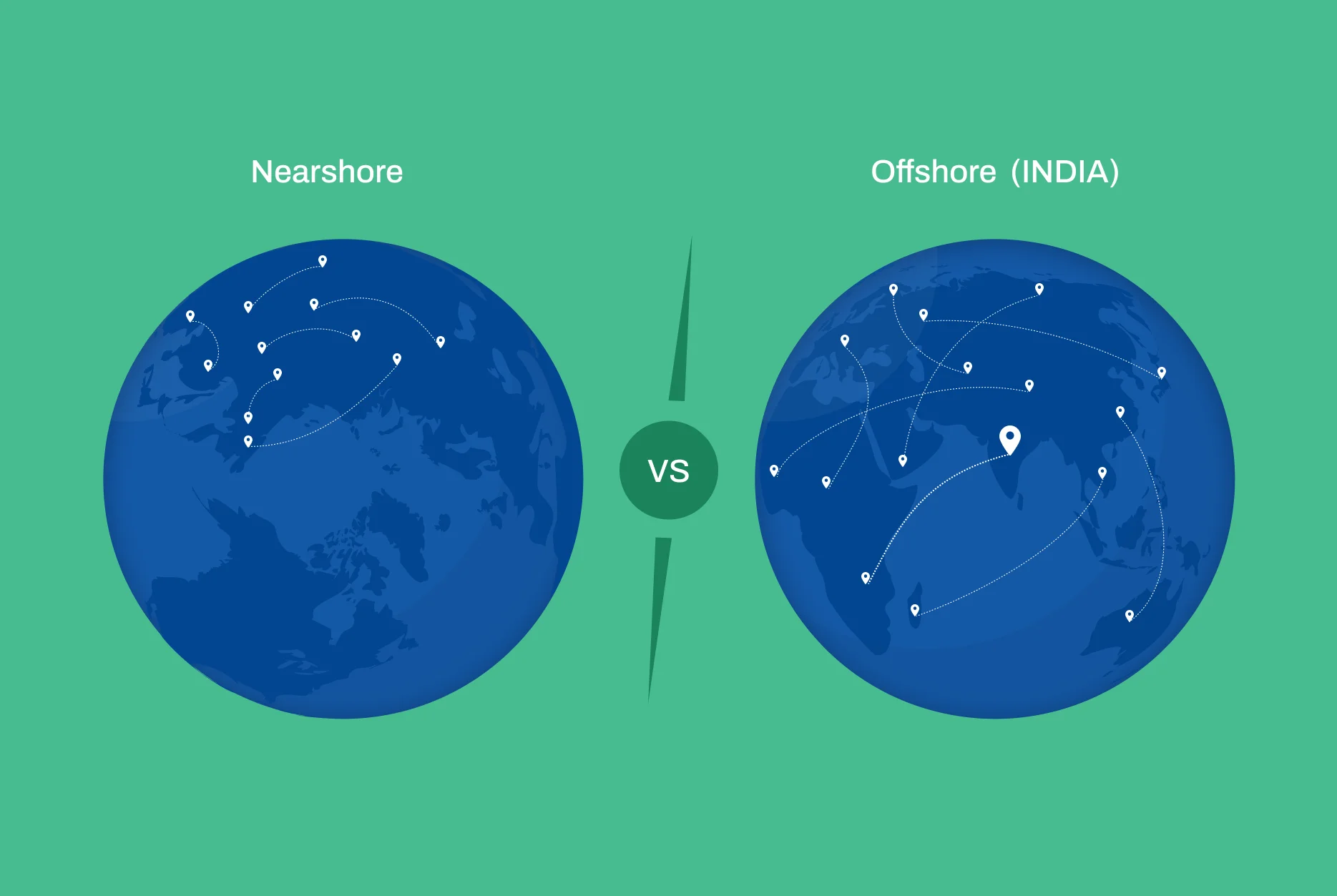
To every CTO, Product Head, and Founder racing the clock in Silicon Valley, London, or Toronto: the question isn’t if you should outsource your next SaaS Product Development cycle, but where.
You’re past the early-stage questions. You need to know the true trade-offs between cost and velocity. The choice largely boils down to two established models, each with distinct advantages for a SaaS business:
- Offshore (India): The powerhouse of scale, expertise, and ultimate cost optimisation.
- Nearshore (LATAM for US, Eastern Europe for UK): The strategic choice for time zone alignment and seamless, real-time collaboration.
Navigating this choice in 2025 requires a deep understanding of not just the developer’s hourly rate, but the total cost of ownership (TCO), factoring in communication overhead, risk, and compliance.
The Great Divide: Definitions for a Strategic Decision
The Global SaaS Outsourcing Spectrum – India vs. Nearshore Regions Two models, one goal – efficient, compliant, scalable product delivery.
| Parameter | Offshore (India) | Nearshore (LATAM / Eastern Europe) |
|---|---|---|
| Time Zone | 5-10.5 hours ahead | 1-4 hours overlap |
| Talent Pool | Largest in the world; rapid team scaling | Strong mid-tier niche experts |
| Cost per Hour | $30-50 (avg. mid-level) | $40-75 (avg. mid-level) |
| Project Fit | Well-defined scope, scalable maintenance | High-collaboration Agile projects |
| Communication Model | Asynchronous + follow-the-sun | Synchronous + real-time meetings |
Defining Offshore (India) and Nearshore (LATAM/Europe)
- Offshore (India 🇮🇳): Typically 5.5 to 10.5 hours ahead of the UK/US East Coast, offering the largest talent pool and maximum cost savings. Its model excels at asynchronous development and 24/7 coverage.
- Nearshore (LATAM 🇨🇦/🇲🇽/🇧🇷; Eastern Europe 🇵🇱/🇷🇴): Generally within 1-4 hours of the client’s working day. This model is prised for time zone synchronisation, enabling real-time meetings and rapid feedback loops ideal for Agile methodology.
Battleground 1: Cost, Capacity, and Financial Efficiency
Beyond Hourly Rates – The Total Cost of Ownership (TCO) Equation It’s not about who’s cheaper – it’s about who’s faster, safer, and smarter.
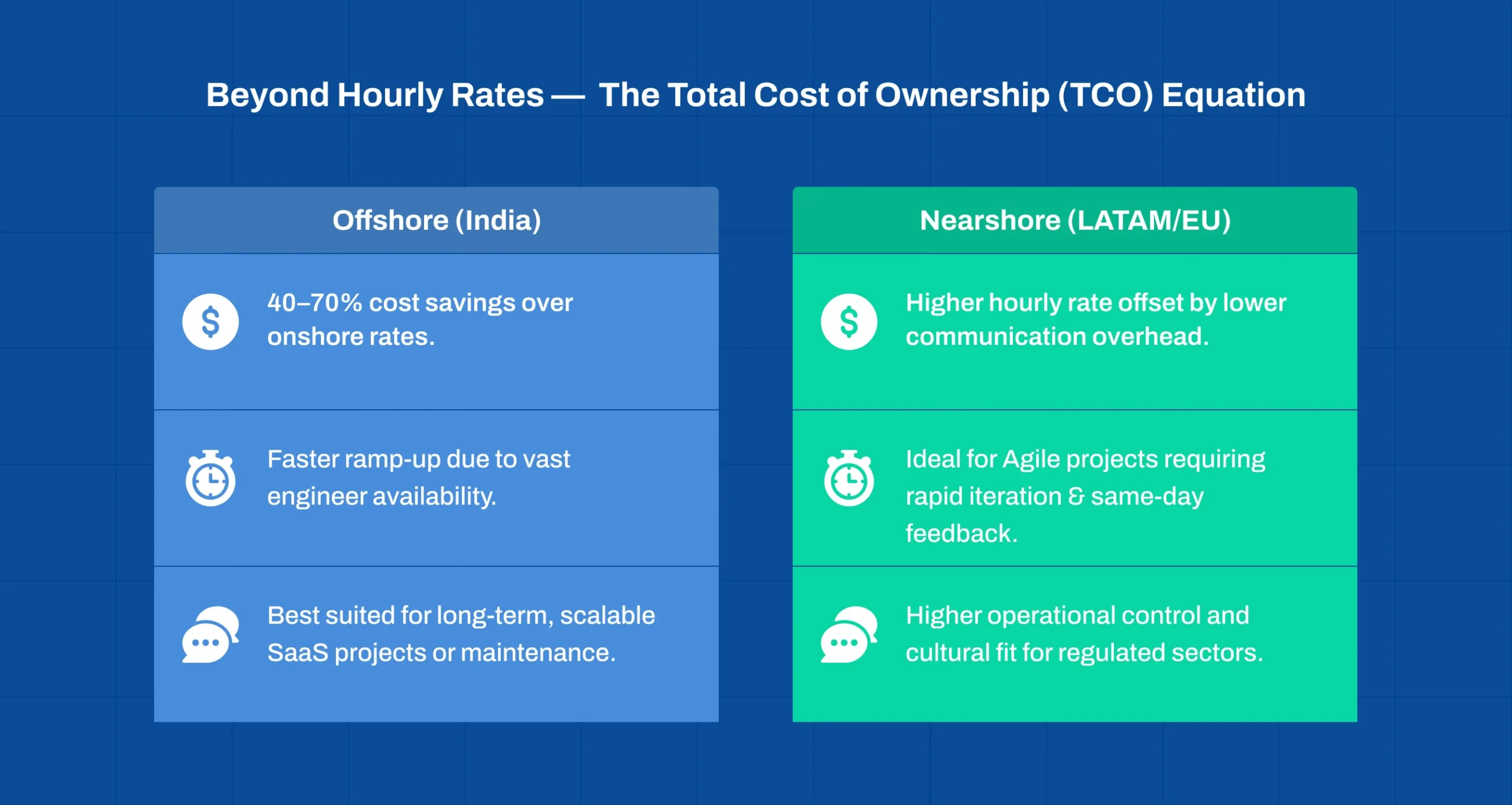
The financial discussion must move beyond the sticker price to consider the all-in cost of a reliable, secure, and expert team.
India’s Unbeatable Price Advantage (The Anchor)
India remains the global anchor for cost-effective SaaS software development, with average mid-level developer rates typically ranging from $30 to $50 per hour. This often translates to a 40-70% reduction in labor costs compared to US/UK onshore talent.
- The Scale Factor: India’s vast talent pool allows for unparalleled team formation speed and the ability to scale up or down a dedicated development team with minimal friction-crucial for venture-backed startups needing fast runway extension.
Nearshore: The Hidden Price of Synchronous Collaboration
Nearshore rates are often higher-ranging from $40 to $75 per hour-as clients willingly pay a premium for shared working hours.
- The TCO Twist: While the hourly rate is higher than India’s, the Total Cost of Ownership (TCO) can sometimes be lower for complex, ambiguous projects. This is because shared time zones drastically reduce communication overhead and time lost waiting for feedback, preventing costly rework.
Battleground 2: Time Zone, Communication, and Project Velocity
Velocity by Design – Leveraging Time Zones for SaaS Delivery Every hour can be a productive hour.
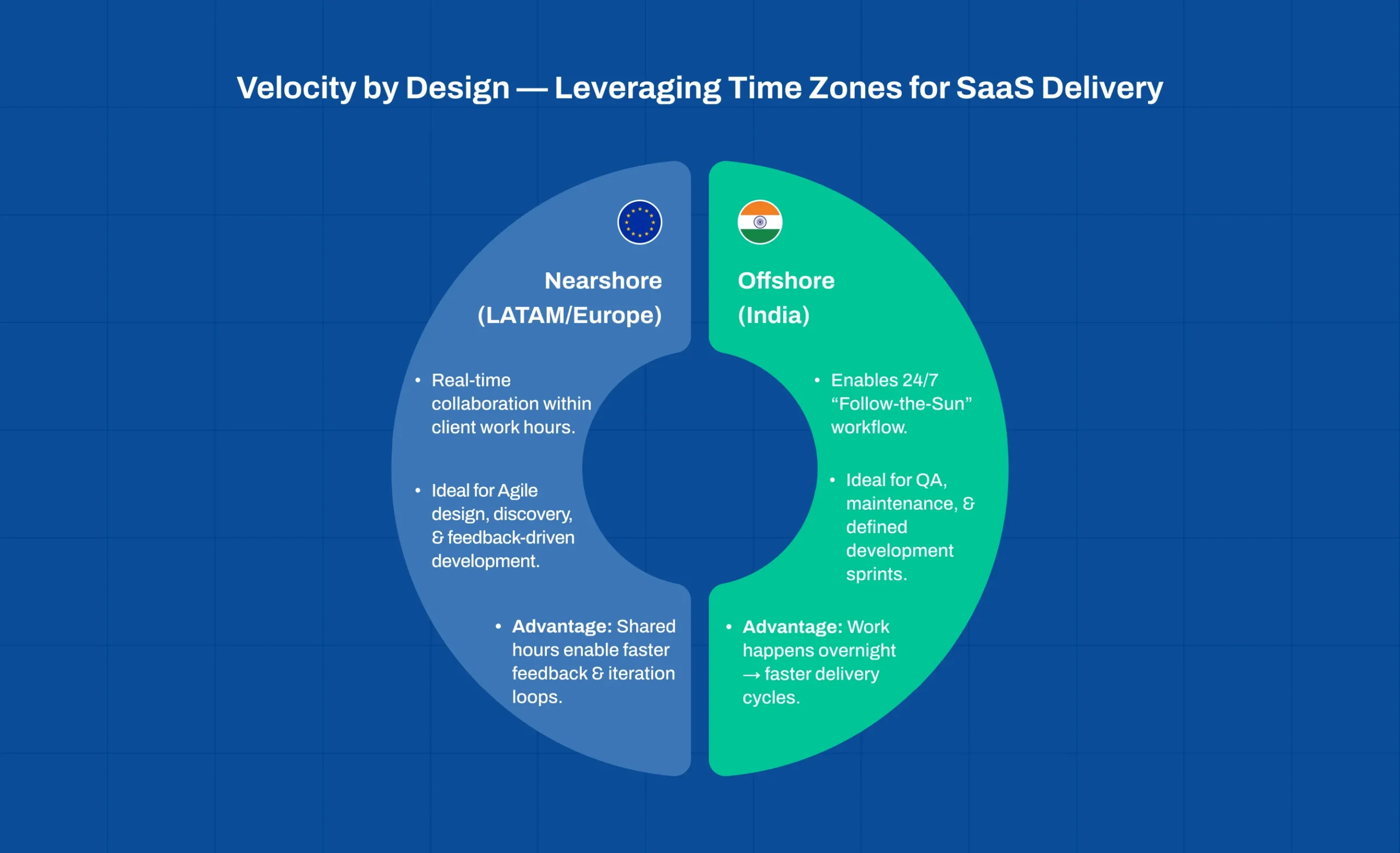
For an Agile-driven SaaS project, communication is the primary predictor of velocity.
The Nearshore Advantage: Real-Time Agile and Velocity
The core value of nearshoring is synchronous work. For US CTOs outsourcing to LATAM (e.g., Mexico) or UK CTOs outsourcing to Central Europe (e.g., Poland), daily stand-ups, impromptu screen-shares, and urgent bug fixes happen in real-time.
- Ideal for: Projects with evolving requirements, complex UI/UX Design & Engineering feedback loops, or those needing tight collaboration with your in-house Strategy Consulting team.
The Offshore Opportunity: 24/7 Development and Asynchronous Mastery
India’s time zone difference, while challenging, can be transformed into an advantage: Follow-the-Sun Development.
- Ideal for: Maintenance, Quality Assurance & Testing cycles, or clearly defined projects (like Data & Analytics pipeline implementation). Your in-house team sets the plan, and the offshore team executes it while you sleep, delivering progress by the start of your next day. This demands excellent documentation and a high degree of process maturity.
Battleground 3: Quality, Talent Pool, and Niche Expertise
Talent Depth and Quality Landscape – India vs. Nearshore Global expertise meets regional excellence.
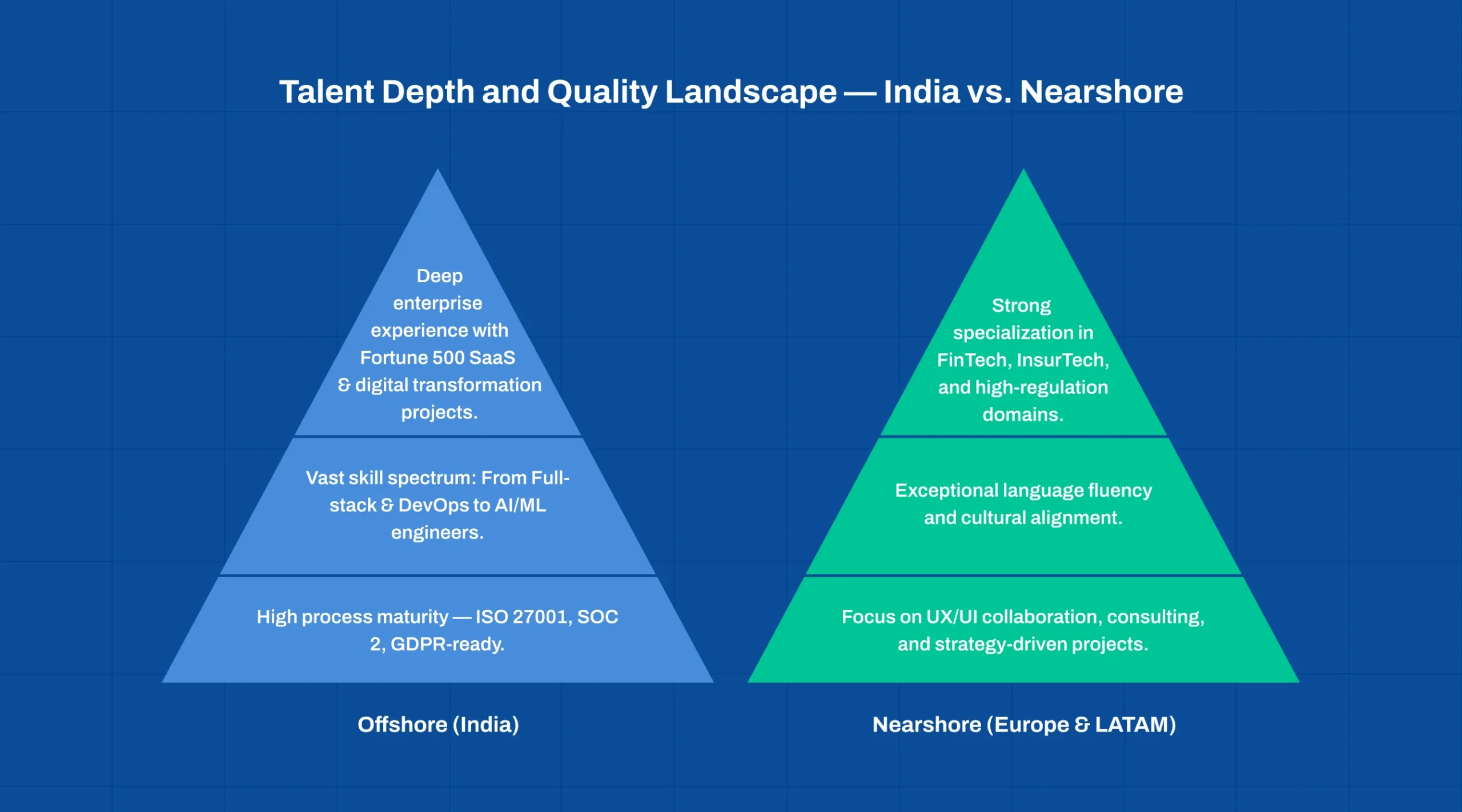
The myth that quality correlates to geography is outdated. High-quality talent exists in both major hubs; the difference is in the type of scale and experience.
India: Unmatched Scale and Enterprise Experience
India has a decades-long history of working with the world’s largest enterprises, leading to a massive, battle-tested talent pool proficient in foundational technologies like Java, Python, and cloud services (AWS, Azure, GCP).
- Niche Strength: Unparalleled capacity to staff large teams for Digital Transformation and long-term Enterprise Software engagements, including specialised skills like Generative AI & LLM Solutions engineers.
- Mitigating Risk: Due diligence must focus on the vendor’s Intellectual Property (IP) protection clauses and their SOC 2/ISO 27001 certifications to ensure secure SaaS development practices.
Nearshore: Cultural Fit and Geographic Specialisation
Nearshore teams often offer high English proficiency and a closer cultural fit with US/UK business norms, reducing the soft cost of miscommunication.
- Niche Strength: Strong regional specialisation, such as FinTech & InsurTech expertise in parts of Eastern Europe (GDPR compliance familiarity) or a growing focus on Mobile App Development across Latin America.
Making the Strategic Choice: When to Choose Which Model
The SaaS Outsourcing Decision Matrix – Offshore or Nearshore?
No one-size-fits-all – match model to mission.
| Priority | Recommended Model | Why It Works |
|---|---|---|
| Cost Optimisation + Scale | Offshore (India) | Vast talent pool, ideal for large-scale builds and maintenance. |
| Collaboration + Ambiguity | Nearshore (Europe/LATAM) | Shared time zones for Agile sprints and design-led iteration |
| AI/ML Development + Fixed Budget | Offshore (India) | Lower rates enable investment in high-skill AI engineers. |
| Compliance-Driven Projects | Nearshore (Europe) | Regulatory alignment and audit-ready collaboration. |
| Project Priority | Best Fit | Why |
|---|---|---|
| Max Cost Savings / Long-Term Scale | Offshore (India) | Lowest hourly rates; vast talent pool; suitable for long-term Maintenance and Support and clear project scope. |
| High Collaboration / Ambiguous Scope | Nearshore (LATAM/Europe) | Shared working hours for real-time Agile sprints, discovery, and fast iteration loops with product owners. |
| AI-Powered MVP with Fixed Budget | Offshore (India) | The cost savings maximise your runway for high-cost AI & Machine Learning talent. |
| Highly Regulated Projects (FinTech) | Nearshore (Europe) | Closer alignment with regulations like GDPR; easier travel for client audits or compliance reviews. |
The hybrid approach is increasingly popular: use a Nearshore team for core development, discovery, and real-time leadership, and an Offshore team for scalable tasks like QA, data processing, or legacy code migration.
Your final decision should be driven by the Project’s Communication Needs, not just the hourly rate. Partner with a trusted vendor who can provide flexible, compliant, and expert talent across both models.