

To the CISOs, CTOs, and Founders navigating the 2026 FinTech landscape: the era of “static” automation is officially behind us. We have moved from simple chatbots to Autonomous AI Agents, intelligent entities capable of planning, using financial tools, and executing complex transactions across the cloud.
As organisations increasingly integrate advanced AI & Machine Learning capabilities into their core operations, the stakes have never been higher. However, as we grant these agents higher degrees of agency, we simultaneously open a new, sophisticated attack surface. In a sector where a single unauthorised wire transfer or a data leak can lead to catastrophic regulatory fines and loss of trust, AI Agent Security is no longer a peripheral concern, it is the core of your cloud architecture.
The Era of Agentic FinTech: Greater Autonomy, Greater Surface Area
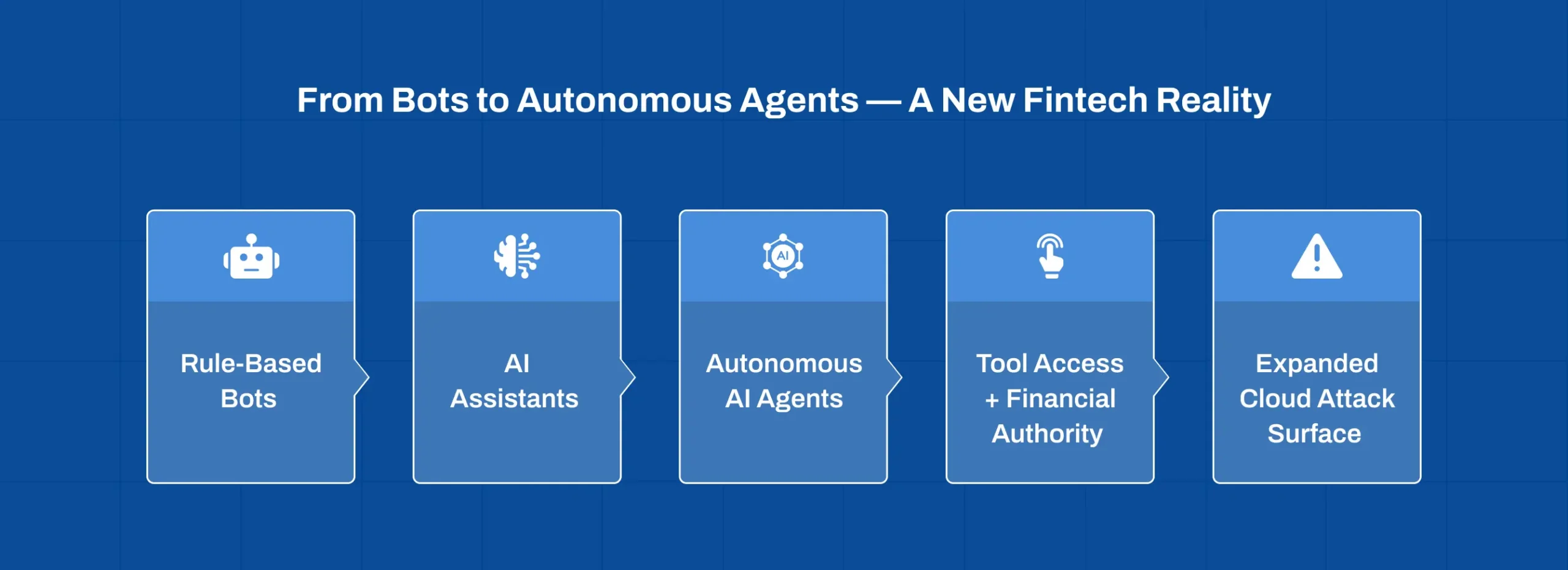
FinTech is moving from assistive bots to fully autonomous agents that can act across cloud systems and financial APIs. This leap in autonomy dramatically expands the attack surface and requires a fundamentally new security approach.
In 2026, FinTech leaders are deploying agents for everything from autonomous fraud investigation to personalised wealth management. These agents don’t just “suggest”; they “do.” They access real-time market data, interface with core banking APIs, and move money between accounts.
From Bots to Agents: Why 2026 Demands a New Security Paradigm
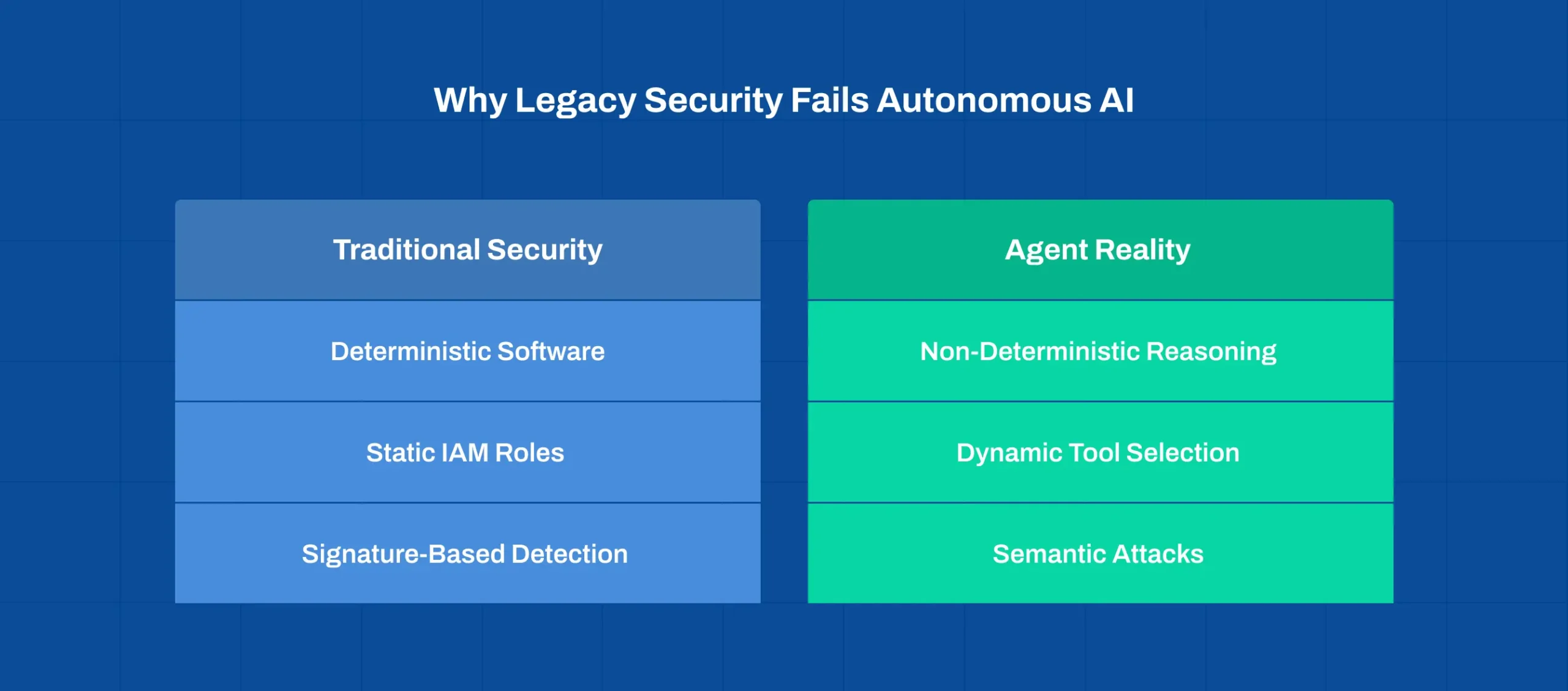
Traditional security assumes predictable software behavior. Autonomous agents are non-deterministic and can be manipulated through logic and semantics, making legacy firewalls and IAM insufficient.
Traditional security tools, firewalls, static IAM roles, and signature-based detection, were built for predictable software. They assume that if a system has permission to call an API, that call is legitimate. Autonomous AI agents, however, are non-deterministic. They can be manipulated into “reasoning” their way into a security breach, using their authorised credentials to perform unauthorised actions.
The “Chain of Threat”: Understanding Autonomous Risks in the Cloud

Autonomous attacks follow a chain: prompt manipulation alters reasoning, reasoning selects dangerous tools, and authorised tools execute harmful actions. Breaking any link in this chain prevents catastrophe.
To secure an agent, you must first understand how it fails. In the cloud, threats against agents often follow a “Chain of Threat” where a small prompt manipulation leads to a massive operational failure.

Agent hijacking overrides intent without hacking infrastructure, while tool misuse turns authorised capabilities into weapons. Both are uniquely dangerous in FinTech environments.
Agent Hijacking and Logic Manipulation
An attacker doesn’t need to hack your server; they just need to “convince” your agent. Through advanced prompt injection or “goal manipulation,” an attacker can override an agent’s system instructions.
- Example: A loan processing agent is tricked via a malicious document into ignoring credit score thresholds for a specific applicant.
Tool Misuse and Unauthorised Code Execution
Agents in the cloud are often equipped with “tools”, Python interpreters, SQL executors, or API connectors. If an agent is compromised, these tools become weapons.
- Example: An agent with access to a database tool is manipulated into executing a DROP TABLE command or exfiltrating the entire customer PII table via an authorised API endpoint.
A Blueprint for Security: The 4 Pillars of Autonomous Defense
The four-pillar blueprint secures AI agents by governing identity, restricting tools, monitoring reasoning in real time, and ensuring every critical action is explainable and auditable.
Securing the FinTech cloud requires a shift from guarding the perimeter to governing the intent of the agent.
1. Identity-Centric Governance (Agents as First-Class Citizens)
Treating agents as first-class identities allows precise control, monitoring, and revocation, preventing a single compromise from cascading across systems.
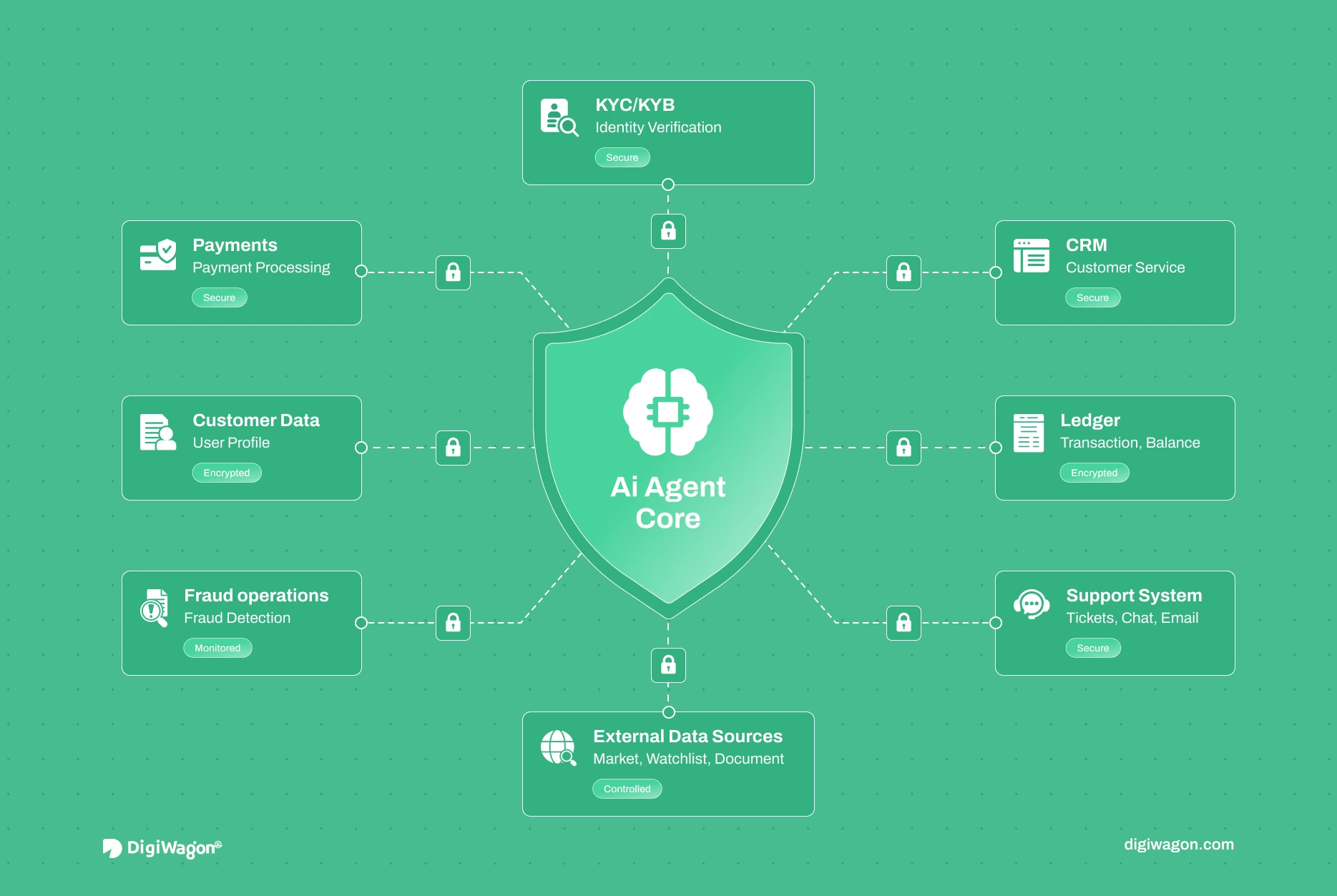
Every AI agent must be treated as a distinct digital identity, not just a service account.
- Action: Register every agent in a central identity provider (IdP). Assign unique, short-lived OAuth tokens and certificates.
- Value: If an agent is compromised, you can revoke its specific identity without bringing down your entire AI stack.
2. Hardened Tool Authorisation & Sandboxing
Least-privilege tool access and sandboxing ensure that even a compromised agent cannot execute destructive actions beyond its narrow scope.
Never give an agent “god mode” access to a tool.
- Action: Implement Least Privilege at the tool level. If an agent needs to read a database, it should not have the capability to write to it. Run all code-execution tools (like Python interpreters) in strictly isolated, ephemeral sandboxes.
- Value: Even if an agent is hijacked, the damage is contained within a restricted environment.
This is a critical design principle in enterprise-grade AI Agent Development.
3. Real-Time Trace Analysis & Behavioral Monitoring
Agentic Trace Analysis detects semantic anomalies by monitoring how an agent reasons, not just what it outputs, enabling early intervention before damage occurs.
Monitoring inputs and outputs is insufficient. You must monitor the agent’s internal reasoning.
- Action: Deploy “Agentic Trace Analysis” tools that scan the intermediate steps an agent takes, which tools it chose, how it interpreted data, and why it decided on an action.
- Value: Detects “Semantic Anomaly”, when an agent’s behavior deviates from its intended logic, even if the final output looks normal.
4. Explainable AI (XAI) for Regulatory Auditability
Explainable AI ensures that every high-risk decision made by an agent can be reconstructed and justified, meeting EU AI Act, UK, and US FinTech compliance expectations.
In the UK, USA, and Europe (under the EU AI Act), FinTechs must be able to explain why a decision was made.
- Action: Build Explainability into the agent’s core loop. Every high-value action should be logged with a “reasoning path” that auditors can review.
- Value: Ensures compliance with RegTech standards and builds trust with consumers.
Implementing Zero Trust for Autonomous Systems
Zero Trust for AI agents verifies every prompt, tool call, and transaction, introducing human approval only when risk thresholds demand it, balancing autonomy with safety.
The ultimate goal for 2026 is Zero Trust for AI Agents. This means “Never Trust, Always Verify” applies to every single step of an agent’s workflow.
- Verify the Prompt: Scan all inputs for malicious intent.
- Verify the Tool Call: Ensure the specific parameters sent to an API are within safe bounds.
- Verify the Human: For high-risk transactions (e.g., transfers over $10,000), require a Human-in-the-Loop (HITL) approval step.
Conclusion: Securing the Future of Financial Autonomy
Autonomous agents represent the most significant leap in FinTech productivity since the move to the cloud. But with great autonomy comes the responsibility for unprecedented security. By moving toward an Identity-centric, trace-aware blueprint, FinTech leaders can empower their agents to innovate without exposing their organisations to autonomous threats.
At DigiWagon, we believe that securing your AI agents isn’t just about preventing a breach; it’s about building the foundation of trust required for the next decade of financial innovation.