
RegTech Integration: What Actually Matters
- RegTech integration is an architecture problem, not a feature problem; the integration layer determines audit survival.
- One four-layer pattern (ingestion, detection or policy evaluation, decisioning, audit and evidence) recurs across AML, policy management, regulatory reporting, and audit readiness.
- Real-time and batch workflows coexist on every RegTech surface; forcing one mode across both is a primary failure pattern.
- Build, Buy, and Compose are the three viable integration strategies, and the choice hinges on regulatory cadence and audit ownership.
- AML platforms usually ship first because the trigger is sharpest, but the architectural pattern extends to the rest of the surface.
- Audit and evidence collection retrofitted late is the single most expensive integration mistake in compliance platforms.
RegTech integration architecture is the system design that connects detection engines, decisioning workflows, policy management, regulatory reporting, and audit infrastructure across multiple vendors and jurisdictions. It rests on a four-layer reference pattern and determines whether a compliance platform survives regulator scrutiny or fails its first inspection.
Why RegTech Integration Is an Architecture Problem, Not a Feature Problem
According to Thomson Reuters Regulatory Intelligence, regulated firms tracked more than 220 regulatory updates per business day across major jurisdictions in 2024. The FATF 2024 Guidance on Cross-Border Payment Monitoring treats near-instantaneous detection as the operating benchmark for payment screening. Neither benchmark survives a stack of disconnected point tools.
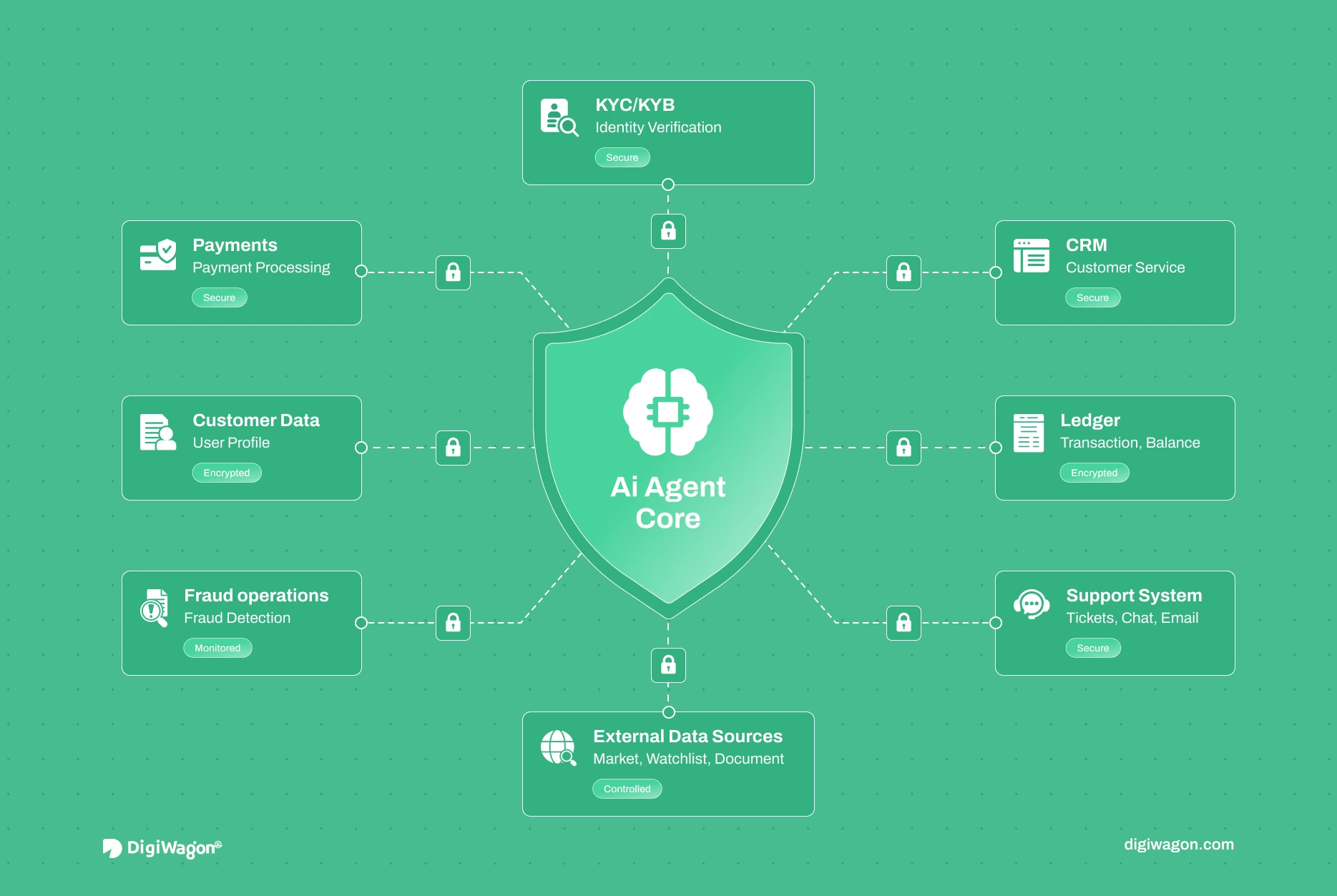
When the regulator asks why a transaction was approved, the platform has to reconstruct the full decision path: which watchlist version was active, which policy rule fired, who approved the override, which evidence object proves it. The detection model is rarely the bottleneck; the wiring between detection, decisioning, policy, reporting, and audit usually is.
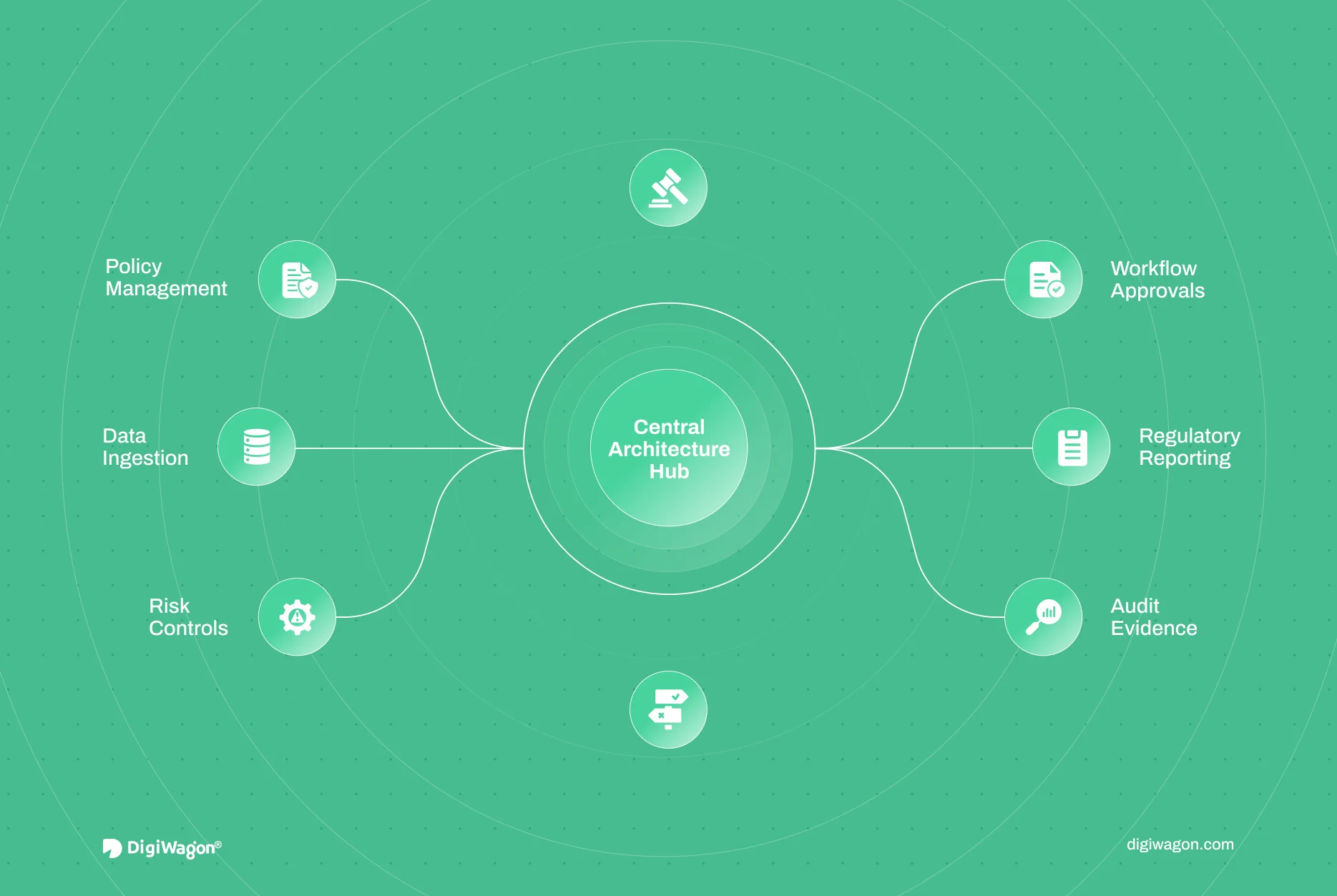
This blueprint covers four surfaces: AML and sanctions screening, policy management, regulatory reporting, and audit readiness. Most teams ship AML first because the trigger is sharpest. The architectural pattern is general.
The Full Architectural Surface of RegTech (Not Just AML)
The mistake most architecture conversations make is collapsing RegTech into AML. AML is the most visible surface and the one usually shipped first, but the integration layer carries three others of comparable engineering weight.
AML and sanctions screening. Customer and counterparty screening, transaction monitoring, suspicious activity reporting. Vendor landscape includes NICE Actimize, ComplyAdvantage, Refinitiv, Quantexa. Detection logic dominates the conversation; integration determines whether escalations survive review.
Policy management and governance. Enterprise policy registries, policy-as-code evaluation, access decisions, control mapping. The NIST Cybersecurity Framework 2.0 introduced the Govern function in February 2024 specifically to formalise this surface, covering organisational policy alignment, supply chain risk, and enterprise risk integration. ISO 37301:2021 sets the international requirements for compliance management systems, including how internal approvals and evidence flows should be structured.
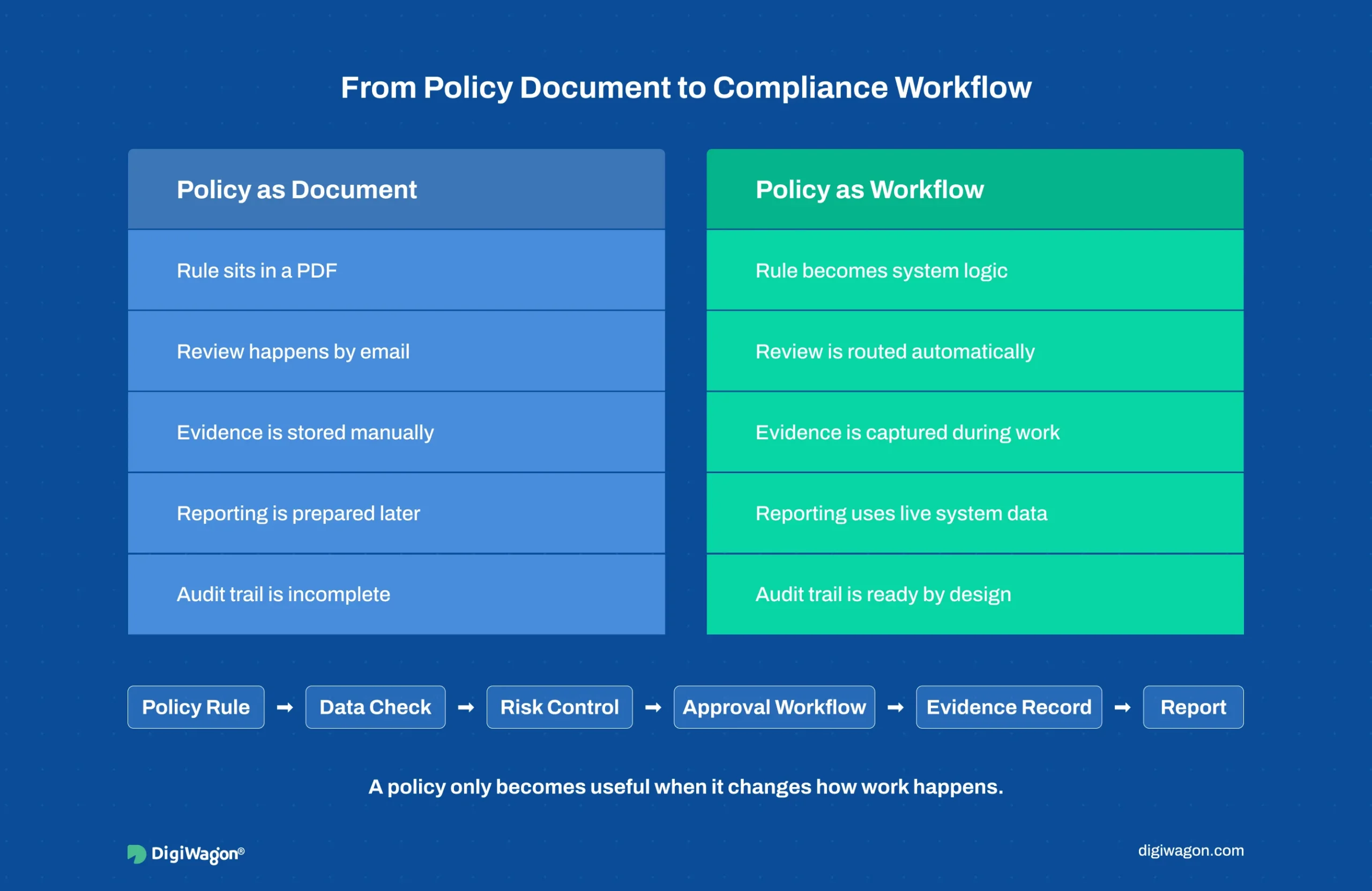
Regulatory reporting. Transaction reporting (MiFID II, EMIR), prudential reporting (FINREP, COREP), AML reporting (CTRs, SARs, Goods Movement Reports). Vendor landscape includes AxiomSL, Wolters Kluwer OneSumX, Vermeg. Format-heavy, schema-driven, deadline-bound. The integration layer is where most regulatory reporting projects quietly die.
Audit readiness and evidence collection. Continuous control monitoring, evidence stores, change history, exam-pack assembly. Microsoft Purview Compliance Manager documents over 360 regulatory templates and is a working reference for multi-cloud, AI-aware compliance automation. COSO Enterprise Risk Management 2017 and its Compliance Risk Management companion guidance sit behind enterprise governance, risk, and control programs more broadly; audit readiness is one operational surface that inherits from that framework, not the totality of it.
Each surface has its own vendors, formats, and regulators. They share the same integration layer. That sharing is the architectural opportunity.
What Are the Core Architectural Layers That Recur Across the RegTech Surface?
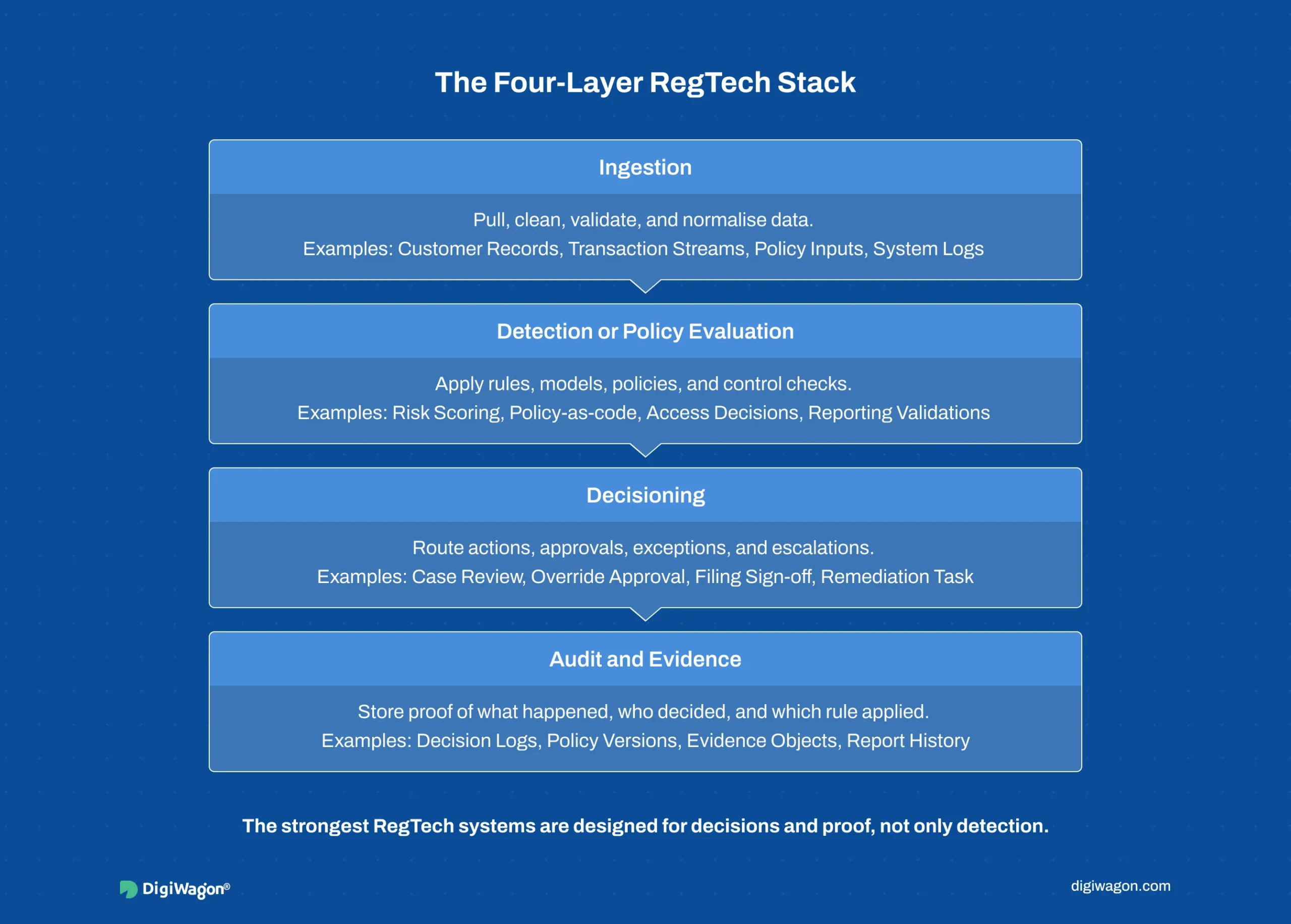
Across all four surfaces, the same four layers appear. Treating them as a reference architecture rather than a per-surface implementation is how integration debt gets controlled.
| Layer | What It Does | AML Example | Policy Example | Reporting Example | Audit Example |
|---|---|---|---|---|---|
| 1. Ingestion | Pull source data, normalise, validate, enrich | KYC profiles, transaction streams, SWIFT messages, watchlists | Identity events, access requests, control attestations | Trade events, position snapshots, reference data | Control evidence, change history, ticket trails |
| 2. Detection / Policy Evaluation | Apply rules, models, policies | Sanctions screening, transaction monitoring, fraud models | Policy-as-code engines (OPA, Rego), access decisions | Regulatory rule matching, jurisdictional schema validation | Continuous control evaluation, drift detection |
| 3. Decisioning | Workflow, escalation, override, four-eyes approval | Alert triage, SAR filing decision, override approval | Exception approvals, policy waivers | Filing approvals, dual-control sign-off | Finding acceptance, remediation tracking |
| 4. Audit and Evidence | Immutable trail of who decided what, when, with what data | Alert lineage, decision evidence, model version | Policy version, approver identity, decision context | Filed return, source snapshot, signing identity | Evidence object, attestation record, review trail |
Layer 1 is the easiest to underspec. The discipline matches any data engineering pipeline design problem; the compliance twist is that Layer 1 outputs are evidence, so every transformation has to be reversible and explainable.
Layer 2 is where surface differences look biggest and matter least architecturally. AML screening is structurally identical to policy-as-code evaluation: take an input, evaluate against a versioned ruleset, return a structured decision with reason codes. The deeper detection-model engineering belongs to the AI and ML engineering practice; the integration contract is generic.
Layer 3 is where most platforms fragment. Each vendor ships its own workflow surface. Without a decisioning abstraction, compliance teams end up navigating five UIs to close one case.
Layer 4 is the layer most teams retrofit. Audit infrastructure built as an afterthought never survives a real exam.
How Do Real-Time and Batch Compliance Workflows Differ Across the Surface?
Every RegTech surface has both real-time and batch workflows. Designing for only one mode is a recurring failure pattern.
Real-time: AML payment screening at authorisation (FATF treats sub-second decisioning as the operating norm), policy access decisions at the request boundary, same-day transaction reporting under regimes like MiFID II Article 26, continuous control monitoring with near-real-time drift detection.
Batch: periodic re-screening when a watchlist republishes, scheduled policy review cycles and control attestation campaigns, end-of-period regulatory filings (monthly FINREP, quarterly COREP, annual returns), and periodic audit cycles with external examiner walkthroughs.
The decision is not which mode wins. The decision is whether the same evaluation logic serves both modes or whether two parallel implementations get maintained. Two implementations drift, and the drift surfaces as a regulator finding three years later when a real-time alert and a batch re-screen produce different decisions on the same record.
The clean pattern: a stateless evaluator core fronted by two ingress paths. The streaming path runs over an event log (Kafka, Kinesis, Pub/Sub) feeding a low-latency consumer that calls the evaluator synchronously for each record. The batch path runs over an orchestrator (Airflow, Step Functions, Dagster) that fans out parallel evaluator calls across the dataset and reconciles outputs at the end. Both paths produce decisions with deterministic IDs (typically a hash of input payload plus the active version bundle) so a re-screen of the same record against the same version produces an identical decision ID, which is how drift gets detected mechanically rather than via manual reconciliation. Decision outputs land in a shared decision store that is the system of record; downstream case management, audit, and reporting all read from there rather than from the ingress path that produced the decision. AML payment screening alongside daily re-screening sweeps is the most stressed instance of this pattern in production; the same design serves policy access decisions and continuous control monitoring without architectural change.
What Are the Most Common Integration Failure Modes Across the Surface?
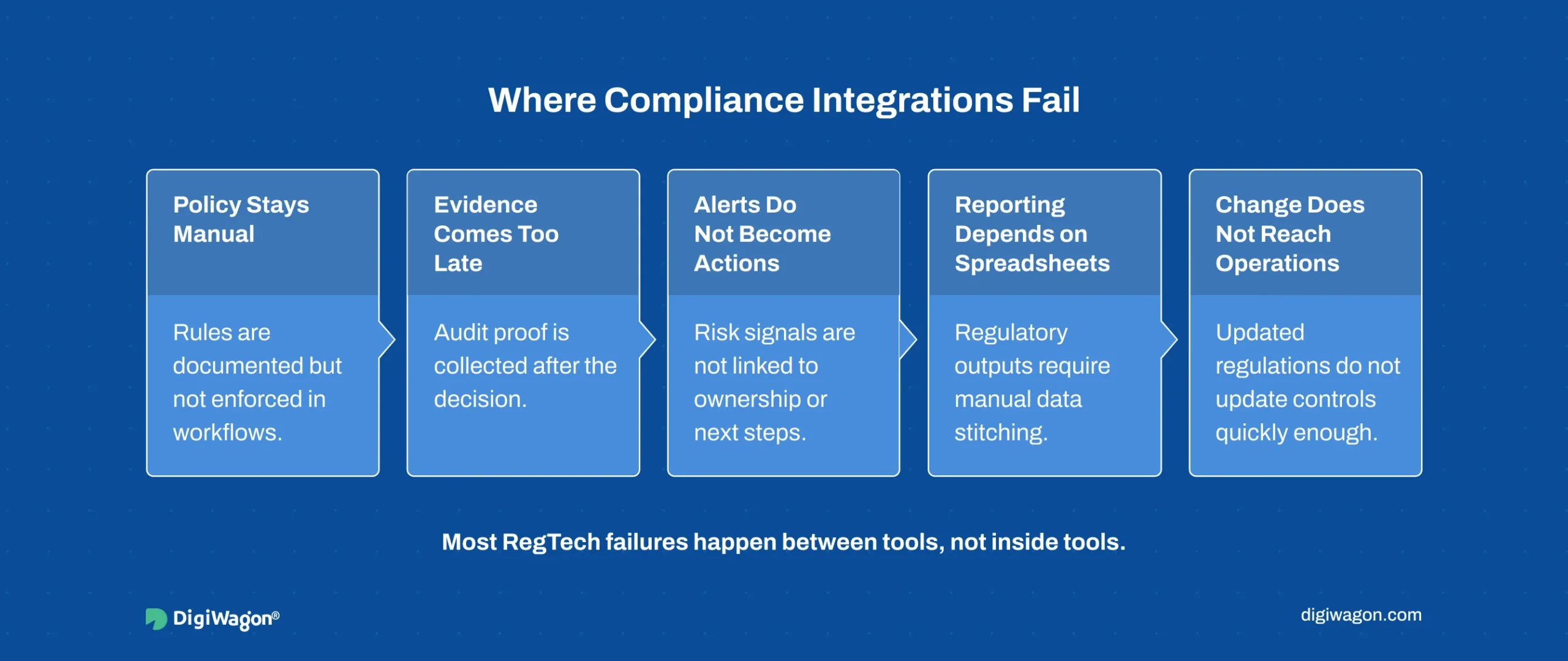
Four failure modes recur across every RegTech surface.
1. Stale reference data. Watchlists, policy registries, regulatory rule libraries, and control catalogues are reference data that detection depends on. The failure: decisions made against yesterday’s version of the truth with no way to prove which version was active when the decision was rendered. The pattern that holds: version reference data with explicit effective-from and effective-to timestamps, store the version identifier in every decision record, forbid evaluation without an explicit version bind. AML watchlist governance is the most operationally demanding instance because the data updates daily and the regulator examines diffs forensically; the principle generalises to policy registries and regulatory rule libraries.
2. Audit retrofit. A platform runs in production for a year, then the first audit demands evidence the platform cannot produce. Reconstructing decision lineage from operational logs is a rebuild, not a fix. The discipline: ship Layer 4 with Layer 1. Every detection event, decisioning event, and override gets an evidence object at the moment it happens.
3. Detection-workflow coupling. Vendors ship detection and workflow as one product, so swapping the screening engine means swapping the case-management UI, alert queue, escalation rules, and override audit. Most platforms get locked in not by detection quality but by workflow surface. The decoupling pattern keeps Layer 2 and Layer 3 on separate substrates with an explicit decision contract between them.
4. Cross-border data residency. A platform built for one jurisdiction discovers that data from a second cannot leave that jurisdiction’s borders. The pattern that survives: design Layer 1 with per-jurisdiction data planes from day one, with a federated decision plane that calls into the local data plane rather than pulling data across borders.
Teams evaluating compliance integration end-to-end often find custom RegTech integration architecture carries more lifetime value than vendor-led implementations.
Build vs Buy vs Compose: How Do You Choose the Right Integration Strategy?
Three strategies, three economics, three risk profiles.
| Strategy | What It Means | When It Works | When It Breaks |
|---|---|---|---|
| Build | Custom integration platform, custom detection or policy engines, custom workflow | When regulatory exposure is the firm’s primary risk, when no vendor covers the specific jurisdictional mix, when audit ownership must stay in-house | When the team underestimates Layer 4 (audit and evidence) effort, when regulatory cadence outpaces engineering velocity |
| Buy | End-to-end vendor platform (e.g., NICE Actimize, ComplyAdvantage, MetricStream, AxiomSL) covering detection through audit | When the regulator’s expectations align closely with the vendor’s reference implementation, when the firm wants vendor accountability in the audit room | When two surfaces require two vendors and the vendors do not interoperate, when jurisdictional edges are not in the vendor roadmap |
| Compose | Best-of-breed components per layer, glued by a custom integration layer that owns Layer 1 (ingestion) and Layer 4 (audit) | When the firm has the engineering capacity to own the integration layer, when audit lineage must span multiple vendors, when surfaces share infrastructure | When the integration layer is treated as glue rather than as a product, when no team owns it as a long-term asset |
The compose pattern is the one most under-recognised. Most enterprise compliance stacks already look like compose patterns by accident: a vendor for AML, a different vendor for policy, a third for regulatory reporting, with home-grown ingestion and audit reconciliation between. The accident becomes an architecture when the integration layer is treated as a first-class product with its own engineering team, roadmap, and audit story.
Build is correct in narrower cases than internal teams claim; buy in narrower cases than vendors claim. Compose is the default for any firm operating in more than two jurisdictions or covering more than two of the four RegTech surfaces. For firms delivering compliance platforms to multiple customers, the compose pattern extends into multi-tenant SaaS product engineering, where the integration layer becomes the firm’s IP and operational moat.
Lessons from Architecting AML and Sanctions Compliance Stacks
The deepest shipped evidence for these lessons sits in AML work: RapidAML for multi-jurisdiction watchlist screening, transaction monitoring, and case management; a real-time transaction intelligence engine for high-volume payment screening; and a SWIFT orchestration layer normalising MT and ISO 20022 traffic for downstream screening and reporting.
Three architectural decisions translated cleanly across all three:
Decision one: separate the screening evaluator from the case workflow. The first cut put both on the same vendor stack. Two regulator queries later, it became clear the workflow surface had to evolve faster than the screening engine. Decoupling them through an explicit decision contract (alert, reason codes, version identifiers, evidence pointer) unlocked independent iteration on each. The same decoupling is what makes the four-layer model viable beyond AML.
Decision two: version everything that gets read. Watchlists, screening rules, scoring thresholds, fuzzy-match parameters. Every alert record carries the exact version bundle that produced it. When a regulator asks why a name matched in March but not in April, the answer is a version diff, not a forensic excavation. The cost of getting this wrong is asymmetric: building it from day one adds maybe two weeks to the platform timeline; retrofitting it from operational logs after the first regulator query is a multi-quarter project that often fails on production data that was never designed to be reconstructed.
Decision three: ship the evidence object on day one. Every alert, every override, every escalation, every approval generates an immutable evidence object at the moment it happens. The object includes the input snapshot, the version bundle, the decision payload, the actor identity, and a tamper-evident hash chain back to the previous object on the same case. Day-one evidence collection has zero glamour and the highest audit ROI of any architectural decision in a compliance stack.
The AML surface is where these decisions were paid for. The next section explains why they generalise.
Architectural Position: Why the Pattern Extends Beyond AML
The four-layer model is not specific to AML. It is the structural form of any system that detects, decides, and proves. The argument for extending it to policy management, regulatory reporting, and audit readiness rests on three observations, each grounded in published standards rather than shipped work.
Policy management is detection with a different payload. In a policy-as-code system using OPA and Rego, the evaluator takes an input (an access request, a deployment manifest, an attestation), evaluates it against a versioned policy bundle, and returns a structured decision with reason codes. That contract is identical to a screening alert contract. The Govern function explicitly treats policy alignment, supply chain risk, and enterprise risk integration as architectural concerns rather than document-management concerns. The failure mode is the same as AML: ship Layer 2 without Layer 4, and the platform cannot answer the audit question “which policy version produced this decision, and who approved the override.” Trade-off: policy-as-code engines have weaker ecosystem support for case workflows than AML vendors, so Layer 3 often has to be custom. That cost is recovered in audit defensibility.
Regulatory reporting is detection plus schema enforcement. A regulatory return is the output of evaluating production data against a jurisdictional schema (XBRL, FpML, FINREP) and a regulatory rule library. The same Layer 1 ingestion, Layer 2 evaluation, Layer 3 decisioning (filing approval, dual control), and Layer 4 audit (which source snapshot produced which filed return) apply. ISO 37301:2021 sets the requirements for the management system surrounding this, including evidence and internal approval flows. Failure mode: teams treat regulatory reporting as an ETL job rather than a decision pipeline, and lose decision lineage when the regulator asks how a reported figure was derived.
The control framework underneath all of this. The COSO ERM 2017 framework, together with its Compliance Risk Management companion guidance, is the canonical enterprise reference covering governance, risk, and controls across the full compliance surface, not just audit. Policy management inherits its risk-and-control structure from it. Regulatory reporting inherits its control-objective and accountability structure from it. Audit readiness (continuous evaluation of those controls, evidence capture, attestation) is one operational surface that inherits from the framework, not the totality of it. Microsoft Purview Compliance Manager operationalises the broader compliance-automation pattern across over 360 regulatory templates. Failure mode: compliance ownership splits between a GRC team that operates outside the engineering integration layer and an engineering team that does not see the framework, producing two parallel sources of truth that diverge.
The architectural risk in extending the pattern is over-generalisation. The four-layer model is a reference, not a rigid template. The detection technology at Layer 2 is fundamentally different across surfaces (transformer-based screening versus Rego policies versus XBRL rule libraries), and the integration layer has to respect those differences in latency, throughput, and explainability. What stays constant is the contract between layers and the evidence object that survives the platform.
DigiWagon’s Role in RegTech Integration Architecture
DigiWagon designs and builds the integration layer for regulated platforms across AML, policy management, regulatory reporting, and audit readiness. The work spans architecture review, layer-by-layer build, and long-term audit-defensibility engineering, drawing on the RegTech software development practice.
- Four-layer reference architecture design across AML and adjacent compliance surfaces
- Detection, decisioning, and audit decoupling on multi-vendor stacks
- Versioning, evidence, and lineage infrastructure built day-one rather than retrofitted
- Cross-jurisdictional data residency and federated decisioning patterns
Making the Architecture Call
The argument of this blueprint is that RegTech survival is an integration question. Detection models, policy engines, reporting tooling, and audit infrastructure each get measurable attention; the wiring between them rarely does, and that wiring is what fails first under regulator scrutiny. The four-layer reference (ingestion, detection or policy evaluation, decisioning, audit and evidence) is the architectural form that holds across all four RegTech surfaces, even when teams ship the AML surface first because the regulatory trigger is sharpest there. Three decisions carry across surfaces: decouple detection from workflow, version everything that gets read, ship the evidence object on day one. Platforms that internalise those decisions early survive the surface they were built for and extend cleanly to the ones they were not.
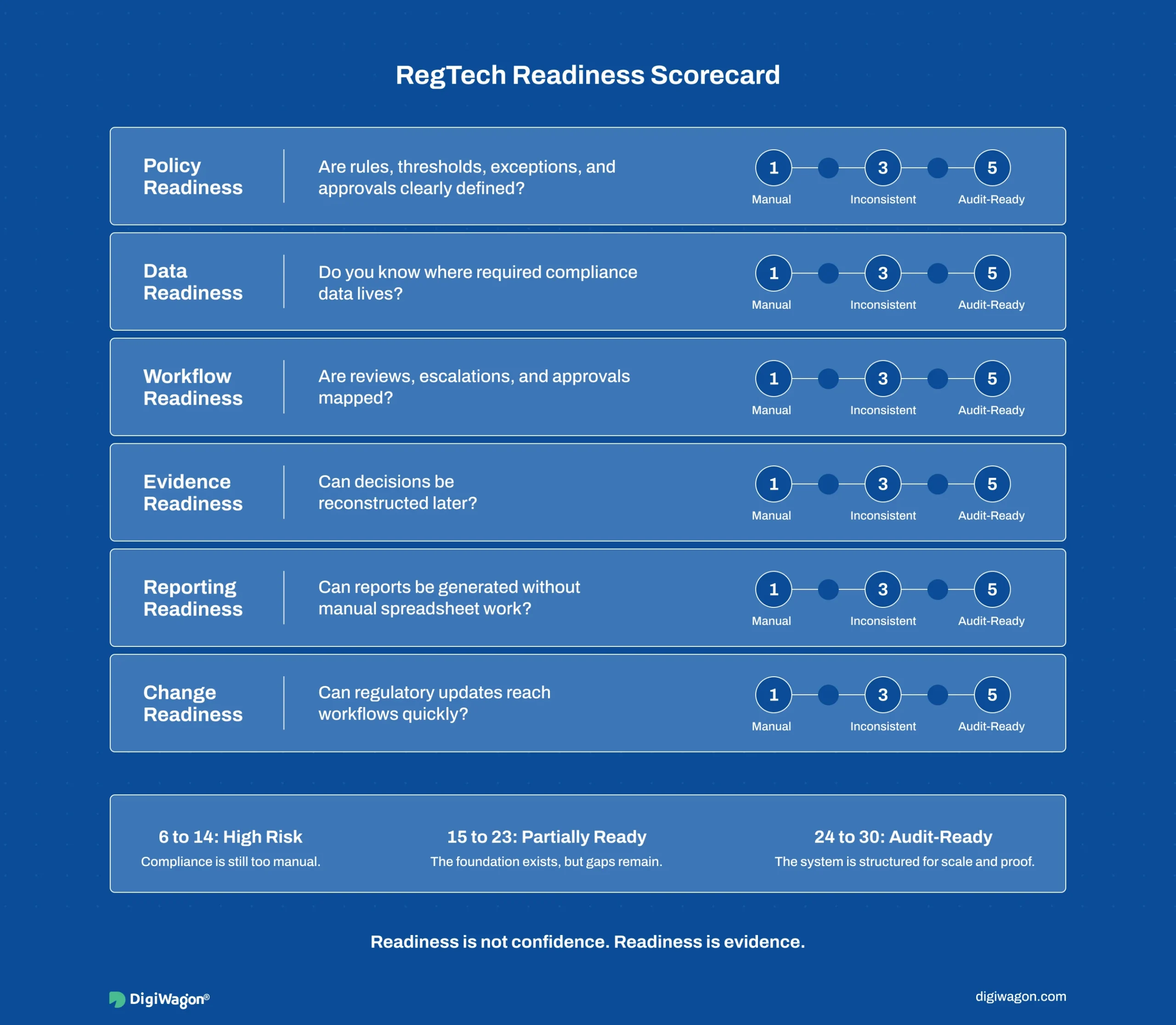
Planning a RegTech Integration Architecture Review?
Our compliance engineering team works through the four-layer model with your detection, policy, reporting, and audit owners in one room.