
Sovereign Sourcing Framework Overview
- Sovereign sourcing keeps outsourcing possible while ensuring data, infrastructure, and administrative control remain under UAE or EU jurisdiction.
- In 2026, EU AI Act and UAE PDPL enforcement makes basic data residency insufficient for regulated enterprises.
- Data sovereignty requires local control of access, encryption keys, and operational governance, not just local hosting.
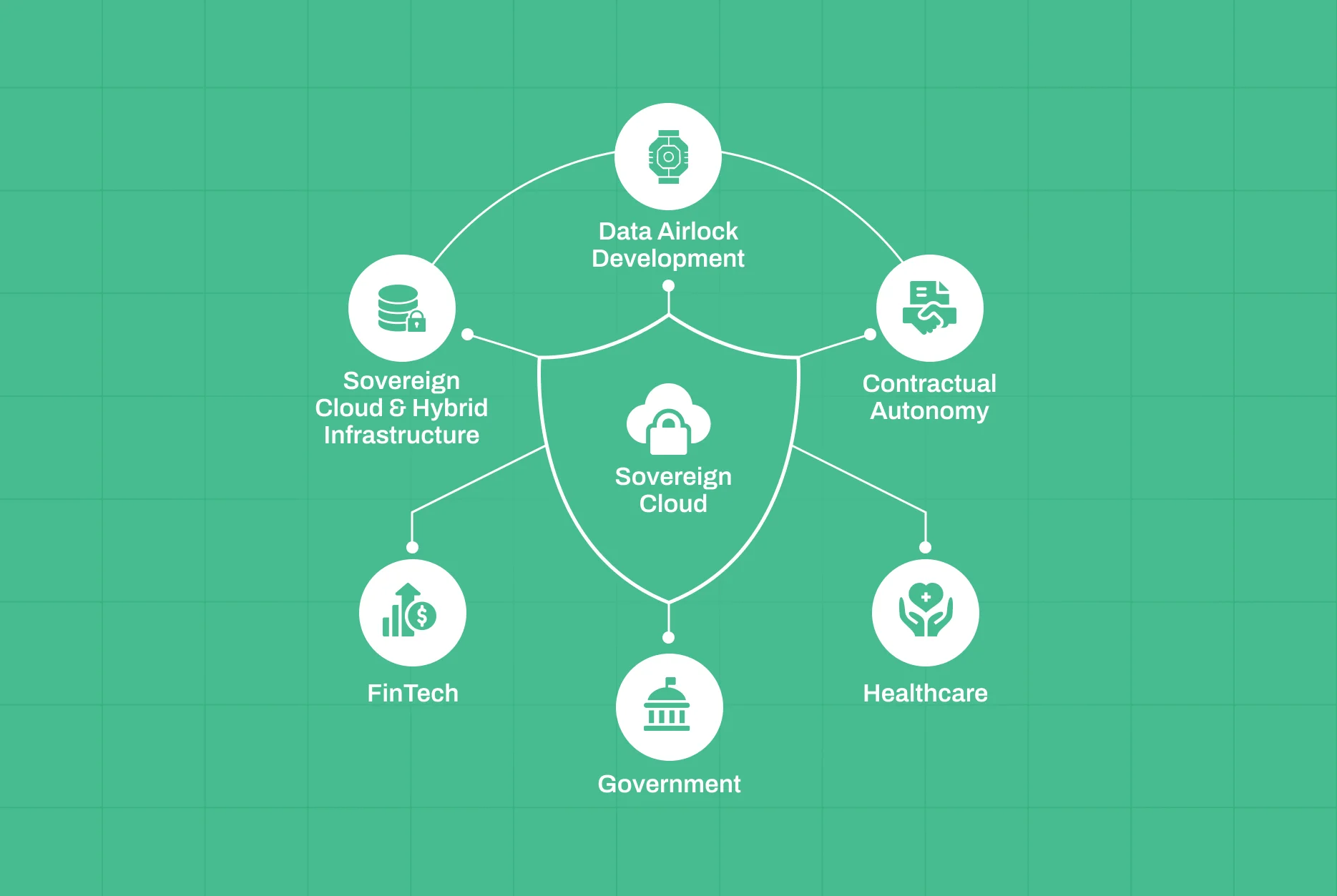
- The Sovereign Sourcing Framework works through three layers: sovereign cloud infrastructure, a data airlock development model, and contractual autonomy.
- This model is most relevant for FinTech, RegTech, Healthcare, Government, and AI-driven SaaS platforms operating in UAE and Europe.
In 2026, software outsourcing is no longer just about cost and speed.
For enterprises operating in the UAE and Europe, it has become a matter of jurisdiction, regulatory compliance, and architectural control. Organizations are increasingly adopting Advanced Software Solutions that combine global engineering expertise with strict governance and regulatory alignment.
With enforcement of the EU AI Act and the UAE’s Federal Data Protection Law (PDPL), CTOs must ensure that:
- Sensitive data remains within national boundaries
- Infrastructure is governed by local legal systems
- Cross-border development does not create compliance exposure
This is where the Sovereign Sourcing Framework becomes essential.
What Is Sovereign Sourcing?
Sovereign sourcing is not a buzzword. It’s an operating model that combines engineering controls with governance. For many enterprises, it becomes a hybrid of delivery execution and a Strategy Consulting model, because the delivery approach is as important as the code itself.
In simple terms:
You can leverage global engineering talent, but your data, encryption keys, and control plane never leave your jurisdiction.
Unlike traditional outsourcing, sovereign sourcing requires:
- Jurisdiction-aware cloud architecture
- Controlled administrative access
- Compliance-aligned vendor contracts
- Zero-trust development environments
It is especially critical for:
- FinTech platforms
- RegTech solutions
- Healthcare systems
- Government technology
- AI-driven SaaS products
Data Residency vs Data Sovereignty (The Critical 2026 Distinction)
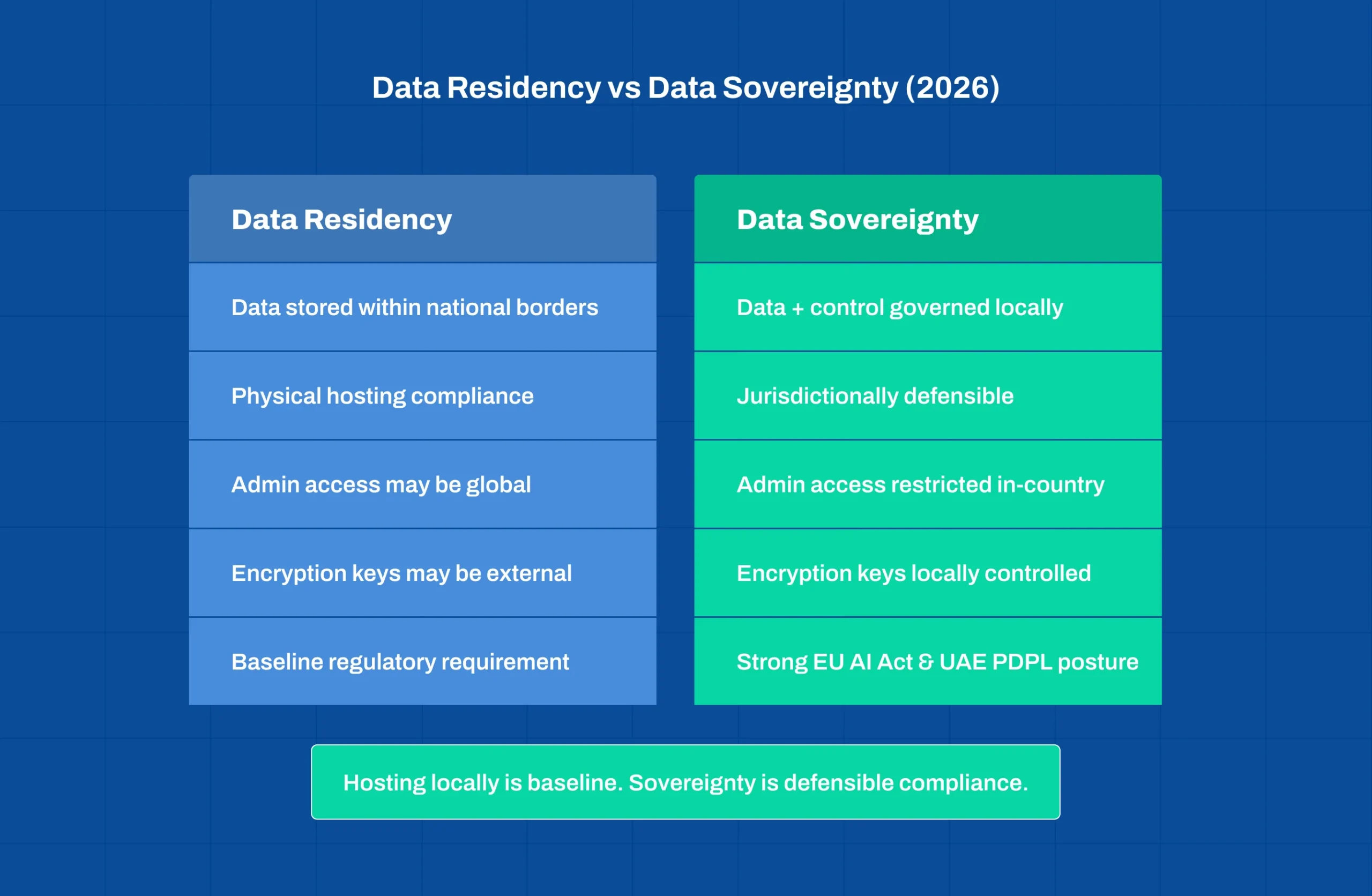
Many organisations assume hosting in a UAE or EU data center solves compliance challenges. It does not.
What Is Data Residency?
- Data residency means your data is physically stored in a specific country
Example:
- Your SaaS platform runs in a Dubai-based cloud region.
- This satisfies location requirements.
What Is Data Sovereignty?
Data sovereignty goes further. It ensures:
- Infrastructure is governed only by local law
- Encryption keys are locally controlled
- Administrative access is locally operated
- Foreign extraterritorial access risks are mitigated
In 2026, sovereignty is the defensible position, especially for high-risk AI systems under the EU AI Act and regulated data under UAE PDPL.
Hosting locally is the baseline.
Sovereignty is strategic compliance.
How the EU AI Act and UAE PDPL Impact Software Outsourcing
The EU AI Act introduces strict requirements for high-risk AI systems, including:
- Data quality and traceability
- Transparency documentation
- Human oversight mechanisms
- Risk management systems
Similarly, UAE PDPL restricts cross-border data transfer and mandates clear data governance controls.
For CTOs, this means:
- Global developers cannot directly access production data
- AI training pipelines must be audit-ready
- Infrastructure must be jurisdictionally defensible
This shift moves enterprises from “global cloud-only” models toward sovereign cloud architecture.
The Three-Layer Sovereign Sourcing Framework

A practical sovereign sourcing model operates across three layers:
Layer 1 – Sovereign Cloud & Hybrid Infrastructure
Enterprises are moving toward:
- Dedicated sovereign cloud regions
- Logical and physical isolation from global control planes
- In-country encryption key management
- Localized identity and telemetry governance
Key principle:
The control plane must be sovereign, not just the storage layer.
Layer 2 – The Data Airlock Development Model

To enable global outsourcing without compliance risk, organisations implement a Data Airlock Model.
This includes:
- AI-synthesized testing datasets
- Strict segregation of live production data
- Encrypted Virtual Desktop Infrastructure (VDI)
- Zero-trust access policies
- No local storage on remote devices
Developers work within controlled sovereign environments.
Audit logs remain centralised and traceable.
This allows global engineering velocity without jurisdictional exposure.
Layer 3 – Contractual & Operational Autonomy
Technical controls alone are not enough. Sovereign sourcing requires:
- Back-to-back compliance clauses aligned with EU AI Act and PDPL
- Defined data processing boundaries
- Vendor audit obligations
- A technical “Kill Switch” protocol
The Kill Switch ensures that if a global vendor’s environment is compromised, access can be immediately severed while maintaining sovereign service continuity.
Business Benefits of Sovereign Sourcing
Beyond compliance, sovereign sourcing provides strategic advantages.
1. Regulatory Risk Reduction
EU AI Act fines can reach tens of millions of euros.
Sovereign architecture reduces exposure by design.
2. Competitive Differentiation
For FinTech, RegTech, and Healthcare providers:
“Your data never leaves the UAE.”
“Fully EU-sovereign AI infrastructure.”
Trust becomes a market differentiator.
3. Operational Resilience
Sovereign models reduce dependence on a single global control plane and protect against:
- Geopolitical tensions
- Supply chain disruptions
- Extraterritorial legal claims
4. AI-Ready Governance
High-risk AI systems require strict training data controls and documentation. Sovereign sourcing builds those controls into the architecture.

When Does Your Enterprise Need a Sovereign Sourcing Framework?
You should consider sovereign sourcing if:
- You operate in the UAE or EU
- You process regulated personal data
- You deploy AI systems impacting citizens
- You outsource development outside your jurisdiction
- You require audit-ready compliance posture
If two or more apply, sovereignty is no longer optional.
Build Sovereign-Ready Software with DigiWagon
Don’t let data borders become business barriers. Build sovereign. Build compliant. Build resilient.