
Subscription Commerce for Indian D2C: Key Takeaways
- Most Indian D2C brands rely on one-time purchases. Subscription commerce converts that into predictable monthly revenue.
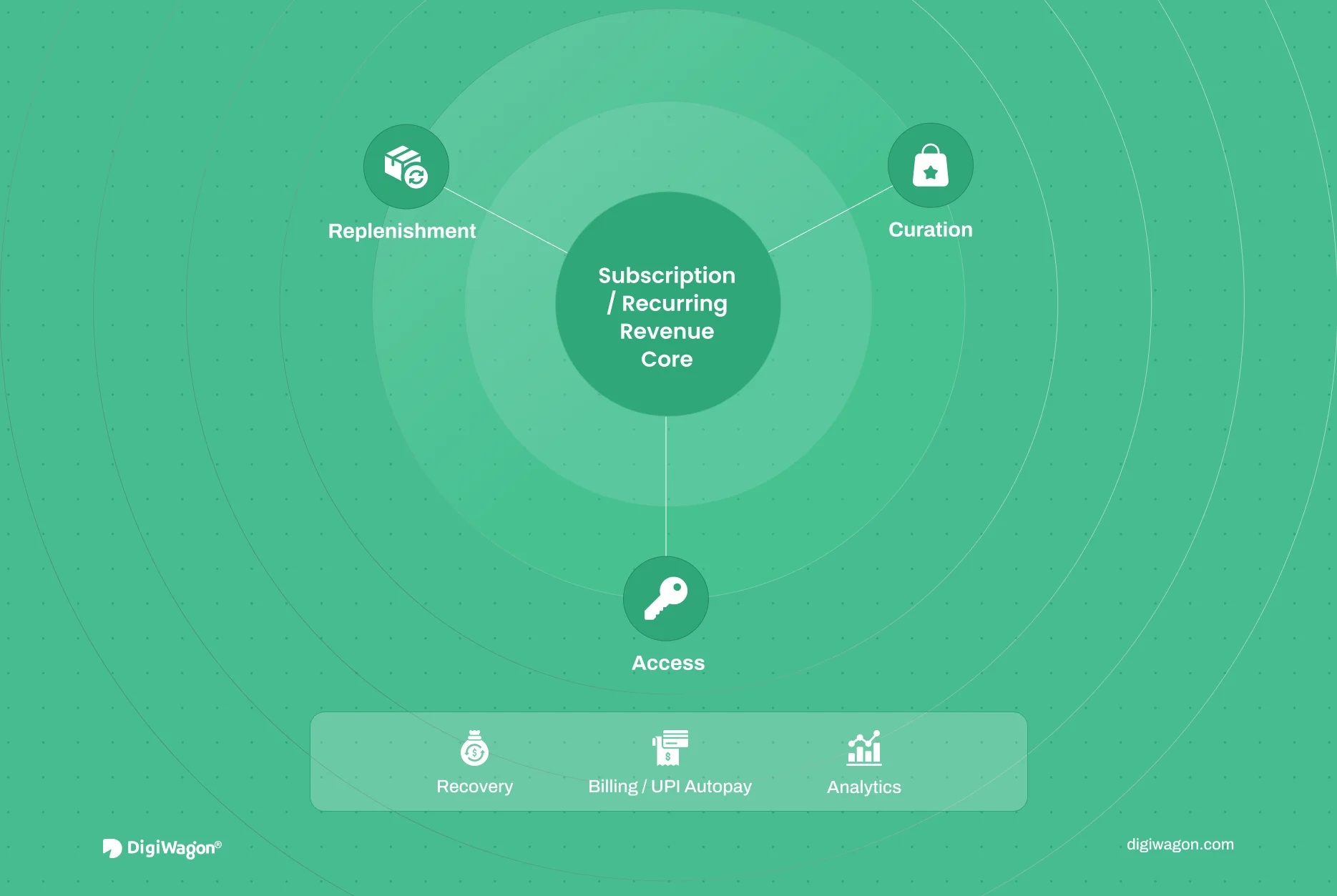
- Three models work for physical goods: replenishment (auto-refill), curation (surprise boxes), and access (members-only pricing). Each needs different billing and logistics architecture.
- The biggest technical challenge is not the storefront. It is the billing and retry logic that handles India’s payment ecosystem: UPI Autopay mandates, RBI e-mandate rules, and COD-heavy buyer habits.
- Start with one product line, one billing engine, and WhatsApp-first dunning. Scale from there.
What Is Subscription Commerce?
Subscription commerce is an eCommerce model where customers pay a recurring fee (weekly, monthly, or quarterly) in exchange for automatic product delivery or exclusive access. It shifts the revenue model from per-transaction to per-relationship. Unlike marketplace selling where the platform owns the customer, subscription D2C gives brands direct control over billing cycles, retention levers, and lifetime value.
Why Indian D2C Brands Need Subscription Models Now
India’s D2C market crossed $87.5 billion in 2025, according to Mordor Intelligence. Over 10,000 active D2C brands now sell primarily through online channels. But most of them are stuck in a costly loop: spend on acquisition, get a one-time purchase, hope the customer comes back.
The unit economics of that loop are getting worse. Customer acquisition costs for Indian D2C brands have risen roughly 30% year-on-year, according to industry estimates from Inc42 and CII-Shiprocket reports. Meanwhile, the D2C brands that are winning across dairy, personal care, and packaged food all share one thing: a subscription or repeat-purchase model that locks in revenue before the next ad rupee is spent.
Subscription commerce flips the economics. Instead of paying to acquire each order, you pay once to acquire a subscriber who generates 6-12 months of recurring revenue. For categories with natural replenishment cycles (personal care, food, supplements, pet supplies), the model is obvious. For categories without natural cycles (fashion, home decor), curation and access models create the recurring trigger.
The timing is right for India specifically. UPI Autopay, which enables recurring payments via UPI with RBI-compliant e-mandate, crossed 50 million active mandates in 2025. That is the payment infrastructure that makes subscription billing viable at scale for Indian consumers who do not use credit cards. Combined with India’s improving last-mile logistics (Delhivery, Ecom Express, and ONDC’s plug-and-play fulfillment), the operational barriers to subscription D2C have dropped materially in the last 18 months.
For brands operating in India’s retail and eCommerce software development space, subscription is no longer a nice-to-have feature. It is a margin architecture decision.
What Are the Three Subscription Models for D2C Brands?
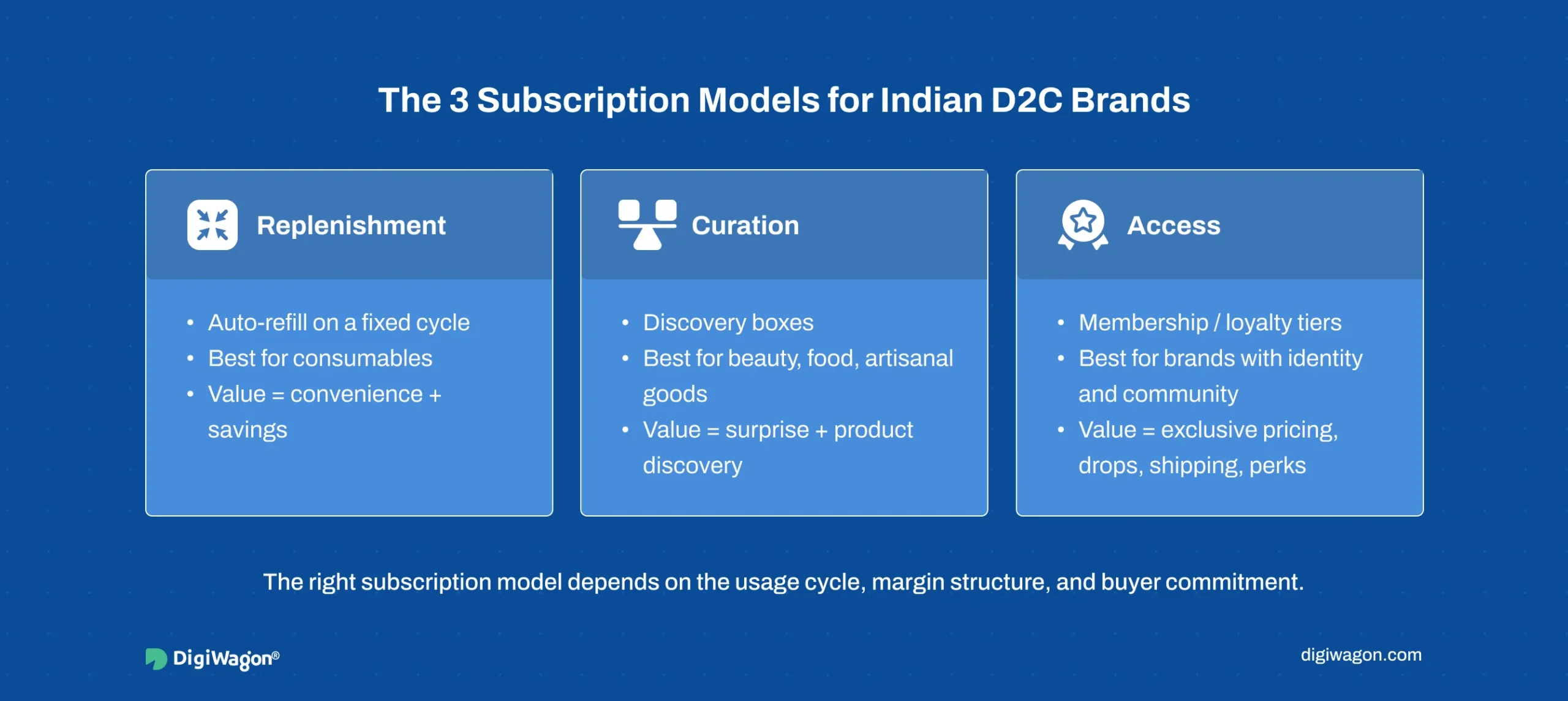
Not every subscription model fits every product. The choice depends on your product’s consumption cycle, your margin structure, and your customer’s willingness to commit.
Replenishment (Auto-Refill)
The simplest model. Customers subscribe to receive the same product on a fixed schedule. Toothpaste every 45 days. Coffee every 2 weeks. Dog food every month. The value proposition is convenience and a small discount (typically 10-15%) for committing to recurring delivery.
Works best for: Consumables with predictable usage cycles. Skincare, supplements, household supplies, pet food, baby products.
India-specific consideration: COD is still 25-30% of D2C orders in India. Replenishment subscriptions require prepaid payment, which means you need to convert COD-habituated buyers to UPI Autopay or card-on-file. Some leading Indian dairy D2C brands solved this by starting with a wallet-based prepay model before layering in UPI recurring mandates.
Curation (Discovery Boxes)
Customers receive a curated selection of products each cycle. The appeal is surprise and discovery. Beauty sample boxes and gourmet snack crates are the most common formats in India.
Works best for: Categories where product discovery drives value. Beauty, gourmet food, artisanal goods, books.
India-specific consideration: Curation margins are tricky in India because of high shipping costs relative to box value. A INR 999 beauty box with INR 150 shipping eats into margins fast. Successful Indian curation brands offset this with brand partnerships: the “samples” in the box are often subsidised by the brands seeking exposure.
Access (Membership / Loyalty Tiers)
Customers pay a recurring fee for exclusive benefits: early access to drops, members-only pricing, free shipping, or priority support. This is not about delivering a product on schedule. It is about creating a tiered relationship where the membership itself becomes the product.
Works best for: Brands with strong identity and community. Fashion, lifestyle, fitness, premium food.
India-specific consideration: Indian consumers are price-sensitive about membership fees. The threshold is low: INR 99-299/month for most D2C brands. The value must be immediately tangible. Free shipping alone (which saves INR 50-80 per order) is often enough to justify membership for frequent buyers.
How Do You Build the Subscription Billing Stack for India?

The subscription storefront is the easy part. The billing infrastructure is where most implementations fail. India’s payment ecosystem has specific constraints that global subscription platforms (Recharge, Bold) were not built for.
| Component | Global Default | India-Specific Requirement |
|---|---|---|
| Recurring payments | Credit/debit card tokenisation | UPI Autopay (e-mandate), RBI tokenisation rules, prepaid wallets |
| Payment retry logic | 3 retries over 7 days | 5+ retries needed; UPI mandate re-authentication required after failures |
| COD handling | Not applicable | Must offer COD-to-prepaid conversion flow for first 1-2 orders |
| Invoicing | Single currency, standard tax | GST-compliant invoicing with HSN codes, state-wise tax calculation |
| Dunning management | Email-based | WhatsApp + SMS dunning (email open rates in India are 15-20% vs 35%+ in USA) |
| Subscription pause/skip | Standard feature | Non-negotiable in India; 27% of subscribers cancel if they cannot pause (Swell) |
The Core Tech Stack
- Subscription billing engine: Chargebee (India-headquartered, UPI Autopay native), Razorpay Subscriptions, or custom-built on Stripe India + webhook handlers. For subscription-based eCommerce development, the billing engine choice determines your entire downstream architecture.
- Payment gateway: Razorpay or Cashfree for UPI Autopay mandate creation and management. Juspay for payment orchestration if you need multi-gateway fallback (route failed Razorpay transactions to Cashfree automatically).
- Storefront: Shopify with Recharge (if platform-led), or a custom Next.js/React frontend with API calls to Chargebee/Razorpay for plan management. For brands building D2C eCommerce platform development from scratch, the storefront should expose subscription plan selection, skip/pause controls, and billing history as first-class UI elements, not buried settings.
- Dunning and recovery: WhatsApp Business API (via Gupshup, Wati, or Interakt) for failed payment notifications. SMS via MSG91 or Twilio India. Email via Mailmodo or Brevo. The dunning sequence should be WhatsApp first, SMS second, email third, matching Indian consumer communication preferences.
- Analytics: Subscription-specific metrics (MRR, churn rate, LTV:CAC ratio, cohort retention) tracked in Mixpanel, Amplitude, or a custom dashboard. Standard eCommerce analytics (Google Analytics, Shopify reports) do not track subscription health well.
For teams building composable subscription stacks, the billing engine and storefront communicate via APIs, following the same SaaS product architecture principles used in recurring revenue software platforms. Subscription commerce and SaaS share identical billing infrastructure problems: plan management, proration, upgrades/downgrades, and dunning.
How Should Indian D2C Brands Think About Subscription Retention?

Acquisition gets the subscriber. Retention keeps the revenue. Most Indian D2C brands over-invest in signup flows and under-invest in the systems that prevent cancellation. Here is what to focus on.
Design the skip/pause experience before the signup flow. In India, festivals, travel, and family events disrupt purchasing routines frequently. If a subscriber cannot pause with one tap on WhatsApp or in the app, they will cancel. A paused subscriber is still your subscriber. A cancelled one is gone.
Separate payment failures from product dissatisfaction. In India, a large share of subscription “churn” is actually failed UPI mandates, expired cards, or insufficient wallet balance. These subscribers did not choose to leave. Your retry logic and dunning sequence brought them back or lost them. Treat this as an engineering problem (more retries, WhatsApp reminders, alternate payment fallback), not a product problem.
Track order-to-engagement ratio, not just order count. A subscriber who orders every month but never opens your emails or app is at high cancellation risk. A subscriber who skips a month but browses your catalog, reads your content, or interacts on WhatsApp is actually more retained. Build engagement signals (page views, WhatsApp replies, review submissions) into your churn prediction model alongside billing data.
Instrument cohort analysis by acquisition channel. Subscribers acquired through Instagram ads behave differently from those acquired via referral or organic search. Measure retention by cohort and channel, not as a blended average. If your Instagram cohort churns at 15% monthly while your referral cohort churns at 4%, the problem is not your subscription product. It is your acquisition targeting.
Set a “subscription health” alert at the 3rd billing cycle. Most subscription cancellations happen between cycle 2 and cycle 4. If a subscriber reaches cycle 5, they are statistically likely to stay for 12+ months. Trigger a personalised retention touchpoint (a small gift, a thank-you note via WhatsApp, or an upgrade offer) at the 3rd cycle to push subscribers past the danger zone.
What D2C Brands in India Get Subscription Wrong
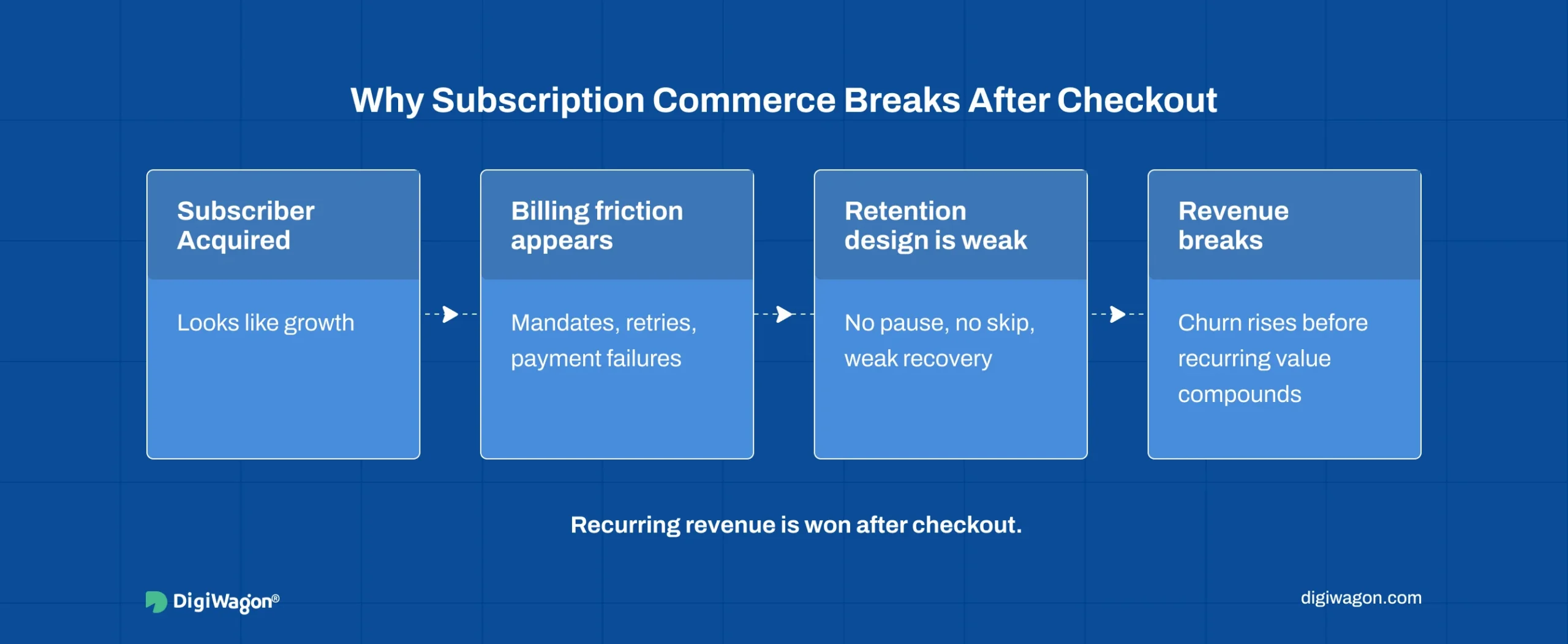
Most Indian D2C brands that try subscription commerce make the same three mistakes.
Mistake 1: Treating subscription as a discount lever. Offering 15% off for subscribing sounds logical, but it trains the customer to value the discount, not the convenience. When a competitor offers 20%, the subscriber leaves. The subscription value should be framed around convenience, consistency, and exclusivity, not price.
Mistake 2: Ignoring the pause/skip UX. In India, festivals, travel, and seasonal purchasing patterns mean subscribers frequently need to skip a delivery. If your system does not let them skip easily (one tap on WhatsApp or the app), they will cancel instead. The cancel-and-resubscribe friction is too high, and you lose them permanently.
Mistake 3: Building subscription on top of a one-time-purchase stack. Bolting a subscription plugin onto a storefront designed for single orders creates data model problems. Subscription needs its own entities: plans, billing cycles, mandate references, skip history, proration logic. When it is an afterthought, the inventory system does not know about upcoming subscription shipments, the warehouse gets surprised by recurring order volumes, and customer service cannot see the subscriber’s billing state. Build subscription into the data model from the start, or use a dedicated billing engine (Chargebee, Razorpay Subscriptions) that owns the subscription lifecycle separately from the order management system.
For a contrasting fulfilment model, see how quick commerce compresses delivery to 15 minutes while subscription commerce extends it to days or weeks. Quick commerce and subscription commerce are not competitors. They serve different purchase intents: impulse vs. planned replenishment.
DigiWagon’s Subscription Commerce Approach
DigiWagon builds subscription-based eCommerce development solutions for D2C brands in India and the UAE, covering billing architecture, payment integration, and retention tooling. Our capabilities include:
- UPI Autopay and Razorpay/Chargebee subscription billing integration
- Custom dunning workflows via WhatsApp Business API
- Subscription analytics dashboards (MRR, churn, cohort retention)
- GST-compliant recurring invoicing for multi-state operations
Making Subscription Work for Your D2C Brand
Subscription commerce is not a feature toggle. It is an operating model change that touches billing, logistics, customer communication, and product strategy. The Indian market adds specific constraints (UPI mandates, COD habits, WhatsApp-first communication) that global subscription tools do not handle natively.
Start with one product line that has a natural replenishment cycle. Build the billing stack on a dedicated engine (Chargebee or Razorpay Subscriptions). Instrument dunning via WhatsApp from day one. Track involuntary churn separately from voluntary churn. And design the pause/skip experience before you design the signup flow, because the subscriber who stays is worth more than the subscriber you acquire.
The D2C brands building omnichannel platforms for Indian consumers are the same brands best positioned to add subscription as a revenue layer. The customer data, logistics infrastructure, and brand relationship are already in place. Subscription is the monetisation upgrade.
Building a Subscription Model For Your D2C Brand?
Book a free architecture review to map your billing stack, payment integration, and retention tooling.