
Sustainable AI by Design: What CTOs Must Do in 2026 Learning in 2026
- Sustainable AI is now a board-level priority as ESG reporting expands across the USA, UAE, and Europe
- AI carbon footprint depends on electricity use and grid carbon intensity, measured using E × C
- The most effective reductions come from pruning + quantisation, carbon-aware training, and knowledge distillation
- Sustainable AI also improves cost efficiency through smarter hardware, cooling, and edge/sovereign deployment
To the CTOs, Sustainability Officers, and Product Leaders: in 2026, the metrics for “successful” AI have expanded. It is no longer enough for your Machine Learning models to be accurate; they must be sustainable.
As AI & Machine Learning adoption hits record highs across the USA, UAE, and Europe, the environmental cost has become a boardroom priority. Training a single large language model can emit as much CO₂ as five cars over their entire lifetime. In response, 2026 has ushered in the era of Sustainable AI by Design, a strategic movement to integrate energy efficiency into the very architecture of our digital intelligence.
The 2026 Climate Mandate: Why “Green AI” is No Longer Optional
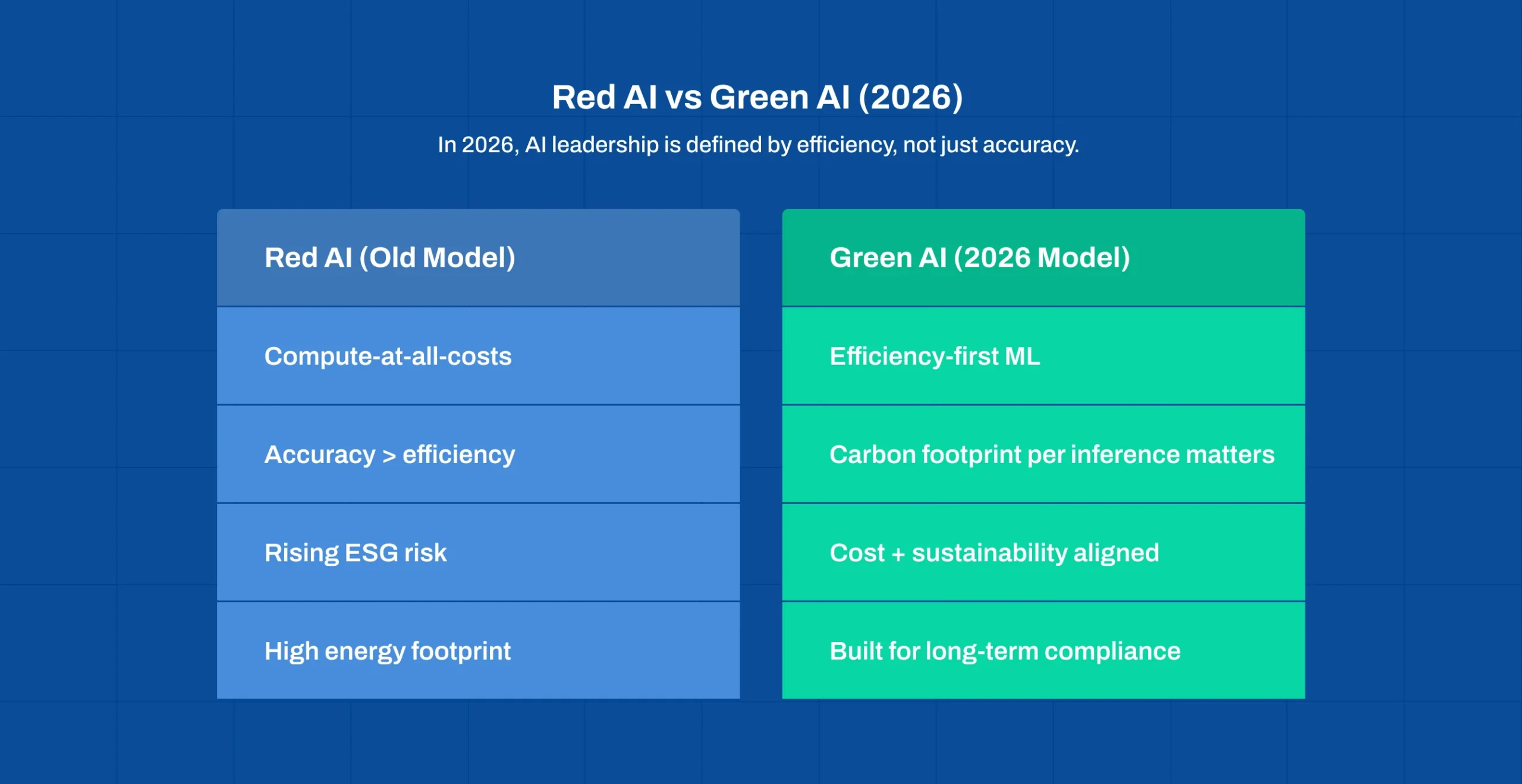
For years, the industry followed the path of “Red AI”, a “compute-at-all-costs” approach where marginal gains in accuracy were bought with massive increases in energy consumption. However, with new ESG (Environmental, Social, and Governance) reporting mandates in Germany and the US, Red AI is becoming a financial and regulatory liability.
From Red AI to Green AI: The Efficiency Paradigm Shift
The transition to Green AI prioritises algorithmic efficiency over raw power. The goal is to achieve state-of-the-art results while minimising the carbon footprint per inference. In 2026, “efficiency” is the new “accuracy.”
Calculating the Cost: Understanding the Environmental Impact of Training
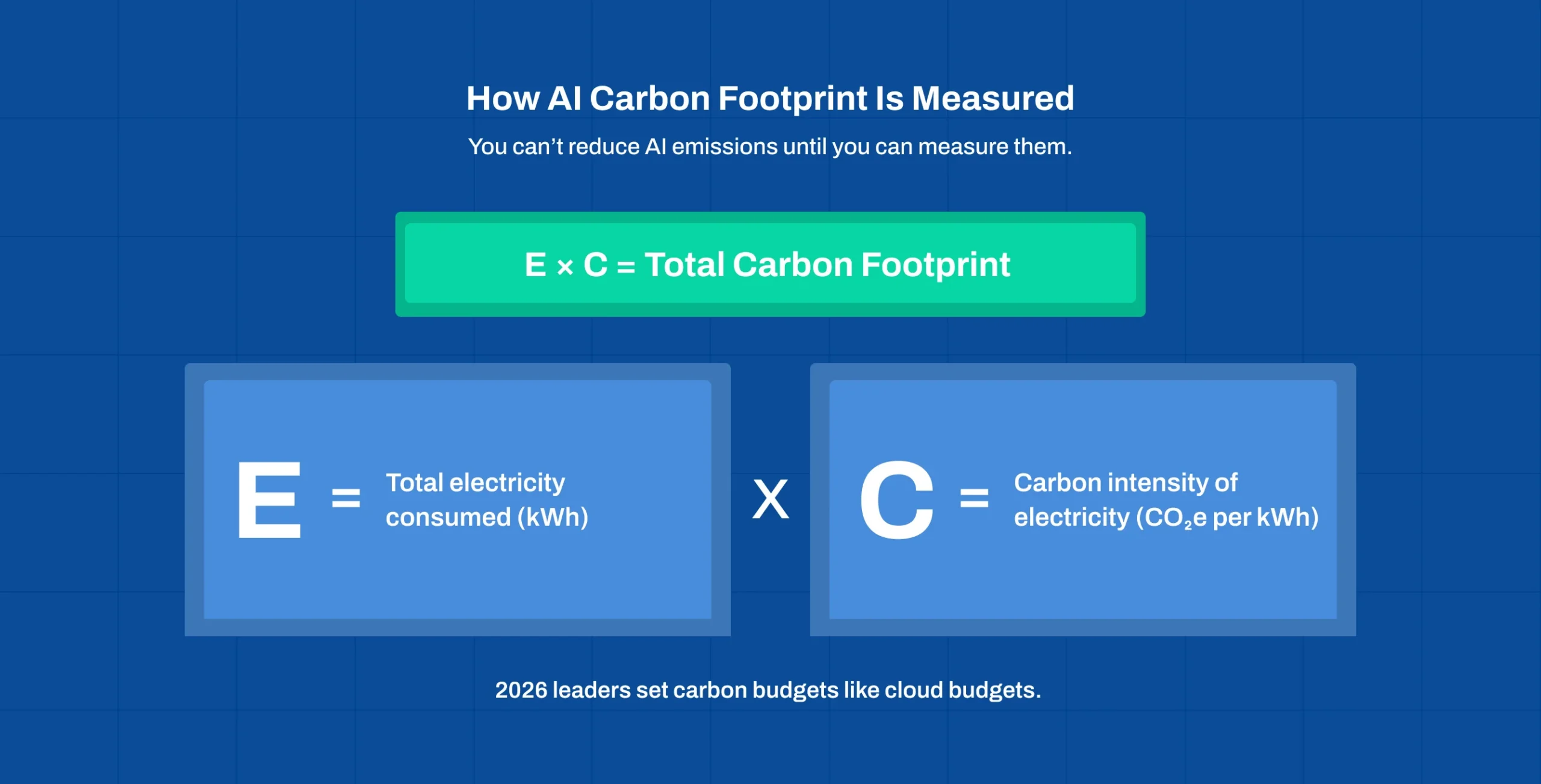
To reduce your footprint, you must first measure it. The carbon footprint of an ML model is defined by the formula:
E X C = Total Carbon Footprint
Where E is the total electricity consumed (kWh) and C is the carbon intensity of that electricity (CO₂e per kWh).
In 2026, leading enterprises are setting “Carbon Budgets” for every AI project, treating CO₂ emissions with the same scrutiny as cloud spend.
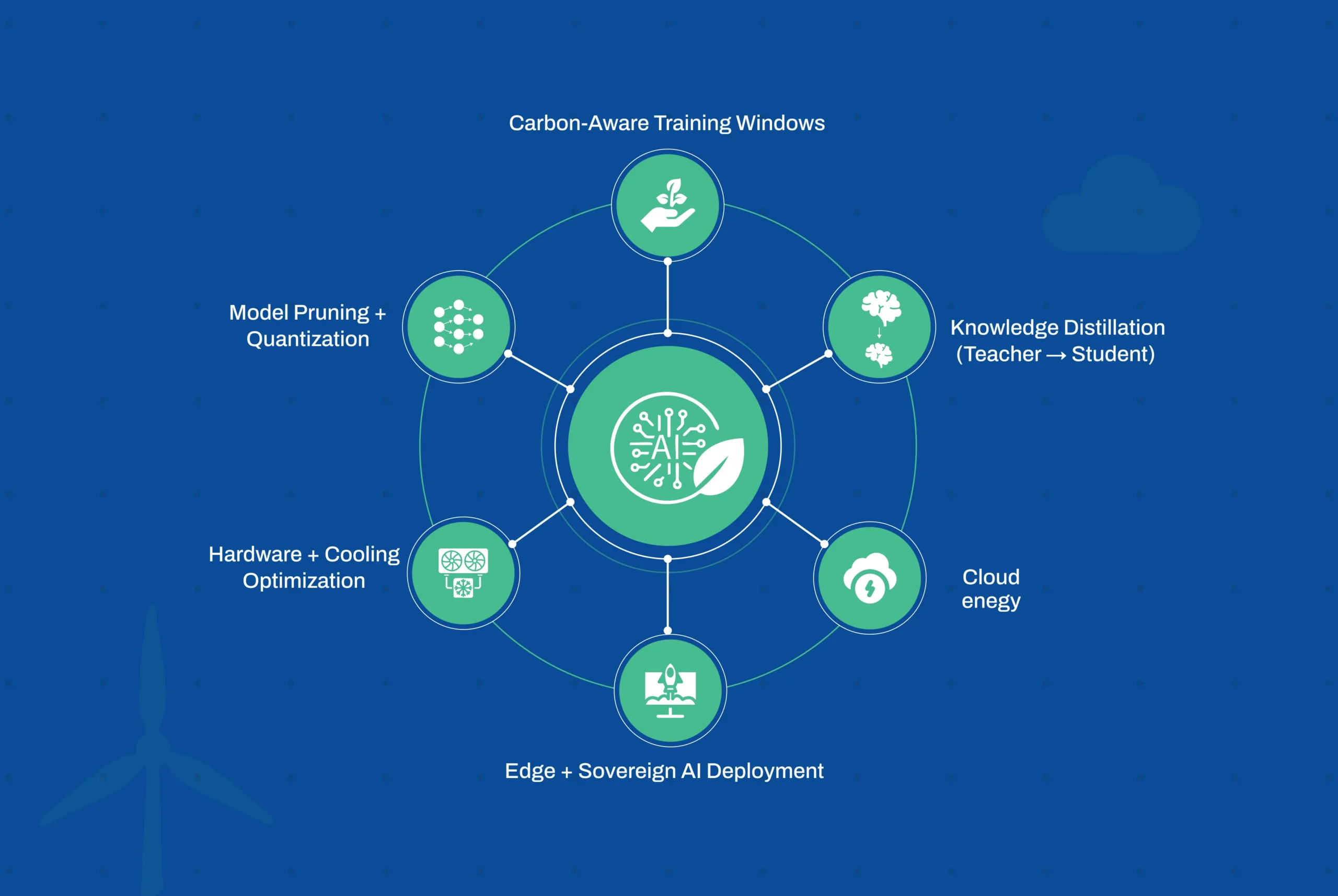
The Blueprint for Sustainable AI: 5 Core Strategies

1. Algorithmic Frugality: Model Pruning and Quantisation
One of the most effective ways to reduce energy is to make the models smaller without losing their “intelligence.”
- Model Pruning: Removing redundant neurons and weights that don’t contribute to the final output.
- Quantisation: Reducing the precision of weights (e.g., from 32-bit to 8-bit). This can reduce memory usage and energy consumption by up to 75% while maintaining nearly identical performance.
2. Carbon-Aware Computing: Timing the Grid
The carbon intensity of the power grid fluctuates throughout the day.
- Action: Schedule heavy training jobs during “green windows”, times when renewable energy (wind, solar) is at its peak on the local grid.
- ROI: Some firms are seeing a 40% reduction in training-related emissions simply by shifting when they hit “train.”
3. Knowledge Distillation: Teacher-Student Efficiency
Why run a massive 175B parameter model for a simple task?
- Strategy: Use a “Teacher” model to train a much smaller, highly specialised “Student” model. The student model retains the teacher’s expertise but runs at a fraction of the energy cost.
- Benefit: Ideal for SaaS Product Development where low latency and low energy use are critical.
4. Strategic Hardware Selection
Not all chips are created equal. In 2026, the shift is toward specialised AI accelerators (TPUs and specialised GPUs) and liquid-cooled data centres.
- Innovation: Liquid immersion cooling can reduce the energy required for data centre cooling by up to 90%, significantly lowering the overall Power Usage Effectiveness (PUE) ratio.
5. Sovereign & Edge AI: Reducing Data Transfer
Moving massive amounts of data to the cloud for processing is energy-intensive.
- Action: Deploying Edge AI (processing data locally on devices) or Sovereign AI (localised clusters in regions like Germany or the UAE) reduces the “network tax” of data transfer and supports regional data residency laws.
Governance and E-E-A-T: Reporting Your Environmental ROI
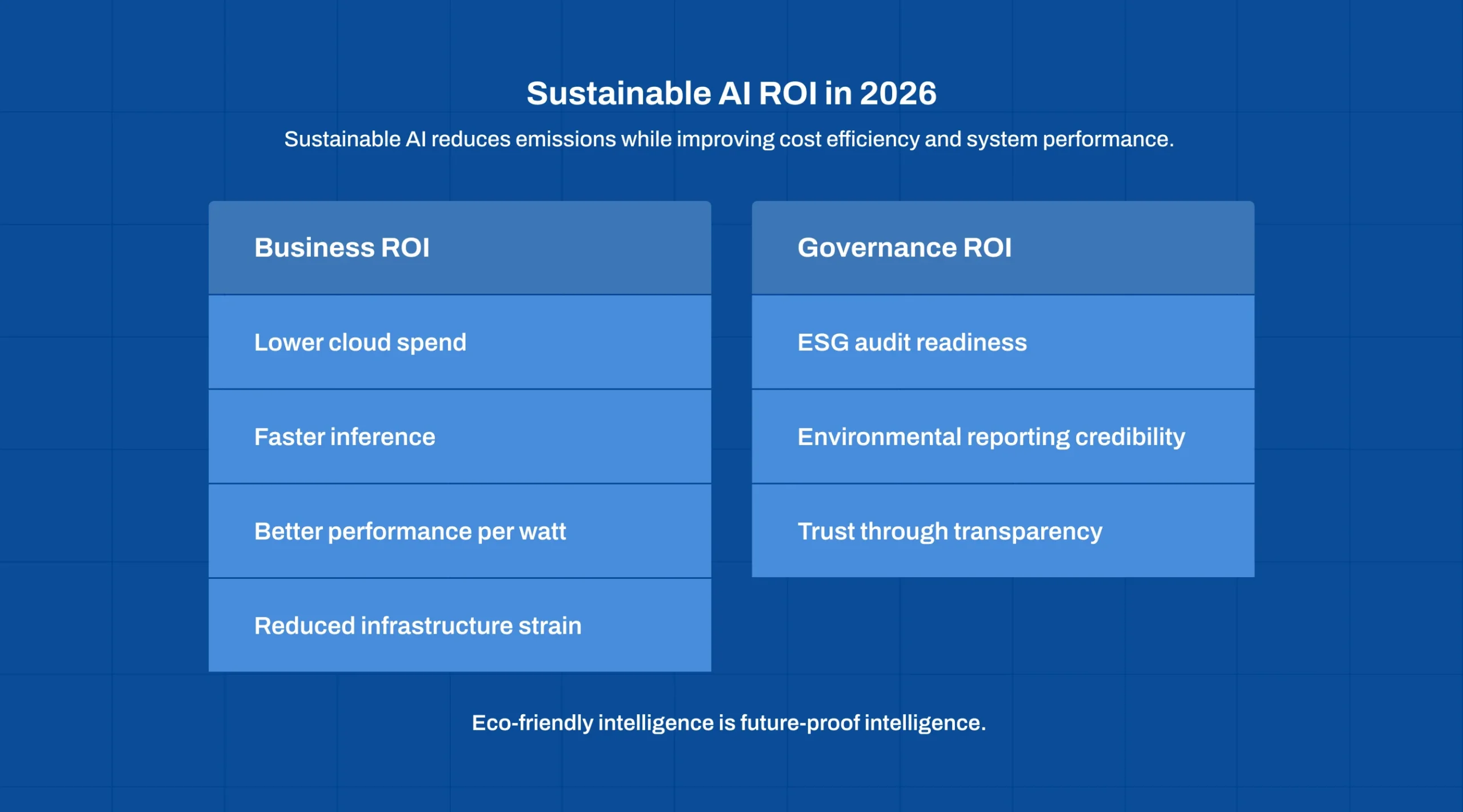
Trust (the ‘T’ in E-E-A-T) in 2026 is built on transparency. Clients and regulators expect to see:
- Environmental Audits: Regular reporting on the carbon and water footprint of your AI operations.
- Green Labelling: Using “Energy-Star” style labels for models to show their efficiency rating.
By documenting your commitment to Sustainable AI by Design, you demonstrate Authoritativeness in the evolving tech landscape.
Conclusion: Future-Proofing with Eco-Friendly Intelligence
Sustainable AI is not a compromise on innovation; it is a catalyst for it. At DigiWagon, we see sustainability as a strategic driver of intelligent growth. By optimising for energy efficiency, enterprises reduce cloud costs, improve system performance, and align with global climate goals. As we move through 2026, the leaders in the AI space will be those who prove that intelligence doesn’t have to cost the Earth.
Build AI That Performs and Sustains
Design machine learning systems that optimise compute efficiency, reduce carbon impact, and strengthen long-term enterprise resilience.