

The Non-Negotiable Role of Trust in YMYL (Your Money or Your Life) Software
In the high-stakes world of B2B IT, especially within the FinTech and Healthcare sectors, a great user interface (UI) is no longer enough. The software you deliver to US enterprises handles two of the most critical aspects of human life: money and health.
When your software touches these “Your Money or Your Life” (YMYL) topics, search engine algorithms-and more importantly, the end-users-demand a level of quality and credibility rooted in Google’s quality framework: E-E-A-T.
E-E-A-T stands for Experience, Expertise, Authoritativeness, and Trustworthiness. We know it’s quickly becoming the gold standard for evaluating the quality, safety, and adoption of the digital products themselves. For CTOs and Product Heads, applying E-E-A-T to your UX Design & Engineering strategy isn’t an option-it’s the fastest path to market adoption and sustained success in regulated environments.
Decoding E-E-A-T for Digital Products, Not Just Content
E-E-A-T for UX – The Trust Framework for FinTech & Healthcare Software
Experience, Expertise, Authority, and Trust – the foundation of adoption.
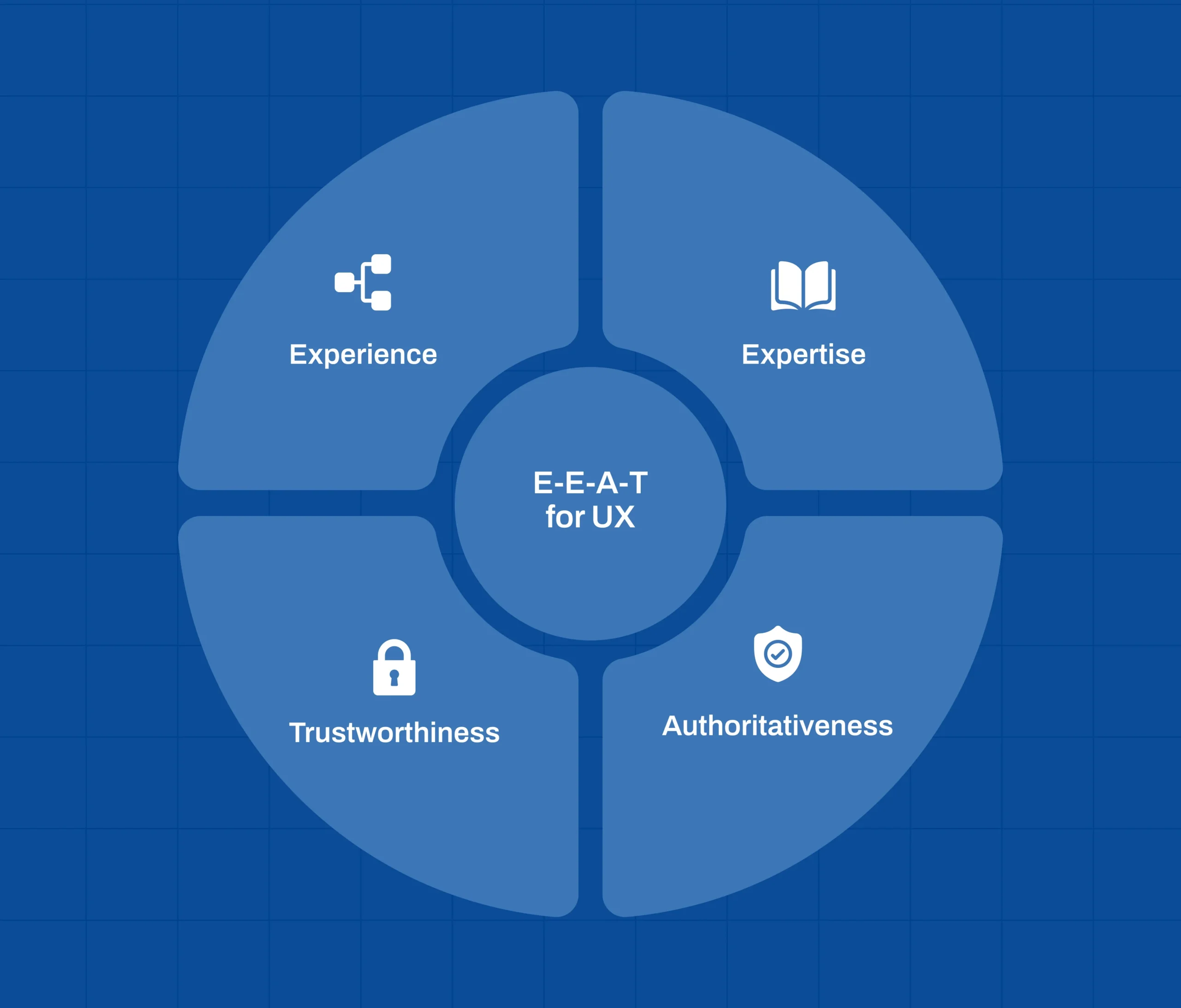
Think of E-E-A-T as the intangible glue that converts a functional piece of software into a trusted digital partner. Let’s break down how each pillar translates from an abstract concept into tangible design elements.
Experience (E): Translating Practitioner Insight into Workflow
The newest ‘E’ emphasises first-hand, real-world experience. In software, this means the platform must feel like it was designed by someone who has actually lived the user’s job.
- UX Application: A Healthcare EMR (Electronic Medical Record) system built for US physicians needs to mirror the actual flow of a clinic visit, not an idealised corporate process. We demonstrate experience through intensive User Research and Contextual Inquiry, ensuring the UI is frictionless and aligned with industry best practices (e.g., reducing “alert fatigue” common in legacy systems).
- The Outcome: The user feels instinctively familiar with the product, reducing training time and boosting adoption.
Expertise (E): Showcasing the ‘Why’ Behind the Functionality
Expertise refers to the specialised knowledge baked into the software’s features and output.
- UX Application: A FinTech wealth management tool must clearly cite its data sources for investment recommendations, displaying the relevant regulatory licenses of the adviser or firm providing the content. In a diagnostic application, the UI must explain the logic behind a scoring model.
- The Outcome: Users (e.g., licensed financial planners, board-certified doctors) trust the outputs because they can verify the depth and validity of the underlying knowledge.
Authoritativeness (A): Building a Reputational Halo Around the App
Authoritativeness is your product’s reputation within the broader industry. It’s what makes industry leaders cite your software as the “go-to” platform in its niche.
- UX Application: Use established Design System components and conventions that are recognised as reliable in the industry. Prominently display security badges, audit certifications, and institutional partnerships (e.g., links to the Federal Reserve or relevant medical associations).
- The Outcome: Your product gains a status that transcends its features. It’s not just a tool; it’s the industry benchmark.
Trustworthiness (T): The Foundation of Security and Predictability
Trust is the most critical element. It encompasses security, accuracy, transparency, and safety. For YMYL software, Trustworthiness is non-negotiable.
- UX Application: This is where the technical and design worlds align: clear privacy policies, transparent data usage disclosures, easily accessible support contact information, robust Security Testing, and an ironclad commitment to compliance (like HIPAA in the USA). All user actions must be predictable, with clear, jargon-free error states and confirmation messages.
- The Outcome: Users feel safe, secure, and confident that the software will perform as expected, every single time.
Turn your UX into a trust signal. Build with DigiWagon – where design equals credibility
UX Strategy for High-Stakes Sectors (FinTech & Healthcare in the USA)
Designing for Trust: FinTech vs Healthcare UX Priorities
E-E-A-T principles adapt to the realities of each regulated industry.
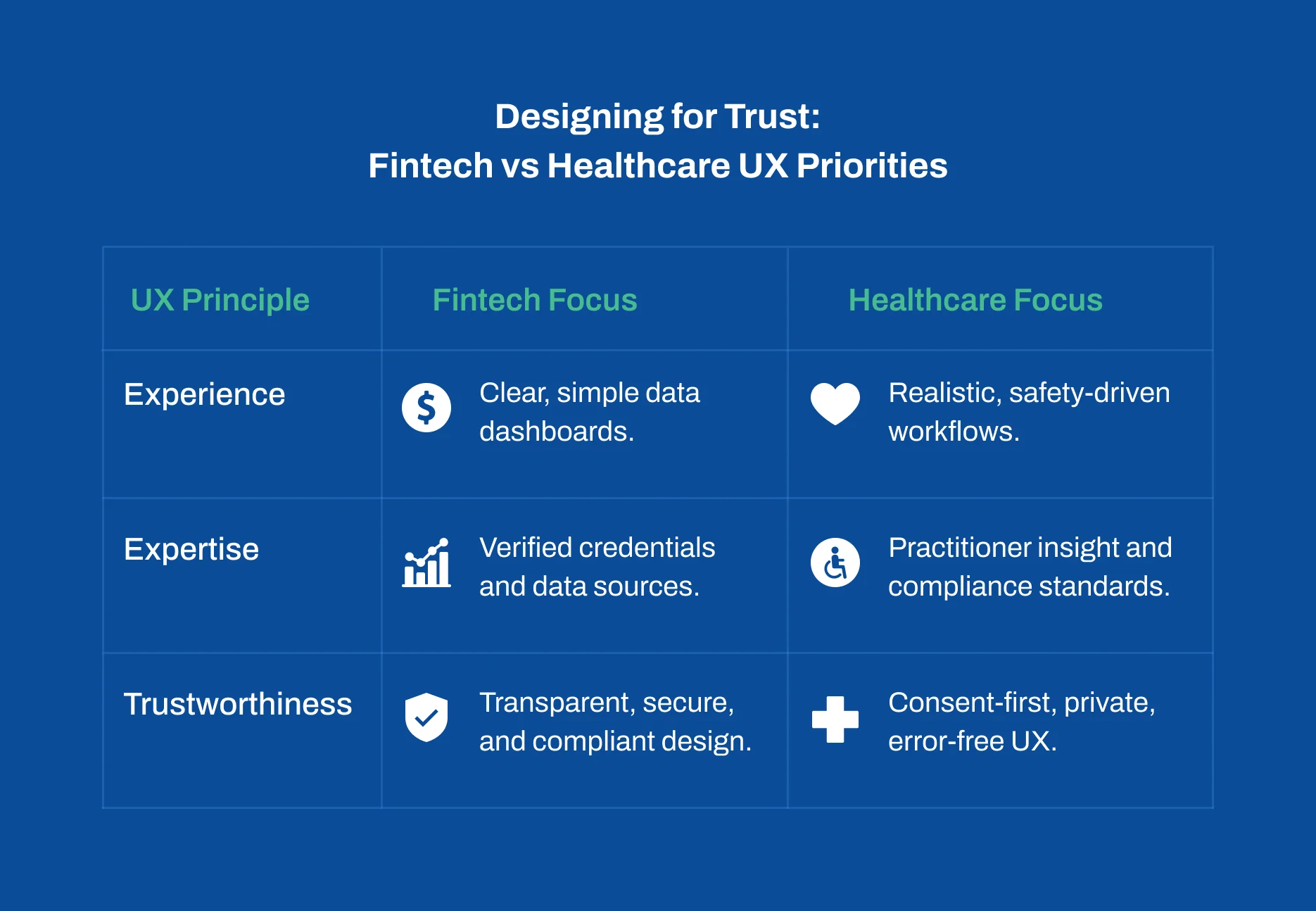
Delivering solutions in the USA requires a deep understanding of the local regulatory environment, which E-E-A-T perfectly complements.
FinTech Focus: Simplifying Complexity to Build Financial Confidence
FinTech UX must simplify complex financial instruments without sacrificing transparency. Our approach for B2B eCommerce and financial Enterprise Software focuses on:
- Transparency of Fees and Risk: Use interactive visualisations and simple language to break down complex concepts like interest rates or fund risk profiles. The design must be transparent, not deceptive.
- Clear Audit Trails: For RegTech or InsurTech solutions, every transaction or decision must have an accessible, one-click log, demonstrating expertise and compliance.
- Predictable Micro-Interactions: Forms and data entry in financial systems must have instant, positive feedback to reduce user anxiety (e.g., “Your connection is securely encrypted”).
Healthcare Focus: The Human-Centered Design Mandate (HIPAA & Accessibility)
For Healthcare Transformation projects, UX is literally a matter of life or death.
- Accessibility-First Design: Meeting WCAG (Web Content Accessibility Guidelines) is essential, but a true E-E-A-T approach goes beyond compliance. It ensures all users-from older patients to clinicians with high cognitive load-can use the software safely.
- Consent and Privacy UX: HIPAA compliance requires more than a simple checkbox. Design clear, understandable consent flows for data sharing. Use subtle visual cues to remind users when sensitive patient data is on screen.
- Frictionless Workflows: By performing a Design Audit on existing EMRs, we find and eliminate points of friction that contribute to clinician burnout, demonstrating Experience and Expertise in the clinical process.
Whether it’s financial confidence or patient safety – trust begins with E-E-A-T-driven UX design.
Technical UX Pillars for Demonstrating E-E-A-T
Building Trust by Design – The Technical UX Foundations of E-E-A-T
Trust isn’t added later – it’s architected into every pixel.
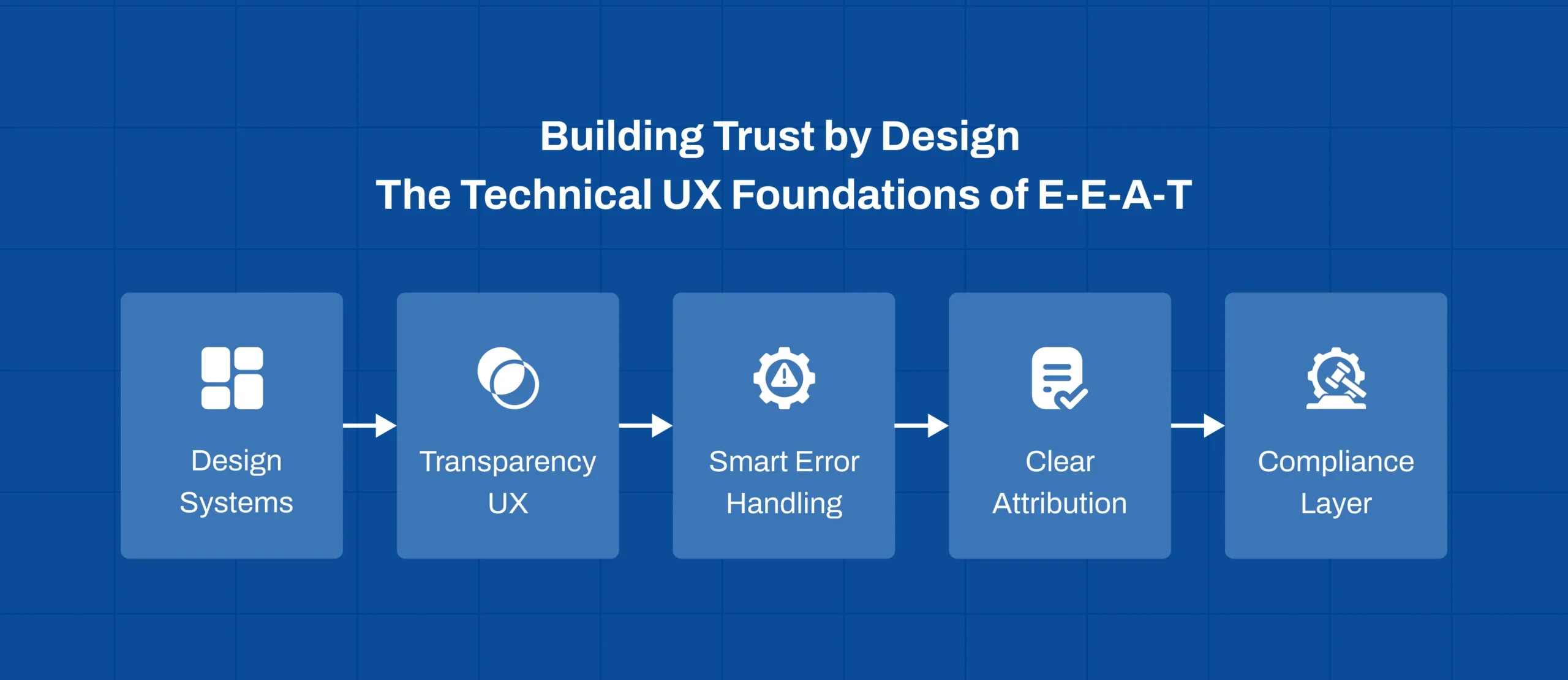
The E-E-A-T UX strategy relies on powerful technical underpinnings, key to scalable software development.
Design Systems: The Engine of Consistency and Authority
A robust Design System is the technical blueprint of E-E-A-T. It ensures that every component – from buttons to forms – behaves predictably across your SaaS ecosystem. Consistency builds familiarity and reliability, reinforcing Trustworthiness while signaling design maturity and organisational Expertise.
Transparency UX: Building Openness into Every Interaction
Transparency is more than compliance – it’s ethical design in action. By clearly showing how data is used, processed, or shared, users gain confidence in your platform’s integrity. Transparent workflows and microcopy communicate accountability, strengthening both Trust and Authority in regulated industries.
Attribution for AI Outputs: Designing for Clarity and Credibility
In the era of AI-driven insights, clear attribution is essential to maintain user trust. Label all AI-generated content (“Generated via AI Model X”) and allow users to explore supporting logic or human validation. This transparency upholds Trustworthiness, safeguards credibility, and aligns your software with global compliance standards.
Compliance by Design: Turning Regulation into a Competitive Edge
True compliance isn’t tacked on – it’s built into the experience. Integrating HIPAA, PCI DSS, and GDPR safeguards directly into core workflows reassures users that their data is protected at every step. When security and privacy are visible in design, compliance shifts from a regulatory burden to a mark of brand excellence.
Make compliance your competitive edge – not your constraint.
Conclusion: The ROI of a Trustworthy User Experience
For enterprise leaders, investing in E-E-A-T-driven UI/UX Design & Engineering is not merely a box to check for search engines or regulators; it is a direct investment in the Return on Investment (ROI) of your software.
Software that is experienced, expert-driven, authoritative, and trustworthy sees:
- Higher User Adoption Rates: Users gravitate toward platforms they implicitly trust.
- Reduced Training and Support Costs: Intuitive, experienced-driven UX requires less hand-holding.
- Faster Regulatory Approvals: Proactive compliance baked into the Custom Software design smooths the path to market.
In the competitive US, UK, and European markets, trust is the new utility. Make E-E-A-T the core of your next digital initiative. We specialize in building this level of foundational trust into your Advanced Software Solutions.