
To the CTOs, Product Heads, and Founders across London, New York, and beyond: the conversation around enterprise automation has fundamentally changed.
For years, Robotic Process Automation (RPA) was the flagbearer of efficiency. But as the market demands agility, hyper-personalisation, and real-time decision-making, simply following a script no longer delivers competitive advantage. We’re moving into the era of Autonomous AI Agents-intelligent software entities that don’t just follow rules; they perceive, reason, act, and learn. For US and UK enterprises looking to redefine productivity in 2025, Agentic AI is no longer a futuristic concept-it’s the mandate for next-gen automation.
The End of Static Automation: Why RPA Isn’t Enough Anymore
The Evolution of Automation – From RPA to Autonomous AI Agents Automation that learns, adapts, and acts on its own.

1. Traditional RPA (Rule-Based):
Structured, repetitive tasks. Breaks easily with UI or logic changes.
Example: Data entry or invoice processing
Limitation: No learning or adaptability.
2. Cognitive Automation (RPA + AI):
Basic intelligence layer via NLP or OCR.
Example: Reading documents, classifying data.
Limitation: Partial autonomy, still dependent on static logic.
3. Autonomous AI Agents:
Perceive, reason, act, and learn in real time.
Example: AI agent detecting fraud, rerouting logistics, or handling compliance autonomously.
Outcome: Dynamic adaptability and self-improving intelligence.
Move from automation to autonomy – build intelligent agents that think for your enterprise.
Think about the automation stack in a typical enterprise. You have ERPs, CRMs, and a layer of RPA bots handling repetitive, structured tasks like data entry or invoice processing. This worked for a time, delivering measurable cost savings.
The problem? RPA is fundamentally rigid. If the user interface changes, the bot breaks. If the process requires an unpredictable decision-like assessing credit risk on a new data point or rerouting a shipment due to a sudden weather event-the system halts, requiring human intervention. In fast-moving sectors like Fintech or Logistics, these friction points erode time-to-market and customer experience.
The Limitations of Rule-Based Systems
- Inability to Adapt: They fail when faced with unstructured data (e.g., non-standard emails, images).
- Zero Learning: They can’t self-improve or adjust their logic based on new outcomes or data.
- Narrow Scope: They are limited to pre-defined, single-application tasks.The market has matured. A recent survey suggests that 79% of organisations in major markets are already adopting autonomous AI agents because traditional methods cannot handle the complexity of modern business processes.
What Exactly is an Autonomous AI Agent? (The “Perceive, Reason, Act, Learn” Loop)
The Intelligent Core: How Autonomous AI Agents Work Perceive. Reason. Act. Learn – the loop that never sleeps.

1. Perceive:
Gathers contextual data from emails, APIs, or sensors.
Example: Reads supplier data and system alerts simultaneously.
2. Reason:
Uses LLMs and neural reasoning to plan next steps.
Example: Determines optimal action sequence for resolving a customer issue.
3. Act:
Executes multi-step workflows autonomously via integrations.
Example: Freezes fraudulent accounts or reroutes delayed shipments.
4. Learn:
Records results, measures success, and refines its logic.
Example: Improves future routing accuracy or fraud thresholds.
Deploy intelligent agents that grow smarter with every task.
An autonomous AI agent is a software system with a defined goal that can operate independently within an environment to achieve that goal. Unlike an LLM (which is a model) or an RPA bot (which is a script), an agent possesses agency, meaning it can choose its own course of action.
Its functionality is defined by a continuous loop:
- Perceive: Gathers context-rich data from multiple systems (e.g., read an email, check a database, monitor a sensor feed).
- Reason: Uses advanced Large Language Models (LLMs) and deep learning to break down the task, create a dynamic plan, and make a context-aware decision.
- Act: Executes a complex action, often involving multiple steps, tool calls (APIs), and system integrations.
- Learn: Evaluates the outcome, stores the experience in memory, and refines its internal logic for future tasks, leading to continuous improvement.
The Core Difference: Autonomy and Adaptability
The shift from RPA to Agentic AI is a paradigm leap from automation to autonomy. You are not just automating a task; you are delegating a functional goal to a digital employee.
| Feature | Traditional RPA | Autonomous AI Agent |
|---|---|---|
| Foundation | Fixed Ruleset / Pre-defined Script | Large Language Models (LLMs) & Reasoning Engine |
| Adaptability | None (Breaks on process change) | High (Adapts to new data, self-corrects) |
| Task Complexity | Simple, Repetitive, Structured Data | Complex, Multi-step, Unstructured Data |
| Goal | Execute a specific action | Achieve a defined objective (e.g., “Resolve the customer’s issue”) |
High-Impact Agentic AI Use Cases for US & UK Enterprises
Autonomous AI in Action – Real Enterprise Impact Where human judgment meets machine precision.

FinTech & RegTech
1. Autonomous Fraud Response:
- Agents detect anomalies and take instant action – freeze, verify, report.
2. Regulatory Compliance Automation:
- Agents adapt to new KYC/AML laws in real time.
3. Risk Scoring Optimisation:
- Evaluate creditworthiness dynamically with zero human input.
Logistics & Supply Chain
1. Adaptive Shipment Management:
- Multi-agent systems reroute shipments during delays.
2. Vendor Performance Tracking:
- Continuous data collection and renegotiation automation.
3. Predictive Resource Allocation:
- Balances inventory based on real-time global conditions.
DigiWagon builds autonomous systems that deliver measurable ROI – from FinTech to FreightTech.
The highest-value applications are emerging in heavily data-driven and regulated sectors across the US and UK.
Financial Services: From Fraud Detection to Autonomous Compliance
In FinTech and InsurTech, agents deliver speed and precision that human teams cannot match, resulting in significant ROI (often reported above 300% for specific compliance use cases).
- Autonomous Fraud Response: An agent monitors billions of transactions in real-time. Upon detecting an anomaly (e.g., rapid, high-value purchases in a new geography), it doesn’t just flag it. It instantly initiates an action chain: freezes the account, sends a verification alert to the customer, and generates an audit-ready incident report for a human analyst.
- Real-Time Regulatory Compliance: Agents absorb new regulations (RegTech) and automatically enforce them across internal processing stages, such as checking a new KYC rule against a customer’s profile before approving a high-risk transaction. They proactively log every action for instant auditing.
Logistics & Supply Chain: Predictive and Adaptive Routing
For our clients in the Logistics and Supply Chain sector, AI agents are transforming unpredictable operations into optimised workflows.
- Adaptive Shipment Management: A multi-agent system monitors global variables (weather, traffic, port congestion, supplier inventory). If an agent detects a 48-hour delay at a major UK port due to a strike, it autonomously calculates the cost-benefit of rerouting the cargo, contacts the customer with new estimated times, and updates all upstream and downstream systems (inventory, billing, and fulfillment).
- Procurement and Vendor Management: Agents track supplier performance, analyse current market prices for raw materials, and autonomously initiate re-ordering or even open negotiations with alternative suppliers when a pre-set risk threshold is breached.
The CTO’s Strategic Playbook: Implementing Multi-Agent Systems
The CTO’s Playbook for Multi-Agent Success From strategy to scalability.
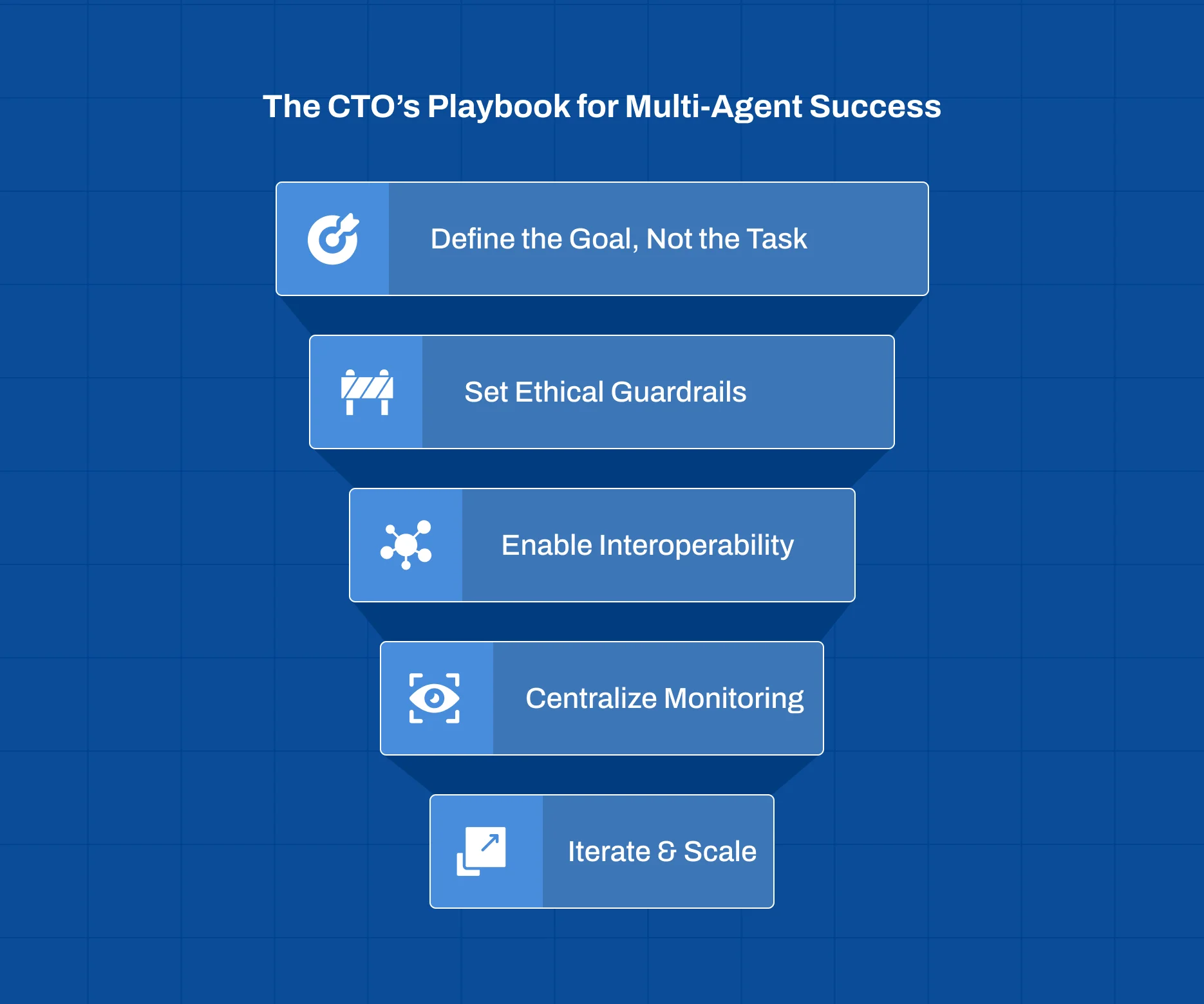
1. Define the Goal, Not the Task: Let agents decide optimal steps within clear business objectives.
2. Set Ethical Guardrails: Ensure Responsible AI governance – explainable and traceable.
3. Enable Interoperability: Agents must work seamlessly across ERP, CRM, and data systems.
4. Centralise Monitoring: Track agent performance via dashboards and feedback loops.
5. Iterate & Scale: Expand from single-use agents to fully collaborative ecosystems.
Partner with DigiWagon to design multi-agent ecosystems that think, collaborate, and evolve.
The real power of Agentic AI lies in multi-agent systems-where specialised agents collaborate to solve a complex, end-to-end business problem.
Imagine a team of agents handling a mortgage application: one agent gathers all financial data; a second agent performs automated compliance checks; a third agent calculates the risk score and finalises the loan terms; and a fourth agent generates and sends the legally compliant offer documents. This is a coordinated, autonomous workflow.
Overcoming the Challenges of Agent Orchestration
Implementing these systems requires a robust technical foundation and clear governance.
- Define the Goal, Not the Steps: Successful AI Agent Development starts by defining a clear, measurable business objective, allowing the agent’s reasoning engine to determine the optimal steps.
- Establish Guardrails: Implement strong Responsible AI frameworks to ensure the agent’s actions are transparent, explainable, and accountable, which is crucial for regulated markets like the UK and US.
- Prioritise Interoperability: Ensure the agents can seamlessly integrate with your existing Enterprise Software and legacy systems, acting as a dynamic layer of intelligence that orchestrates action across your IT stack.
Future-Proofing Your Enterprise with Agentic AI Development
The era of autonomous AI agents is an inflection point for enterprise efficiency. By transitioning from static, rule-based automation to dynamic, learning-driven Agentic AI, CTOs and business leaders in the US, UK, and Europe can unlock unprecedented productivity gains, leading to:
- Cost Reduction: Automating decision-heavy, complex processes.
- Agility: Real-time adaptability to market and operational changes.
- Innovation: Freeing up skilled talent to focus on strategic, human-centric tasks.
Don’t wait for your competitors to redefine the benchmark for efficiency. The time to invest in a strategic AI Agent Development partner to build your multi-agent architecture is now.