

Executive Summary
- In-house UX makes sense when design work is continuous, embedded in product delivery, and central to long-term growth.
- Consultants are often the better choice when the need is time-bound, domain-specific, or tied to a high-impact product problem.
- Most SaaS companies do not need to choose one model permanently. Hybrid often works best while the design function is still maturing.
- The right decision depends less on hourly cost and more on capability fit, product stage, and execution speed.
What Are UX Consulting Services?
UX consulting services are professional advisory and design engagements where an external UX specialist or team evaluates, designs, or restructures the user experience of a product, application, or digital service. Unlike ongoing staff augmentation, UX consulting is scoped around a defined problem – a conversion bottleneck, a compliance-driven redesign, or a new product launch. It differs from hiring a freelance designer in that consulting includes strategic recommendations, research synthesis, and architectural decisions about information flow, not just wireframes and visual polish.
Why This Decision Matters More in 2026?
For SaaS leaders, the question is no longer whether UX matters. It is how to access the right UX capability without creating the wrong team structure too early.
Demand for UX expertise is rising, while hiring remains expensive and slow across major SaaS markets. At the same time, product teams are under pressure to improve onboarding, retention, and workflow clarity faster than in-house hiring cycles often allow. That makes the decision between a UX consultant and an in-house team more strategic than it used to be.
The real issue is not which option looks cheaper on paper. It is which model fits the product stage, delivery cadence, and complexity of the work.
What Is the True Cost of Building an In-House UX Team?
The cost of an in-house UX team goes well beyond salary. Compensation is only one part of the equation. Benefits, tooling, recruiting, management overhead, and ramp-up time all increase the real cost of a hire.
In practice, benefits alone can add around 25% on top of base salary. Recruiting, onboarding, and tool access increase that further, while the first few months of ramp-up reduce output before the designer reaches full productivity.
That means the true first-year cost of an in-house UX hire is often substantially higher than the salary figure leadership teams use in planning discussions.
When In-House Makes Sense
In-house UX is usually the right investment when:
- Design demand is continuous The business has a steady flow of UX work, not occasional bursts.
- Domain knowledge compounds over time The product operates in a complex environment where context becomes more valuable with long-term ownership.
- Design is strategically core UX directly shapes retention, conversion, or product differentiation, rather than acting as a supporting function.
Most SaaS companies should not build a full in-house UX function before the demand for design is continuous and strategically important. Hiring too early creates fixed overhead before the design model is mature enough to justify it.
UX Consultant vs. In-House UX Team
| Decision Factor | UX Consultant | In-House UX Team |
|---|---|---|
| Speed to start | Faster for focused work | Slower due to hiring and ramp-up |
| Domain expertise | Strong when specialised experience is needed | Builds over time inside the business |
| Continuity | Best for defined engagements or advisory support | Best for ongoing design demand |
| Product context | Brings outside perspective quickly | Builds deeper internal context over time |
| Team structure | Flexible and lower-commitment | Fixed headcount and long-term ownership |
| Strategic fit | Strong for time-bound, high-impact UX challenges | Strong when design is continuous and core to product growth |
What Does a UX Consulting Engagement Actually Deliver?
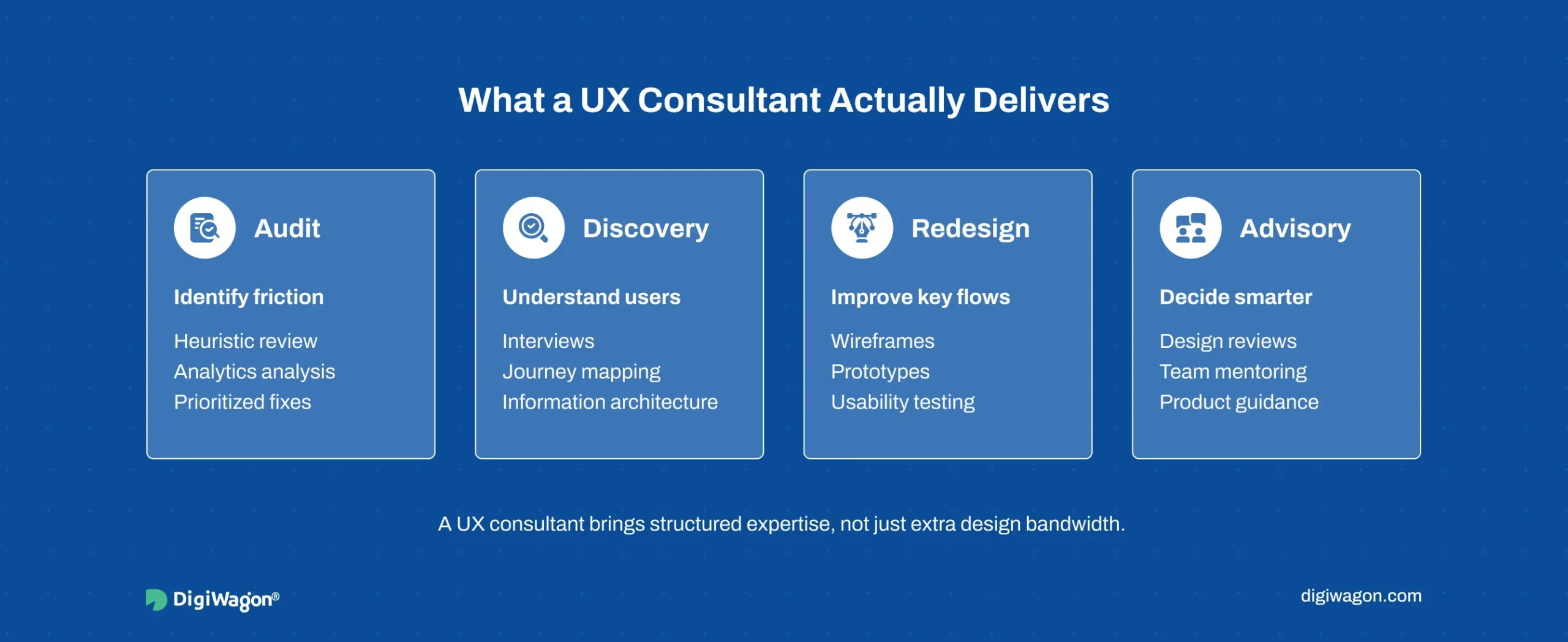
A UX consulting engagement is not just external design support. It gives the business access to structured methodology, fresh product perspective, and experience the current team may not have in-house.
- Depending on the need, a consulting engagement may deliver:
- A targeted UX audit with prioritized recommendations
- A product discovery sprint with research, journey mapping, and information architecture
- A scoped redesign covering workflows, wireframes, prototypes, and testing
- Ongoing advisory support through design reviews, mentoring, and product guidance
A consulting engagement may also include workflow reviews in Figma, user testing through platforms such as Maze or UserTesting, and behavioural insight from tools like Hotjar or FullStory where product teams need stronger evidence behind design decisions.
The value is not just execution. It is bringing the right level of UX capability to the product without locking the business into permanent headcount too early.
When a Consultant Wins
A consultant is often the better choice when:
- The problem is time-boxed The business needs focused UX work on a specific product area, not a full-time design function.
- Specialized experience is missing The product operates in a domain where UX decisions depend on industry knowledge, regulated workflows, or complex user journeys.
- An outside perspective is needed Internal teams can become too close to the product. A consultant brings objectivity and a clearer view of friction points.
- Speed matters more than building headcount A consultant can usually begin much faster than a full hiring cycle and helps the business move earlier on critical UX work.
How Do You Decide? A Five-Question Framework

The consultant versus in-house decision becomes clearer when you stop asking who is cheaper and start asking what kind of UX problem you actually have.
These five questions help separate recurring design demand from time-bound product challenges, and capability gaps from simple bandwidth needs.
1. Is the UX challenge recurring or time-bound?
If the work is continuous and embedded in product delivery, in-house usually makes more sense. If the need is tied to a defined redesign, launch, or workflow problem, a consultant is often the stronger fit.
2. Does the work require domain-specific expertise?
If the product operates in regulated or complex environments, a consultant with relevant experience can create value much faster than a generalist in-house hire ramping up from zero context.
3. Are you trying to build a design function or solve a product problem?
If the goal is long-term design maturity, internal hiring is often the right move. If the goal is to fix a specific onboarding, activation, or workflow issue, consulting is usually more efficient.
4. Does the situation need embedded context or outside perspective?
In-house teams build deep product understanding over time. Consultants bring sharper objectivity when internal teams are too close to the current experience to see friction clearly.
5. Are you investing in permanent capability or temporary leverage?
If design will remain a strategic, ongoing function, internal capability matters more. If the business needs focused progress without committing to full-time overhead, external expertise is often the better model.
How to read the answer?
If most of your answers point toward continuity, embedded context, and long-term capability, an in-house team is the better path.
If they point toward speed, specialized expertise, outside perspective, and time-bound work, a consultant is usually the stronger choice.
If the answers are mixed, the right answer is often a hybrid model.
What This Looks Like in Practice?
In products like SmartLend, UX was not just about visual polish. It shaped how users moved through sensitive workflows, how trust was communicated, and how product logic was translated into a usable experience. In that kind of environment, consultant-led support can add value quickly because the problem is not just design capacity. It is domain-aware product judgment.
The Hybrid Model: Why Most SaaS Companies Land Here
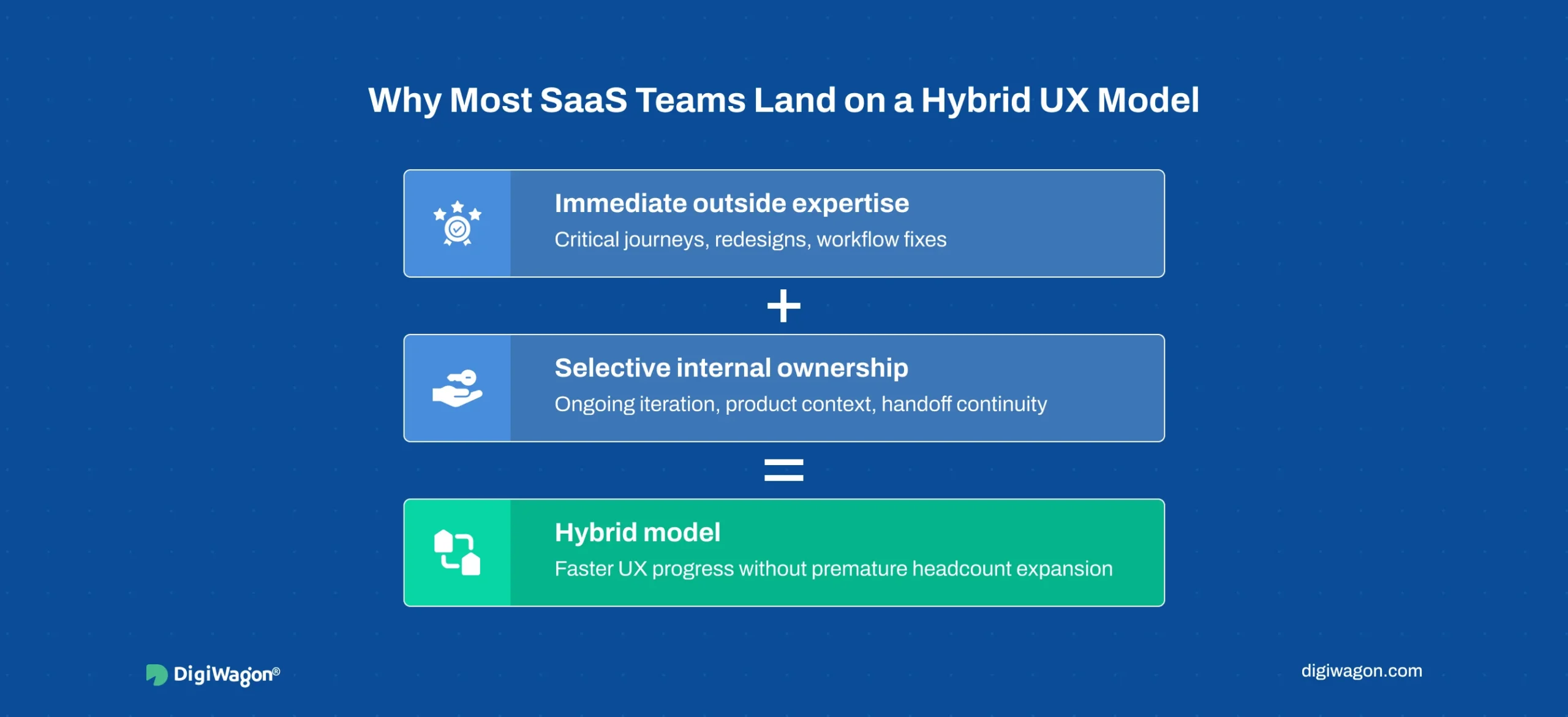
In many SaaS companies, the decision is not strictly consultant versus in-house. The better answer is often a staged model that uses both at different moments of product maturity.
A hybrid approach works best when the company needs senior UX judgment immediately, but is not yet ready to build a full internal design function. In that scenario, a consultant can help define the product direction, improve key workflows, and establish stronger UX foundations while the internal team grows more selectively around long-term needs.
This model is especially useful when:
- The product has urgent UX issues but not enough continuous work for a full team
- Internal product and engineering teams need design support, but not permanent headcount across every surface
- The company wants outside expertise on critical journeys while preserving internal ownership over ongoing iteration
- Leadership is still learning whether UX will become a strategic function or remain a focused support capability
The hybrid model works well because it separates immediate capability from permanent structure. It allows the business to improve the product now without locking into the wrong operating model too early.
How to Engage DigiWagon Across UX Needs?
DigiWagon supports SaaS teams across different UX needs, depending on whether the requirement is strategic, time-bound, or ongoing.
Common engagement models include:
- Focused UX consulting engagements For teams that need expert support on a specific challenge such as onboarding redesign, workflow simplification, usability review, or product discovery.
- Domain-aware UX support For products operating in regulated or complexity-heavy environments where UX decisions depend on workflow clarity, compliance logic, and industry context.
- Fractional design leadership For companies that need senior UX direction, design reviews, and product guidance without committing to a full-time in-house lead too early.
- Hybrid team support For SaaS businesses that already have product and engineering teams in place but need external UX capability to accelerate delivery, unblock internal teams, or strengthen decision-making on high-impact journeys.
- Foundation building for internal teams For companies that want to improve UX now while also building stronger design processes, collaboration models, and handoff practices for future in-house growth.
The right engagement model depends on the product stage, the complexity of the UX work, and whether the business needs short-term leverage, specialist expertise, or longer-term design direction. Depending on the engagement, this may include work across design, testing, and behavioural insight tools such as Figma, Maze, UserTesting, Hotjar, or FullStory.
This makes DigiWagon useful not only as an external design resource, but as a flexible partner across different stages of product and team maturity.
Conclusion
The decision between a UX consultant and an in-house team is not just about cost or hiring speed. It is about matching the right capability model to the stage, complexity, and strategic value of the UX work.
In-house design makes sense when UX is continuous, embedded, and central to product growth. Consulting is often the better choice when the need is time-bound, domain-specific, or tied to a critical product challenge that requires outside expertise and faster execution.
For many SaaS teams, the right answer is not fixed. It changes as the product, the team, and the design function mature.
Choose the Right UX Model for Your Product
Get clarity on whether your product needs consulting support, in-house design capacity, or a hybrid model.