Visual Intelligence Designed for Real-World Conditions
We develop computer vision solutions that detect, inspect, recognize and track what matters across images and video, with accuracy, edge latency, environmental variation, and model drift considered from the start.
The model performs on a workstation and not where it has to run, because the bandwidth, the latency, the connectivity or the privacy rules are different there.
What we would build
What you could end up with
Models optimised to run on the device, not beside it
Low-latency inference close to the camera or machine
Offline operation where connectivity cannot be assumed
Reliable computer vision depends on more than model accuracy. We work across images, documents and video to detect, interpret and respond to visual information under real operating conditions.
01
Image Recognition, Detection & Tracking
Recognize, locate and follow objects, people, or visual patterns across images and video.
Accuracy in a Demo Is Not Accuracy in the Real World
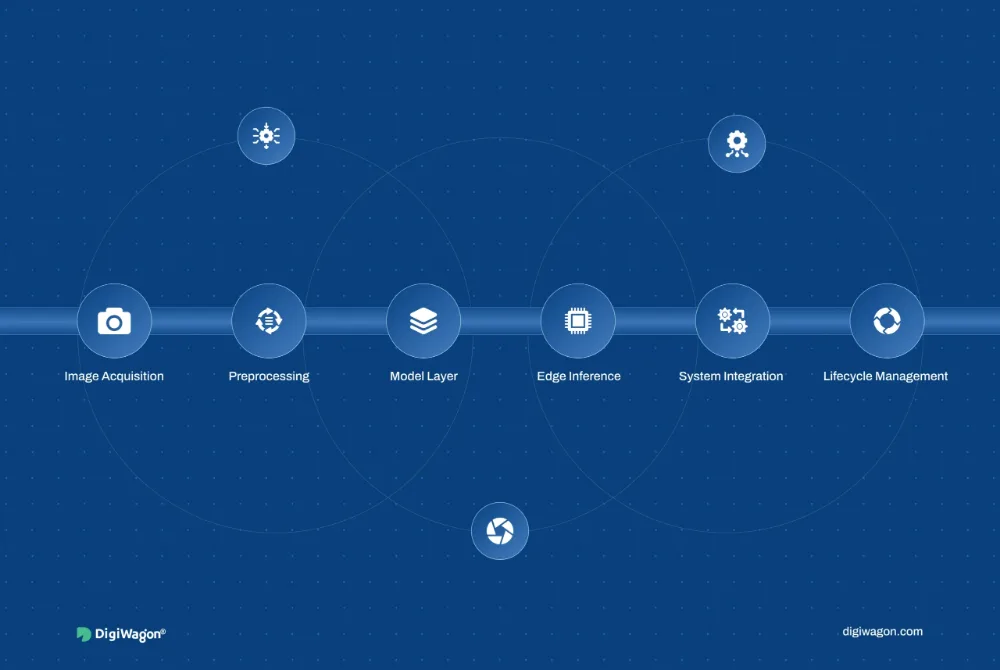
Computer vision performance depends on what the camera sees, how reliably the model interprets it, and how quickly the result can be used. Across the full vision pipeline, performance should be tested and monitored against lighting changes, occlusion, camera variation, model drift and dataset refresh.
01
Capture
Can the camera consistently see what matters? Resolution, lighting, angle and field of view.
02
Detect
Can the model identify the right object or condition? Detection accuracy, segmentation, false positives and confidence.
03
Interpret
What does the visual result mean? Classification, measurement, context and decision logic.
04
Respond
How quickly must something happen? Latency, edge versus cloud, event triggering and response time.
Industry context
Computer Vision Solutions Across Industries
Computer vision is most useful when visual information can be converted into faster detection, safer operations, better quality control, or more consistent decisions.
01 / 09
FinTech
01Identity Verification
02Document Capture
03Cheque Processing
04Fraud Pattern Detection
02 / 09
RegTech
01KYC Document Checks
02ID Verification
03Evidence Extraction
04Visual Compliance Review
03 / 09
InsurTech
01Damage Assessment
02Claims Image Analysis
03Document Verification
04Visual Fraud Indicators
04 / 09
Healthcare
01Medical Image Analysis
02Scan Classification
03Visual Measurement
04Clinical Decision Support
05 / 09
Manufacturing
01Defect Detection
02Quality Inspection
03Component Verification
04Safety Monitoring
06 / 09
Retail & eCommerce
01Visual Search
02Product Recognition
03Shelf Monitoring
04Store Analytics
05Checkout Assistance
07 / 09
Logistics & Supply Chain
01Package Recognition
02Barcode/OCR Capture
03Damage Detection
04Yard & Warehouse Monitoring
08 / 09
SaaS & Technology
01Image Understanding
02Visual Search
03Document Intelligence
04Embedded Vision Features
09 / 09
Defence
01Object Detection
02Visual Surveillance Assistance
03Equipment Inspection
04Controlled Imagery Analysis
Our work
AI & Machine Learning in practice.
Engagements from the wider AI & Machine Learning practice this service sits in — 4 of them written up in full.
We settle what the camera can actually see and what a mistake costs before choosing a model, because almost every vision failure is decided at the point of capture rather than in the network.
01
Frame the Target
Establish what has to be detected, how often a miss or a false alarm is acceptable, and what the accuracy target means in this environment rather than in a benchmark.
Focus
The detectionCost of a missCost of a false alarmTarget
02
Fix the Capture
Settle resolution, lighting, angle and field of view at the physical inspection point, and collect a dataset that includes the variation you will actually meet.
Focus
LightingAngleDatasetVariation
03
Train and Validate
Train against that variation and test on the cases that break it: occlusion, camera changes, unusual parts, and the edge conditions nobody photographs on a good day.
Focus
TrainingOcclusionEdge casesConfidence
04
Deploy Where It Runs
Put the model where the latency, bandwidth and privacy rules allow — often on the device — then monitor drift and refresh the dataset as conditions move.
Focus
Edge or cloudLatencyModel driftDataset refresh
Frame01 Frame the TargetCapture02 Fix the CaptureTrain03 Train and ValidateDeploy04 Deploy Where It Runs
Insights
Thinking Behind Visual Intelligence.
Perspectives on inspection pipelines, edge deployment and what accuracy actually means once the lighting, the camera and the parts all start to vary. Choosing a computer vision company is mostly a question of whether it has seen your conditions before.
AI & Machine Learning
How to Architect a Computer Vision Inspection Pipeline for Manufacturing
· Jigar Vavadia · 9 min read
AI & Machine Learning
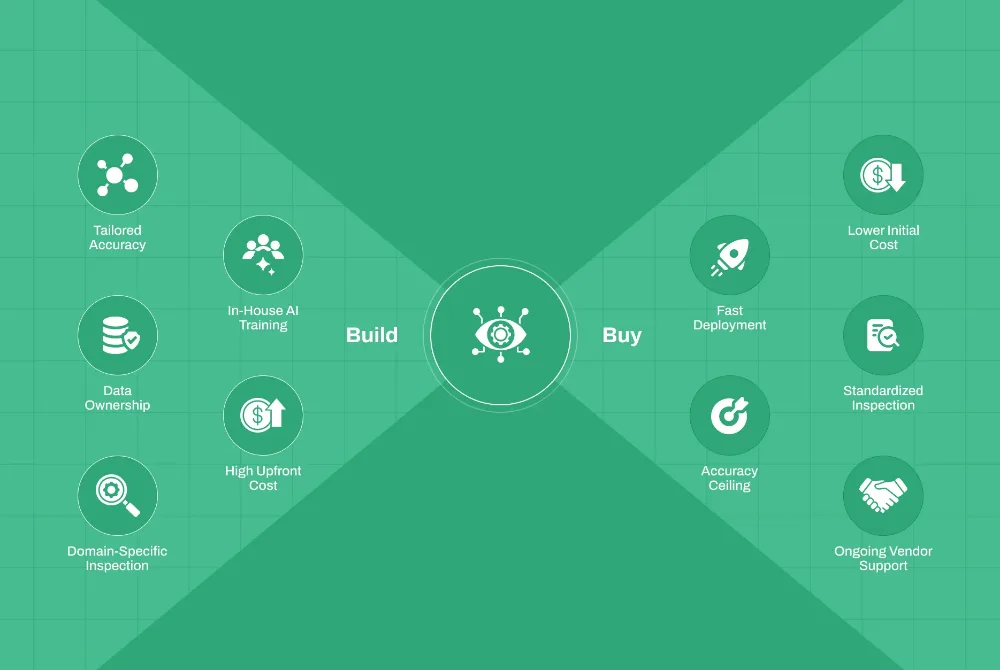
Computer Vision for Quality Inspection: Build vs. Buy for Manufacturing CTOs
· Akash Thakor · 11 min read
AI & Machine Learning
Computer Vision in Manufacturing: 5 Use Cases Driving Operational Efficiency in Germany & UAE
Straight answers on inspection accuracy, image processing versus computer vision, and where video analytics software fits against a pipeline built for your own conditions.
01What is computer vision?
Computer vision enables software to interpret information from images and video. It can detect objects, classify visual content, extract text, identify defects, track movement, and recognize patterns, so visual information can be used in operational or digital experiences. In production what matters is not only what the model sees but how quickly that result can be used.
02What is the difference between computer vision and image processing?
Image processing mainly enhances or transforms images through techniques such as filtering, resizing, or contrast adjustment. Computer vision goes further by interpreting what an image contains, such as identifying objects, detecting defects, recognizing patterns, or understanding activity within a video stream.
03What accuracy is realistic for visual inspection?
There is no universal accuracy target for visual inspection. Performance depends on image quality, lighting, camera placement, defect variability, training data, and the cost of false positives or missed defects. A useful target should therefore be defined against the actual operating environment and decision being made.
Make Visual Data Work in the Real World
From inspection and recognition to video analytics and edge vision, we help move computer vision from controlled testing into reliable real-world use.
One click opens the assistant you already use with a question that points it at this page, so the answer comes from what we publish, not a guess.
The question it opens withRead https://digiwagon.com/computer-vision-development-services and explain how DigiWagon runs a Computer Vision Development Services engagement, what I should expect in the first 90 days, and how to judge whether a partner like this fits a team of our size. Stick to what the page says and mark anything you are not sure about.