
eCommerce Migration: What Actually Goes Wrong
- Most failed migrations break on data fidelity and integration drift, not the new platform itself.
- SEO equity collapses when redirect maps and structured data are treated as a launch-week task rather than a foundation.
- A phased cutover with a rehearsed rollback path almost always beats a big-bang go-live for enterprise volumes.
- The new platform is a decision; the migration is a project, and the two need separate plans.
What eCommerce Platform Migration Means
eCommerce platform migration is the process of moving a live storefront, including its catalogue, customer history, orders, content, and integrations, from one commerce platform to another. It covers data extraction, transformation, validation, redirect mapping, integration rebuild, and a controlled cutover. Unlike a redesign, migration changes the underlying system that runs the business while the business keeps running.
Why Replatforming Has Become a Board-Level Decision
According to Forrester’s 2024 commerce technology survey, more than half of enterprise retailers were either mid-migration or planning one within twelve months primarily to escape monolithic platforms that block headless and composable patterns. The shift is not aesthetic. Legacy platforms make every new revenue lever, whether that is omnichannel inventory, marketplace expansion, or AI-driven merchandising, slower and more expensive to ship.
The risk profile has shifted along with the urgency. A botched migration in 2026 does not just bruise a quarter. It surfaces in Google Search Console as a permanent traffic step-down, in payment processor reports as elevated error rates, and on the P&L as months of stalled growth.
Why Most Enterprise eCommerce Migrations Fail

Migrations rarely fail because the destination platform is wrong. They fail because four assumptions are made too early.
1. Data is treated as a one-way pipe.
Catalogue, customer, and order data carry historical baggage: deactivated SKUs, partial refunds, store credit balances, mid-flight subscriptions. Engineering teams build extract-and-load scripts without a reconciliation layer that proves the destination matches the source row by row.
2. Integrations are scoped late.
ERP, OMS, PIM, tax engine, fraud screening, marketing automation, and reviews. A mid-sized retailer typically has 20 to 40 integrations. Each one needs its own contract test before cutover.
3. SEO is treated as a launch-week task.
URL slugs change. Schema disappears. Canonical tags shift. By the time organic traffic drops, the redirect window has closed.
4. Rollback is theoretical.
Teams document a rollback plan but never rehearse it. When something breaks at 4am on go-live night, no one is sure whether to roll back, hotfix, or wait.
What Are the Real Migration Risks?
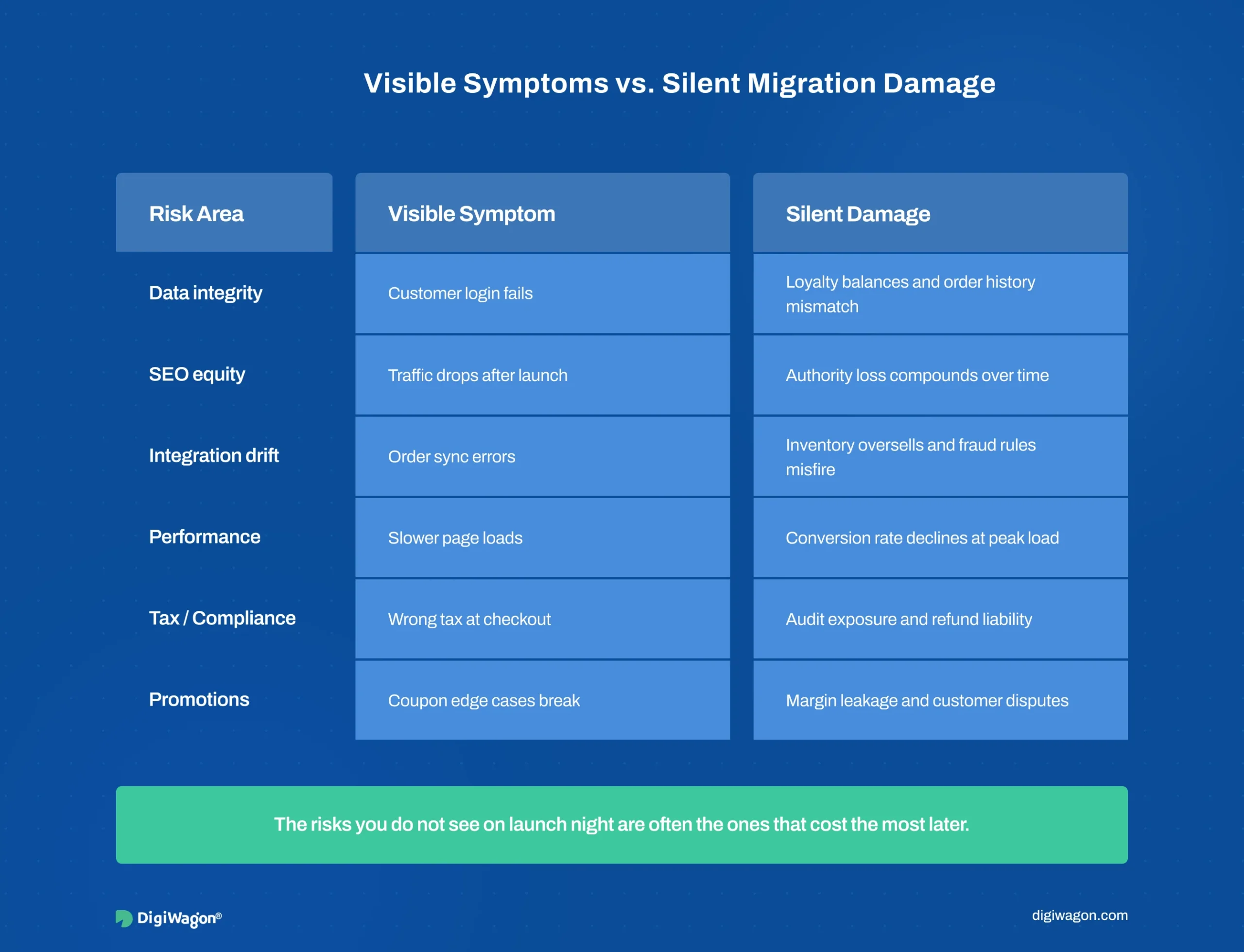
The visible risks are obvious: downtime, data loss, broken checkout. The harder risks are silent.
| Risk Category | Visible Symptom | Silent Damage |
|---|---|---|
| Data integrity | Customer login fails | Loyalty balances and order history mismatched, surfaces months later |
| SEO equity | Traffic drop after launch | Authority loss compounds; recovery takes 6+ months |
| Integration drift | Order sync errors | Inventory oversells, fraud rules misfire |
| Performance regression | Slower page loads | Conversion rate decline at peak load (e.g., “every 1s of mobile LCP delay reduces conversion by ~7%”) |
| Tax and compliance | Wrong sales tax on checkout | Audit exposure, refund liability |
| Promotion logic | Coupon edge cases break | Margin leakage and customer disputes |
For US and UK enterprises, two compliance layers add weight. PCI DSS scope changes when payment tokenisation moves between providers. UK GDPR and CCPA require explicit handling of customer consent records during the data migration itself, not after.
Choosing a Migration Approach
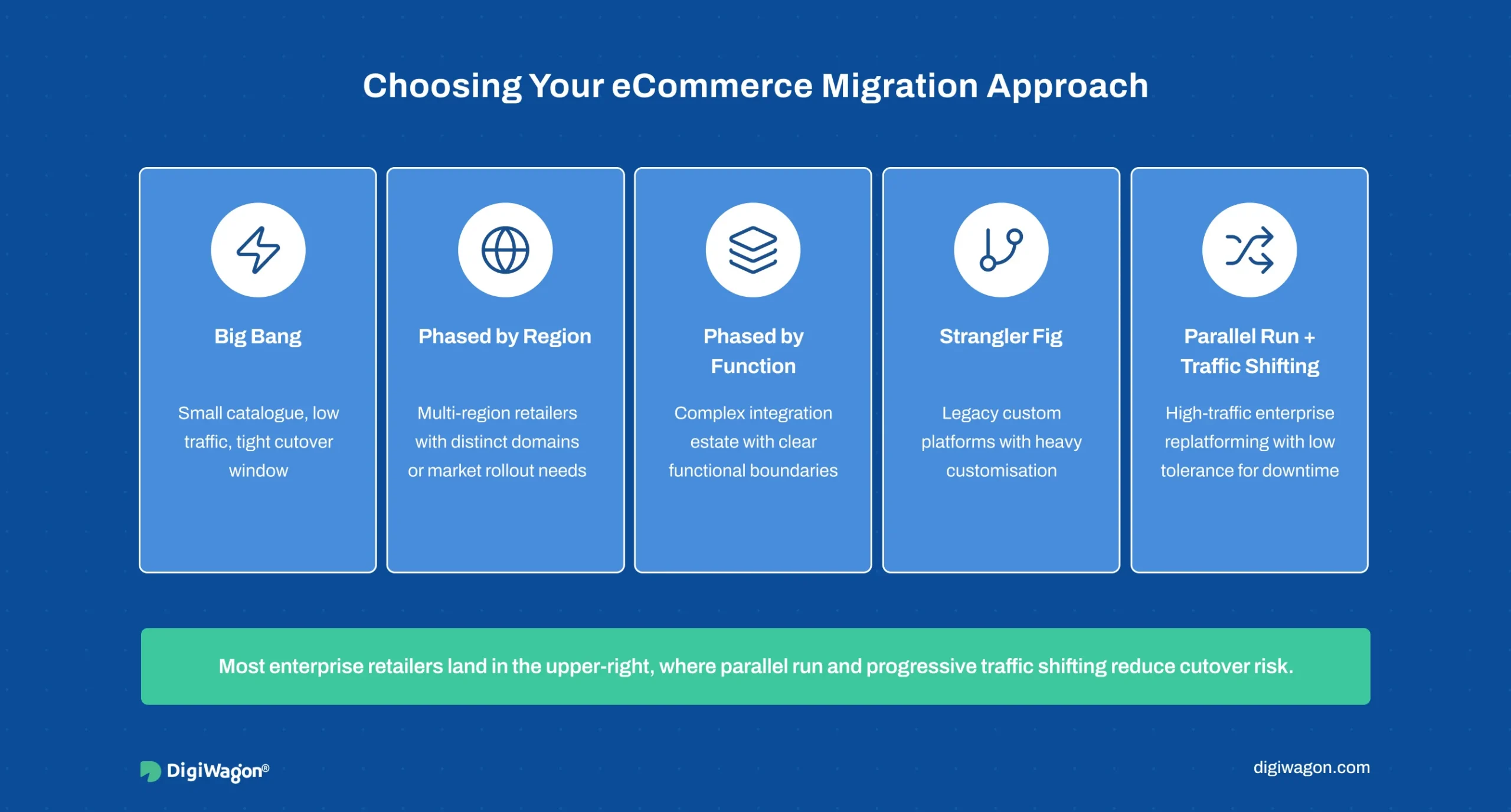
There is no universally correct migration model. The right one depends on traffic patterns, integration complexity, and tolerance for parallel operations.
| Approach | When It Fits | Primary Risk | Mitigation |
|---|---|---|---|
| Big Bang | Small catalogue, low traffic, tight maintenance window | All risk concentrates on one cutover night | Full rehearsal in staging, frozen feature scope |
| Phased by Region | Multi-region retailers with distinct domains | Inconsistent customer experience during transition | Region-specific redirect logic, unified loyalty backend |
| Phased by Function | Complex integration estate | Two systems of record running in parallel | Clear ownership boundary, sync layer with conflict rules |
| Strangler Fig | Legacy custom platforms with heavy customisation | Long migration tail, sustained dual-platform cost | Strict architectural fitness functions, defined retirement triggers |
| Parallel Run with Traffic Shifting | High-traffic enterprises that cannot risk a hard cutover | Operational overhead of running both systems | Feature flag gating, percentage-based traffic ramp |
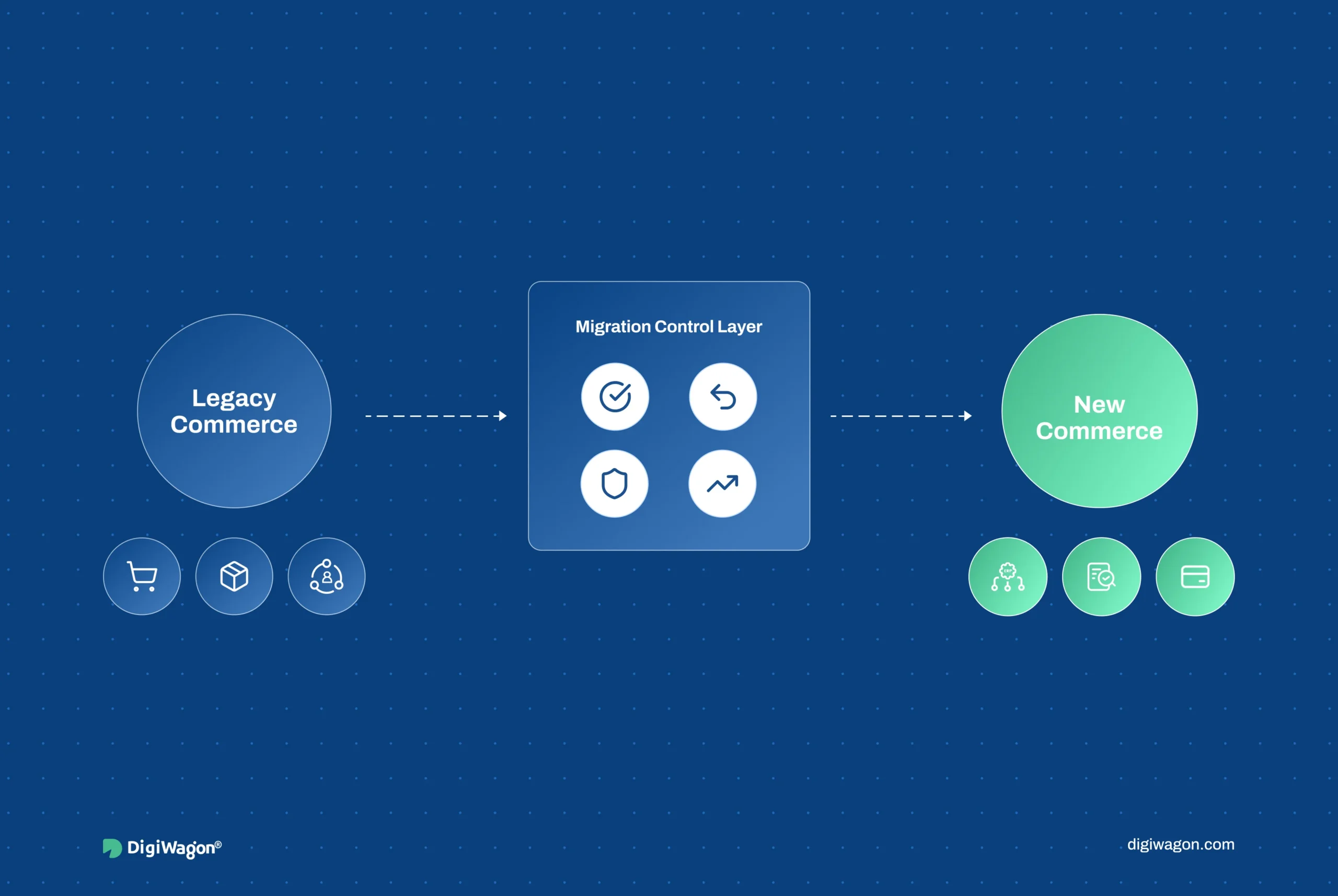
Parallel run with progressive traffic shifting has become the default pattern for enterprise replatforming. It lets teams move from a small percentage of real traffic to full production while the legacy platform stays warm as an instant rollback target.
For teams stress-testing this kind of cutover, DigiWagon’s eCommerce migration services cover migration planning, data reconciliation, and zero-downtime cutover design end to end.
How to Plan a Zero-Downtime Cutover
Zero downtime is a discipline, not a feature. Five practices distinguish migrations that hold their ground from those that lose traffic.
Build a reconciliation layer, not just an ETL.
For every entity moved, run a row-level diff between source and destination. Customer counts, order totals, lifetime value, loyalty point balances. The reconciliation report runs continuously during the parallel-run phase, not only on cutover day.
Map redirects before the new URLs exist.
The destination platform’s URL structure should be designed against the legacy URL inventory, not chosen in isolation. Every legacy URL needs a 301 destination, including filtered category pages and out-of-stock product pages with backlinks.
Preserve schema continuity.
Product, Breadcrumb, and Organisation schema markup must be present on day one. Search engines re-evaluate structured data quickly, and missing schema during the recrawl window has a measurable impact on rich-result eligibility.
Rehearse the rollback.
A rollback rehearsal in staging, with the team that will be on the cutover bridge, surfaces the silent dependencies: DNS TTLs, payment gateway configuration, CDN invalidation, search index rebuild time. None of these belong on a runbook for the first time.
Baseline performance before you move.
Capture the legacy platform’s P95 response time, error rate, and conversion rate at peak load. Without that baseline, regressions on the new platform get rationalised away as “the new system feels slower.”
When Migration Becomes a Rebuild
Not every replatforming should ship as a like-for-like move. A migration becomes a rebuild when three conditions hold: the legacy customisation depth makes a clean port impossible, the new commercial proposition demands capabilities the old data model cannot represent, and the catalogue or customer base is small enough that historical fidelity matters less than future flexibility.
Most enterprise migrations are not in that bucket. The faster path to value is a structured migration with a defined modernisation roadmap that lands new capabilities in the months after cutover, not as part of it.
Planning Your eCommerce Migration with DigiWagon
DigiWagon plans, builds, and runs enterprise eCommerce migrations across Shopify Plus, BigCommerce, commercetools, and custom headless stacks for retailers in the US and UK. We focus on:
- Migration approach selection and risk modelling
- Data extraction, transformation, and reconciliation tooling
- SEO preservation, redirect mapping, and schema continuity
- Zero-downtime cutover design with rehearsed rollback
- Post-cutover stabilisation and performance baselining
Planning a Replatforming Project?
Our migration engineers run a free risk assessment against your legacy stack before you commit to a platform.
Conclusion: The Migration Plan Gets the Result
Enterprise eCommerce migration is not just a platform switch. It is a risk-management project that affects data accuracy, SEO equity, integrations, checkout stability, performance, and customer trust.
The new platform may get the attention, but the migration plan determines the outcome. Teams that succeed do not treat redirects, data validation, rollback, and integration testing as launch-week tasks. They plan them from the first sprint, rehearse the cutover, and protect business continuity while the storefront keeps running.
A successful migration is not only about going live on Shopify Plus, BigCommerce, commercetools, or a headless stack. It is about moving without losing what already works: customer history, organic traffic, order accuracy, payment reliability, and operational confidence.
The platform choice gets the headlines. The migration plan gets the result.