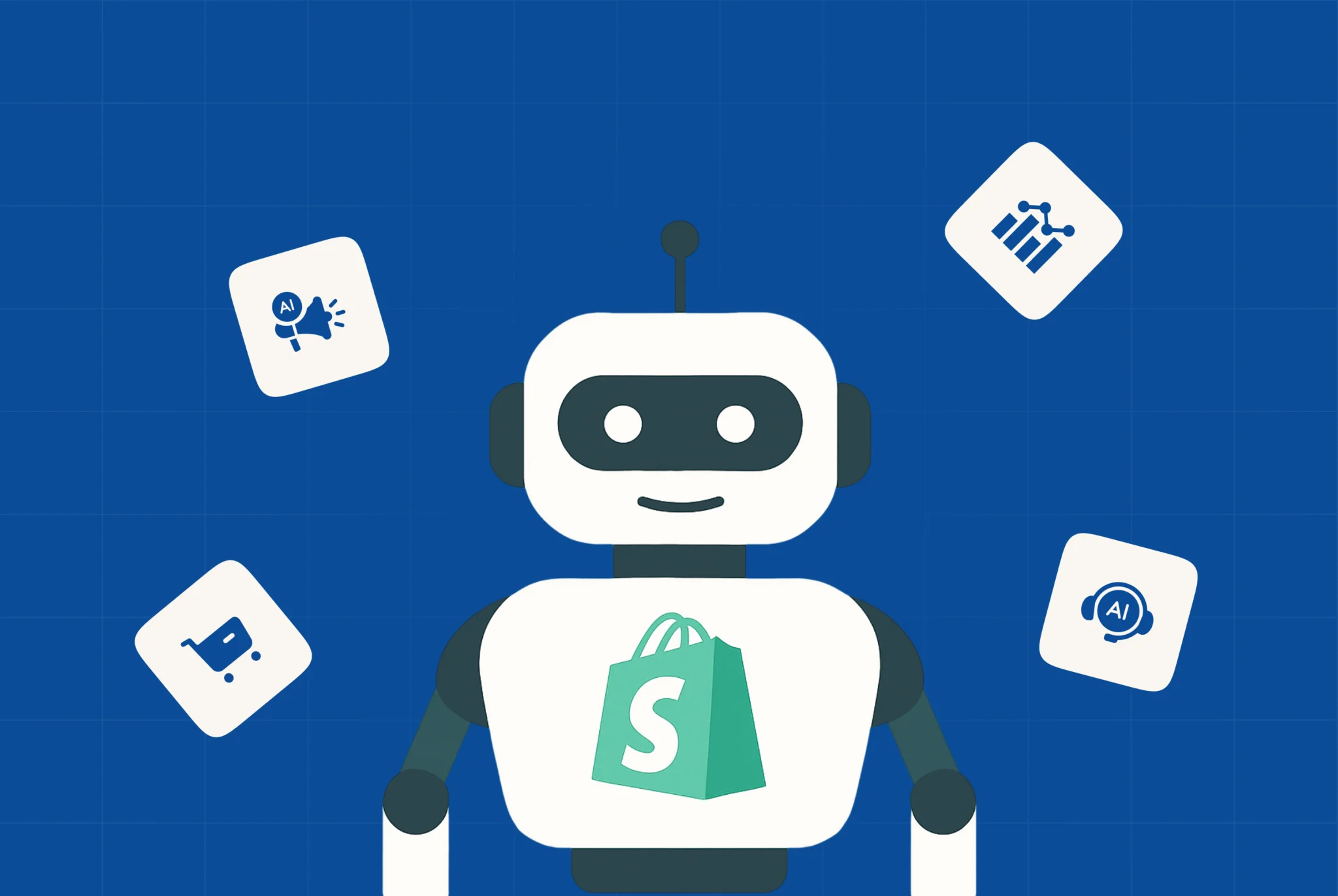
The next evolution of eCommerce is here, and it’s powered by AI. Shopify AI agents are autonomous assistants that work on two sides of a store: inside the admin, where Shopify’s Sidekick and custom agents automate merchandising, support and operations, and in front of the store, where shoppers now ask AI assistants such as ChatGPT to find and buy products. This guide covers both, updated for 2026. This guide provides a strategic deep-dive into this transformative technology, exploring what “agentic commerce” means for your business, its powerful capabilities, and how to prepare your brand for this new era of automation.
An Introduction: The Shift from Automation to Autonomy
For years, eCommerce automation has been about setting predefined rules: “if a customer abandons their cart, send this email.” But a new paradigm is emerging. “Agentic commerce,” powered by AI agents, represents a shift from rule-based automation to goal-based autonomy. These are not simple chatbots; they are intelligent, proactive assistants capable of making decisions and taking actions to achieve specific business objectives. Shopify is at the forefront of this revolution with the introduction of Shopify Agents, a suite of tools designed to fundamentally change how online stores are managed.
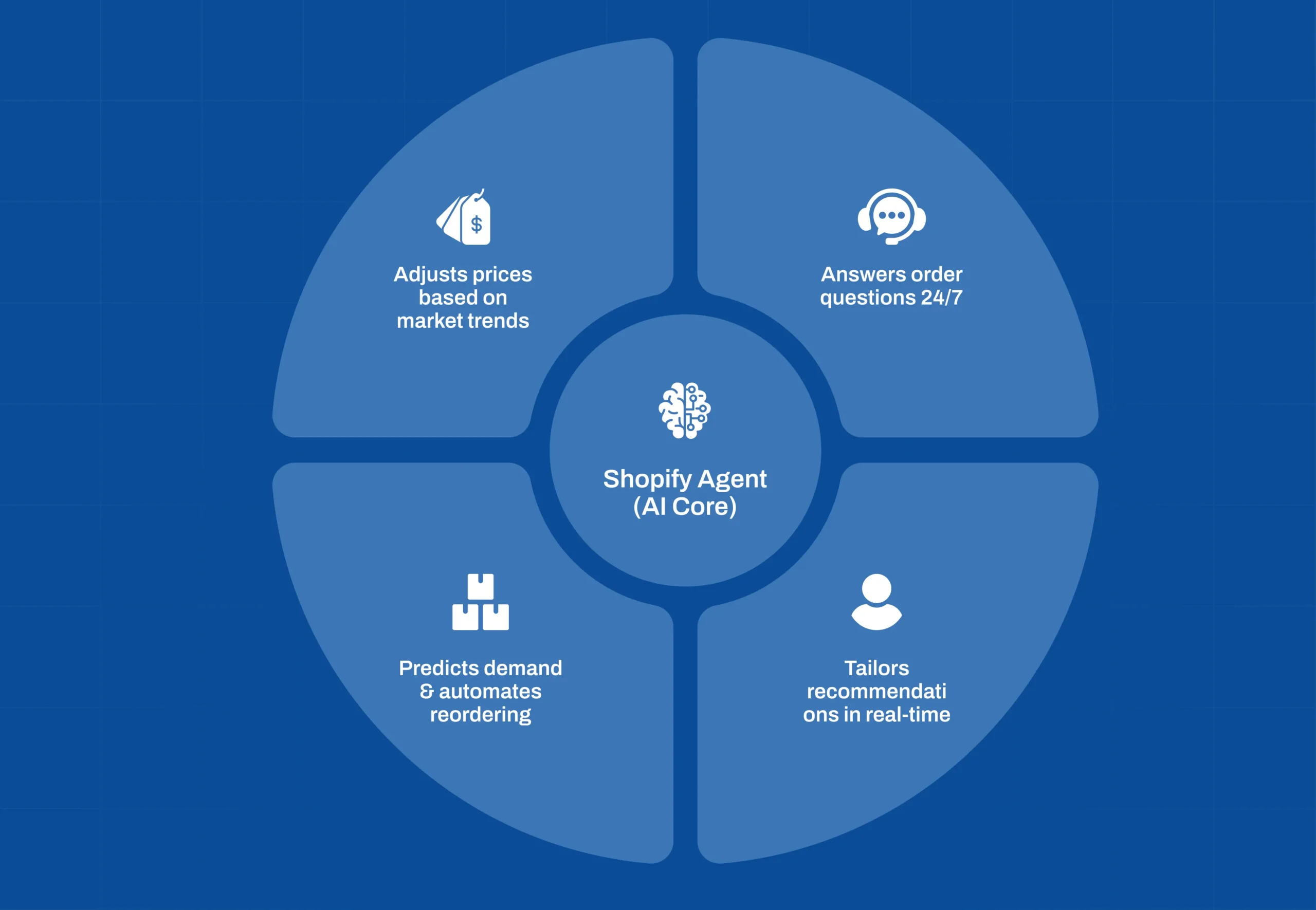
What Are Shopify Agents?
A Shopify Agent is an AI-powered system trained on your store’s specific data—your products, policies, and customer interactions. Unlike a human assistant, an agent can operate 24/7, handling hundreds of tasks simultaneously. They can be configured for a specific purpose or workflow, such as acting as an expert customer service representative or a savvy inventory manager. The core concept is to delegate complex, data-driven tasks to an AI that can learn, adapt, and act on your behalf.
What Has Changed Since 2025: Agents on Both Sides of the Store
When this guide was first written, “Shopify agents” mostly meant AI helpers for the merchant. Two things have moved since then.
- Merchant-side agents can act, not just advise. Shopify’s Sidekick has grown from a chat assistant into an agent that can carry out tasks in the admin, from building segments and discounts to editing products and drafting campaigns, and merchants can extend it with their own tools and data.
- Buyer-side agents are a new sales channel. Shopify has built the rails that let AI shopping assistants discover and buy products directly: a catalog that agents can query, a cart and checkout they can complete, and storefronts designed for conversations rather than pages. Under the Agentic Commerce Protocol, a shopper can complete a purchase from a Shopify merchant inside an AI assistant without visiting the store.
The practical consequence for a merchant is that product data, policies and inventory are no longer read only by people and Google. They are read by agents that decide, in a fraction of a second, whether your product is the answer to a shopper’s question.
Key Capabilities: What Can Shopify Agents Do?
The potential applications for Shopify Agents are vast. Here are some of the most impactful capabilities for merchants:
- Intelligent Customer Support: Agents can go far beyond canned responses. They can access order history to answer “Where is my order?” questions, understand product details to act as a personal shopper, and even handle returns and exchanges conversationally.
- Dynamic Pricing & Promotions: An AI agent can analyze market trends, competitor pricing, and your store’s demand in real-time to automatically adjust product prices, maximizing profit margins while staying competitive.
- Predictive Inventory Management: By analyzing historical sales data, seasonal trends, and even social media buzz, an agent can predict demand spikes, automate reordering processes, and prevent costly stockouts or overstock situations.
- Hyper-Personalization: Agents can create a unique digital storefront for every visitor, tailoring product recommendations, and marketing messages based on their real-time Browse behavior and purchase history.
The Strategic Implications for Your Business
Adopting Shopify Agents is more than a technical upgrade; it’s a strategic business decision with significant implications.
- Opportunity for Hyper-Efficiency: The ability to automate complex tasks frees up your human team to focus on high-level strategy, brand building, and creative marketing.
- Challenge of Data Readiness: AI agents are only as good as the data they are trained on. Businesses with clean, well-organised product catalogs, clear shipping policies, and structured customer data will have a significant advantage.
- Opportunity for Deeper Customer Insights: Agents can analyze thousands of customer interactions to identify emerging trends, common product questions, or points of friction in the buying journey that would be impossible for a human team to spot at scale.
- Challenge of Brand Voice & Control: A key hurdle will be ensuring the AI agent communicates in a way that is perfectly aligned with your brand’s unique tone and voice, requiring careful setup and ongoing refinement.
How to Prepare a Shopify Store for AI Agents
- Clean, complete product data. Agents reason over titles, descriptions, attributes, variants and images. Missing dimensions, inconsistent naming or thin descriptions become wrong answers.
- Machine-readable policies. Shipping, returns, warranties and availability should be structured and current, because an agent will quote them to a customer.
- Reliable inventory and order data. An agent that promises stock you do not have creates a support ticket, not a sale. Integrations with your ERP or warehouse system need to be real time.
- Brand voice and guardrails. Decide what an agent may do alone, what needs a human, and how it speaks. Test it the way you would test a new employee before it talks to customers.
- Measurement. Track which conversations, channels and agents produce orders, so the investment is judged on revenue rather than novelty.
Why Partner with DigiWagon to Implement Agentic Commerce AI?
Leveraging advanced AI like Shopify Agents requires more than just flipping a switch; it requires a strategic partner who understands the nuances of both eCommerce and complex technical integrations. This is where a DigiWagon Shopify consultant plays a critical role.
- We Are eCommerce & AI Strategists: Our eCommerce Consulting services are focused on your business goals. We don’t just implement tools; our consultants build a comprehensive strategy to ensure that agentic commerce AI serves your specific objectives for growth and efficien
- We Ensure Data Readiness: Our team can help you prepare for an AI-powered future by cleaning, structuring, and optimizing your product and customer data, ensuring your AI agents are built on a solid foundation. Start with the free AI Readiness Assessment to see where the gaps are.
- We Handle Complex Integrations: Our expertise in Custom Software Development and APIs allows us to ensure that your AI agents can seamlessly communicate with your other business-critical systems, like your ERP or CRM.
Conclusion: AI is the Future, and Shopify Experts are the Bridge
Shopify Agents are a clear signal of where the future of eCommerce is heading. The brands that will win in the coming years will be those that successfully partner human creativity with AI-powered efficiency. By embracing this new technology and preparing your business for a more autonomous future, you can build a formidable, lasting competitive advantage. The journey into agentic commerce is complex, and expert partners are the bridge to ensuring a successful implementation.
Related reading: our Shopify development page covers the platform work behind these agents, our AI agent development service covers custom agents beyond Shopify’s own, and the guide to autonomous AI agents explains how enterprise agents are governed.