
AML Watchlist Pipelines: What Actually Matters
- An AML watchlist data pipeline is an engineering system, not a compliance process; treating it the other way is the root of most pipeline failures.
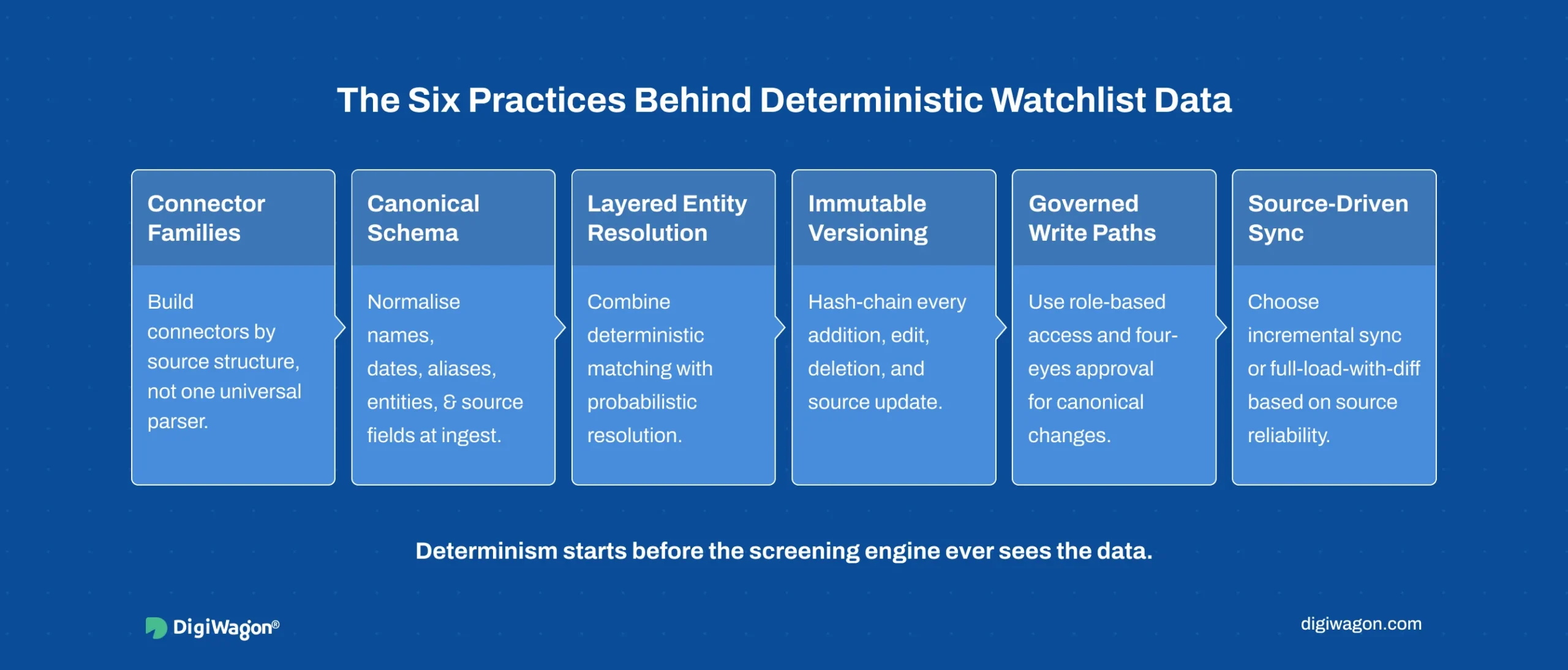
- Six architectural practices keep the pipeline deterministic: connector families per source, canonical schema normalisation, layered entity resolution, immutable versioning, access-controlled write paths, and source-reliability-driven sync strategy.
- Schema variance in raw source feeds (format, naming, date structure, entity shape) is the primary driver of downstream noise, not weak matching algorithms.
- Audit lineage engineered into Layer 1 of the pipeline produces reconstructable decisions; lineage retrofitted from operational logs almost never does.
- Real-time incremental sync only works for sources with reliable change logs; for sources publishing full snapshots, full-load-with-diff is the more resilient pattern.
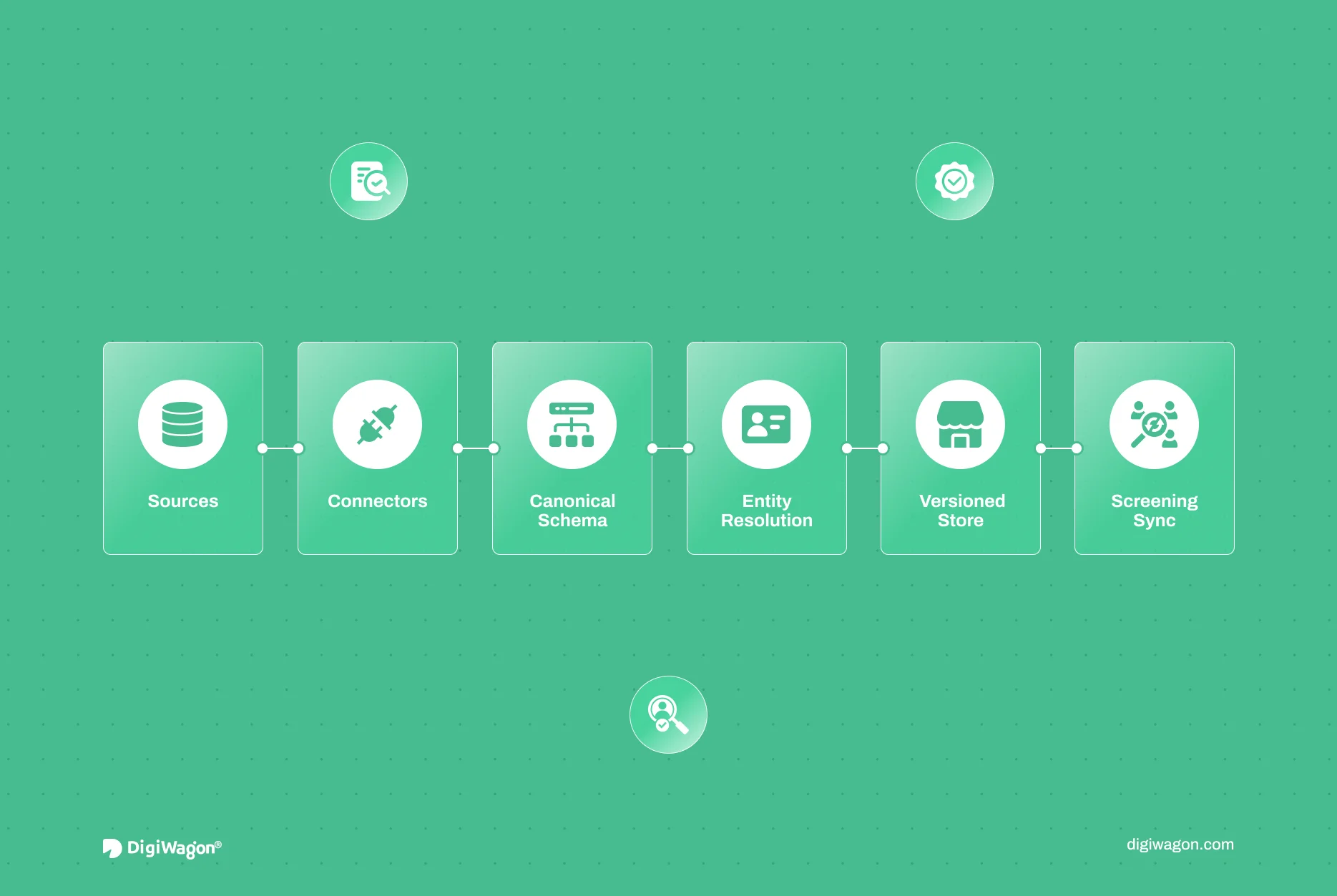
An AML watchlist data pipeline is the engineering system that ingests, normalises, resolves, versions, and synchronises sanctions and watchlist reference data so a downstream screening engine produces deterministic, reconstructable decisions. The pipeline is the canonical system of record for what was true at the moment of every past match.
Why This Is a Data Engineering Problem
Most watchlist failures look like compliance failures (noisy alerts, missed names, audit gaps) but trace back to data engineering decisions made (or skipped) at pipeline-design time. The Wolfsberg Group’s sanctions screening guidance is explicit that screening accuracy is a function of underlying data quality. ISO 8000, the international standard for data quality, codifies the broader principle that schema consistency, completeness, and provenance determine whether downstream systems can act on the data without compensation. The architectural question is how the pipeline delivers data to the screening engine in a state that survives a regulator’s reconstruction request.
Compliance teams own the regulatory requirement. The pipeline owns the engineering response. The six practices below are the response.
How Do You Architect the Pipeline for Screening Determinism?
The first three practices determine whether the screening engine reads clean data or noise.
Practice 1: Connector families per source structure, not a universal parser.Map every watchlist source by format (CSV, XML, JSON, fixed-width text), publication cadence, and structural complexity (flat vs nested, single-entity vs relationship-bearing). Build connector families per structural pattern: an OFAC-style change-log connector, an EU consolidated snapshot connector, a commercial-provider API connector. A universal parser is the seductive wrong answer because it collapses upstream variance into a single point of failure. Connector families isolate failure modes per source and turn new-source onboarding into configuration rather than engineering. The discipline is standard data engineering services work, with the pipeline-as-evidence constraint added on top.
Practice 2: Canonical schema normalisation at ingest. All connector outputs converge on one canonical schema before any downstream component reads them. Name variants (Mohammed / Mohammad / Muhammad), date formats (12-MAR-1970 / 1970-03-12), and entity shapes (flat individual records vs nested individual-plus-aliases records) get normalised once, at the connector boundary. Normalising at ingest is cheaper than normalising inside the screening engine because the normalised representation is what gets versioned and audited; non-canonical data downstream means the audit trail captures noise instead of decisions. Sibling pipeline patterns for upstream ingestion are covered in ETL pipeline design for AML data.

Practice 3: Layered entity resolution: deterministic plus probabilistic, both required. Entity resolution runs in two passes. Pass one is deterministic exact-match on normalised identity fields (name plus DOB plus nationality). Pass two is probabilistic, split by script:
| Resolution Layer | Algorithm Family | Best For | Limitation |
|---|---|---|---|
| Deterministic | Exact-string equality on normalised fields | High-confidence identity matches | Misses transliteration, name-order, date-format variations |
| Probabilistic (Latin scripts) | Edit-distance (Levenshtein, Jaro-Winkler) | Spelling variants, OCR artefacts, abbreviations | Weak on cross-script names |
| Probabilistic (transliterated) | Phonetic (Soundex, Double Metaphone, NYSIIS), language-aware tokenisation; transformer-based name embeddings for state-of-the-art | Arabic, Cyrillic, Chinese name matching | False positives on short or common-syllable names |

Single-layer resolution fails predictably: deterministic-only misses transliteration, probabilistic-only floods the screening engine with noise. The deeper model work sits with the AI/ML engineering practice; the layered architecture is the pipeline requirement regardless of which model fronts the probabilistic pass.
How Do You Architect the Pipeline for Audit Reconstructability?
The next two practices determine whether the pipeline can prove what was true at any past moment.
Practice 4: Immutable, hash-chained versioning from day one. Every addition, modification, or deletion produces a versioned object containing the source, the timestamp, the transformation applied, the source version it came from, and the actor identity. Each version object hash-chains to the previous version on the same list. The screening engine binds to an explicit version identifier at evaluation time and writes that identifier into every decision record. When a regulator asks why a name matched in March but not in April, the pipeline returns a version diff in seconds. Reconstructing the same answer from operational logs after the fact is, in practice, a multi-quarter rebuild that often fails on data that was never designed to be reconstructed.
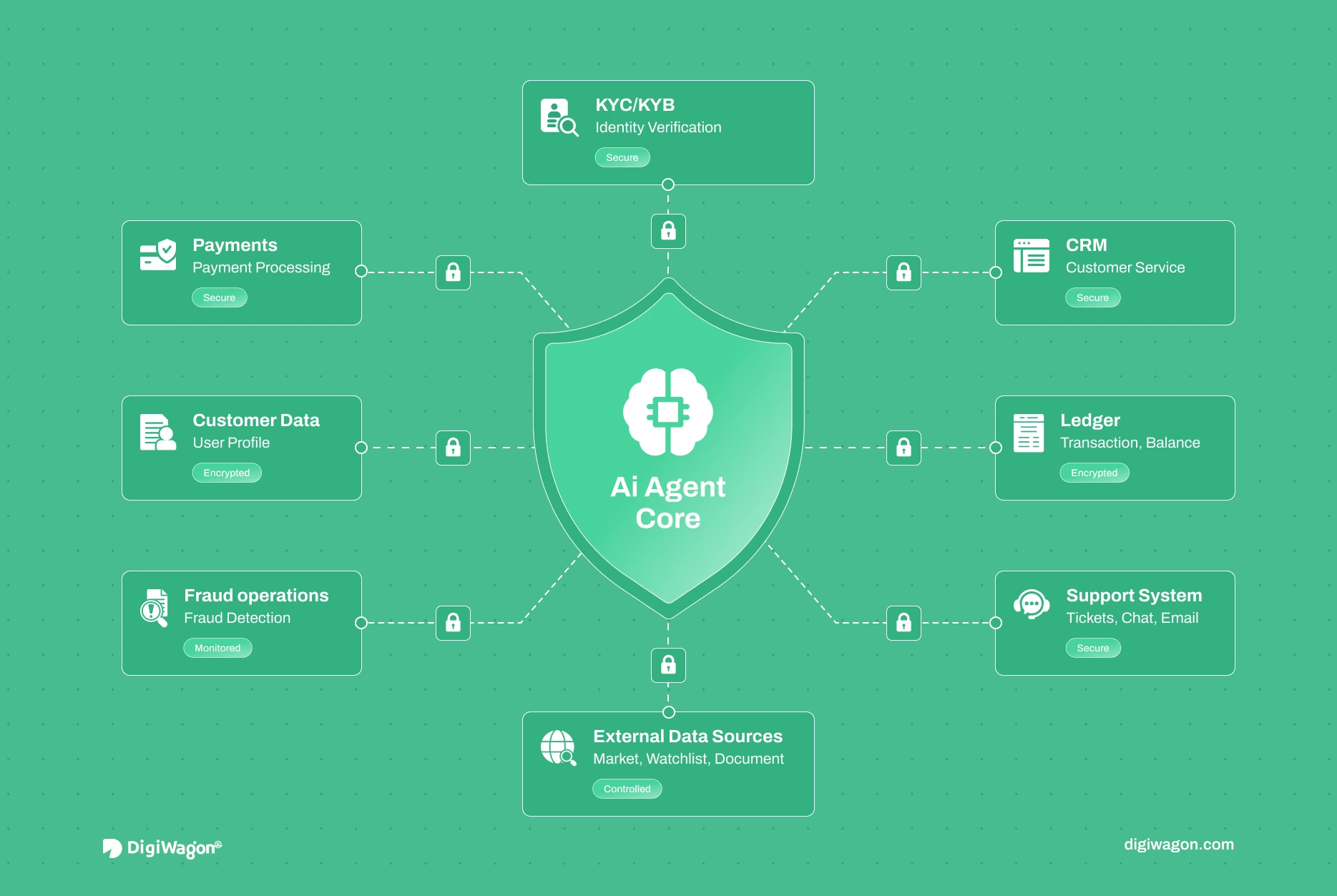
Practice 5: Access-controlled write paths with four-eyes approval. Every write to the canonical store (adding a name, suppressing an entry, marking a false positive, applying an internal-list override) routes through a role-based access check and a four-eyes approval workflow before it lands. The compliance team owns the policy of what requires approval; the pipeline owns the enforcement, so an ungoverned write path simply does not exist. The NIST Cybersecurity Framework 2.0 Govern function, introduced February 2024, formalises the broader expectation around organisational access control; the architectural consequence is that approval workflows belong in the pipeline, not bolted on at the application layer.
When Should the Pipeline Sync Incrementally vs Full-Load?
Practice 6: Sync strategy driven by source reliability, not by ambition. Real-time incremental sync sounds cleaner architecturally but only works for sources with reliable change-event publication (OFAC publishes structured deltas; UN publishes timestamped changes). For sources that publish unversioned full snapshots, forcing incremental logic onto unreliable deltas produces silent data loss when a feed quietly omits records present in the previous snapshot. The resilient pattern for these sources is full-load-with-diff: ingest the snapshot, compute the diff against the previous version inside the pipeline, and treat that diff as the authoritative change set. The decision is mechanical: reliable change log goes to incremental sync; unversioned full snapshot goes to full-load-with-diff; mixed reliability goes to full-load-with-diff plus reconciliation against any partial change feed available.
Lessons from Building an Enterprise Watchlist Data Pipeline
DigiWagon built an enterprise watchlist data orchestration platform for a B2B AML compliance vendor serving banks and regulated financial institutions. The architecture: PostgreSQL as the canonical store (chosen over MongoDB because the audit lineage and version-diff queries are relational and benefit from strong typing and foreign-key constraints; the schema flexibility MongoDB offers was not worth the lineage-query complexity), a Node.js connector framework feeding the ingest path, a React-based operator console for the approval workflow, AWS hosting with per-region data planes, and a transformer-based name-embedding model layered on top of edit-distance and phonetic resolution for cross-script matching.
Three architectural decisions in particular carried the system. First, connector families per source structure made each new regulatory or commercial source a configuration task; the team added several jurisdictional sources post-launch without re-engineering the ingest layer. Second, schema normalisation at the connector boundary (rather than inside the screening engine) reduced false positives via deterministic data shape, not per-source workarounds layered downstream. Third, day-one immutable version chaining gave the compliance team historical reconstruction in seconds for regulatory reviews, with no forensic dive through application logs.
The pre-build state had no version control, no canonical schema, manual file ingestion, and a screening engine doing data-cleaning work it was never designed for. The fix was structural, not procedural.
DigiWagon’s Role in AML Watchlist Pipeline Engineering
DigiWagon engineers AML watchlist data pipelines as production systems: connector frameworks, canonical schema design, entity resolution architecture, version-controlled storage, and access-controlled write paths. The work draws on the RegTech software development practice and connects upward to the RegTech integration architecture blueprint for the broader pillar pattern.
- Connector framework design for regulatory, commercial, and internal source families
- Canonical schema and entity resolution pipeline engineering
- Immutable versioning, hash-chained lineage, and audit-query infrastructure
- Access-controlled write-path architecture with approval workflow integration
Engineering Watchlist Pipelines That Survive Production
A watchlist pipeline is judged by what it can prove, not by what it can ingest. The six practices above produce a pipeline that proves deterministic resolution, reconstructable decisions, governed writes, and resilient synchronisation under upstream feed inconsistency. The engineering cost is modest when paid at design time and severe when paid in a post-audit rebuild. Pipelines built to the pattern hold up under the regulatory reconstruction requests they were designed to answer.
Planning an AML Watchlist Data Pipeline?
Our data engineering team works through source mapping, schema design, resolution layering, and versioning with your compliance and engineering teams in one room.