

Enterprise UI/UX: Key Takeaways
- Enterprise UI/UX is governed by four recurring decisions: design system ownership, audit cadence, engagement model, and trust signals.
- Design system ownership shifts from individual designer to platform team once the product crosses three concurrent squads.
- UX audits return value on compliance, conversion, and onboarding work. They underperform on greenfield builds.
- Engagement model choice (consultant, embedded squad, in-house team) depends more on org maturity than budget.
- Regulated industries require trust signals encoded in the UI: audit trails, attribution lines, evidence-of-action patterns.
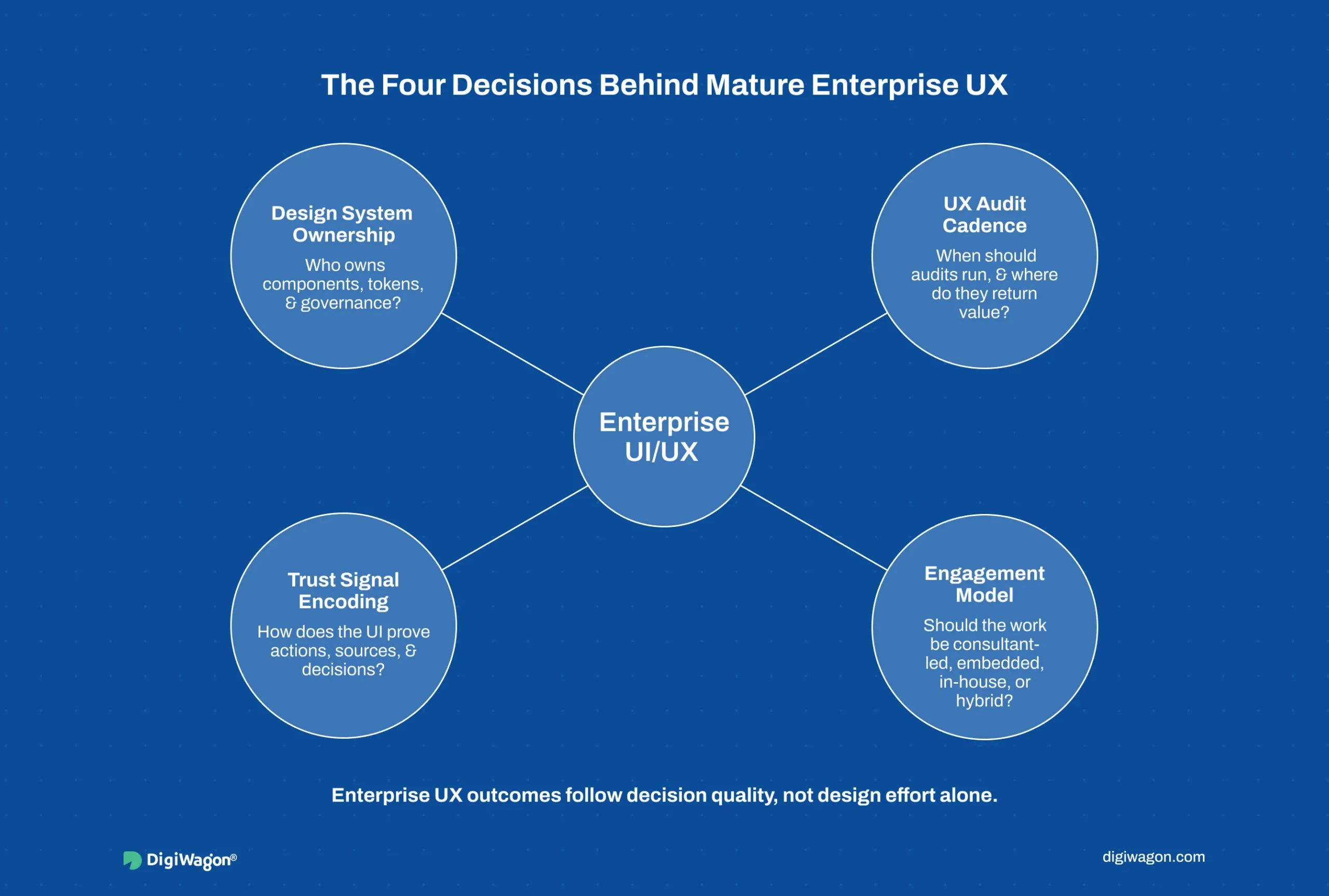
Enterprise UI/UX is the design discipline for software systems used by employees, regulators, and B2B operators inside large organisations. It governs four recurring architectural decisions: design system ownership, audit cadence, engagement model, and trust-signal encoding. Unlike consumer product design, it optimises for paid users who cannot uninstall and who escalate to compliance officers when something breaks.
Why Enterprise UX Now Operates as Decision Discipline
The shift from on-premise enterprise software to SaaS and platform engineering has changed what UX teams ship. Ten years ago, the work was screen-by-screen visual design layered over a fixed information architecture. Today, an enterprise product surface includes the customer-facing app, the admin console, the partner integration UI, the reporting layer, and increasingly an AI-assisted workflow surface. Each is built by a different squad.
The McKinsey Design Index (McKinsey, 2018, refreshed analysis 2023) tracked 300 publicly listed companies over five years and found those in the top quartile of design maturity generated revenues at twice the rate of their industry peers. The mechanism was not better aesthetics. It was decision discipline: design ownership embedded in product, research cadence locked to engineering sprints, and design systems treated as platform infrastructure.
The result is that “good UX” no longer describes a deliverable. It describes whether four foundational decisions have been made consciously, documented, and assigned ownership. The rest of this playbook walks through what those decisions are.
What Makes Enterprise UI/UX Different From Consumer Product Design?
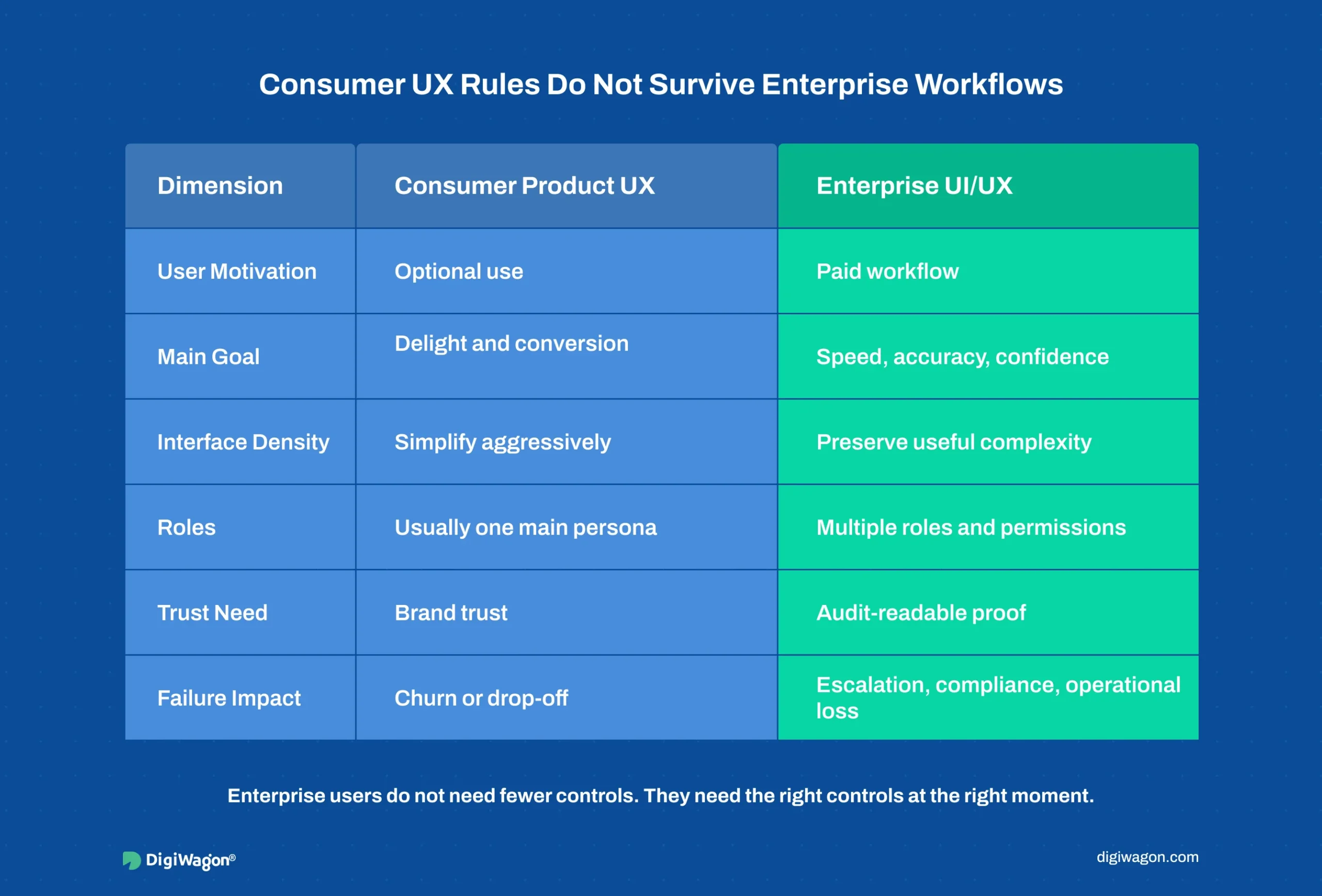
The differences are structural, not stylistic. Enterprise users are paid to use the product. They cannot uninstall. They escalate to compliance officers when something breaks. They run the product alongside three or four other internal tools that someone else built years ago.
That changes design priorities in four ways:
- Density over delight. A relationship manager running 40 client reviews a day needs information density, not generous whitespace. The Nielsen Norman Group’s enterprise UX research (NN/g, 2024) repeatedly finds that consumer-grade simplification reduces expert efficiency in enterprise tools.
- Multi-role surfaces. A single product often serves three or more job roles with different permissions, data scopes, and task patterns. The design accommodates role differences without forking the build.
- Audit-readable interactions. Every meaningful user action needs to be reconstructible later. The UI either captures this evidence cleanly or the audit team rebuilds it from server logs, which is expensive.
- Integration constraints. Enterprise products inherit upstream APIs, downstream reporting requirements, and identity providers that were not designed together. UX absorbs the seams.
These constraints rule out most consumer product design playbooks. The four decisions below replace them.
Who Should Own the Design System at Enterprise Scale?
The default failure mode is treating the design system as a designer’s side project. When the product has one squad, this works. When it has four squads shipping in parallel, the design system fragments within a quarter. Components fork per squad, tokens drift, accessibility regresses, and the design team spends its time policing instead of designing.
Ownership maturity follows a predictable progression:
| Ownership Model | Best Fit | Common Failure |
|---|---|---|
| Designer-owned, part-time | Single-product, fewer than 10 designers | Tokens drift, components fork per squad |
| Dedicated design-systems designer | 2-3 squads, growing surface | Bottleneck on review, slow component velocity |
| Platform team (designers + engineers) | 4+ squads, multi-product | Resourcing battle with product roadmap |
| External vendor + internal steward | Bridge phase, capability gap | Vendor exits leave undocumented decisions |
The right answer is not the most senior model. It is the model that matches the current surface area. A two-squad product running a platform team is overstaffed. A six-squad product running a part-time designer-owned system is heading for an expensive consolidation project. The decision is governance, not headcount.
For deeper coverage of system architecture at this stage, see our work on design system thinking at scale.
When Do UX Audits Actually Pay Back the Investment?
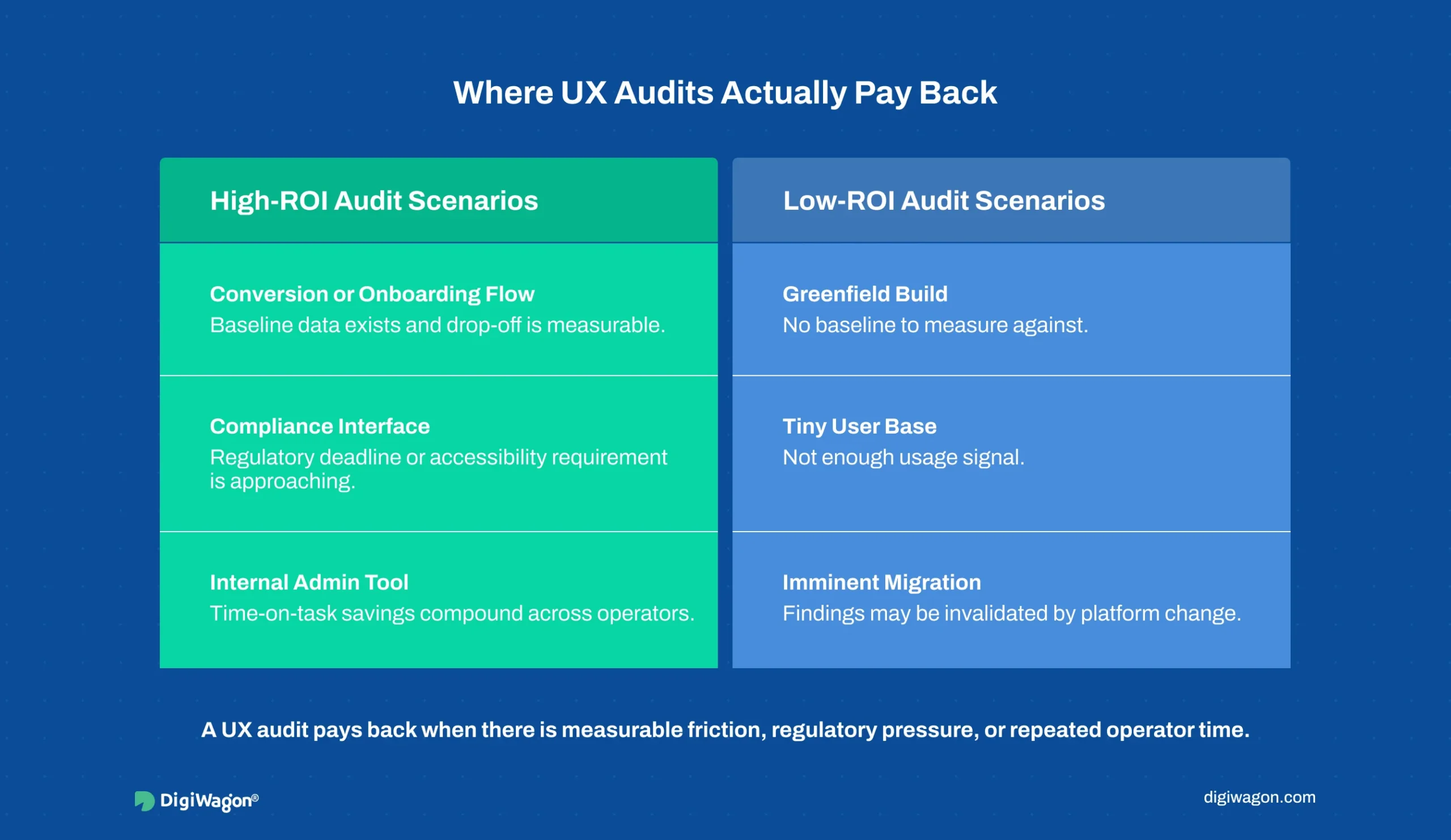
UX audits are sold as universal medicine. They are not. Audits return measurable value when applied to three specific situations:
- Conversion or onboarding flows with measurable drop-off. When a flow has analytics history, an audit can isolate friction points against baseline drop-off data. This is where audits earn their cost back fastest.
- Compliance interfaces approaching a regulatory deadline. When a new regulation lands (GDPR, DORA, AML directives, WCAG 2.2 accessibility conformance), an audit identifies the gap between current UI and required posture before audit penalties arrive.
- Internal admin tools where time-on-task is the primary cost lever. When 200 operators spend two hours daily in a tool, every five-minute saving compounds into a measurable operating cost reduction.
Audits underperform on greenfield builds (no baseline to measure against), on tools used by fewer than 20 people (insufficient signal), and on products undergoing imminent platform migration (audit findings get invalidated by the migration). Teams evaluating their audit roadmap can see how a structured UX consulting approach sequences discovery, audit, and remediation across these scenarios.
Which Engagement Model Fits Your UX Maturity?
The third decision is who delivers the work. Three models dominate enterprise UX, and the right one depends on organisational maturity, not on budget.
Consultant engagement. A specialist firm runs a defined-scope project: an audit, a design system foundation, a discovery sprint. The asset is outside perspective and methodology. Consultants are weak at steady-state product work where institutional context compounds.
Embedded squad. A vendor places designers inside the client team for a multi-quarter engagement. The asset is delivery capacity at expert level without the hiring lift. Embedded squads are strongest during scale-up phases where capability needs to ramp faster than recruiting cycles permit.
In-house team. Full-time designers report through product or engineering. The asset is institutional memory and stakeholder fluency. In-house teams are weak at methodology refresh, design-system foundations, and anything requiring an outsider’s view.
Most mature enterprises run a hybrid: in-house for steady-state product work, consultants on rotation for foundational projects, and embedded squads during scale-up windows. The comparison between consultant and in-house team economics details the trade-offs by engagement phase.
Forrester’s framework for justifying UX investment (Forrester, 2023) shows that organisations matching engagement model to maturity stage achieve UX ROI roughly twice as fast as those running a fixed model across all phases.
How Do You Encode Trust Signals for Regulated Buyers?
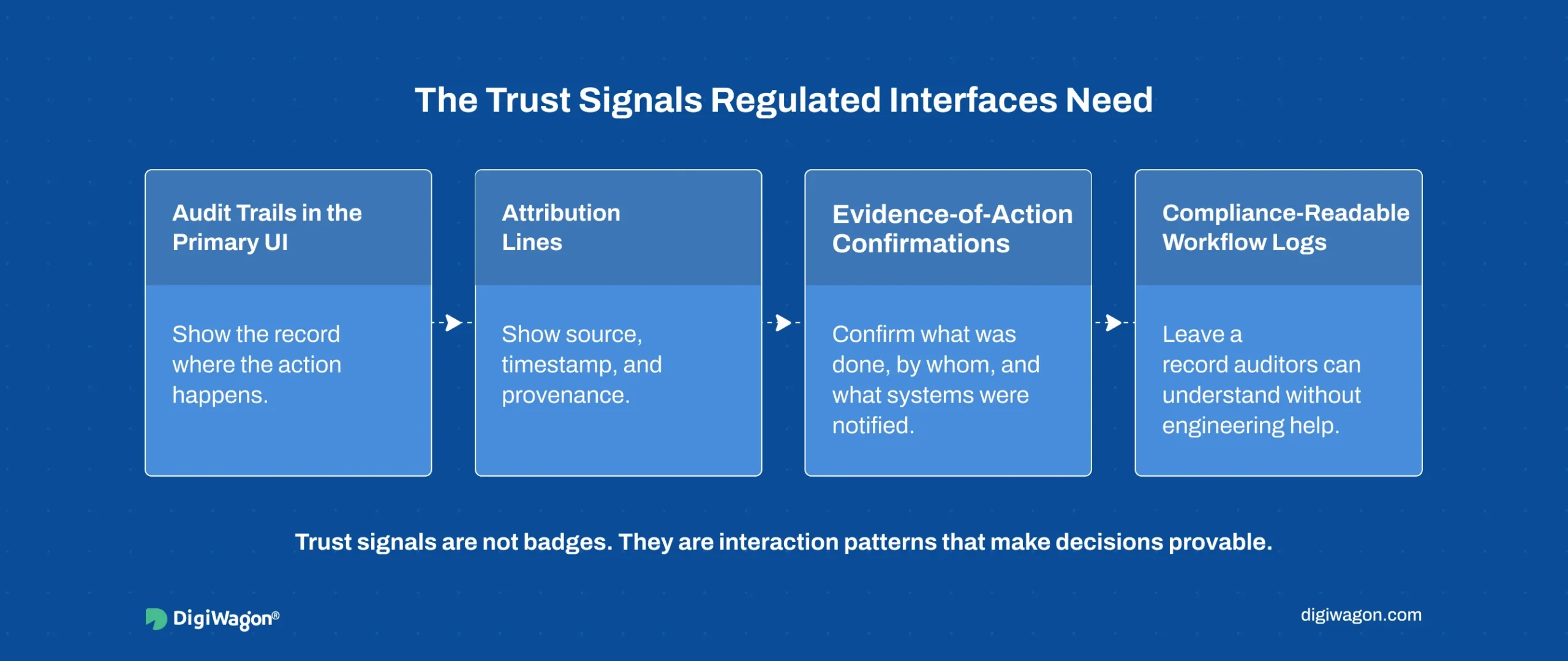
The fourth decision applies most sharply in RegTech, FinTech, Healthcare, and any industry where an external auditor or regulator reads the product output. Trust signals are not badges and certifications in the footer. They are interaction patterns encoded in the UI itself.
The core trust-signal patterns are:
- Audit trails as primary UI, not hidden logs. When a user takes an action with regulatory weight (approving a transaction, flagging a screening hit, signing off on a clinical decision), the audit record is visible in the same view, not buried in a separate audit module.
- Attribution lines. Every data point a user is asked to trust shows its source, its last-updated timestamp, and its provenance chain. “This sanctions list was last refreshed at 09:42 from OFAC” is a trust signal. A green check mark is not.
- Evidence-of-action confirmations. When an irreversible action is taken, the confirmation includes what was done, by whom, and what downstream systems were notified. This is how the product proves to its user (and the user’s auditor) that the action is durable.
- Compliance-readable workflow logs. Workflows leave behind a record an external auditor can read without engineering help. The E-E-A-T framework applied to UX shows how these trust patterns extend to public-facing surfaces as well.
These patterns are expensive to retrofit. They cost very little to design in from the start. The cost differential is the single strongest argument for involving UX in regulated product architecture before the first wire frame gets drawn.
Lessons from Five Enterprise UX Programmes
Across the practice, the same four decisions show up project after project. Five examples make the pattern visible.
Audit Trails and Workflow Density (AML Screening)
The RapidAML screening platform serves compliance officers reviewing several hundred matches per day across 700+ global watchlists. The decision that drove the UI was making the audit trail part of the primary review surface. Each match shows the source list, the confidence score, the historical context, and the reviewer’s decision capture in a single dense view. The trade-off was visual density that would have been rejected in any consumer product context. The compliance team reduced average review time once the audit evidence stopped requiring a context switch into a separate log.
Dual Personas and Clinical Trust Signals (Clinical Companion)
The C3 MedTech companion app serves two roles with different stakes: clinicians making treatment decisions and patients tracking adherence. The dual-persona decision drove a split information architecture sharing the same data model but rendering it differently per role. Clinician views surface evidence chains and protocol citations. Patient views surface plain-language summaries with one-tap escalation to their care team. The trust signal that mattered most was attribution: every clinical recommendation showed which protocol version, which clinician approved it, and when.
Role-Based Density for Operational Surfaces (Workforce Production Platform)
The Mining Intelligence workforce platform tracks production data across multiple sites with shift supervisors, maintenance leads, and site managers all using the same product. The role-based decision was rendering the same data hierarchy with different default depths per role. A shift supervisor opens to operational alerts. A site manager opens to cross-site comparison views. The same underlying screens, different default density. The pattern reduced training time because the interface adapted to the role instead of asking the role to adapt to the interface.
Design System Ownership in Multi-Tenant SaaS (Business Setup Software)
The Xanado business setup platform crossed the three-squad threshold within a year of launch. The ownership decision was promoting a part-time designer-owned system into a dedicated systems role with engineering pair support. Component velocity dropped briefly during the transition, then recovered with cleaner governance. The lesson was timing: the decision needed to be made before fragmentation, not after, because the consolidation cost would have been substantially higher.
Conversion Versus Compliance Trade-offs (Paperless FD Onboarding)
The Suryoday Bank paperless fixed deposit onboarding journey balanced two metrics in tension: completion rate and KYC audit readiness. The conversion decision was front-loading the lightest-friction steps to capture early commitment, then layering compliance disclosures progressively rather than batching them at the start. The auditability decision was structuring every disclosure interaction to leave a reconstructible record. Both metrics improved together once disclosures stopped being a single intimidating wall and became contextual checkpoints.
Planning Your Enterprise UX Engagement
DigiWagon designs enterprise UX programmes for regulated platforms, multi-product SaaS, and operations-heavy workflows. Our practice covers:
- Design system architecture and ownership transition
- UX audits with prioritised remediation roadmaps
- Embedded squad models for ongoing programmes
- Trust-signal patterns for RegTech, FinTech, and Healthcare interfaces
For broader context on the full service surface, see enterprise UI/UX design and engineering services and the operational cost of “good enough” UI for the case against under-investing here.
UX Maturity Is a Decision Problem, Not a Hiring Problem
Enterprise teams that struggle with UX rarely lack designers. They lack documented answers to the four decisions in this playbook: who owns the system, when audits run, which engagement model fits, and how trust signals get encoded. Make those decisions consciously, write them down, assign ownership, and revisit them when the surface area grows. The output quality follows from the decision quality, not the other way around. Treat UX as architecture, not as decoration, and the maturity curve compresses by a year or more.
Ready to Mature Your UX Practice?
Our design team helps enterprise teams move from project-based UX to platform-grade discipline.